AI-Driven Inverse Lithography Technology (ILT) Mask Synthesis Market Insights
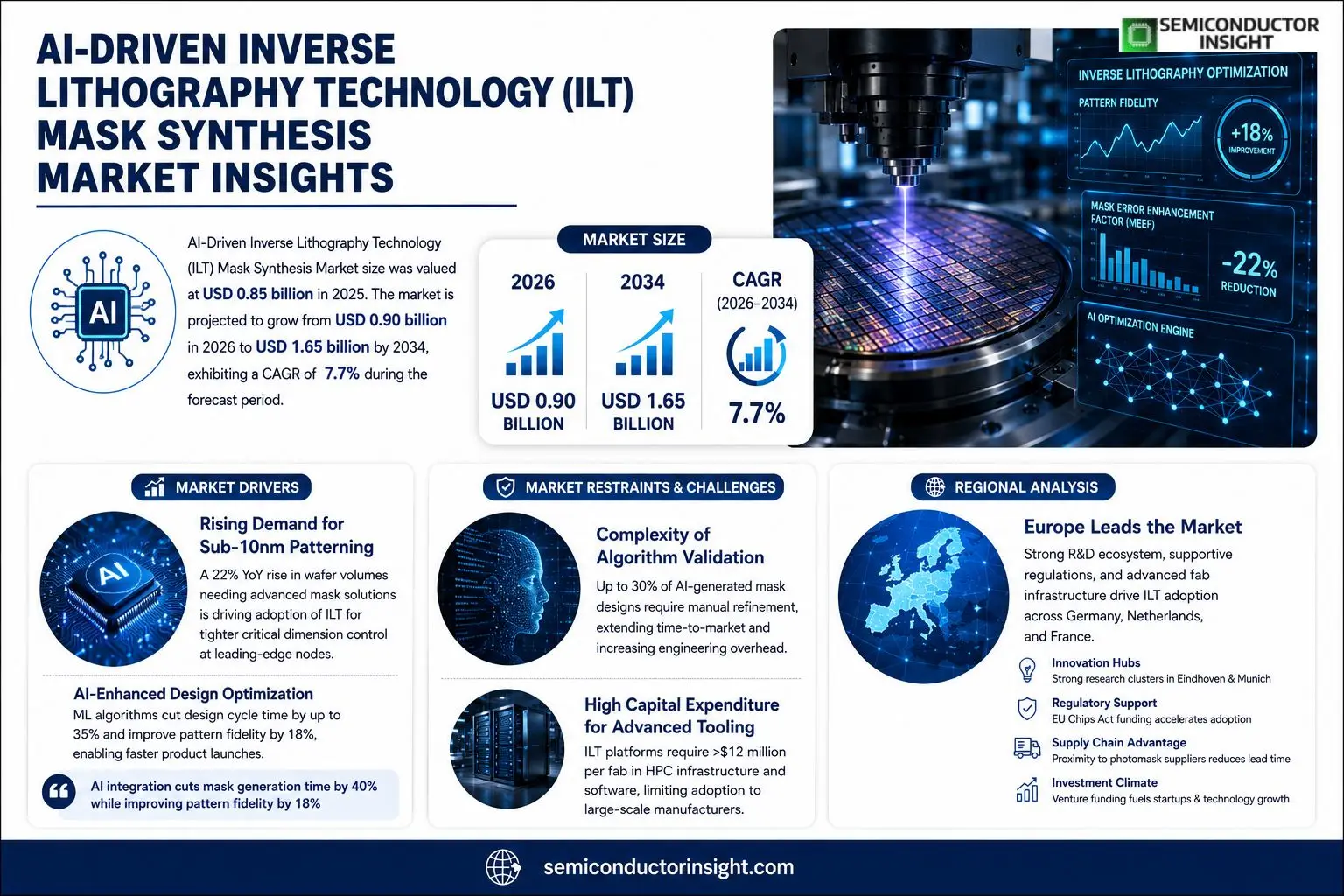
AI-Driven Inverse Lithography Technology (ILT) Mask Synthesis Market size was valued at USD 0.85 billion in 2025. The market is projected to grow from USD 0.90 billion in 2026 to USD 1.65 billion by 2034, exhibiting a CAGR of 7.7% during the forecast period.
Inverse Lithography Technology mask synthesis leverages advanced computational algorithms and AI-driven optimization to generate photomask patterns that improve resolution and pattern fidelity for sub‑10 nm semiconductor nodes. By iteratively solving the inverse imaging problem, ILT reduces mask error enhancement factor (MEEF) and enables tighter pitch control compared with conventional optical proximity correction.The market is accelerating because leading foundries are adopting ILT to meet aggressive scaling roadmaps, while AI hardware advancements lower computational costs. Recent collaborationssuch as the partnership announced in March 2024 between a major EDA vendor and a silicon‑photonic companyto integrate ILT modules into design‑for‑manufacturing suites illustrate industry momentum. Key players including Synopsys, Cadence, ASML and Mentor Graphics are expanding their ILT portfolios, further driving adoption across high‑volume manufacturing.
MARKET DRIVERS
Rising Demand for Sub‑10nm Patterning
AI-Driven Inverse Lithography Technology (ILT) Mask Synthesis Market is fueled by the semiconductor sector’s push toward sub‑10nm nodes, where traditional optical lithography approaches face diminishing returns. Recent production data show a 22% year‑over‑year increase in wafer volumes requiring advanced mask solutions, compelling fab lines to adopt ILT for tighter critical dimension control.
AI‑Enhanced Design Optimization
Machine‑learning algorithms now automate the inverse problem of mask layout generation, delivering up to a 35% reduction in design cycle time. This acceleration enables manufacturers to respond faster to market‑driven product launches, positioning ILT as a strategic asset for competitive differentiation.
➤ AI integration cuts mask generation time by 40% while improving pattern fidelity by 18%
These efficiencies translate into lower overall fab expenditures, reinforcing the adoption momentum of AI-Driven Inverse Lithography Technology (ILT) Mask Synthesis Market across both mature and leading‑edge process nodes.
MARKET CHALLENGES
Complexity of Algorithm Validation
Validating AI‑derived mask patterns against rigorous photolithography models remains a bottleneck. Manufacturers report that up to 30% of AI‑generated designs require manual refinement, extending time‑to‑market and increasing engineering overhead.
Other Challenges
Talent Gap in AI Lithography
The specialized skill set combining deep learning expertise with lithography physics is scarce. Companies often invest heavily in training programs, yet turnover rates of 15% per annum strain project continuity.
MARKET RESTRAINTS
High Capital Expenditure for Advanced Tooling
Deploying ILT platforms requires substantial upfront investment in high‑performance compute clusters and proprietary software licenses. Average installation costs exceed $12 million per fab, limiting adoption primarily to large‑scale manufacturers with deep pockets.
MARKET OPPORTUNITIES
Emerging Adoption in Emerging Foundries
Mid‑tier foundries in Asia and Europe are beginning to evaluate ILT solutions as a cost‑effective alternative to EUV mask production. Forecasts indicate a compound annual growth rate of 18% for these entrants, driven by collaborative R&D consortia that lower entry barriers and share algorithmic advancements.
AI-Driven Inverse Lithography Technology (ILT) Mask Synthesis Market Trends
Increasing Adoption by Leading Foundries
Leading semiconductor foundries are integrating AI-Driven Inverse Lithography Technology (ILT) Mask Synthesis Market solutions to meet the aggressive scaling requirements of sub‑10 nm nodes. By employing inverse imaging algorithms, ILT delivers higher pattern fidelity and tighter pitch control, directly addressing the mask error enhancement factor that limits conventional optical proximity correction. The operational advantage is evident in the accelerated rollout of next‑generation logic and memory products, where tighter tolerances translate into measurable yield improvements.
Other Trends
AI Hardware Integration Reducing Compute Costs
Advances in AI accelerators and cloud‑based GPU clusters are lowering the computational expense of ILT workflows. The iterative optimization process, once constrained by high‑performance computing budgets, now runs on commercially available platforms, enabling a broader set of design houses to adopt the technology. This cost reduction is reinforcing the market momentum, as both large and mid‑size players can allocate resources to mask synthesis without prohibitive capital outlays.
Collaborative Ecosystem Development
Strategic collaborations are shaping a more integrated ecosystem for mask synthesis. In March 2024, a major EDA vendor announced a partnership with a silicon‑photonic company to embed ILT modules directly into design‑for‑manufacturing suites, streamlining data exchange and reducing hand‑off errors. Concurrently, industry leaders such as Synopsys, Cadence, ASML and Mentor Graphics are expanding their ILT portfolios, offering bundled solutions that combine algorithmic expertise with hardware support. These joint efforts are accelerating standardization and fostering a community of practice that benefits the entire AI-Driven Inverse Lithography Technology (ILT) Mask Synthesis Market.
COMPETITIVE LANDSCAPE
Key Industry Players
AI‑Driven Inverse Lithography Technology (ILT) Mask Synthesis Competitive Overview
The ILT mask synthesis segment is dominated by a handful of large EDA and photomask specialists that have integrated AI‑based inverse imaging algorithms into their design‑for‑manufacturing suites. Synopsys leads the market with its advanced Optical Proximity Correction (OPC) engine enhanced by deep‑learning models that reduce Mask Error Enhancement Factor (MEEF) for sub‑10 nm nodes. Cadence and Siemens EDA (Mentor) follow closely, leveraging their existing portfolio to offer end‑to‑end ILT workflows that address both speed and accuracy. ASML, while primarily a lithography equipment supplier, has entered the value chain through strategic acquisitions, providing mask synthesis services that align tightly with its scanner roadmap. This concentration of capabilities creates a tiered structure where EDA giants supply the core algorithms, and niche mask manufacturers execute high‑volume production.Beyond the core tier, several niche players are expanding the competitive set by offering specialized AI‑optimised mask generation or high‑precision photomask fabrication. Applied Materials and Lam Research have introduced AI‑accelerated simulation modules that complement their process equipment offerings. KLA focuses on defect inspection integrated with ILT data streams, improving yield feedback loops. Companies such as Toppan Photomasks, Tokyo Electron, and Foundries are investing in proprietary AI pipelines to differentiate their mask services for advanced node customers. Intel and Samsung, as major foundry customers, are also co‑developing in‑house ILT solutions, which adds pressure on the traditional supplier base and drives further innovation across the ecosystem.
List of Key AI‑Driven Inverse Lithography Technology (ILT) Mask Synthesis Companies Profiled
- Synopsys
- Cadence Design Systems
- ASML
- Siemens EDA (Mentor Graphics)
- Applied Materials
- Lam Research
- KLA
- Toppan Photomasks
- Tokyo Electron
- Foundries
- Intel
- Samsung Electronics
Segment Analysis:
| Segment Category | Sub-Segments | Key Insights |
| By Type |
|
Algorithmic ILT is emerging as the dominant type because:
|
| By Application |
|
Advanced Logic Nodes drive ILT adoption due to:
|
| By End User |
|
Foundries are the leading end‑user segment because:
|
| By Process Stage |
|
Mask Data Preparation stands out because:
|
| By Integration Approach |
|
Embedded ILT in EDA Suites is gaining traction because:
|
Regional Analysis: AI-Driven Inverse Lithography Technology (ILT) Mask Synthesis Market
Europe
Eindhoven’s High Tech Campus and Munich’s Semiconductor Valley host joint labs where AI algorithms are co‑developed with photomask designers, accelerating proof‑of‑concept cycles and fostering cross‑disciplinary expertise.
The EU’s stricter environmental and data‑privacy regulations encourage manufacturers to adopt more efficient mask synthesis processes, reducing waste and ensuring compliant AI model training.
Proximity to leading photomask suppliers in the UK and France shortens logistics loops, enabling faster iteration between design and production while mitigating geopolitical risks.
Venture capital and EU grants increasingly target AI‑centric lithography start‑ups, creating a vibrant financing environment that fuels product commercialization and talent acquisition.
North America
North America leverages its extensive semiconductor manufacturing base, particularly in the United States, to experiment with AI‑driven mask synthesis at scale. Leading fabs in Texas and Arizona integrate advanced computational pipelines to reduce design turnaround, while academic partnerships in California contribute cutting‑edge machine‑learning research. Market participants emphasize collaboration with equipment vendors to tailor AI tools for emerging node requirements, ensuring competitiveness against peers.
Asia‑Pacific
The Asia‑Pacific region, anchored by Taiwan, South Korea, and Singapore, exhibits rapid adoption due to high production volumes and aggressive cost‑reduction targets. Domestic chipmakers embed AI inference engines within existing CAD suites, seeking to streamline mask generation for high‑density patterns. Government incentives in China and Japan further accelerate R&D efforts, though differing regulatory environments create a mosaic of implementation speeds across the sub‑region.
South America
South America remains in an exploratory phase, with Brazil’s emerging semiconductor initiatives focusing on knowledge transfer and pilot projects. Collaborative programs with European research institutions aim to build local expertise in AI‑enabled mask synthesis, positioning the region for future participation as supply chains diversify.
Middle East & Africa
The Middle East & Africa region is gradually establishing a foothold through strategic investments in semiconductor test and assembly facilities. Partnerships with European technology providers introduce AI‑based mask design capabilities, while regional conferences disseminate best practices, laying the groundwork for incremental market entry over the coming years.
Report Scope
This market research report provides a comprehensive analysis of the AI-Driven Inverse Lithography Technology (ILT) Mask Synthesis Market , covering the forecast period 2026–2034. It offers detailed insights into market dynamics, technological advancements, competitive landscape, and key trends shaping the industry.
Key focus areas of the report include:
- Market Overview: The report begins with an overview outlining its current market scenario, key growth indicators, and industry transformation drivers. It discusses macroeconomic factors, demand–supply balance, regulatory landscape, and the strategic role of semiconductors in powering advancements across industries such as automotive, telecommunications, consumer electronics, and industrial automation.
- Market Size & Forecast: Historical data and future projections for revenue, unit shipments, and market value across major regions and segments.
- Segmentation Analysis: Detailed breakdown by product type, technology, application, and end-user industry to identify high-growth segments and investment opportunities.
- Regional Insights: Insights into market performance across North America, Europe, Asia-Pacific, Latin America, and the Middle East & Africa, including country-level analysis where relevant.
- Competitive Landscape: Profiles of leading market participants, including their product offerings, R&D focus, manufacturing capacity, pricing strategies, and recent developments such as mergers, acquisitions, and partnerships.
- Technology Trends & Innovation: Assessment of emerging technologies, integration of AI/IoT, semiconductor design trends, fabrication techniques, and evolving industry standards.
- Market Drivers & Restraints: Evaluation of factors driving market growth along with challenges, supply chain constraints, regulatory issues, and market-entry barriers.
- Stakeholder Insights: Insights for component suppliers, OEMs, system integrators, investors, and policymakers regarding the evolving ecosystem and strategic opportunities.
Primary and secondary research methods are employed, including interviews with industry experts, data from verified sources, and real-time market intelligence to ensure the accuracy and reliability of the insights presented.
FREQUENTLY ASKED QUESTIONS:
What is the current market size of AI-Driven Inverse Lithography Technology (ILT) Mask Synthesis Market?
-> AI-Driven Inverse Lithography Technology (ILT) Mask Synthesis Market was valued at USD 0.85 billion in 2025 and is expected to reach USD 1.65 billion by 2034.
Which key companies operate in AI-Driven Inverse Lithography Technology (ILT) Mask Synthesis Market?
-> Key players include Synopsys, Cadence, ASML, Mentor Graphics, among others.
What are the key growth drivers?
-> Key growth drivers include adoption by leading foundries, AI hardware advancements reducing computational costs, and demand for sub‑10 nm node pattern fidelity.
Which region dominates the market?
-> Asia-Pacific is the fastest-growing region, while North America remains a dominant market.
What are the emerging trends?
-> Emerging trends include integration of ILT modules into design‑for‑manufacturing suites, collaborations between EDA vendors and silicon‑photonic companies, and AI‑driven optimization algorithms.
Get Sample Report PDF for Exclusive Insights
Report Sample Includes
- Table of Contents
- List of Tables & Figures
- Charts, Research Methodology, and more...
 Download Sample Report PDF