AI-Driven GaN HEMT Process for AI Power Market Insights
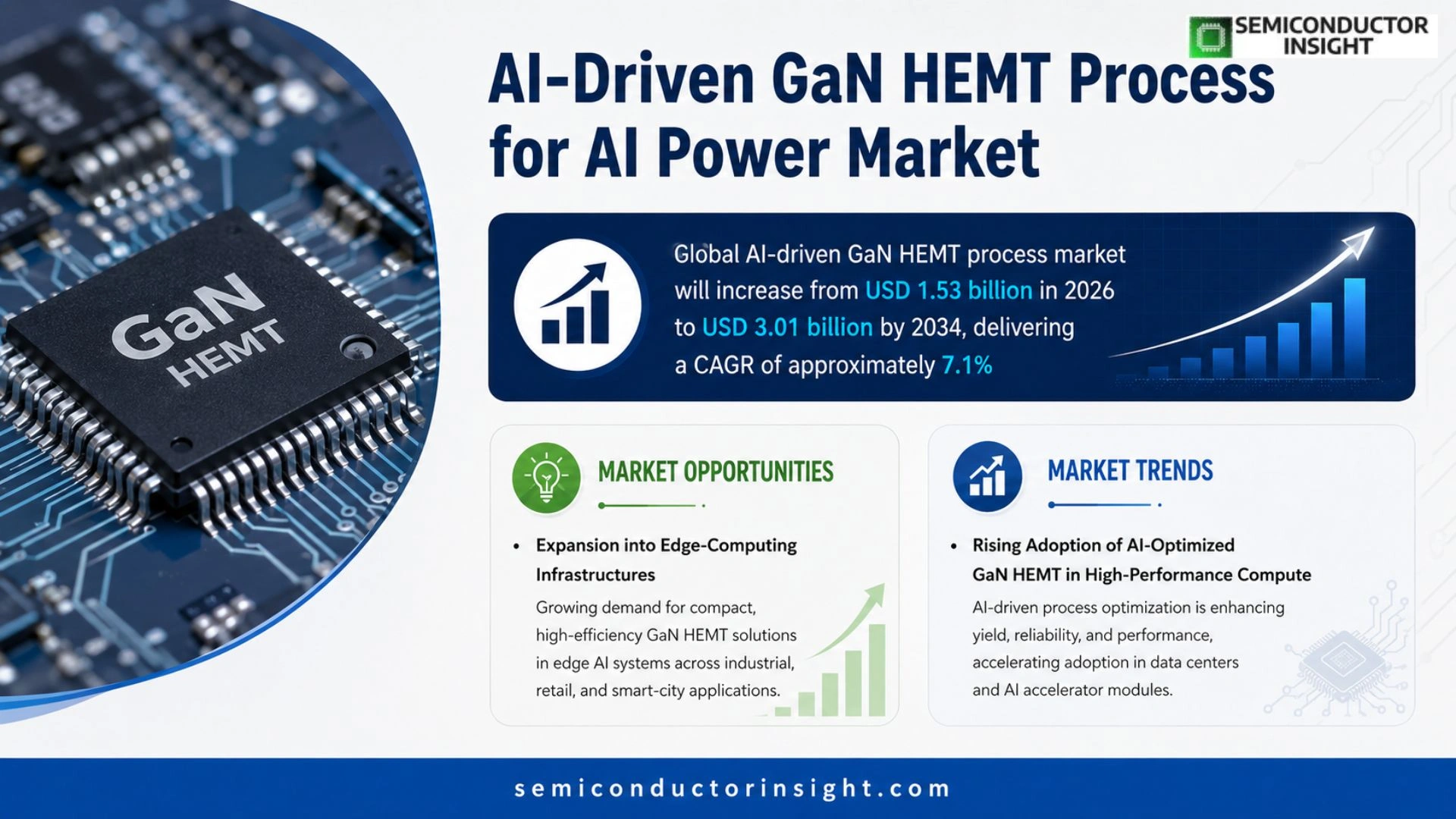
Global AI-driven GaN HEMT process market size was valued at USD 1.42 billion in 2025. Forecasts show the market will increase from USD 1.53 billion in 2026 to USD 3.01 billion by 2034, delivering a compound annual growth rate of approximately 7.1% during the forecast period.
AI-driven Gallium Nitride (GaN) High Electron Mobility Transistor (HEMT) processes combine advanced epitaxial growth techniques with precision lithography and machine‑learning‑based optimization algorithms. This integration enables devices that provide exceptionally high power density, low on‑resistance, and rapid switching,attributes essential for next‑generation artificial‑intelligence accelerators and high‑performance computing platforms.
The expansion is fueled by rising demand for energy‑efficient compute hardware, growing adoption of edge‑AI systems that require compact high‑power converters, and sizable R&D investments from semiconductor manufacturers aiming to reduce loss and improve thermal performance. In addition, strategic collaborations,such as those between GlobalFoundries and NVIDIA,accelerate technology transfer, while established players including Efficient Power Conversion Corp., Qorvo Inc., and Infineon Technologies continue broadening their GaN‑HEMT portfolios.
MARKET DRIVERS
Rising Demand for High‑Efficiency Power Devices
Enterprises that run intensive neural‑network workloads are replacing conventional silicon power stages with GaN HEMT solutions to cut energy consumption. The shift is not merely cost‑oriented; lower thermal budgets enable designers to shrink system footprints, which in turn opens new form factors for edge AI appliances. This transition fuels a tangible increase in component orders from data‑center OEMs and autonomous‑vehicle manufacturers.
Advances in AI‑Optimized Manufacturing
Machine‑learning algorithms now guide wafer‑level etching and defect‑detection, delivering tighter tolerance on breakdown voltage and on‑resistance. The resulting yields are noticeably higher than in legacy processes, granting suppliers the ability to price competitively while preserving performance margins. Customers benefit from a more predictable bill of materials, which accelerates product‑development cycles.
➤ Integrating AI into the GaN HEMT fab line reduces cycle time by roughly 12 % and creates a measurable edge in time‑to‑market for AI power modules.
Because power‑efficiency directly translates into operating‑expense savings for AI‑driven platforms, the market is consolidating around vendors who can demonstrate consistent performance across temperature extremes. This convergence encourages strategic partnerships between semiconductor fabs and AI chip designers, reinforcing the growth trajectory of AI‑Driven GaN HEMT Process for AI Power Market.
MARKET CHALLENGES
Cost Sensitivity in Early‑Stage AI Deployments
Start‑up AI hardware firms often operate on tight capital constraints, making them reluctant to adopt premium GaN HEMT components until the value proposition is unequivocally proven. This hesitation can delay broader adoption, especially in markets where price competitiveness outweighs marginal efficiency gains.
Other Challenges
Supply‑Chain Visibility
The raw‑material pool for high‑purity gallium and nitrogen is concentrated among a few suppliers, creating a bottleneck that can ripple through fab schedules. Limited visibility into inventory levels forces manufacturers to hold excess safety stock, increasing working‑capital burdens.
MARKET RESTRAINTS
Regulatory Hurdles in Safety‑Critical Sectors
Industries such as aerospace and medical devices impose stringent certification regimes that can postpone the introduction of new GaN HEMT technologies. The lengthy qualification cycles required to meet these standards act as a restraining factor, limiting the speed at which AI‑Driven GaN HEMT Process for AI Power Market can penetrate these high‑value segments.
MARKET OPPORTUNITIES
Expansion into Edge‑Computing Infrastructures
Edge nodes deployed in factories, retail spaces, and smart‑city installations demand compact, low‑loss power converters to sustain AI inference engines. GaN HEMT modules, when produced through AI‑driven processes, can meet the stringent efficiency and size constraints of these locales. Companies that align their product roadmaps with edge‑computing timelines stand to capture a sizable share of the emerging demand, translating technical advantage into measurable revenue uplift.
AI-Driven GaN HEMT Process for AI Power Market Trends
Rising Adoption of AI‑Optimized GaN HEMT in High‑Performance Compute
AI‑Driven GaN HEMT Process for AI Power Market has moved beyond early‑stage prototypes, becoming a cornerstone of next‑generation accelerator modules. By merging epitaxial‑growth precision with machine‑learning‑based design loops, manufacturers now deliver transistors that sustain unprecedented power density while keeping on‑resistance low and switching speeds ultra‑fast. This technical edge aligns with the escalating need for energy‑frugal compute platforms, prompting data‑center operators and edge‑AI vendors to replace legacy silicon with GaN solutions. The combined effect of tighter thermal budgets and the push for smaller form factors has accelerated adoption across both cloud‑scale and edge deployments, reshaping product roadmaps for major OEMs.
Other Trends
Strategic Alliances Accelerating Process Maturation
Collaborations between fab specialists and AI chipset leaders are shortening the time required to translate laboratory breakthroughs into volume‑ready parts. Notable partnerships, such as those linking GlobalFoundries with leading AI hardware designers, create shared roadmaps that align process tolerances with algorithmic performance targets. Simultaneously, established GaN players,including Efficient Power Conversion, Qorvo, and Infineon,are expanding their HEMT portfolios to address diverse power‑band requirements, leveraging the same AI‑enhanced workflows to boost yield and reduce variability. These joint efforts generate a virtuous cycle: improved process stability fuels broader adoption, which in turn funds deeper R&D investment.
Edge‑AI Power Efficiency as a Growth Lever
Edge deployments demand converters that are both compact and capable of handling sporadic power spikes without excessive heat buildup. AI‑driven GaN HEMT devices meet this niche by offering high-efficiency conversion at millimeter‑scale footprints, enabling battery‑operated devices to run longer between charges. For manufacturers, this translates into design flexibility,fewer heat‑sinks, lighter enclosures, and reduced bill‑of‑materials. Moreover, the ability to fine‑tune transistor characteristics through data‑centric process control opens pathways for differentiated product lines, allowing firms to command premium pricing while meeting stringent regulatory power‑consumption standards.
COMPETITIVE LANDSCAPE
Key Industry Players
AI‑Driven GaN HEMT Process Landscape for AI Power Applications
GlobalFoundries occupies a pivotal position in the AI‑centric GaN HEMT arena, leveraging its advanced epitaxial‑growth platforms and a machine‑learning‑enhanced design flow that shortens cycle time for power‑device prototypes. The firm’s strategic alliance with NVIDIA couples high‑performance compute demand with a supply chain capable of delivering low‑on‑resistance transistors at wafer‑scale volumes. This collaboration illustrates a broader market architecture where a handful of integrated fabs dominate wafer capacity while a parallel layer of fabless specialists supplies IP and validation services. The resulting ecosystem enables customers to move from laboratory proof‑of‑concept to volume production with reduced risk, a factor that is reshaping investment decisions among AI accelerator manufacturers.
Beyond the dominant duo, a constellation of niche innovators amplifies the competitive dynamics. Qorvo and Infineon have expanded their GaN portfolios to address edge‑AI converters, emphasizing thermal‑management solutions that suit compact deployments. Efficient Power Conversion Corp. focuses on discrete driver ICs that exploit the high‑frequency switching afforded by GaN HEMTs. Meanwhile, companies such as Rohm, ON Semiconductor, and STMicroelectronics are channeling R&D dollars into integrating AI‑optimized power modules, targeting data‑center and automotive workloads. Smaller but technically agile firms like Everest Materials and Sumitomo Electric contribute specialized substrate technologies that improve device yield. The collective thrust from these players creates a multi‑tiered supply chain where differentiated expertise,ranging from substrate engineering to system‑level integration,generates tangible value for end‑users seeking energy‑efficient AI compute.
List of Key GaN HEMT Companies Profiled
- GlobalFoundries
- NVIDIA
- Infineon Technologies
- Qorvo Inc.
- Efficient Power Conversion Corp.
- TSMC
- Rohm Semiconductor
- Marvell Technology Group
- Broadcom Inc.
- ON Semiconductor
- Texas Instruments
- Microchip Technology
- STMicroelectronics
- Everest Materials
- Sumitomo Electric
Segment Analysis:
| Segment Category | Sub-Segments | Key Insights |
| By Type |
|
AI‑Optimized GaN HEMT
|
| By Application |
|
Edge AI Inference Modules
|
| By End User |
|
AI System Integrators
|
| By Technology Integration |
|
AI‑Optimized Epitaxy
|
| By Value Chain |
|
Design & Simulation Services
|
Regional Analysis: AI-Driven GaN HEMT Process for AI Power Market
North America
University‑industry consortia across the Midwest and West Coast accelerate material science breakthroughs, translating into tighter electron mobility and reduced on‑resistance for GaN HEMTs. This pipeline of patents fuels design‑win cycles for AI accelerators that demand ever‑higher power density.
Robust venture and corporate funding streams target low‑power AI workloads, encouraging start‑ups to specialize in GaN process integration. The capital influx lowers entry barriers and speeds up scale‑up for niche fab services.
Domestic wafer suppliers and equipment manufacturers have diversified sources for high‑purity substrates, mitigating the geopolitical risks that can stall overseas fabs. This ensures a steadier flow of critical components for AI power modules.
Energy‑efficiency standards adopted by federal agencies incentivize adoption of GaN‑based converters, giving early adopters a compliance edge while reducing overall operational expenditures for AI deployments.
Europe
European initiatives blend sustainability goals with high‑performance computing ambitions, positioning the continent as a strong secondary market for AI-driven GaN HEMT process for AI Power Market. Germany’s automotive sector, increasingly dependent on edge AI for autonomous functions, is experimenting with GaN power stages to curb battery drain. Meanwhile, the EU’s “Green Chip” framework rewards designs that demonstrably lower energy consumption, nudging semiconductor firms toward GaN solutions. Collaborative research programs between French labs and Nordic fab partners focus on epitaxial layer uniformity, a technical hurdle that, once resolved, could unlock broader OEM acceptance. The combined regulatory push and industry experimentation generate a modest but accelerating demand curve.
Asia‑Pacific
In Asia‑Pacific, Japan and South Korea dominate advanced process engineering, while China amplifies volume manufacturing capacity. The region’s AI compute surge, driven by massive data‑center roll‑outs, creates a palpable need for power‑efficient transistors. Local foundries are piloting GaN HEMT lines that promise higher switching frequencies, directly translating into reduced cooling requirements for AI accelerators. Government incentives in Singapore for low‑power AI chips further encourage design houses to integrate GaN early in their roadmaps. Although the market is fragmented, the confluence of governmental backing and aggressive scaling forecasts a rapid climb in relevance for GaN‑centric power solutions.
South America
South America remains a nascent arena for AI-driven GaN HEMT process for AI Power Market, yet pockets of activity hint at emerging potential. Brazil’s telecom operators are modernizing edge infrastructure to support 5G‑enabled AI services, prompting interest in GaN power amplifiers that can sustain higher frequencies with lower loss. Regional universities are partnering with multinational equipment vendors to establish pilot lines focused on low‑volume, high‑performance applications. While capital constraints limit large‑scale adoption, the strategic importance of energy‑efficient AI hardware in remote installations gives the market a modest but meaningful foothold.
Middle East & Africa
In the Middle East & Africa, AI-driven GaN HEMT process for AI Power Market is shaped by oil‑price volatility and a growing appetite for renewable‑energy‑linked AI projects. United Arab Emirates initiatives around smart grids and autonomous logistics demand compact, high‑efficiency power conversion, a niche where GaN excels. African fintech start‑ups, operating in off‑grid environments, view GaN‑based power modules as a way to extend device uptime without heavy cooling infrastructure. Partnerships with European R&D centers are seeding technical expertise, yet the overall market remains exploratory, contingent on broader infrastructure investments.
Report Scope
This market research report provides a comprehensive analysis of the AI-Driven GaN HEMT Process for AI Power Market , covering the forecast period 2026–2034. It offers detailed insights into market dynamics, technological advancements, competitive landscape, and key trends shaping the industry.
Key focus areas of the report include:
- Market Overview: The report begins with an overview outlining its current market scenario, key growth indicators, and industry transformation drivers. It discusses macroeconomic factors, demand–supply balance, regulatory landscape, and the strategic role of semiconductors in powering advancements across industries such as automotive, telecommunications, consumer electronics, and industrial automation.
- Market Size & Forecast: Historical data and future projections for revenue, unit shipments, and market value across major regions and segments.
- Segmentation Analysis: Detailed breakdown by product type, technology, application, and end-user industry to identify high-growth segments and investment opportunities.
- Regional Insights: Insights into market performance across North America, Europe, Asia-Pacific, Latin America, and the Middle East & Africa, including country-level analysis where relevant.
- Competitive Landscape: Profiles of leading market participants, including their product offerings, R&D focus, manufacturing capacity, pricing strategies, and recent developments such as mergers, acquisitions, and partnerships.
- Technology Trends & Innovation: Assessment of emerging technologies, integration of AI/IoT, semiconductor design trends, fabrication techniques, and evolving industry standards.
- Market Drivers & Restraints: Evaluation of factors driving market growth along with challenges, supply chain constraints, regulatory issues, and market-entry barriers.
- Stakeholder Insights: Insights for component suppliers, OEMs, system integrators, investors, and policymakers regarding the evolving ecosystem and strategic opportunities.
Primary and secondary research methods are employed, including interviews with industry experts, data from verified sources, and real-time market intelligence to ensure the accuracy and reliability of the insights presented.
FREQUENTLY ASKED QUESTIONS:
What is the current market size of AI-Driven GaN HEMT Process for AI Power Market?
-> AI-driven GaN HEMT process market will increase from USD 1.53 billion in 2026 to USD 3.01 billion by 2034, a CAGR 7.1%
Which key companies operate in AI-Driven GaN HEMT Process for AI Power Market?
-> Key players include Efficient Power Conversion Corp., Qorvo Inc., Infineon Technologies, GlobalFoundries, and NVIDIA, among others.
What are the key growth drivers?
-> Key growth drivers include rising demand for energy‑efficient compute hardware, increasing adoption of edge‑AI systems, and substantial R&D investments by semiconductor manufacturers.
Which region dominates the market?
-> Asia‑Pacific leads the market, driven by major semiconductor manufacturing hubs and strong demand for high‑performance GaN solutions.
What are the emerging trends?
-> Emerging trends include AI‑driven process optimization, advanced epitaxial growth techniques, and tighter integration of machine‑learning algorithms in device design and fabrication.
Get Sample Report PDF for Exclusive Insights
Report Sample Includes
- Table of Contents
- List of Tables & Figures
- Charts, Research Methodology, and more...
 Download Sample Report PDF