AI-Driven Formal Verification Market Insights
Global AI-driven formal verification market size was valued at USD 0.78 billion in 2025. The market moves from USD 0.85 billion in 2026 to USD 2.15 billion by 2034, reflecting a CAGR of 9.6% over the forecast horizon.
AI-driven formal verification combines machine‑learning algorithms with traditional mathematical proof techniques to automatically check hardware designs or software code for logical errors, safety violations, or security flaws. By learning patterns from large codebases, these tools can prioritize critical paths and generate proofs faster than conventional methods.
The expansion is linked to rising investment in safety‑critical sectors such as automotive electronics and aerospace, where certification standards demand higher assurance levels. Moreover, recent collaborations,e.g., Cadence Design Systems integrating NVIDIA’s GPU‑accelerated AI models into its verification suite,illustrate how leading vendors are enhancing tool performance and scalability.
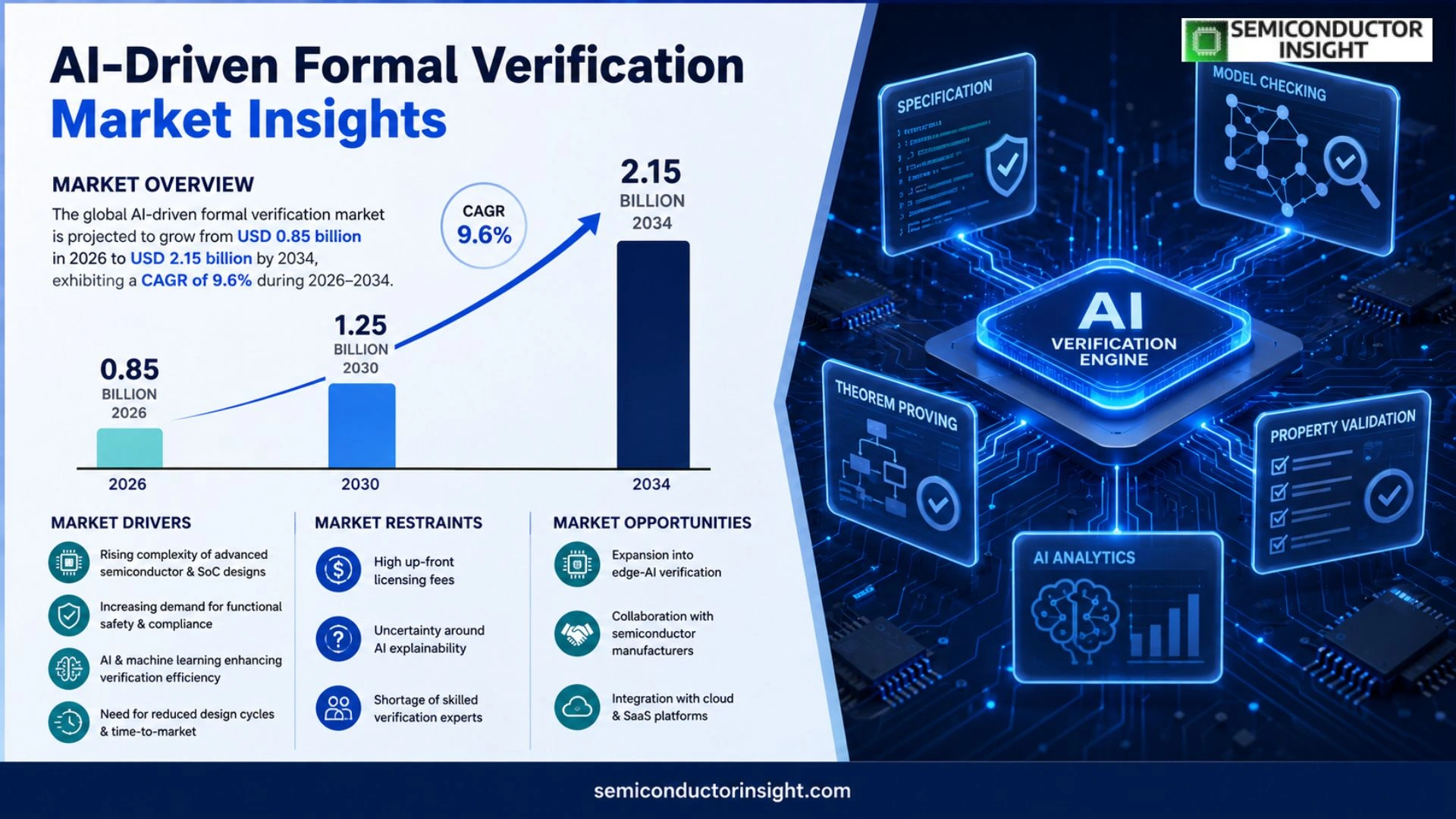
MARKET DRIVERS
Rising Complexity of Embedded Systems
Manufacturers of automotive, aerospace, and IoT devices are confronting design complexity that exceeds traditional verification methods. AI-driven formal verification Market offers algorithmic reasoning that can exhaustively explore state spaces, reducing the likelihood of undetected bugs that could trigger costly recalls.
Pressure to Shorten Development Cycles
Competitive pressure forces firms to compress time‑to‑market. AI‑enabled formal tools automate lemmas that otherwise require manual proof, shaving weeks from validation phases and freeing engineering resources for product differentiation.
➤ Adoption spikes when regulatory scrutiny intensifies, because automated proof artifacts satisfy compliance auditors more efficiently.
Consequently, investment budgets are earmarked for AI‑based verification platforms, and vendors that integrate machine learning with theorem proving are securing long‑term contracts across the sector.
MARKET CHALLENGES
Talent Shortage in Formal Methods
Although AI reduces some manual effort, successful deployment still depends on engineers versed in model checking and theorem proving. Companies report difficulty recruiting such specialists, which inflates project costs and slows rollout.
Other Challenges
Integration with Legacy Toolchains
Many enterprises operate entrenched verification suites. Aligning AI‑driven engines with existing pipelines often requires custom adapters, creating friction that discourages early adopters.
MARKET RESTRAINTS
High Up‑Front Licensing Fees
Vendors charge substantial upfront fees for AI models that have been trained on proprietary verification data. Smaller firms find the cost barrier prohibitive, limiting market penetration beyond large OEMs.
Uncertainty Around AI Explainability
Regulators and certification bodies increasingly demand transparent proof trails. When AI makes inference steps opaque, organizations hesitate to rely on the output for safety‑critical approvals.
MARKET OPPORTUNITIES
Expansion into Edge‑AI Verification
Edge devices are adopting on‑device AI inference, raising verification requirements for low‑power, real‑time execution. Companies that tailor formal methods to resource‑constrained environments can capture a nascent segment that is currently underserved.
Additionally, collaborations with semiconductor manufacturers to embed verification kernels directly into design‑time tools promise a seamless workflow, turning verification from a separate phase into a continuous quality gate.
AI-Driven Formal Verification Market Trends
Accelerated Adoption in Safety‑Critical Applications
The surge of AI‑driven formal verification tools is reshaping how manufacturers address safety and security mandates in automotive electronics and aerospace programs. Certification regimes in these sectors require demonstrable proof of functional correctness, yet traditional theorem‑proving methods consume extensive engineering cycles. By embedding machine‑learning models that learn from historical code bases, verification suites can isolate high‑risk paths and emit proof artifacts in a fraction of the time, allowing design teams to meet stringent deadlines without compromising rigor. This efficiency gain is prompting OEMs to embed AI‑enhanced verification early in the development pipeline rather than treating it as a post‑design checkpoint.
Other Trends
AI‑Enhanced EDA Toolchains
Leading electronic design automation vendors are embedding AI accelerators directly into their verification environments. A recent partnership between Cadence Design Systems and NVIDIA integrates GPU‑powered inference engines with Cadence’s verification suite, delivering order‑of‑magnitude speed improvements for large‑scale hardware descriptions. The collaboration exemplifies how hardware‑focused firms are leveraging high‑performance computing to scale formal analysis, reducing turnaround time for complex system‑on‑chip designs and freeing engineers to pursue higher‑level architectural exploration.
Strategic Alliances Expanding Tool Capabilities
Beyond hardware, software providers are forging joint initiatives with AI research labs to broaden the applicability of formal methods across the software stack. By combining deep‑learning‑based anomaly detection with classic proof techniques, these alliances produce hybrid solutions that can automatically generate proof obligations for emerging programming languages used in autonomous vehicle firmware. For enterprise customers, the implication is a lower barrier to entry for adopting formal verification, as the tools require less manual rule‑crafting and can adapt to evolving code bases.
COMPETITIVE LANDSCAPE
Key Industry Players
AI‑Driven Formal Verification Market – Competitive Overview
Cadence Design Systems commands the most visible share of the AI‑enhanced verification segment, largely because of its early integration of NVIDIA‑accelerated deep‑learning models into the JasperGold suite. This move not only shortens proof cycles for complex System‑on‑Chip designs but also provides a seamless bridge between traditional theorem proving and data‑driven risk assessment. Synopsys follows closely, leveraging its VCS Formal and the recent acquisition of AI‑focused startup Zenasys to embed predictive bug‑ranking algorithms into its verification flow. Siemens EDA (formerly Mentor Graphics) differentiates itself through an extensive portfolio of safety‑critical tools for automotive and aerospace, where formal methods are mandated by ISO‑26262 and DO‑178C. Their strategy of bundling AI‑driven path‑selection with legacy formal engines gives them a foothold in regulated markets that demand both rigor and throughput.
Beyond the tier‑one vendors, a handful of niche innovators are reshaping the competitive set. ANSYS has introduced AI‑augmented verification modules that target high‑performance computing hardware, capitalising on its simulation heritage. IBM and Microsoft are experimenting with cloud‑native formal services that couple large‑scale language models to code‑base mining, hoping to capture enterprise software customers seeking continuous‑integration safety nets. NVIDIA, while primarily a hardware supplier, is increasingly visible as a partner that supplies GPU‑scaled inference engines to verification vendors. Intel’s internal verification group, though not a pure‑play vendor, contributes open‑source AI kernels that accelerate proof generation. Google’s DeepMind unit is publishing research on neural‑guided model checking, which may translate into future commercial offerings. Arm provides lightweight AI‑assisted verification blocks for edge IP, and KLA Corporation has begun embedding AI defect detection into its silicon‑level inspection tools, signalling a convergence of verification and quality‑control capabilities.
List of Key AI-Driven Formal Verification Companies Profiled
- Cadence Design Systems
- Synopsys
- Siemens EDA
- ANSYS
- IBM
- Microsoft
- NVIDIA
- Intel
- Google DeepMind
- Arm
- KLA Corporation
- ESL Consulting (Siemens Business)
Segment Analysis:
| Segment Category | Sub-Segments | Key Insights |
| By Type |
|
Hybrid verification
|
| By Application |
|
Autonomous vehicle software verification
|
| By End User |
|
Automotive OEMs
|
| By Integration Approach |
|
Integrated AI modules within EDA suites
|
| By Adoption Phase |
|
Early adopters
|
Regional Analysis: AI-Driven Formal Verification Market
OEMs are leveraging AI‑enhanced formal methods to shorten verification loops for safety‑critical products. The compelling ROI stems from early detection of logical flaws, which curtails expensive downstream redesigns and strengthens certification dossiers.
Federal agencies have begun referencing formal verification in guidance for autonomous systems, prompting vendors to align toolchains with emerging standards and thereby creating a de‑facto compliance incentive.
Top‑tier universities supply a pipeline of engineers proficient in both machine learning and formal methods, enabling firms to staff sophisticated verification projects without extensive retraining.
Venture capital flows favor startups that augment traditional verification suites with AI inference, while larger incumbents allocate R&D capital to integrate these capabilities into end‑to‑end design platforms.
Europe
European firms are capitalizing on stringent functional safety directives to embed AI‑driven verification early in the hardware lifecycle. Collaborative consortia across Germany, France, and the UK facilitate knowledge sharing, accelerating the maturation of domain‑specific models. The emphasis on cross‑border standardization reduces friction for multinational projects, making the continent a fertile ground for solution providers targeting regulated industries such as rail transport and medical devices.
Asia‑Pacific
In the Asia‑Pacific, rapid digitization of manufacturing and a surge in semiconductor fab capacity are driving demand for scalable verification frameworks. Companies in Japan, South Korea, and Taiwan are experimenting with AI‑augmented proof techniques to manage the complexity of emerging 3‑nm chips. Although the ecosystem is still consolidating, governmental incentives for AI research create a supportive backdrop for local vendors to pitch tailored verification offerings.
South America
South American markets are beginning to explore AI‑based formal verification as part of broader digital transformation initiatives. Brazil’s aerospace sector, in particular, is piloting verification tools to meet international certification standards, while regional universities are nurturing expertise in formal methods. The nascent stage of adoption suggests ample room for early entrants to shape the market narrative.
Middle East & Africa
The Middle East & Africa region is witnessing modest uptake driven by defense and telecom projects that require validated hardware integrity. Partnerships between Gulf sovereign wealth funds and global verification vendors are fostering technology transfer, while South Africa’s research institutions contribute to a growing talent pool. Though market penetration remains limited, strategic collaborations hint at a gradual expansion of the AI‑Driven Formal Verification Market footprint.
Report Scope
This market research report provides a comprehensive analysis of the AI-Driven Formal Verification Market , covering the forecast period 2026–2034. It offers detailed insights into market dynamics, technological advancements, competitive landscape, and key trends shaping the industry.
Key focus areas of the report include:
- Market Overview: The report begins with an overview outlining its current market scenario, key growth indicators, and industry transformation drivers. It discusses macroeconomic factors, demand–supply balance, regulatory landscape, and the strategic role of semiconductors in powering advancements across industries such as automotive, telecommunications, consumer electronics, and industrial automation.
- Market Size & Forecast: Historical data and future projections for revenue, unit shipments, and market value across major regions and segments.
- Segmentation Analysis: Detailed breakdown by product type, technology, application, and end-user industry to identify high-growth segments and investment opportunities.
- Regional Insights: Insights into market performance across North America, Europe, Asia-Pacific, Latin America, and the Middle East & Africa, including country-level analysis where relevant.
- Competitive Landscape: Profiles of leading market participants, including their product offerings, R&D focus, manufacturing capacity, pricing strategies, and recent developments such as mergers, acquisitions, and partnerships.
- Technology Trends & Innovation: Assessment of emerging technologies, integration of AI/IoT, semiconductor design trends, fabrication techniques, and evolving industry standards.
- Market Drivers & Restraints: Evaluation of factors driving market growth along with challenges, supply chain constraints, regulatory issues, and market-entry barriers.
- Stakeholder Insights: Insights for component suppliers, OEMs, system integrators, investors, and policymakers regarding the evolving ecosystem and strategic opportunities.
Primary and secondary research methods are employed, including interviews with industry experts, data from verified sources, and real-time market intelligence to ensure the accuracy and reliability of the insights presented.
FREQUENTLY ASKED QUESTIONS:
What is the current market size of AI-Driven Formal Verification Market?
-> AI-driven formal verification market moves from USD 0.85 billion in 2026 to USD 2.15 billion by 2034, reflecting a CAGR of 9.6%
Which key companies operate in AI-Driven Formal Verification Market?
-> Key players include Cadence Design Systems, NVIDIA, Synopsys, and Mentor Graphics, among others.
What are the key growth drivers?
-> Key growth drivers include rising investment in safety‑critical sectors such as automotive electronics and aerospace, and the need for higher assurance levels in certification standards.
Which region dominates the market?
-> North America shows strong leadership due to a concentration of semiconductor and AI technology firms, while Europe and Asia‑Pacific also exhibit significant growth.
What are the emerging trends?
-> Emerging trends include GPU‑accelerated AI models for verification, tighter integration of machine‑learning algorithms with traditional proof techniques, and strategic collaborations between EDA vendors and AI hardware providers.
Get Sample Report PDF for Exclusive Insights
Report Sample Includes
- Table of Contents
- List of Tables & Figures
- Charts, Research Methodology, and more...
 Download Sample Report PDF