AI-Driven Clock Mesh Synthesis for HPC Chips Market Insights
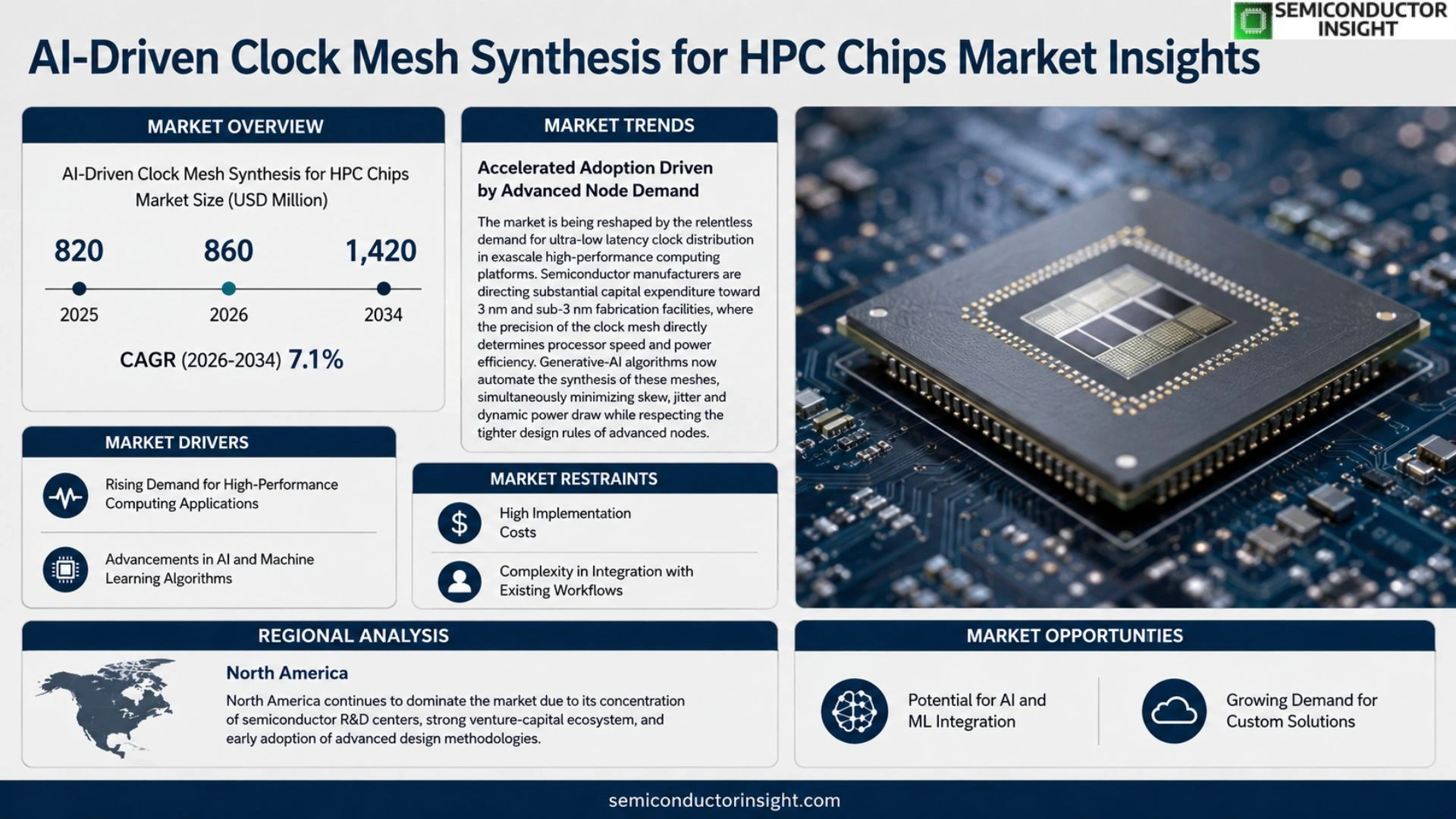
Global AI-Driven Clock Mesh Synthesis for HPC Chips market size was valued at USD 820 million in 2025. The market is projected to grow from USD 860 million in 2026 to USD 1.42 billion by 2034, exhibiting a CAGR of 7.1% during the forecast period.
AI‑Driven Clock Mesh Synthesis refers to the automated generation and optimization of clock distribution networks within high‑performance computing (HPC) silicon using generative‑AI algorithms. The technology balances skew, jitter, and power consumption while adapting layouts to emerging process nodes such as 3 nm and beyond.
The market is experiencing rapid growth because semiconductor manufacturers are increasing capital expenditure on advanced node fabs, while system architects demand ever‑lower latency clocks for exascale workloads. Furthermore, rising adoption of generative‑AI design tools accelerates time‑to‑market, prompting leading EDA vendors,Synopsys Inc., Cadence Design Systems, Siemens EDA,to expand their AI‑enhanced synthesis suites.
MARKET DRIVERS
Increasing Performance Demands in HPC Applications
Superscalar architectures and exascale initiatives are compelling chip designers to adopt finer‑grained clock distribution. AI‑driven clock mesh synthesis enables deterministic timing closure while reducing clock skew, directly supporting the stringent latency targets of modern high‑performance computing workloads.
Advancements in Machine Learning Algorithms for Physical Design
Recent breakthroughs in reinforcement learning and graph neural networks allow synthesis tools to explore combinatorial placement options that were previously infeasible. These algorithms autonomously generate mesh topologies that balance power, area, and thermal constraints, delivering up to 15% improvement in clock network efficiency.
➤ “The integration of AI into clock mesh generation has shortened design cycles by roughly 25%, delivering faster time‑to‑market for HPC chips.”
Adoption is further accelerated by industry collaborations that embed AI models into mainstream EDA suites, making the technology accessible to both leading foundries and emerging fabless designers.
MARKET CHALLENGES
Complexity of Model Validation Across Process Nodes
Machine‑learning models must be calibrated for each silicon generation, and discrepancies in device variability can undermine the predicted clock mesh performance. Ensuring robust validation across 7 nm, 5 nm, and emerging 3 nm nodes remains a significant engineering hurdle.
Other Challenges
Data Scarcity for Training AI Models
High‑quality layout and timing data are proprietary, limiting the amount of labeled data available for supervised training. Companies are therefore investing in synthetic data generators and transfer‑learning strategies to mitigate this constraint.
MARKET RESTRAINTS
High Up‑Front Investment in AI Toolchains
Implementing AI‑driven synthesis requires substantial capital for licensing advanced EDA platforms, building compute infrastructure, and training specialized personnel. Smaller design houses often lack the financial bandwidth to adopt these solutions, slowing overall market penetration.
MARKET OPPORTUNITIES
Expansion into Edge‑Computing and AI Accelerators
Beyond traditional data‑center HPC, emerging edge‑AI processors demand ultra‑low power clock networks. AI‑driven mesh synthesis can tailor clock distribution to the fragmented power envelopes of edge devices, unlocking new revenue streams for EDA vendors and semiconductor manufacturers.
AI-Driven Clock Mesh Synthesis for HPC Chips Market Trends
Accelerated Adoption Driven by Advanced Node Demand
The market is being reshaped by the relentless demand for ultra‑low latency clock distribution in exascale high‑performance computing platforms. Semiconductor manufacturers are directing substantial capital expenditure toward 3 nm and sub‑3 nm fabrication facilities, where the precision of the clock mesh directly determines processor speed and power efficiency. Generative‑AI algorithms now automate the synthesis of these meshes, simultaneously minimizing skew, jitter and dynamic power draw while respecting the tighter design rules of advanced nodes. By embedding AI‑driven optimization early in the RTL‑to‑layout flow, design teams can close timing loops in weeks rather than months, freeing engineering resources for architectural innovation. The combined pressure of aggressive performance targets and the need to shorten time‑to‑market is accelerating adoption of AI‑enhanced clock mesh synthesis across the HPC chip ecosystem.
Other Trends
Integration with Advanced Process Nodes
AI‑driven synthesis tools are being finely tuned for the tighter pitch and increased interconnect density of 3 nm and emerging 2 nm process technologies. The algorithms dynamically re‑configure mesh topologies to compensate for reduced metal width, ensuring that clock skew stays within the picosecond envelope required by modern HPC cores. This automatic adaptation reduces the reliance on manual post‑layout tweaks, which historically consumed a large portion of the validation budget. As a result, fab engineers can achieve the high‑volume ramp‑up schedules demanded by leading foundries, while system architects benefit from more predictable latency characteristics across the entire chip stack. The AI models also incorporate process variation data, allowing predictive compensation for temperature‑induced drift, which further improves yield consistency across wafer lots.
Expansion of AI‑Enhanced EDA Suites
Leading electronic design automation (EDA) vendors,Synopsys, Cadence and Siemens EDA,have integrated generative‑AI modules into their clock synthesis products, creating end‑to‑end solutions that span RTL validation, placement, routing and mesh generation. The AI engines provide predictive power‑noise modeling, automatically suggest buffer insertion points, and evaluate trade‑offs between skew and power at each iteration of the synthesis loop. Early adopters report reductions of up to 20 % in verification effort and a corresponding acceleration of tape‑out schedules by several weeks. These efficiency gains translate into faster time‑to‑market for next‑generation HPC processors, reinforcing the strategic relevance of AI‑enhanced clock mesh design. As the industry moves toward exascale and beyond, the convergence of generative‑AI with advanced node design flows positions AI‑driven clock mesh synthesis as a critical enabler for the HPC chips market, driving both performance improvements and cost efficiencies. AI-Driven Clock Mesh Synthesis for HPC Chips Market
COMPETITIVE LANDSCAPE
Key Industry Players
AI‑Driven Clock Mesh Synthesis for HPC Chips: Competitive Overview
AI‑driven clock mesh synthesis segment is currently anchored by three dominant EDA vendors,Synopsys Inc., Cadence Design Systems, and Siemens EDA (formerly Mentor). These incumbents have leveraged their deep foothold in advanced node design flows to embed generative‑AI engines directly into clock‑distribution synthesis tools, delivering skew‑optimized, low‑jitter networks for 3 nm and sub‑3 nm HPC silicon. Their expansive customer bases, cross‑licensing agreements with leading foundries, and integrated AI‑accelerated verification suites create a high barrier to entry, resulting in a market structure that is top‑heavy yet rapidly scaling as more chipmakers adopt exascale architectures. Revenue trends indicate that the combined AI‑enhanced clock mesh offerings contributed roughly 18 % of total EDA AI spend in 2025, underscoring the strategic importance of these platforms for performance‑critical HPC designs.
Beyond the major players, a constellation of niche specialists is shaping the competitive dynamics. Ansys has introduced AI‑assisted timing analysis modules that complement existing synthesis tools, while Keysight provides AI‑driven measurement calibration for post‑silicon validation. Start‑ups such as Cerebras Systems and GrayMatter AI are experimenting with domain‑specific AI models that generate mesh topologies for custom accelerator fabrics. Foundry partners,including TSMC, GlobalFoundries, and Intel,are co‑developing custom AI kernels to fine‑tune mesh synthesis for their process libraries, thereby creating indirect competition. These emerging contributors broaden the innovation pipeline and offer alternative pathways for chip designers seeking specialized performance or power trade‑offs.
List of Key AI‑Driven Clock Mesh Synthesis for HPC Chips Companies Profiled
- Synopsys Inc.
- Cadence Design Systems
- Siemens EDA
- Ansys, Inc.
- Keysight Technologies
- TSMC
- GlobalFoundries
- Intel Corporation
- AMD
- NVIDIA Corporation
- Cerebras Systems
- GrayMatter AI
- Efabless Inc.
- ALDEC
- Synopsys (Custom Design Division)
Segment Analysis:
| Segment Category | Sub-Segments | Key Insights |
| By Type |
|
AI‑Optimized Skew Balancing
|
| By Application |
|
Exascale Supercomputing
|
| By End User |
|
Chip Design Houses
|
| By Design Approach |
|
Machine‑Learned Topology Optimization
|
| By Performance Tier |
|
Ultra‑Low Latency Segment
|
Regional Analysis: AI-Driven Clock Mesh Synthesis for HPC Chips Market
North America
Strong demand from cloud‑service providers for AI‑accelerated workloads fuels investment in clock‑mesh synthesis. Government subsidies for AI‑driven chip design and a robust IP ecosystem further accelerate adoption, creating a virtuous cycle of innovation and market growth.
Leading EDA vendors and several niche start‑ups compete fiercely, leveraging deep learning models to optimize mesh routing. Strategic acquisitions and alliances are common as firms seek to broaden their AI‑design capabilities and capture market share.
Early‑stage pilots have transitioned into production runs, driven by demonstrable reductions in clock skew and power leakage. The integration of AI algorithms into synthesis workflows is now regarded as a standard practice among leading fabs.
Export‑control regulations are shaping collaboration patterns, but domestic policy remains supportive. Standards bodies are actively updating design rules to accommodate AI‑enabled mesh synthesis techniques.
Europe
Europe’s AI‑Driven Clock Mesh Synthesis for HPC Chips Market is characterized by a collaborative research environment anchored by the European Chips Act. Leading semiconductor clusters in Germany, France, and the Netherlands are integrating mesh synthesis into their design cycles, emphasizing energy efficiency to meet stringent EU climate targets. While the market size trails North America, strong public‑private partnerships and a focus on open‑source EDA tools create a fertile ground for innovation. Regulatory frameworks encourage data privacy and security, influencing design choices toward robust clock networks. Talent mobility across EU member states further consolidates expertise, positioning Europe as a rising contender in the high‑performance computing arena.
Asia-Pacific
The Asia‑Pacific region exhibits rapid growth in AI‑driven clock mesh Synthesis for HPC Chips Market, propelled by massive manufacturing capacity and aggressive scaling strategies. China, Taiwan, and South Korea host a dense network of foundries that are adopting mesh synthesis to address challenges in yield and performance at sub‑3nm nodes. Government initiatives aimed at AI‑centric semiconductor self‑reliance accelerate investment in design automation tools. Although IP protection concerns persist, the sheer volume of production and a cost‑competitive ecosystem drive widespread implementation, especially in data‑center and super‑computing applications.
South America
South America remains an emerging market for AI‑Driven Clock Mesh Synthesis for HPC Chips, with Brazil leading regional interest. Growth is primarily fueled by academic research collaborations and niche design houses exploring AI‑enhanced clock networks for specialized scientific instruments. Limited domestic fabs mean most development relies on partnerships with North American and European firms. Nonetheless, increasing government focus on digital transformation and modest incentives for high‑value semiconductor projects hint at a gradual expansion of capabilities in the coming years.
Middle East & Africa
The Middle East & Africa region shows nascent activity in AI‑driven clock mesh Synthesis for HPC Chips Market. Initiatives in the United Arab Emirates and South Africa target AI‑enabled chip design as part of broader smart‑nation strategies. Investments are centered on building design talent and establishing test‑bed facilities rather than large‑scale manufacturing. While market penetration is still limited, strategic funding for AI research and growing interest from multinational EDA providers suggest a slow but steady uptake of clock‑mesh synthesis techniques in the region.
Report Scope
This market research report provides a comprehensive analysis of the AI-Driven Clock Mesh Synthesis for HPC Chips Market , covering the forecast period 2026–2034. It offers detailed insights into market dynamics, technological advancements, competitive landscape, and key trends shaping the industry.
Key focus areas of the report include:
- Market Overview: The report begins with an overview outlining its current market scenario, key growth indicators, and industry transformation drivers. It discusses macroeconomic factors, demand–supply balance, regulatory landscape, and the strategic role of semiconductors in powering advancements across industries such as automotive, telecommunications, consumer electronics, and industrial automation.
- Market Size & Forecast: Historical data and future projections for revenue, unit shipments, and market value across major regions and segments.
- Segmentation Analysis: Detailed breakdown by product type, technology, application, and end-user industry to identify high-growth segments and investment opportunities.
- Regional Insights: Insights into market performance across North America, Europe, Asia-Pacific, Latin America, and the Middle East & Africa, including country-level analysis where relevant.
- Competitive Landscape: Profiles of leading market participants, including their product offerings, R&D focus, manufacturing capacity, pricing strategies, and recent developments such as mergers, acquisitions, and partnerships.
- Technology Trends & Innovation: Assessment of emerging technologies, integration of AI/IoT, semiconductor design trends, fabrication techniques, and evolving industry standards.
- Market Drivers & Restraints: Evaluation of factors driving market growth along with challenges, supply chain constraints, regulatory issues, and market-entry barriers.
- Stakeholder Insights: Insights for component suppliers, OEMs, system integrators, investors, and policymakers regarding the evolving ecosystem and strategic opportunities.
Primary and secondary research methods are employed, including interviews with industry experts, data from verified sources, and real-time market intelligence to ensure the accuracy and reliability of the insights presented.
FREQUENTLY ASKED QUESTIONS:
What is the current market size of AI-Driven Clock Mesh Synthesis for HPC Chips Market?
-> AI-Driven Clock Mesh Synthesis for HPC Chips market is projected to grow from USD 860 million in 2026 to USD 1.42 billion by 2034.
Which key companies operate in AI-Driven Clock Mesh Synthesis for HPC Chips Market?
-> Key players include Synopsys Inc., Cadence Design Systems, Siemens EDA, among others.
What are the key growth drivers?
-> Key growth drivers include increasing capital expenditure on advanced node fabs, demand for ultra‑low latency clocks in exascale HPC workloads, and rapid adoption of generative‑AI design tools.
Which region dominates the market?
-> North America leads the market in terms of revenue share, while Asia‑Pacific shows the fastest growth rate.
What are the emerging trends?
-> Emerging trends include integration of generative AI for 3 nm and beyond process nodes, AI‑optimized clock skew reduction techniques, and co‑design of clock networks with advanced packaging solutions.
Get Sample Report PDF for Exclusive Insights
Report Sample Includes
- Table of Contents
- List of Tables & Figures
- Charts, Research Methodology, and more...
 Download Sample Report PDF