AI Data Center 48V Bus Converter GaN Chip Market Insights
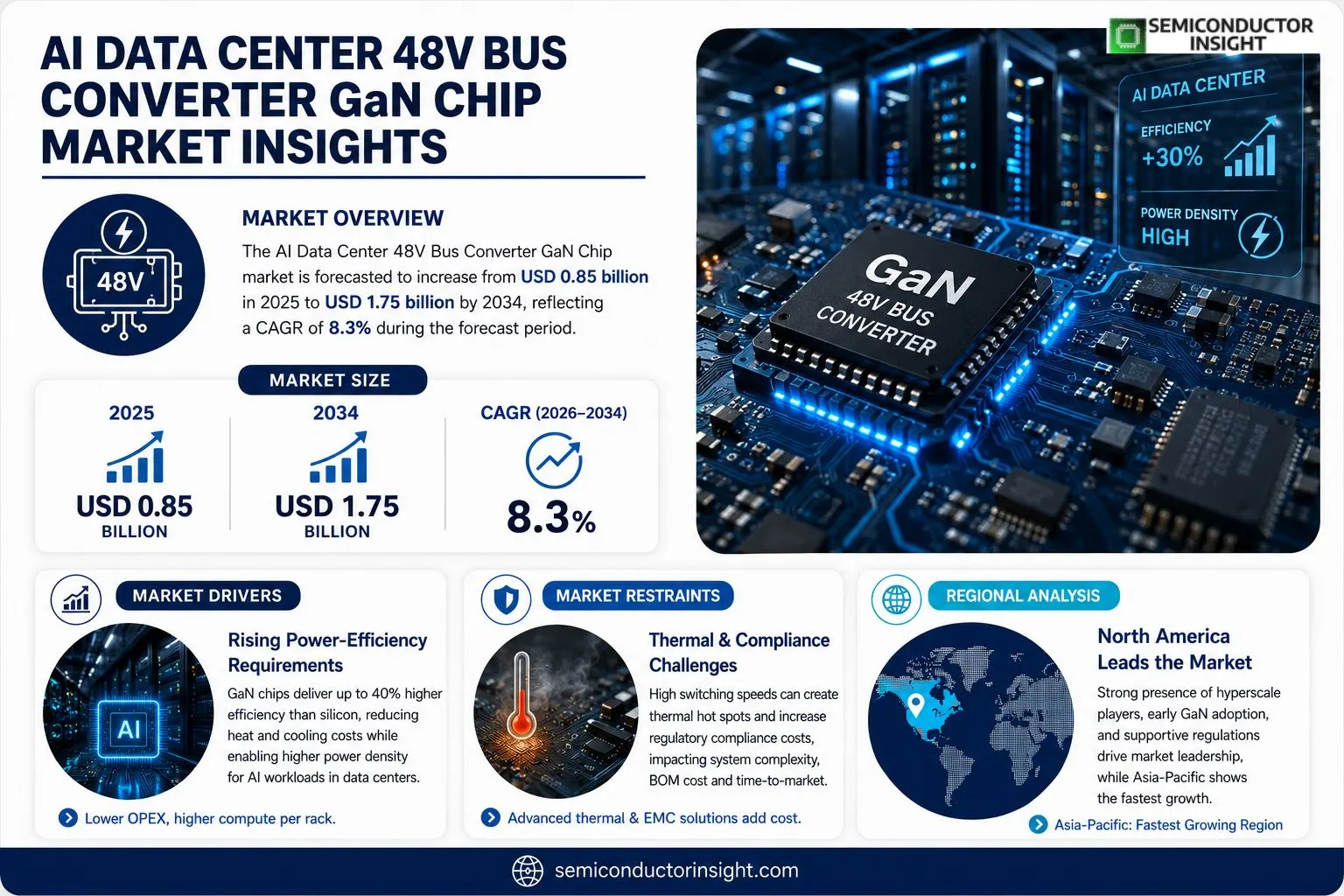
AI Data Center 48V Bus Converter GaN Chip market size was valued at USD 0.85 billion in 2025. The market is forecasted to increase from USD 0.85 billion in 2025 to USD 1.75 billion by 2034, reflecting a compound annual growth rate of approximately 8.3% during the forecast period.
A 48‑volt bus converter built on gallium‑nitride (GaN) technology serves as the core power‑conversion element within modern AI‑driven data centers. By switching at higher frequencies and exhibiting lower on‑resistance than silicon counterparts, these chips enable compact converters that deliver up‑to‑30 % higher efficiency while reducing thermal footprintscritical for dense rack deployments where power density and cooling costs dominate.The upward trajectory stems from surging AI inference workloads that push hyperscale operators toward ultra‑efficient power architectures; investors are channeling capital into next‑generation silicon alternatives because traditional silicon converters struggle with the required power density.Recent collaborations underscore this momentumNavitas Semiconductor teamed with Microsoft Azure in Q3 2023 to co‑develop custom GaN modules for edge AI clusters, while Efficient Power announced a new hybrid SiC/GaN solution targeting high‑performance computing platforms in early 2024.These initiatives, combined with growing OEM adoption of modular “plug‑and‑play” bus converters, are expanding the addressable market for GaN chips across data center ecosystems.
MARKET DRIVERS
Rising Power‑Efficiency Requirements
The shift toward low‑loss power conversion in AI‑focused data centers has made Gallium Nitride (GaN) devices attractive. GaN‑based 48 V bus converters can deliver up to 40 % higher efficiency than silicon equivalents, directly lowering operating expenses for high‑density AI workloads. This efficiency edge reduces heat generation, allowing facility managers to pack more compute per rack without overtaxing cooling infrastructure.
Intensifying AI Compute Loads
AI models now routinely exceed 100 TFLOPS per node, demanding power delivery architectures that sustain high current while maintaining tight voltage regulation. The 48 V bus topology, combined with GaN switching, supports rapid transient response, which is essential for accelerators that fluctuate between idle and peak states. Operators are therefore prioritizing converters that can keep up with these dynamic profiles.
➤ “In the next two years, data‑center designers will treat GaN bus converters as a baseline component rather than an optional upgrade.”
Adoption of the 48 V bus scheme also simplifies cabling and reduces the bill of materials. When the total cost of ownership is calculated over a five‑year horizon, the modest upfront premium for GaN chips is offset by lower electricity bills and diminished cooling overhead, making the technology a financially sensible choice for AI‑heavy facilities.
MARKET CHALLENGES
Thermal Management Constraints
Despite GaN’s superior switching speed, the high switching frequency can produce localized hot spots on the converter board. Designers must integrate advanced heat‑spreading substrates or active cooling solutions, which adds to system complexity and can erode some of the efficiency gains.
Other Challenges
Supply‑Chain Volatility
The niche nature of GaN wafers means that a limited number of foundries dominate production. Any disruptionwhether geopolitical or pandemic‑relatedquickly translates into longer lead times for AI Data Center 48V Bus Converter GaN Chip Market, forcing OEMs to hold larger safety stocks.
MARKET RESTRAINTS
Regulatory Compliance Costs
Data‑center equipment must meet strict electromagnetic compatibility (EMC) and safety standards. GaN converters, operating at higher switching frequencies, often require additional filtering and shielding to satisfy these regulations, leading to higher bill‑of‑materials and engineering effort.Furthermore, regional power‑quality directives impose stringent harmonic distortion limits. Achieving compliance without sacrificing the conversion efficiency that GaN promises can be a delicate balancing act for manufacturers.Finally, the need for certification across multiple jurisdictionsNorth America, Europe, and Asia‑Pacificcreates a fragmented approval landscape, slowing time‑to‑market for new converter designs.
MARKET OPPORTUNITIES
Edge‑AI Deployments
Edge data centers, positioned close to end‑users, demand compact power solutions that can operate efficiently in constrained footprints. The 48 V GaN bus converter fits this niche perfectly, offering high power density while minimizing thermal envelope.In addition, the growing adoption of modular AI accelerators in edge locations creates a predictable demand pipeline for standardized GaN converters, allowing suppliers to capitalize on volume production economies.Strategic partnerships between chip manufacturers and system integrators can accelerate the rollout of pre‑qualified converter modules, shortening deployment cycles and opening new revenue streams across AI Data Center 48V Bus Converter GaN Chip Market.
AI Data Center 48V Bus Converter GaN Chip Market Trends
Efficiency‑Driven Adoption Accelerates Market Momentum
The 48‑volt bus converter built on gallium‑nitride (GaN) technology is reshaping power‑delivery strategies inside AI‑focused data centers. By operating at higher switching frequencies and presenting a markedly lower on‑resistance than traditional silicon counterparts, GaN‑based converters deliver up to 30 % better efficiency while trimming the thermal envelope. Those characteristics matter most where rack density and cooling expenditure dominate total cost of ownership. The market valuation, recorded at roughly USD 0.85 billion in 2025, is projected to climb to about USD 1.75 billion by 2034, reflecting a compound annual growth near 8 % per year. The upward trajectory reflects a clear response to expanding AI inference workloads that demand power architectures capable of sustaining higher power density without proportionate cooling upgrades.
Other Trends
Strategic Partnerships Expand Ecosystem Reach
Recent collaborations illustrate how OEMs and cloud operators are leveraging GaN expertise to accelerate deployment timelines. In the third quarter of 2023, Navitas Semiconductor joined forces with Microsoft Azure to co‑engineer custom GaN modules aimed at edge AI clusters, shortening the path from prototype to production. Early 2024 saw Efficient Power introduce a hybrid SiC/GaN solution tailored for high‑performance computing platforms, providing a bridge for facilities transitioning from legacy silicon to next‑generation converters. These joint efforts not only validate the technology’s commercial viability but also broaden the addressable pool of data‑center designers seeking plug‑and‑play bus converters that integrate seamlessly into modular infrastructure.
Scalable Architecture Fuels Hyperscale Deployment
Beyond efficiency gains, the modular nature of 48 V GaN bus converters aligns with the scaling philosophy of hyperscale operators. Because the converters occupy a smaller footprint and generate less heat, they enable tighter rack arrangements and simplify power‑distribution network layouts. This translates into lower capital outlay for power‑distribution equipment and reduced operational expenses linked to cooling. As hyperscale providers continue to expand capacity to meet AI‑driven demand, the preference for compact, high‑efficiency power conversion becomes a decisive factor in equipment selection, reinforcing the market’s forward momentum.
COMPETITIVE LANDSCAPEKey Industry Players
Competitive Outlook for AI Data Center 48V Bus Converter GaN Chip Market
The market is currently anchored by a handful of firms that have transformed GaN from a niche power‑switching material into a mainstream component for high‑density AI workloads. Navitas Semiconductor, leveraging its deep‑submicron GaN process, secured a strategic partnership with Microsoft Azure in late 2023, delivering custom‑engineered modules that cut rack‑level cooling demand by double‑digit percentages. This collaboration not only illustrates Navitas’ ability to co‑develop solutions at scale but also signals a broader shift toward vertically integrated ecosystems where silicon‑alternative suppliers work hand‑in‑hand with cloud operators. Meanwhile, Efficient Power has introduced a hybrid SiC/GaN converter line that targets the upper‑end of high‑performance computing platforms, positioning it as a bridge between legacy silicon designs and pure GaN architectures. The concentration of R&D spend among these leaders creates a competitive moat, compelling new entrants to either secure niche IP or align with established fab partners to access the sophisticated epitaxial tooling required for 48 V bus applications.Beyond the two frontrunners, a diverse cohort of specialists is expanding the field of viable suppliers. GaN Systems and Transphorm have each rolled out 48‑volt device families that emphasize low on‑resistance and ultra‑fast switching, attributes that translate directly into reduced thermal budgets for dense server farms. Infineon, STMicroelectronics, and Qorvo are repurposing their broad automotive and RF portfolios to address data‑center power conversion, betting on cross‑segment synergies. Smaller innovators such as MagnaChip, Rohm, and ON Semiconductor contribute differentiated packaging approaches, while Wolfspeed (Cree) leverages its extensive SiC heritage to offer hybrid power modules that blend SiC robustness with GaN efficiency. The mosaic of capabilities fosters a competitive environment where product differentiation hinges on efficiency gains, integration flexibility, and the speed at which manufacturers can certify new architectures for hyperscale deployment.
List of Key AI Data Center 48V Bus Converter GaN Chip Companies Profiled
- Navitas Semiconductor
- Efficient Power
- GaN Systems
- Transphorm
- Infineon Technologies
- STMicroelectronics
- Qorvo
- MagnaChip
- Rohm Semiconductor
- ON Semiconductor
- Wolfspeed
- Broadcom (Power Solutions Division)
- Microchip Technology
Segment Analysis:
| Segment Category | Sub-Segments | Key Insights |
| By Type |
|
Pure GaN
|
| By Application |
|
AI Inference Accelerators
|
| By End User |
|
Hyperscale Cloud Providers
|
| By Power Architecture |
|
Resonant Converters
|
| By Integration Level |
|
Monolithic Integrated Power‑ICs
|
Regional Analysis: AI Data Center 48V Bus Converter GaN Chip Market
North America
Vendors are rapidly integrating GaN transistors into 48 V converters to meet AI workloads that demand sub‑microsecond response. Early adopters cite reduced board space and higher frequency operation as decisive factors, prompting a cascade of design refinements across the ecosystem.
Domestic wafer capacity, bolstered by recent governmental incentives, lessens reliance on Asian fabs. This localized supply chain shortens lead times and improves resilience, a crucial advantage for data center roll‑outs with tight project schedules.
Energy‑efficiency standards such as ENERGY STAR v3.0 drive adoption of high‑efficiency converters. Compliance not only reduces operating costs but also aligns with ESG commitments that many North American operators now prioritize.
Hyperscale facilities are scaling AI clusters at unprecedented rates. Their demand for modular, high‑power‑density solutions fuels a market where every incremental efficiency gain translates into tangible CAPEX savings.
Europe
European data center operators balance ambitious sustainability targets with the need for compute intensity. The 48 V bus converter market here is shaped by strict EU energy‑performance directives, which push suppliers toward GaN solutions that can deliver higher efficiencies while fitting into compact rack designs. German and Nordic markets, in particular, exhibit a collaborative approach between telecom carriers and chip makers, fostering pilots that validate the reliability of GaN‑based converters under mixed‑load conditions. Although funding cycles are more measured than in North America, the region benefits from a dense network of standards bodies that streamline certification processes, accelerating commercial rollout once a technology passes compliance thresholds.
Asia‑Pacific
Asia‑Pacific presents a heterogeneous picture: while Japan and South Korea exhibit advanced AI data center deployments, emerging economies such as India and Vietnam are still constructing foundational infrastructure. The market for 48 V bus converters is gaining traction as regional cloud providers upgrade legacy power architectures to accommodate AI workloads. Supply‑chain proximity to major GaN wafer producers offers cost advantages, yet the fragmented regulatory environment creates divergent adoption speeds across the sub‑region. Strategic partnerships between local integrators and silicon firms are beginning to inject expertise, setting the stage for a more coordinated expansion in the next few years.
South America
In South America, data center growth is driven largely by the acceleration of digital services and a gradual shift toward AI‑enhanced analytics. Brazil leads the conversation, with operators exploring 48 V bus converters to reduce the footprint of power distribution networks in densely populated urban zones. Market momentum is tempered by capital‑intensity concerns; however, the emergence of financing models linked to renewable energy projects is softening barriers. Providers that can demonstrate clear total‑cost‑of‑ownership advantages for GaN‑based converters are beginning to secure pilot contracts, indicating a nascent but promising trajectory.
Middle East & Africa
The Middle East & Africa region is at an early adoption stage, yet it offers distinct incentives for advanced power solutions. Megaprojects in the United Arab Emirates and Saudi Arabia, focused on AI‑enabled smart city initiatives, are specifying high‑efficiency power conversion as a core requirement. Meanwhile, African markets are still ramping up basic broadband capacity, but pockets of AI research hubs are experimenting with modular 48 V bus architectures to test scalability. The combination of government‑backed sustainability programs and a growing appetite for AI compute creates a fertile environment for GaN chip manufacturers willing to navigate the region’s diverse market conditions.
Report Scope
This market research report provides a comprehensive analysis of the AI Data Center 48V Bus Converter GaN Chip Market , covering the forecast period 2026–2034. It offers detailed insights into market dynamics, technological advancements, competitive landscape, and key trends shaping the industry.
Key focus areas of the report include:
- Market Overview: The report begins with an overview outlining its current market scenario, key growth indicators, and industry transformation drivers. It discusses macroeconomic factors, demand–supply balance, regulatory landscape, and the strategic role of semiconductors in powering advancements across industries such as automotive, telecommunications, consumer electronics, and industrial automation.
- Market Size & Forecast: Historical data and future projections for revenue, unit shipments, and market value across major regions and segments.
- Segmentation Analysis: Detailed breakdown by product type, technology, application, and end-user industry to identify high-growth segments and investment opportunities.
- Regional Insights: Insights into market performance across North America, Europe, Asia-Pacific, Latin America, and the Middle East & Africa, including country-level analysis where relevant.
- Competitive Landscape: Profiles of leading market participants, including their product offerings, R&D focus, manufacturing capacity, pricing strategies, and recent developments such as mergers, acquisitions, and partnerships.
- Technology Trends & Innovation: Assessment of emerging technologies, integration of AI/IoT, semiconductor design trends, fabrication techniques, and evolving industry standards.
- Market Drivers & Restraints: Evaluation of factors driving market growth along with challenges, supply chain constraints, regulatory issues, and market-entry barriers.
- Stakeholder Insights: Insights for component suppliers, OEMs, system integrators, investors, and policymakers regarding the evolving ecosystem and strategic opportunities.
Primary and secondary research methods are employed, including interviews with industry experts, data from verified sources, and real-time market intelligence to ensure the accuracy and reliability of the insights presented.
FREQUENTLY ASKED QUESTIONS:
What is the current market size of AI Data Center 48V Bus Converter GaN Chip Market?
-> AI Data Center 48V Bus Converter GaN Chip Market was valued at USD 0.85 billion in 2025 and is expected to reach USD 1.75 billion by 2034, reflecting a compound annual growth rate of approximately 8.3 % during the forecast period.
Which key companies operate in AI Data Center 48V Bus Converter GaN Chip Market?
-> Key players include Navitas Semiconductor, Efficient Power, Infineon Technologies, GaN Systems, and partnerships such as Navitas with Microsoft Azure, among others.
What are the key growth drivers?
-> Key growth drivers include surging AI inference workloads, the need for ultra‑efficient power architectures, higher power‑density requirements, and the drive to reduce cooling costs in hyperscale data centers.
Which region dominates the market?
-> North America currently holds a leading share owing to the concentration of large‑scale data center operators, while Asia‑Pacific shows the fastest growth trajectory.
What are the emerging trends?
-> Emerging trends include hybrid SiC/GaN solutions, modular “plug‑and‑play” bus converters, and custom GaN modules for edge AI clusters.
Get Sample Report PDF for Exclusive Insights
Report Sample Includes
- Table of Contents
- List of Tables & Figures
- Charts, Research Methodology, and more...
 Download Sample Report PDF