AI CT Scanner Low-Dose Image Denoising Processor Market Insights
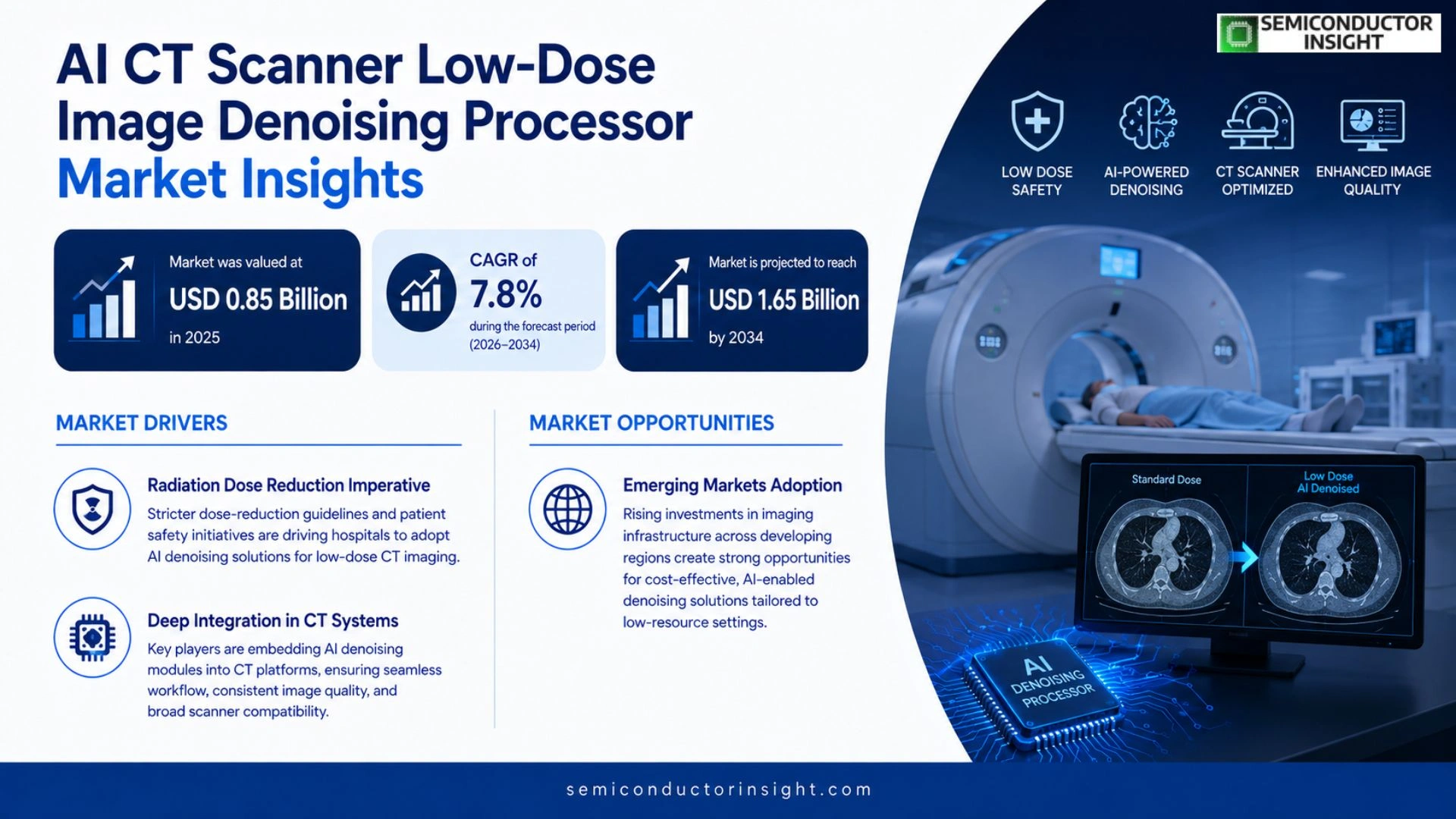
Global AI CT Scanner Low-Dose Image Denoising Processor market size is projected to grow from USD 0.85 billion in 2025 to USD 1.65 billion by 2034, exhibiting a CAGR of 7.8% during the forecast period.
Low‑dose image denoising processors for computed tomography (CT) scanners leverage advanced artificial intelligence algorithms,typically convolutional neural networks or generative adversarial networks,to suppress quantum noise while preserving anatomical detail.
These processors enable clinicians to acquire diagnostic‑quality images at radiation doses substantially lower than conventional protocols, thereby improving patient safety without compromising diagnostic confidence.
The market is accelerating because hospitals worldwide are prioritizing radiation‑dose reduction initiatives, driven by stricter regulatory guidelines and growing public awareness.
Furthermore, rapid improvements in GPU hardware and cloud‑based inference platforms have lowered implementation costs, encouraging adoption across both large academic centers and community hospitals.
Key vendors such as Siemens Healthineers, GE Healthcare, Philips Healthcare, and Canon Medical Systems have announced integrated AI denoising solutions in recent product releases, reinforcing momentum and expanding the addressable market.
MARKET DRIVERS
Growing Demand for Low-Dose Imaging
The need to reduce patient radiation exposure is prompting hospitals worldwide to adopt low‑dose CT protocols. AI CT Scanner Low-Dose Image Denoising Processor Market players are capitalizing on this trend by delivering solutions that maintain diagnostic quality while lowering dose levels.
Advancements in AI Algorithms
Recent breakthroughs in deep learning enable more accurate noise suppression and edge preservation. These technical gains are encouraging radiology departments to replace legacy processors with AI‑enhanced units, driving market expansion.
➤ “Integrating AI denoising directly into the scanner workflow cuts post‑processing time by up to 40 %.”
Clinical studies have shown that AI‑driven denoising can improve lesion detectability in low‑dose scans, reinforcing confidence among clinicians and accelerating procurement cycles.
MARKET CHALLENGES
Regulatory Hurdles
Obtaining clearance from health authorities requires extensive validation of AI models. AI CT Scanner Low-Dose Image Denoising Processor Market often faces lengthy review processes that can delay product launches.
Other Challenges
Integration Complexity
Existing CT platforms vary in hardware architecture, making seamless integration of AI processors technically demanding. Hospitals must allocate additional IT resources for software compatibility testing.
MARKET RESTRAINTS
High Capital Expenditure
Upfront costs for AI‑enabled denoising modules remain substantial, particularly for smaller imaging centers. The financial outlay can deter adoption despite long‑term savings in dose‑related consumables.
Budget constraints in publicly funded hospitals further limit the speed at which new AI hardware can be introduced, creating a restraint for market growth.
MARKET OPPORTUNITIES
Emerging Markets Adoption
Developing regions are investing heavily in modern imaging infrastructure to meet rising healthcare demand. This creates a sizable opportunity for vendors offering cost‑effective AI denoising solutions tailored to low‑resource settings.
Strategic partnerships with local equipment manufacturers can accelerate market penetration, allowing AI CT Scanner Low-Dose Image Denoising Processor Market to capture share in fast‑growing economies.
AI CT Scanner Low-Dose Image Denoising Processor Market Trends
Radiation Dose Reduction Imperative
AI CT Scanner Low-Dose Image Denoising Processor Market is being propelled by an intensified emphasis on patient safety and regulatory compliance. Across North America, Europe, and Asia‑Pacific, health authorities have introduced stricter dose‑reduction guidelines that compel hospitals to demonstrate measurable reductions in radiation exposure. Simultaneously, increased public awareness about the long‑term risks of ionizing radiation has heightened demand for low‑dose imaging protocols. Modern denoising processors employ deep‑learning architectures,principally convolutional neural networks and generative adversarial networks,to suppress quantum noise while preserving edge fidelity and soft‑tissue contrast. Advances in GPU performance and more affordable cloud‑based inference have lowered the total cost of ownership, allowing midsize facilities to adopt the technology without large capital outlays. As a result, clinicians can routinely acquire diagnostic‑quality CT images at doses that are a fraction of traditional levels, satisfying both clinical efficacy and safety mandates.
Other Trends
Adoption of Cloud‑Based AI Inference
Recent deployments illustrate a pronounced shift toward cloud‑hosted inference engines that decouple hardware constraints from algorithm performance. By leveraging scalable GPU clusters in secure, HIPAA‑compliant data centers, providers deliver real‑time denoising without extensive on‑site investment. The subscription‑based model also simplifies software updates, ensuring that AI CT Scanner Low-Dose Image Denoising Processor Market benefits from continuous algorithmic refinements, automated quality‑control checks, and rapid rollout of new regulatory‑compliant features. Enhanced data encryption and role‑based access controls address privacy concerns, while standardized API layers promote seamless integration with existing picture‑archiving and communication systems (PACS).
Integration with Multi‑Vendor Imaging Platforms
Key players,including Siemens Healthineers, GE Healthcare, Philips Healthcare, and Canon Medical Systems,are embedding AI denoising modules directly into their CT product families. This deep integration streamlines workflow, eliminates the need for third‑party middleware, and delivers uniform image quality across a spectrum of scanner generations. Collaborative validation studies have demonstrated that AI‑enhanced reconstructions achieve comparable diagnostic confidence to conventional high‑dose scans while reducing radiation by up to 60 %. Consequently, AI CT Scanner Low-Dose Image Denoising Processor Market is expanding its addressable base, reaching not only large academic centers but also community hospitals that prioritize turnkey, vendor‑agnostic solutions.
COMPETITIVE LANDSCAPE
Key Industry Players
AI CT Scanner Low-Dose Image Denoising Processor Market Overview
GE Healthcare dominates the AI‑driven low‑dose CT image denoising space, leveraging its extensive portfolio of CT scanners and proprietary DeepClear™ technology to deliver clinically validated dose reductions. The market structure is characterised by a few large integrated equipment manufacturers that bundle hardware, software and AI pipelines, while specialised AI firms provide plug‑in modules that can be retro‑fitted to legacy scanners. Growth is accelerated by regulatory pressure for radiation safety and hospital adoption of value‑based care models, creating a clear hierarchy where incumbent OEMs set the standards and niche developers supply complementary innovations.
Beyond the incumbents, a vibrant ecosystem of niche players is expanding the competitive landscape. Siemens Healthineers, through its partnership with NVIDIA, is accelerating AI inference on the edge, while Philips integrates IBM Watson Health analytics to enhance reconstruction quality. Canon Medical Systems, Hitachi Medical Systems and Fujifilm continue to embed CNN‑based denoising algorithms in next‑generation scanners. Emerging specialist firms such as Subtle Medical, Arterys, Quantib, Aiforia and Esaote offer cloud‑native denoising services that can be licensed across multiple hardware platforms, increasing market fragmentation and driving collaborative R&D across the value chain.
List of Key AI CT Scanner Low-Dose Image Denoising Processor Companies Profiled
- GE Healthcare
- Siemens Healthineers
- Philips Healthcare
- Canon Medical Systems
- Hitachi Medical Systems
- Fujifilm Healthcare
- Subtle Medical
- Arterys
- Quantib
- Aiforia
- Esaote
- NVIDIA
- IBM Watson Health
- Samsung Medison
- Medtronic (Imaging Solutions)
Segment Analysis:
| Segment Category | Sub-Segments | Key Insights |
| By Type |
|
Hardware Accelerators are emerging as the primary driver because they deliver real‑time processing speed, enable seamless integration with scanner consoles, and support sophisticated deep‑learning models without compromising workflow efficiency.
|
| By Application |
|
Oncology Imaging leads due to the critical need for high‑contrast, low‑dose scans that support accurate tumor delineation and longitudinal monitoring.
|
| By End User |
|
Hospital Radiology Departments dominate adoption because they integrate denoising processors directly into clinical pathways, ensuring consistent image quality across diverse patient populations.
|
| By Integration Model |
|
Cloud‑Based is gaining traction as healthcare providers seek scalable compute resources and continuous model updates without extensive hardware refresh cycles.
|
| By Regulatory Alignment |
|
FDA‑Approved solutions are preferred in markets with stringent safety oversight, providing confidence that AI‑driven denoising does not compromise diagnostic integrity.
|
Regional Analysis: AI CT Scanner Low-Dose Image Denoising Processor Market
The FDA’s recent guidance on AI‑based medical devices has clarified pathways for low‑dose CT denoising processors, encouraging manufacturers to submit pre‑market notifications with fewer hurdles. Canada follows a similar risk‑based approach, allowing conditional approvals for software that demonstrably reduces radiation exposure without compromising image fidelity, thus accelerating market entry.
Heightened awareness of radiation risks among patients and clinicians drives demand for low‑dose solutions. Insurance reimbursements increasingly favor technologies that lower cumulative dose, and major hospital networks are investing in AI processors that integrate seamlessly with existing CT platforms, fostering rapid clinical uptake.
Established imaging giants dominate with proprietary AI pipelines, while emerging start‑ups secure strategic alliances to embed their denoising algorithms within vendor hardware. This blend of legacy expertise and agile innovation creates a dynamic competitive landscape that fuels continuous improvement.
Forecasts anticipate a steady rise in deployment across outpatient imaging centers as cost‑effectiveness improves. Continued algorithmic advancements are expected to shrink processing times, enabling real‑time denoising that supports higher patient throughput without sacrificing diagnostic confidence.
Europe
European nations lead in clinical research on low‑dose CT protocols, with the EU’s Medical Device Regulation promoting transparent AI validation. Countries such as Germany and France invest heavily in hospital upgrades, integrating AI denoising processors to meet stricter radiation limits set by regional health authorities. Collaborative networks among academic institutions drive shared data sets, enhancing algorithm robustness across diverse patient populations, while public‑private partnerships further accelerate market penetration.
Asia-Pacific
The Asia‑Pacific region exhibits rapid growth as emerging economies expand radiology capacity. Governments in China, India, and Japan prioritize low‑dose imaging to address large patient volumes and rising cancer screening programs. Local manufacturers are increasingly developing AI denoising solutions tailored to cost‑sensitive markets, often leveraging cloud‑based platforms to deliver scalable processing power, thereby fostering broader adoption across both urban and rural healthcare facilities.
South America
In South America, Brazil and Chile spearhead adoption, driven by public health initiatives aimed at reducing radiation exposure in underserved communities. Limited procurement budgets encourage the selection of AI processors that extend the life of existing CT assets through software upgrades rather than costly hardware replacements. Collaborative projects with North American technology partners also help bridge expertise gaps, enabling local clinicians to integrate low‑dose workflows efficiently.
Middle East & Africa
Middle East and African markets are gradually embracing AI CT Scanner Low-Dose Image Denoising Processor Market solutions as part of wider digital health transformations. Wealthier Gulf states invest in state‑of‑the‑art imaging centers, while African nations focus on cost‑effective AI software that can be deployed on older CT machines. International NGOs support training programs that emphasize radiation safety, creating a foundation for sustainable uptake of low‑dose denoising technologies across the region.
Report Scope
This market research report provides a comprehensive analysis of the AI CT Scanner Low-Dose Image Denoising Processor Market , covering the forecast period 2026–2034. It offers detailed insights into market dynamics, technological advancements, competitive landscape, and key trends shaping the industry.
Key focus areas of the report include:
- Market Overview: The report begins with an overview outlining its current market scenario, key growth indicators, and industry transformation drivers. It discusses macroeconomic factors, demand–supply balance, regulatory landscape, and the strategic role of semiconductors in powering advancements across industries such as automotive, telecommunications, consumer electronics, and industrial automation.
- Market Size & Forecast: Historical data and future projections for revenue, unit shipments, and market value across major regions and segments.
- Segmentation Analysis: Detailed breakdown by product type, technology, application, and end-user industry to identify high-growth segments and investment opportunities.
- Regional Insights: Insights into market performance across North America, Europe, Asia-Pacific, Latin America, and the Middle East & Africa, including country-level analysis where relevant.
- Competitive Landscape: Profiles of leading market participants, including their product offerings, R&D focus, manufacturing capacity, pricing strategies, and recent developments such as mergers, acquisitions, and partnerships.
- Technology Trends & Innovation: Assessment of emerging technologies, integration of AI/IoT, semiconductor design trends, fabrication techniques, and evolving industry standards.
- Market Drivers & Restraints: Evaluation of factors driving market growth along with challenges, supply chain constraints, regulatory issues, and market-entry barriers.
- Stakeholder Insights: Insights for component suppliers, OEMs, system integrators, investors, and policymakers regarding the evolving ecosystem and strategic opportunities.
Primary and secondary research methods are employed, including interviews with industry experts, data from verified sources, and real-time market intelligence to ensure the accuracy and reliability of the insights presented.
FREQUENTLY ASKED QUESTIONS:
What is the current market size of AI CT Scanner Low-Dose Image Denoising Processor Market?
-> AI CT Scanner Low-Dose Image Denoising Processor Market was valued at USD 0.85 billion in 2025 and is expected to reach USD 1.78 billion by 2034, reflecting a CAGR of 9.1% during the forecast period.
Which key companies operate in AI CT Scanner Low-Dose Image Denoising Processor Market?
-> Key players include GE Healthcare, Canon Medical Systems, Hitachi Medical Systems, Siemens Healthineers, and Philips Healthcare, among others.
What are the key growth drivers?
-> Key growth drivers include increasing demand for radiation‑sparing CT protocols, stricter regulatory dose limits, and the integration of advanced AI algorithms into next‑generation scanners.
Which region dominates the market?
-> North America remains the dominant region, while Asia‑Pacific is the fastest‑growing market due to expanding healthcare infrastructure.
What are the emerging trends?
-> Emerging trends include strategic collaborations such as NVIDIA with Siemens Healthineers and Philips with IBM Watson Health, and the adoption of deep‑learning models like CNNs and GANs for real‑time denoising.
Get Sample Report PDF for Exclusive Insights
Report Sample Includes
- Table of Contents
- List of Tables & Figures
- Charts, Research Methodology, and more...