AI Chip Ultra-High Purity Gas Delivery System Market Insights
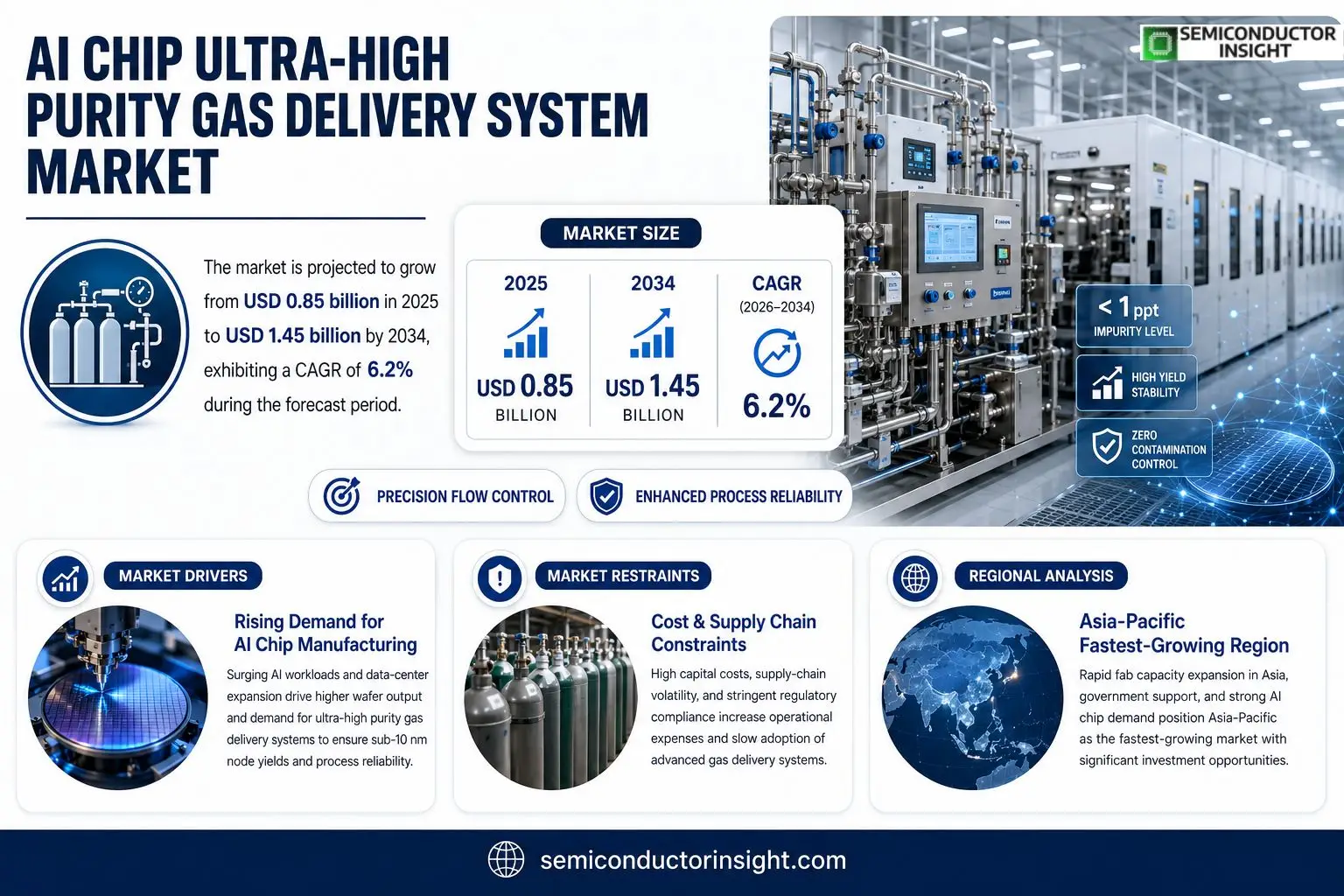
AI Chip Ultra-High Purity Gas Delivery System market size was valued at USD 0.85 billion in 2025. The market is projected to grow from USD 0.85 billion in 2025 to USD 1.45 billion by 2034, exhibiting a CAGR of 6.2% during the forecast period.
AI Chip Ultra-High Purity Gas Delivery Systems provide precisely controlled flow of ultra‑high purity gases,such as nitrogen, argon, and specialty dopants,to semiconductor fabrication equipment that manufactures advanced AI processors. These systems combine mass‑flow controllers, contamination‑free manifolds, and real‑time monitoring sensors to maintain parts‑per‑trillion impurity levels required for sub‑10 nm node chips.The market gains momentum because AI accelerators demand tighter transistor tolerances, which in turn require cleaner process gases. However, supply‑chain constraints on high‑purity gas cylinders add cost pressure, prompting manufacturers to invest in on‑site generation units. Furthermore, collaborations between gas suppliers like Air Liquide and chipmakers such as NVIDIA illustrate how ecosystem partnerships accelerate adoption. Key players,including Linde Engineering, Air Products & Chemicals, and MKS Instruments,continue expanding their portfolios with modular delivery platforms tailored for AI chip fabs.
MARKET DRIVERS
Rising Demand for AI Chip Manufacturing Capacity
The surge in data‑center deployments and generative‑AI workloads has forced semiconductor fabs to expand capacity at an unprecedented pace. Foundries are now targeting wafer outputs that exceed 50,000 per month, a scale that can only be sustained when gas delivery systems maintain contaminant levels below 1 ppt. In AI Chip Ultra-High Purity Gas Delivery System Market, this translates into a direct need for equipment that can support higher throughput without compromising purity.
Stringent Yield Requirements
Modern AI chips feature sub‑7 nm nodes where a single impurity can cause a 5‑10 % yield loss. Manufacturers therefore prioritize gas delivery solutions that guarantee reproducible flow and temperature stability. **Yield improvement of even 2 % can add several hundred million dollars to annual revenue**, making ultra‑high purity control a decisive competitive lever.
➤ Precision‑engineered gas manifolds enable line‑time adjustments that align with real‑time process feedback, reducing scrap rates by up to 15 %.
Overall, the convergence of scale‑up pressure and yield sensitivity creates a fertile environment for vendors offering next‑generation delivery hardware, positioning AI Chip Ultra-High Purity Gas Delivery System Market for measurable expansion over the next three years.
MARKET CHALLENGES
Cost Sensitivity of High‑Purity Gas Infrastructure
Capital outlays for ultra‑high purity delivery platforms typically range from $500 k to $2 M per line, a figure that strains budgets of midsize fabs seeking to stay competitive. While the amortization period can extend beyond five years, the upfront financial commitment often forces plants to defer upgrades, slowing technology adoption cycles.
Other Challenges
Supply Chain Volatility
shortages of specialty gases such as nitrogen trifluoride and hydrogen fluorides have created lead times that exceed six months. This volatility forces manufacturers to hold larger inventories, increasing working‑capital requirements and exposing them to price fluctuations that erode profit margins.
MARKET RESTRAINTS
Regulatory Compliance Burden
Environmental and safety statutes in the U.S., EU, and Asia‑Pacific now mandate extensive reporting on gas usage, emissions, and leak detection. Compliance audits can add 3‑5 % to operating expenses, discouraging some operators from adopting more sophisticated delivery architectures that would otherwise deliver performance gains.Additionally, the certification process for new gas‑handling equipment often exceeds 12 months, delaying market entry for innovative solutions and creating a lag between technological breakthroughs and commercial availability.
MARKET OPPORTUNITIES
Emerging Edge AI Deployments
Edge‑compute nodes are moving from cloud‑centric GPUs to purpose‑built AI ASICs that require ultra‑pure process gases to meet power‑efficiency targets. Small‑scale fabs dedicated to edge‑AI chip production are seeking modular delivery systems that can be rapidly installed and calibrated, opening a niche segment for turnkey solutions.Parallel advances in extreme‑ultraviolet (EUV) lithography are driving demand for gas‑delivery modules that can operate under higher photon flux without introducing particles. Vendors that can integrate real‑time monitoring with AI‑based control loops are positioned to capture a share of this emerging high‑margin market.
AI Chip Ultra-High Purity Gas Delivery System Market Trends
Escalating Purity Demands in AI Chip Fabrication
The surge in AI accelerator adoption is forcing semiconductor fabs to tighten control over every impurity that enters the process chamber. Ultra‑high purity gas delivery systems have moved from optional accessories to essential infrastructure for sub‑10 nm node production. By integrating mass‑flow controllers with contamination‑free manifolds and continuous monitoring sensors, manufacturers can sustain parts‑per‑trillion impurity thresholds that were previously unattainable. As a result of the need to keep transistor variability within margins that enable high‑throughput inference workloads, capital spending plans now earmark a larger share for precision gas handling equipment, influencing product roadmaps of major OEMs. These dynamics are reshaping AI Chip Ultra-High Purity Gas Delivery System Market.
Other Trends
On‑Site Gas Generation as a Cost Mitigation Strategy
The tightening of supply chains for high‑purity gas cylinders has introduced a noticeable cost pressure on AI chip fabs. To offset the volatility of cylinder deliveries, several manufacturers have installed on‑site gas generation units that produce nitrogen, argon, and specialty dopants directly at the fab perimeter. These units lower logistics expenses and reduce the carbon footprint associated with repeated cylinder shipments. Early adopters report a 12% reduction in overall gas procurement spend within the first year of implementation. From an operational standpoint, the ability to fine‑tune gas composition in real time translates into higher yield stability during critical lithography steps. Vendors that bundle generation modules with smart diagnostics are positioning themselves as preferred partners for cost‑conscious fabs.
Strategic Partnerships Between Gas Suppliers and AI Chip Makers
Recent collaborations between leading gas suppliers and AI‑focused chipmakers illustrate a shift toward joint development rather than simple supply contracts. Partnerships such as the one between Air Liquide and NVIDIA enable co‑creation of delivery architectures that integrate sensor data into the fab’s manufacturing execution system. This alignment shortens the feedback loop between gas purity events and process adjustments, thereby reducing scrap rates. For suppliers, the strategic move opens recurring revenue streams linked to service and maintenance contracts, while chipmakers gain assurance of a steady flow of contaminant‑free gases. The evolving partnership model is redefining expectations within AI Chip Ultra-High Purity Gas Delivery System Market, and analysts expect that this collaborative approach will shape procurement standards across the AI chip supply chain for the next decade.
COMPETITIVE LANDSCAPEKey Industry Players
AI Chip Ultra‑High Purity Gas Delivery System Market – Competitive Overview
Linde Engineering continues to dominate the front‑end of the market, leveraging its long‑standing expertise in cryogenic gas handling and its recent rollout of modular ultra‑high purity (UHP) manifolds customized for AI‑focused fabs. The company’s ability to integrate mass‑flow controllers with inline impurity sensors gives customers a single‑source solution that reduces line‑up time and minimizes cross‑contamination risk. This end‑to‑end offering has prompted several tier‑1 semiconductor manufacturers to lock in multi‑year supply agreements, effectively shaping the market hierarchy where a handful of integrated vendors control the majority of system spend.Beyond the leading trio, a cohort of specialists is expanding the competitive set. Air Products & Chemicals and Air Liquide have deep gas production portfolios and are now packaging on‑site generation units that address the cylinder‑supply bottleneck. MKS Instruments differentiates itself through high‑precision flow‑control electronics that cater to sub‑10 nm node requirements. Meanwhile, niche players such as Nordson, Entegris, Showa Denko, IHI Corporation, and Membrane Technology & Research focus on ancillary components,high‑purity valves, filtration media, and contamination‑free tubing,that are increasingly viewed as value‑adding accessories in a cost‑sensitive fab environment. Their collective presence forces the larger firms to broaden feature sets and to negotiate more collaborative development arrangements.
List of Key AI Chip Ultra‑High Purity Gas Delivery System Companies Profiled
- Linde Engineering
- Air Products & Chemicals
- Air Liquide
- MKS Instruments
- Nordson Corporation
- Entegris, Inc.
- Showa Denko K.K.
- IHI Corporation
- Membrane Technology & Research (MT&R)
- Azbil Corporation
- Tokyo Electron Ltd.
- Praxair (now part of Linde)
- Samson Technologies
Segment Analysis:
| Segment Category | Sub-Segments | Key Insights |
| By Type |
|
Mass‑Flow Controllers are pivotal because they enable precise regulation of ultra‑high purity gases, directly influencing transistor uniformity.
|
| By Application |
|
AI Accelerator Fabrication drives demand for ultra‑pure gas delivery because sub‑10 nm nodes require impurity levels measured in parts‑per‑trillion.
|
| By End User |
|
Foundries prioritize ultra‑high purity delivery systems to sustain multi‑customer wafer lines where process consistency is paramount.
|
| By Integration Architecture |
|
Embedded Systems are gaining traction as fab lines seek tighter integration between gas delivery and process equipment controllers.
|
| By System Configuration |
|
Modular Platforms dominate strategic roadmaps because they accommodate rapid technology node transitions inherent to AI chip development.
|
Regional Analysis: AI Chip Ultra-High Purity Gas Delivery System Market
North America
Parallel to the hardware push, a wave of talent migration from Asia to the Bay Area and the Great Lakes region has amplified expertise in both AI chip design and ultra‑clean gas logistics. Universities now partner with equipment makers to prototype next‑generation delivery manifolds, accelerating the feedback loop between research and production.
The regulatory environment, while not overtly prescriptive, encourages clean‑room standards that indirectly raise the bar for gas purity. State‑level incentives for green manufacturing also motivate firms to adopt delivery systems that minimize waste gases, aligning environmental goals with cost control.
From a market‑strategic perspective, North American players are leveraging these dynamics to bundle software‑enabled diagnostics with hardware, creating a service‑oriented revenue stream that insulates them from pure commodity price fluctuations. The resulting ecosystem,characterized by tight collaboration, rapid iteration, and a strong IP portfolio,reinforces the region’s leadership in the AI Chip Ultra‑High Purity Gas Delivery System Market.
The push for sub‑nanometer AI chips forces gas delivery vendors to embed real‑time monitoring, predictive analytics, and adaptive control loops. These capabilities allow fabs to react instantly to minute deviations, preserving wafer integrity while extracting maximum yield.
A handful of legacy equipment firms dominate the high‑purity segment, yet a new cohort of start‑ups is leveraging AI‑driven design tools to produce lighter, more modular delivery units that challenge incumbent pricing structures.
Federal clean‑room guidelines and state‑level sustainability programs shape procurement criteria, nudging buyers toward systems that combine low emissions with rigorous impurity controls.
The scarcity of ultra‑pure specialty gases has prompted manufacturers to forge longer‑term contracts with chemical producers, creating a more resilient upstream network that can sustain abrupt demand spikes.
Europe
European AI chip fabs are increasingly focusing on specialty nodes for automotive and industrial IoT, which drives demand for ultra‑high purity gas delivery solutions that can guarantee consistent performance across varied climate conditions. Collaborative research programmes between German engineering schools and equipment firms are delivering modular delivery kits that can be retrofitted into older fabs, extending their useful life. Meanwhile, the EU’s emphasis on circular economy standards incentivizes suppliers to offer recycling programmes for gas delivery components, aligning environmental compliance with cost efficiencies.
Asia‑Pacific
In Asia‑Pacific, the rapid expansion of fab capacity in Taiwan, South Korea, and China creates a burgeoning market for precision gas delivery hardware. Manufacturers are experimenting with AI‑enabled process control to offset labor shortages and improve throughput. Local governments are offering tax credits for projects that adopt high‑purity systems, reinforcing a climate where technology adoption accelerates faster than in mature markets.
South America
South America’s semiconductor ecosystem remains nascent, yet several governments are investing in pilot lines aimed at AI chip prototyping. These initiatives prioritize ultra‑clean gas delivery as a critical enabler for achieving research‑grade yields. Partnerships with North American equipment vendors are common, allowing local players to import best‑in‑class technology while building indigenous expertise through joint training programs.
Middle East & Africa
The Middle East & Africa region is witnessing early‑stage interest from sovereign wealth funds seeking to diversify into high‑technology manufacturing. Boutique clean‑room facilities are emerging in the United Arab Emirates and South Africa, where the scarcity of ultra‑pure gases is being mitigated through strategic import agreements. The focus here is on establishing a reliable delivery infrastructure that can support future AI chip design hubs, positioning the region as a potential new node in the supply chain.
Report Scope
This market research report provides a comprehensive analysis of the AI Chip Ultra-High Purity Gas Delivery System Market , covering the forecast period 2026–2034. It offers detailed insights into market dynamics, technological advancements, competitive landscape, and key trends shaping the industry.
Key focus areas of the report include:
- Market Overview: The report begins with an overview outlining its current market scenario, key growth indicators, and industry transformation drivers. It discusses macroeconomic factors, demand–supply balance, regulatory landscape, and the strategic role of semiconductors in powering advancements across industries such as automotive, telecommunications, consumer electronics, and industrial automation.
- Market Size & Forecast: Historical data and future projections for revenue, unit shipments, and market value across major regions and segments.
- Segmentation Analysis: Detailed breakdown by product type, technology, application, and end-user industry to identify high-growth segments and investment opportunities.
- Regional Insights: Insights into market performance across North America, Europe, Asia-Pacific, Latin America, and the Middle East & Africa, including country-level analysis where relevant.
- Competitive Landscape: Profiles of leading market participants, including their product offerings, R&D focus, manufacturing capacity, pricing strategies, and recent developments such as mergers, acquisitions, and partnerships.
- Technology Trends & Innovation: Assessment of emerging technologies, integration of AI/IoT, semiconductor design trends, fabrication techniques, and evolving industry standards.
- Market Drivers & Restraints: Evaluation of factors driving market growth along with challenges, supply chain constraints, regulatory issues, and market-entry barriers.
- Stakeholder Insights: Insights for component suppliers, OEMs, system integrators, investors, and policymakers regarding the evolving ecosystem and strategic opportunities.
Primary and secondary research methods are employed, including interviews with industry experts, data from verified sources, and real-time market intelligence to ensure the accuracy and reliability of the insights presented.
FREQUENTLY ASKED QUESTIONS:
What is the current market size of AI Chip Ultra-High Purity Gas Delivery System Market?
-> AI Chip Ultra-High Purity Gas Delivery System Market was valued at USD 0.85 billion in 2025 and is expected to reach USD 1.45 billion by 2034, exhibiting a CAGR of 6.2% during the forecast period.
Which key companies operate in AI Chip Ultra-High Purity Gas Delivery System Market?
-> Key players include Linde Engineering, Air Products & Chemicals, MKS Instruments, among others.
What are the key growth drivers?
-> Key growth drivers include increased demand for AI accelerators that require tighter transistor tolerances, the need for ultra‑high purity gases, and supply‑chain constraints prompting on‑site gas generation investments.
Which region dominates the market?
-> Asia-Pacific is the fastest-growing region, while North America remains a dominant market.
What are the emerging trends?
-> Emerging trends include integration of real‑time monitoring sensors, modular delivery platforms, and strategic collaborations between gas suppliers and AI chip manufacturers.
Get Sample Report PDF for Exclusive Insights
Report Sample Includes
- Table of Contents
- List of Tables & Figures
- Charts, Research Methodology, and more...
 Download Sample Report PDF