AI Chip Intellectual Property Core Licensing Market Insights
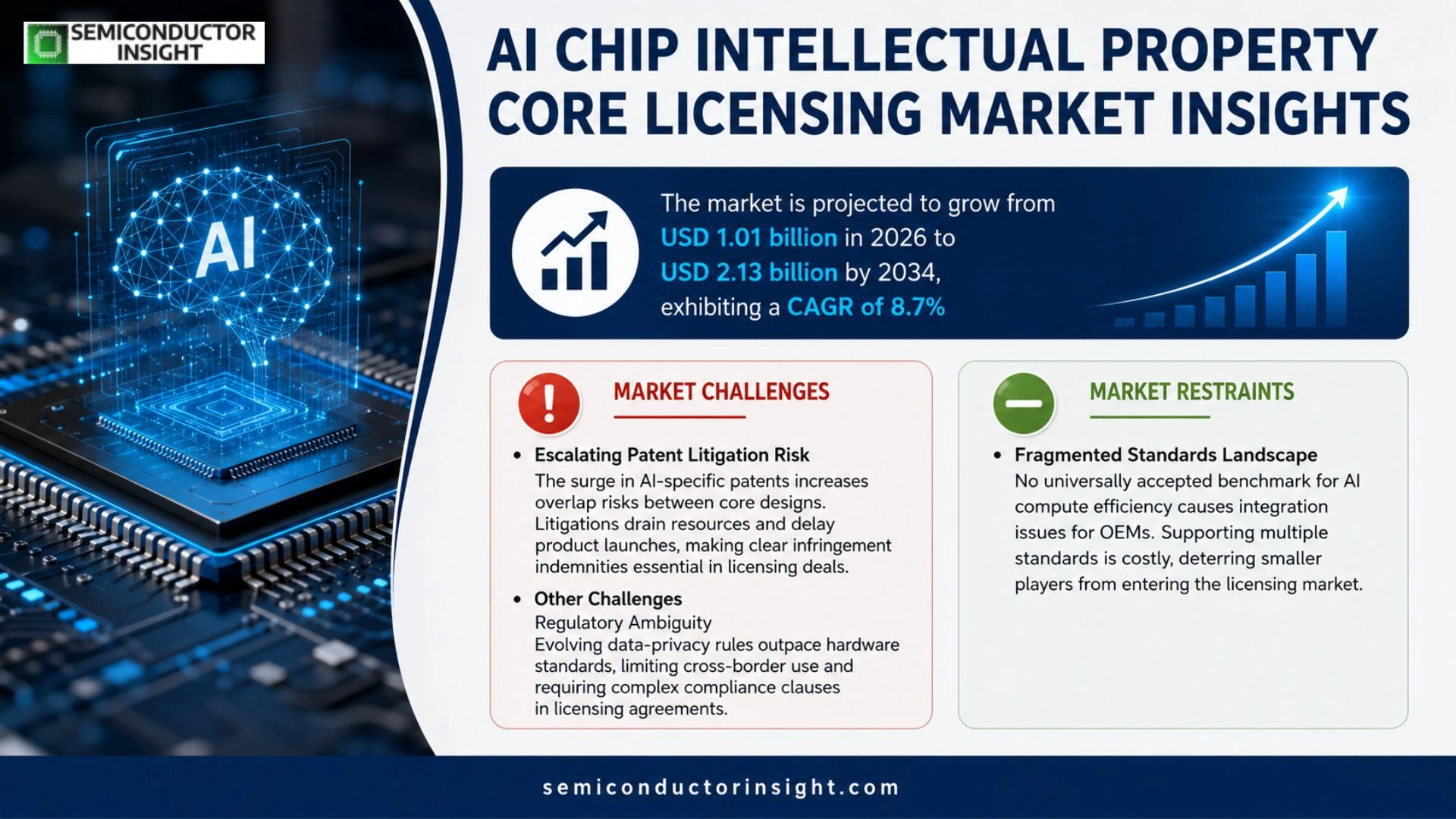
Global AI Chip Intellectual Property Core Licensing market size was valued at USD 0.92 billion in 2025. The market is projected to grow from USD 1.01 billion in 2026 to USD 2.13 billion by 2034, exhibiting a CAGR of 8.7% during the forecast period.
This segment covers the licensing of proprietary AI‑accelerator designs,such as tensor cores, neural‑network inference engines, and specialized matrix multipliers,enabling semiconductor firms or OEMs to embed proven AI functionality into custom silicon without developing core technology from scratch.
MARKET DRIVERS
Increasing Demand for Custom AI Acceleration
The surge in data‑intensive workloads has pushed semiconductor designers toward bespoke AI compute blocks. Companies that can embed proprietary algorithms directly into silicon gain a decisive performance edge, prompting a rapid uptick in core‑licensing agreements across AI Chip Intellectual Property Core Licensing Market. This shift is less about volume than about the strategic value of differentiation.
Convergence of Cloud and Edge Strategies
Enterprises are blurring the line between centralized cloud services and decentralized edge nodes. That hybrid posture requires licensing models that accommodate frequent updates and cross‑platform compatibility, encouraging IP owners to package modular cores that can be redeployed with minimal redesign. The business impact is a higher turnover of licensing contracts as customers iterate on firmware and AI models.
➤ Licensing velocity is becoming a competitive lever, reshaping how firms negotiate royalty structures and support services.
Because the underlying algorithms increasingly determine end‑product value, firms that secure robust IP portfolios can command premium terms, while newcomers must navigate a landscape where core ownership translates directly into market access.
MARKET CHALLENGES
Escalating Patent Litigation Risk
As the number of AI‑specific patents climbs, the probability of overlap between similar core designs rises sharply. Litigations not only drain cash reserves but also stall product rollouts, making risk‑assessment a central component of licensing negotiations. Companies therefore demand clearer infringement indemnities before committing to large‑scale purchases.
Other Challenges
Regulatory Ambiguity
Data‑privacy regulations are evolving at a pace that outstrips standard‑setting bodies for AI hardware. Uncertainty around cross‑border data handling can restrict the geographic reach of licensed cores, forcing licensors to embed compliance clauses that complicate contract terms.
MARKET RESTRAINTS
Fragmented Standards Landscape
The absence of a universally accepted benchmark for AI compute efficiency creates integration headaches for OEMs, who must reconcile disparate validation suites. This fragmentation discourages smaller players from entering the licensing arena, as the cost of supporting multiple standards can outweigh prospective revenue.
Limited Re‑use of Licensed IP
Many licensing agreements are tightly scoped to a single product line, preventing broader exploitation of the same core across multiple devices. This restriction reduces the overall addressable market for IP holders and hampers economies of scale that could otherwise lower royalty rates.
MARKET OPPORTUNITIES
Emerging Edge‑Compute Deployments
Edge servers deployed in factories, autonomous vehicles, and retail kiosks require low‑latency inference engines. Licensing firms that bundle lightweight, power‑efficient cores with streamlined update mechanisms stand to capture a sizeable share of this growing segment, especially as firms prioritize on‑device processing to reduce bandwidth costs.
AI‑Driven Design Automation Services
Automation platforms that generate custom AI cores based on workload profiles are gaining traction among chipmakers. By integrating licensing modules directly into these design tools, IP owners can monetize usage on a per‑generation basis, turning what was once a one‑off transaction into a recurring revenue stream.
AI Chip Intellectual Property Core Licensing Market Trends
Shift Toward Edge‑Optimized AI Core Licensing
Customers are increasingly demanding AI capabilities that run locally on devices ranging from industrial sensors to consumer wearables. By licensing proven tensor cores and inference engines, chip designers can embed sophisticated models without incurring the time‑intensive effort of developing silicon‑native AI blocks. This approach shortens time‑to‑market, reduces R&D risk, and aligns with the broader industry push to process data at the edge, where bandwidth constraints and latency considerations dominate design decisions.
Other Trends
Strategic Alliances Between Fabless Designers and IP Holders
Recent collaborations illustrate a pattern where fabless companies secure exclusive licensing agreements to differentiate their product portfolios. Such partnerships allow the IP holder to monetize mature designs while the licensee gains immediate access to validated performance characteristics. The result is a more granular segmentation of the AI chip ecosystem, where niche applications,from autonomous drones to smart metering,receive tailored accelerator blocks rather than generic solutions.
Emergence of Domain‑Specific AI Accelerators
Beyond generic inference engines, vendors are carving out market space with accelerators tuned for particular workloads such as computer vision, natural‑language processing, or reinforcement learning. Licensing these domain‑specific cores enables system integrators to achieve higher efficiency per watt, a critical metric for battery‑operated devices. The shift also spurs a secondary market for IP upgrades, where existing licensees can augment their silicon with new algorithmic primitives as model architectures evolve, thereby extending product lifecycles and protecting prior investments.
COMPETITIVE LANDSCAPE
Key Industry Players
AI Chip IP Core Licensing: Competitive Overview
The licensing arena is anchored by a handful of firms that have turned proprietary accelerator architectures into revenue‑generating assets. NVIDIA, with its tensor‑core portfolio, dominates the high‑performance data‑center segment; its licensing agreements allow fabless firms to embed GPU‑level inference capability while sidestepping costly silicon‑design cycles. Intel’s acquisition of Habana Labs has broadened its offering beyond general‑purpose CPUs, providing a suite of matrix‑multiply engines that are now available under a royalty‑based model to OEMs targeting edge and hyperscale workloads. These two vendors command the bulk of licensing volume, shaping pricing bands and setting technical benchmarks that smaller entrants must align with to remain competitive.
Beyond the market leaders, a diverse set of specialized players contributes depth and innovation. Qualcomm’s Cloud‑AI Core, ARM’s ML processor extensions, and Samsung’s NPU IP address mobile and consumer‑electronics use cases where power efficiency is paramount. Graphcore’s IP blocks focus on graph‑centric workloads, while Cerebras supplies massive matrix engines designed for training at scale. Emerging Chinese firms such as Cambricon and Huawei’s HiSilicon leverage domestic demand to offer region‑specific licensing deals. Pure‑play IP houses,including Synopsys, Cadence, and Mentor Graphics,provide verification and integration services that complement core licensing, making them indispensable partners for system‑level designers. This constellation of niche and regional players sustains a competitive ecosystem that pressures incumbents to broaden their portfolios and refine licensing terms.
List of Key AI Chip Intellectual Property Core Licensing Companies Profiled
- NVIDIA
- Intel
- Qualcomm
- ARM
- Samsung Electronics
- Cerebras Systems
- Graphcore
- Cambricon
- Huawei HiSilicon
- Synopsys
- Cadence Design Systems
- Mentor Graphics
- Mythic
- Google (TPU Licensing)
- TSMC
Segment Analysis:
| Segment Category | Sub-Segments | Key Insights |
| By Type |
|
General‑Purpose AI Chips
|
| By Application |
|
Data Center Acceleration
|
| By End User |
|
Semiconductor Foundries
|
| By Technology |
|
Tensor‑Core IP
|
| By Business Model |
|
Royalty‑Based Licensing
|
Regional Analysis: AI Chip Intellectual Property Core Licensing Market
Silicon Valley, Austin, and Boston host dense networks of AI chip designers and IP firms, fostering rapid knowledge exchange that accelerates licensing cycles and encourages collaborative development.
Venture capital remains heavily weighted toward companies that demonstrate a clear pathway to monetize licensed AI cores, pressuring licensors to maintain rigorous roadmaps and transparent performance metrics.
Enterprises across cloud, automotive, and IoT sectors demand plug‑and‑play AI kernels, driving licensors to simplify integration and provide robust support frameworks as part of their licensing terms.
U.S. IP statutes and recent policy initiatives reinforce protection for AI chip designs, reducing licensing risk and encouraging cross‑border technology transfer under clear legal terms.
Europe
Europe’s AI Chip Intellectual Property Core Licensing Market reflects a fragmented yet rapidly consolidating environment. Nations such as Germany and France invest heavily in research consortia that deliver specialized accelerator IP, while the United Kingdom’s fintech sector drives demand for low‑latency inference cores. Licensing activity is increasingly characterized by multi‑party agreements that blend academic patents with corporate designs, enabling European firms to compete on a global stage despite smaller domestic fabs. Regulatory harmonization across the EU, particularly around data sovereignty, influences how licenses are structured, often embedding clauses that address cross‑border data processing. The region’s emphasis on sustainability also pushes licensors to supply power‑efficient cores, aligning with corporate ESG goals and opening new revenue streams for environmentally focused IP providers.
Asia‑Pacific
Asia‑Pacific showcases a dynamic mix of emerging innovators and established manufacturers. China’s aggressive push for self‑reliance has accelerated domestic licensing programs, while Taiwan and South Korea leverage world‑class foundry capabilities to attract foreign IP. The market narrative here revolves around speed‑to‑market; firms prioritize licensing arrangements that shorten design cycles for consumer electronics, smart city infrastructure, and industrial automation. Cultural factors favor long‑term strategic partnerships over one‑off transactions, leading to bundled licensing models that include training, support, and co‑development clauses. Meanwhile, the region’s burgeoning startup ecosystem fuels a steady flow of niche AI kernels, prompting larger players to adopt flexible licensing tiers to capture emerging use‑cases.
South America
South America remains a growth frontier for AI chip licensing, with Brazil and Mexico leading pilot projects in agritech and renewable‑energy monitoring. Limited local fabrication capabilities shift the value proposition toward design‑time IP, where firms acquire proven cores to embed in region‑specific hardware. Licensing discussions often incorporate capacity‑building components, such as knowledge‑transfer workshops, to compensate for a nascent talent pool. While macro‑economic volatility poses challenges, governmental incentives aimed at digital transformation encourage investment in licensed AI solutions, positioning the region as a prospective testbed for cost‑effective, high‑impact deployments.
Middle East & Africa
In the Middle East & Africa, licensing activity is shaped by sovereign wealth funds and defense‑oriented programs that seek advanced AI compute capabilities. The United Arab Emirates and Saudi Arabia have launched ambitious national AI strategies, prompting local firms to secure core licenses that accelerate development of autonomous vehicles, surveillance platforms, and edge analytics. The scarcity of indigenous design houses creates a reliance on external IP, yet agreements increasingly embed joint‑venture clauses to foster local expertise. Additionally, the region’s focus on secure, resilient infrastructure drives licensors to prioritize hardened cores that meet stringent cybersecurity standards, thereby differentiating offerings in a competitive procurement landscape.
Report Scope
This market research report provides a comprehensive analysis of the AI Chip Intellectual Property Core Licensing Market , covering the forecast period 2026–2034. It offers detailed insights into market dynamics, technological advancements, competitive landscape, and key trends shaping the industry.
Key focus areas of the report include:
- Market Overview: The report begins with an overview outlining its current market scenario, key growth indicators, and industry transformation drivers. It discusses macroeconomic factors, demand–supply balance, regulatory landscape, and the strategic role of semiconductors in powering advancements across industries such as automotive, telecommunications, consumer electronics, and industrial automation.
- Market Size & Forecast: Historical data and future projections for revenue, unit shipments, and market value across major regions and segments.
- Segmentation Analysis: Detailed breakdown by product type, technology, application, and end-user industry to identify high-growth segments and investment opportunities.
- Regional Insights: Insights into market performance across North America, Europe, Asia-Pacific, Latin America, and the Middle East & Africa, including country-level analysis where relevant.
- Competitive Landscape: Profiles of leading market participants, including their product offerings, R&D focus, manufacturing capacity, pricing strategies, and recent developments such as mergers, acquisitions, and partnerships.
- Technology Trends & Innovation: Assessment of emerging technologies, integration of AI/IoT, semiconductor design trends, fabrication techniques, and evolving industry standards.
- Market Drivers & Restraints: Evaluation of factors driving market growth along with challenges, supply chain constraints, regulatory issues, and market-entry barriers.
- Stakeholder Insights: Insights for component suppliers, OEMs, system integrators, investors, and policymakers regarding the evolving ecosystem and strategic opportunities.
Primary and secondary research methods are employed, including interviews with industry experts, data from verified sources, and real-time market intelligence to ensure the accuracy and reliability of the insights presented.
FREQUENTLY ASKED QUESTIONS:
What is the current market size of AI Chip Intellectual Property Core Licensing Market?
-> AI Chip Intellectual Property Core Licensing market is projected to grow from USD 1.01 billion in 2026 to USD 2.13 billion by 2034, exhibiting a CAGR of 8.7%
Which key companies operate in AI Chip Intellectual Property Core Licensing Market?
-> Key players include Arm Ltd., NVIDIA Corporation, Intel Corporation, Qualcomm Technologies, Advanced Micro Devices (AMD), and Google (Alphabet Inc.), among others.
What are the key growth drivers?
-> Key growth drivers include surging demand for AI‑accelerated workloads, rapid expansion of edge computing, increasing investments in AI‑driven hardware startups, and the need for customizable AI cores to reduce time‑to‑market for semiconductor manufacturers.
Which region dominates the market?
-> North America currently holds the largest market share, while Asia‑Pacific is the fastest‑growing region driven by extensive semiconductor manufacturing and AI adoption.
What are the emerging trends?
-> Emerging trends include low‑power edge AI IP, integration of neuromorphic computing primitives, AI‑native security features, and modular AI accelerator platforms that enable rapid customization across diverse applications.

Get Sample Report PDF for Exclusive Insights
Report Sample Includes
- Table of Contents
- List of Tables & Figures
- Charts, Research Methodology, and more...
 Download Sample Report PDF