AI-Capable Phase-Locked Loop IP for High-Speed SerDes Market Insights
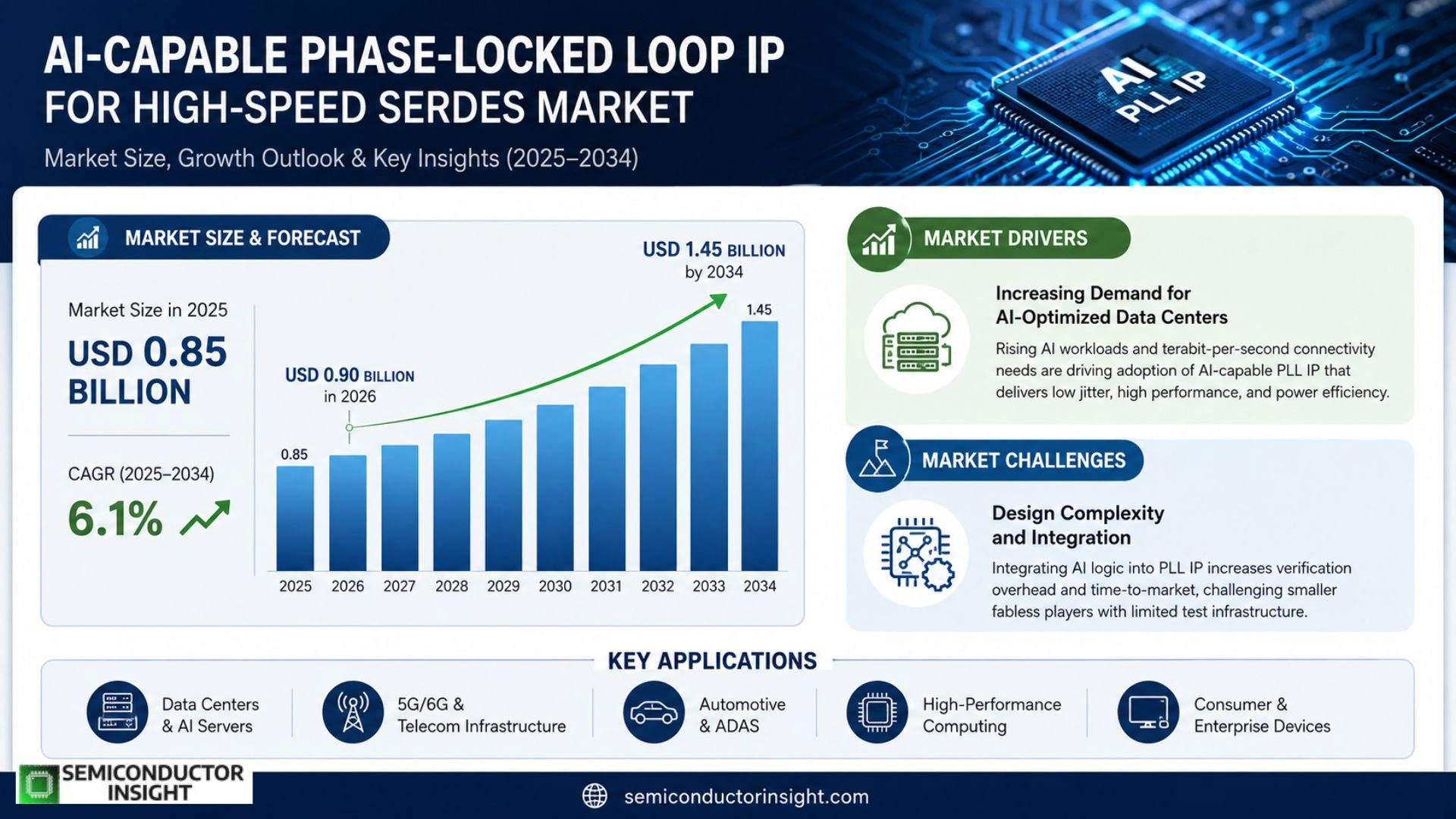
AI‑capable phase‑locked loop IP for high‑speed SerDes market size was valued at USD 0.85 billion in 2025. The market is projected to grow from USD 0.90 billion in 2026 to USD 1.45 billion by 2034, exhibiting a CAGR of 6.1% during the forecast period.
AI‑capable PLL IP provides adaptive frequency synthesis and jitter mitigation for serializer/deserializer links operating at multi‑hundred gigabit per second rates. By embedding machine‑learning algorithms within the control loop, the IP can continuously optimise charge pump current and divider ratios based on real‑time signal integrity metrics, thereby extending link reach and reducing power consumption.
The market is gaining momentum because data‑center interconnects, autonomous‑vehicle Ethernet and emerging AI accelerators demand ever higher lane speeds with tighter power envelopes. Moreover, design teams are turning to intelligent automation tools that shorten verification cycles for complex SerDes blocks. Recent announcements from major vendors,such as Intel’s integration of neural‑network‑tuned PLL cores into its Agilex FPGA family (April 2024) and Cadence’s launch of a machine‑learning‑enhanced PLL compiler (July 2024),illustrate how leading players are capitalising on this trend.
MARKET DRIVERS
Increasing Demand for AI-Optimized Data Centers
Data-center operators are retrofitting silicon to accommodate AI workloads that require tighter clock tolerance and lower jitter. AI‑Capable Phase-Locked Loop IP for High‑Speed SerDes Market suppliers that embed adaptive loop control see higher adoption because they enable servers to sustain terabit‑per‑second links without sacrificing power budgets. This shift is less about speculative hype and more about concrete carrier‑grade performance targets that customers now mandate.
Evolution of High‑Speed SerDes Interfaces
The migration from 56 Gb/s to 112 Gb/s lanes in optical transport equipment forces designers to rely on PLLs that can lock quickly across temperature swings. Vendors that combine machine‑learning‑based prediction models with traditional loop filters deliver faster lock‑times and reduced overshoot, giving them a competitive edge in board‑level integration projects.
➤ Analysts note that customers prioritize PLLs that can self‑tune in situ, because field‑upgrade cycles are becoming prohibitively expensive.
Combined, these forces create a feedback loop: higher data rates demand smarter PLLs, and smarter PLLs unlock new architectural choices for silicon vendors, thereby expanding the addressable market for AI‑enhanced timing solutions.
MARKET CHALLENGES
Design Complexity and Integration
Embedding AI logic inside PLL IP raises verification overhead dramatically. Engineers must validate both analog stability and neural‑network inference pathways, which often requires dual‑track simulation environments. The increased time‑to‑market can deter smaller fabless players that lack deep‑test infrastructure.
Other Challenges
Supply Chain Constraints
Foundry lead times for advanced nodes have stretched, limiting the volume of chips that can incorporate the latest AI‑augmented PLL blocks. This bottleneck pushes pricing upward and forces OEMs to prioritize legacy designs over innovative but risk‑ier alternatives.
MARKET RESTRAINTS
Regulatory and Power‑Efficiency Limits
Regulators in key regions are tightening power‑consumption standards for high‑frequency components. PLLs that rely on intensive AI inference can exceed these limits unless designers employ aggressive voltage‑scaling techniques, which in turn may compromise lock‑range robustness. The resulting trade‑off slows broader acceptance of AI‑enhanced timing blocks.
MARKET OPPORTUNITIES
Emerging Applications in Edge AI
Edge devices,ranging from autonomous‑vehicle sensors to 5G small cells,require sub‑nanosecond synchronization while operating under strict thermal envelopes. AI‑driven PLLs that can predict and compensate for on‑chip variations in real time become essential enablers. Companies that package these capabilities as IP cores stand to secure multi‑year contracts with system integrators seeking to differentiate their edge portfolios.
AI-Capable Phase-Locked Loop IP for High-Speed SerDes Market Trends
Adaptive Frequency Synthesis Gains Traction
Design houses are increasingly embedding machine‑learning algorithms inside the PLL control loop, allowing real‑time adjustment of charge‑pump current and divider ratios. This capability translates into tighter jitter budgets and longer link reach without raising power draw, a combination that directly addresses the pressure from multi‑hundred‑gigabit SerDes lanes. The shift from static, rule‑based PLL configurations to adaptive, data‑driven ones reflects a broader industry move toward self‑optimising silicon, where the IP can react to temperature swings, process variation, and channel loss on the fly. For customers, the payoff appears as reduced board‑level tuning effort and a clearer path to meeting aggressive latency targets in data‑center interconnects and autonomous‑vehicle Ethernet.
Other Trends
Intelligent Automation in Verification
The verification stage is benefiting from compiler‑level AI that predicts optimal PLL parameters before silicon is fabricated. Tools that analyse signal‑integrity metrics and propose divider settings cut iteration cycles by a noticeable margin, allowing design teams to allocate more resources to system‑level validation. Vendors that bundle these AI‑enhanced compilers with their IP portfolios are seeing higher adoption rates, because the bundled solution shortens time‑to‑market and lowers engineering overhead. The net effect is a more agile design flow where changes to lane speeds or power envelopes can be explored without extensive manual re‑calibration.
AI‑Enhanced PLLs Support Emerging Interconnects
Emerging standards for AI accelerators and high‑bandwidth memory demand SerDes lanes that operate beyond 200 Gb/s while staying within stringent energy envelopes. AI‑capable PLL IP addresses this requirement by providing predictive jitter suppression that adapts as traffic patterns evolve. Early integrations, such as the neural‑network‑tuned cores announced for a leading FPGA family in early 2024, demonstrate measurable power savings and improved eye‑diagram quality. As manufacturers of autonomous‑vehicle Ethernet and hyperscale data‑center switches adopt these specialised PLL blocks, the market is likely to see a consolidation around vendors that can deliver both the IP and the supporting AI‑driven design ecosystem. The broader implication is a faster rollout of next‑generation interconnects, where link reliability no longer hinges on conservative engineering margins but on intelligent, on‑chip adaptation.
COMPETITIVE LANDSCAPE
Key Industry Players
Competitive Overview of AI‑Enabled PLL IP for High‑Speed SerDes
The market, valued at roughly USD 0.85 billion in 2025, moved to USD 0.90 billion in 2026 and is anticipated to sit near USD 1.45 billion by 2034, reflecting an average annual increase of about six percent. Intel’s Agilex FPGA family now embeds neural‑network‑tuned PLL cores, giving it a clear advantage in data‑center and autonomous‑vehicle applications where lane rates push beyond several hundred gigabits per second. Cadence’s recent compiler, which layers machine‑learning inference on top of traditional loop‑filter design, has become a reference point for design houses seeking to shave verification cycles. Synopsys complements its broader silicon‑intelligence portfolio with a PLL IP block that automatically re‑optimises charge‑pump bias in response to real‑time jitter metrics, a capability that resonates with customers prioritising power‑efficiency. Meanwhile, AMD’s acquisition of Xilinx adds another strong contender, leveraging its extensive FPGA ecosystem to offer customizable AI‑aware PLL solutions. Larger analog and mixed‑signal vendors such as Texas Instruments, Analog Devices, and NXP also field PLL families enhanced with adaptive control loops, but their offerings tend to focus on integration with broader SoC platforms rather than the pure‑IP specialization seen among the leading FPGA and EDA players.
Beyond the headline names, a cluster of niche specialists is shaping the competitive texture of the segment. SiTime’s MEMS‑based timing devices have begun to incorporate predictive algorithms that pre‑empt jitter spikes, positioning the company as a credible challenger in ultra‑low‑latency interconnects. Ceva and Lattice Semiconductor supply lightweight PLL IP blocks targeting edge‑AI processors, where silicon real‑estate and power budgets are at a premium. Smaller firms such as Syntiant and Qorvo are experimenting with on‑chip learning engines that co‑process PLL diagnostics, hinting at a future where the control loop itself becomes a data source for system‑level AI functions. These players, while less prominent in absolute revenue, provide critical differentiation for OEMs that need highly tailored solutions without the overhead of large‑scale licensing agreements.
List of Key AI‑Capable Phase‑Locked Loop IP Companies Profiled
- Intel
- Cadence Design Systems
- Synopsys
- Analog Devices
- AMD (Xilinx)
- Texas Instruments
- NXP Semiconductors
- Renesas Electronics
- STMicroelectronics
- Microchip Technology
- Broadcom
- Marvell Technology Group
- SiTime
- Ceva
- Lattice Semiconductor
Segment Analysis:
| Segment Category | Sub-Segments | Key Insights |
| By Type |
|
AI‑enabled Adaptive PLLs
|
| By Application |
|
High‑Speed SerDes Enablement
|
| By End User |
|
Design‑Centric Adoption
|
| By Architecture |
|
Hybrid AI‑Driven Architecture
|
| By Market Trend |
|
Intelligent Design Ecosystem
|
Regional Analysis: AI-Capable Phase-Locked Loop IP for High-Speed SerDes Market
Device makers are co‑engineering AI‑enabled PLL cores with fabless providers, sharing silicon‑validation data to refine predictive algorithms. These alliances lower development risk and allow partners to tap specialized AI models that anticipate process variations, resulting in more robust SerDes interfaces. The collaborative roadmap also includes joint IP licensing terms that streamline integration across multiple product families.
EDA suites increasingly embed neural‑network assistants that automate PLL parameter extraction, minimizing manual tuning. Designers experience faster convergence on optimal loop bandwidth, which translates into shorter prototype cycles and earlier silicon qualification. Because the AI engine learns from prior designs, successive projects inherit refined models, steadily reducing the iterative effort required for high‑speed link calibration.
Manufacturers are mapping AI‑enhanced PLL IP dependencies to critical silicon suppliers, enabling contingency plans that activate alternate IP blocks should a foundry disruption occur. This foresight preserves product timelines for bandwidth‑intensive applications. By embedding adaptive fallback configurations, designers can shift between voltage‑frequency trade‑offs without redesign, insulating revenue streams from geopolitical or logistical shocks.
Standard‑setting bodies are referencing AI‑optimized PLL metrics when defining jitter limits for forthcoming communication protocols. Companies aligning their IP roadmaps with these emerging criteria gain early certification advantages, easing market entry for next‑gen SerDes products. The proactive engagement with standards committees also allows firms to propose AI‑based verification methodologies, shaping future compliance testing and reducing the overhead associated with manual measurement regimes.
Europe
Europe’s semiconductor landscape blends strong design houses with a policy framework that encourages energy‑efficient electronics. While the continent lags behind North America in AI‑centric IP volume, its emphasis on low‑power consumption drives interest in PLL blocks that can dynamically adjust loop parameters using lightweight neural inference. German and French chip designers are embedding such capabilities to meet the stringent EMC directives governing high‑speed data links. Meanwhile, the EU’s investment in AI research clusters feeds a pipeline of algorithms that can be licensed to IP vendors, fostering a collaborative ecosystem where academia and industry co‑create adaptive PLL solutions. The cumulative effect is a gradual shift toward smarter clocking primitives that satisfy both performance and sustainability targets.
Asia‑Pacific
Asia‑Pacific remains a hotbed of manufacturing capacity, and its client base increasingly demands AI‑enhanced PLL IP to stay competitive in mobile and networking segments. Japanese firms, long recognized for precision analog design, are integrating machine‑learning‑assisted phase‑detectors that improve lock‑time under process spread. In China, government incentives for AI‑driven semiconductor innovation encourage local startups to develop proprietary PLL cores that learn from field data, accelerating time‑to‑revenue for 5G infrastructure providers. South Korean players capitalize on tight vertical integration, embedding AI‑tuned PLLs directly into SoCs for high‑bandwidth memory interfaces. The regional push for autonomous vehicle platforms further amplifies the need for intelligent clock generators that can adapt in real‑time to temperature and voltage fluctuations.
South America
South America’s market is shaped by a growing demand for affordable high‑speed connectivity in both consumer and industrial sectors. Brazilian telecom operators are upgrading backbone networks, prompting domestic chip designers to adopt AI‑enabled PLL IP that offers cost‑effective jitter mitigation. The region’s limited access to cutting‑edge EDA tools drives partnerships with multinational vendors, enabling knowledge transfer and localized customization of AI models. Additionally, Argentine research institutes are contributing open‑source datasets that help train PLL prediction algorithms, fostering a collaborative environment despite constrained R&D budgets. These dynamics collectively nurture a nascent ecosystem where intelligent clock solutions are leveraged to bridge performance gaps without incurring prohibitive licensing fees.
Middle East & Africa
The Middle East & Africa exhibit a niche but rapidly evolving demand for AI‑capable PLL IP as data‑center projects and satellite constellations expand. United Arab Emirates initiatives to develop AI‑powered communication hubs rely on PLL blocks that can self‑optimize under harsh thermal conditions, ensuring reliable high‑frequency operation. African telecom rollouts, particularly in Kenya and Nigeria, prioritize robust SerDes links that can tolerate power‑grid instability, making adaptive PLL algorithms attractive. Local system integrators often engage in joint development agreements with IP providers, allowing them to embed region‑specific AI training data that reflects unique environmental profiles. This tailored approach positions the region to extract maximum performance from limited silicon resources while supporting ambitious connectivity goals.
Report Scope
This market research report provides a comprehensive analysis of the AI-Capable Phase-Locked Loop IP for High-Speed SerDes Market , covering the forecast period 2026–2034. It offers detailed insights into market dynamics, technological advancements, competitive landscape, and key trends shaping the industry.
Key focus areas of the report include:
- Market Overview: The report begins with an overview outlining its current market scenario, key growth indicators, and industry transformation drivers. It discusses macroeconomic factors, demand–supply balance, regulatory landscape, and the strategic role of semiconductors in powering advancements across industries such as automotive, telecommunications, consumer electronics, and industrial automation.
- Market Size & Forecast: Historical data and future projections for revenue, unit shipments, and market value across major regions and segments.
- Segmentation Analysis: Detailed breakdown by product type, technology, application, and end-user industry to identify high-growth segments and investment opportunities.
- Regional Insights: Insights into market performance across North America, Europe, Asia-Pacific, Latin America, and the Middle East & Africa, including country-level analysis where relevant.
- Competitive Landscape: Profiles of leading market participants, including their product offerings, R&D focus, manufacturing capacity, pricing strategies, and recent developments such as mergers, acquisitions, and partnerships.
- Technology Trends & Innovation: Assessment of emerging technologies, integration of AI/IoT, semiconductor design trends, fabrication techniques, and evolving industry standards.
- Market Drivers & Restraints: Evaluation of factors driving market growth along with challenges, supply chain constraints, regulatory issues, and market-entry barriers.
- Stakeholder Insights: Insights for component suppliers, OEMs, system integrators, investors, and policymakers regarding the evolving ecosystem and strategic opportunities.
Primary and secondary research methods are employed, including interviews with industry experts, data from verified sources, and real-time market intelligence to ensure the accuracy and reliability of the insights presented.
FREQUENTLY ASKED QUESTIONS:
What is the current market size of AI-Capable Phase-Locked Loop IP for High-Speed SerDes Market?
-> AI‑capable phase‑locked loop IP for high‑speed SerDes market size is projected to grow from USD 0.90 billion in 2026 to USD 1.45 billion by 2034.
Which key companies operate in AI-Capable Phase-Locked Loop IP for High-Speed SerDes Market?
-> Key players include Intel, Cadence Design Systems, Synopsys, and Xilinx, among others.
What are the key growth drivers?
-> Key growth drivers include rising data‑center interconnect demand, autonomous‑vehicle Ethernet requirements, and the adoption of AI accelerators that need higher‑speed SerDes links.
Which region dominates the market?
-> North America holds the largest market share, while Asia‑Pacific exhibits the fastest growth rate.
What are the emerging trends?
-> Emerging trends include machine‑learning‑enhanced PLL control loops, adaptive jitter mitigation techniques, and AI‑driven compiler tools for faster SerDes verification.
Get Sample Report PDF for Exclusive Insights
Report Sample Includes
- Table of Contents
- List of Tables & Figures
- Charts, Research Methodology, and more...
 Download Sample Report PDF