
AI Board-Level Burn-in Chamber Temperature Uniformity Controller Market Insights
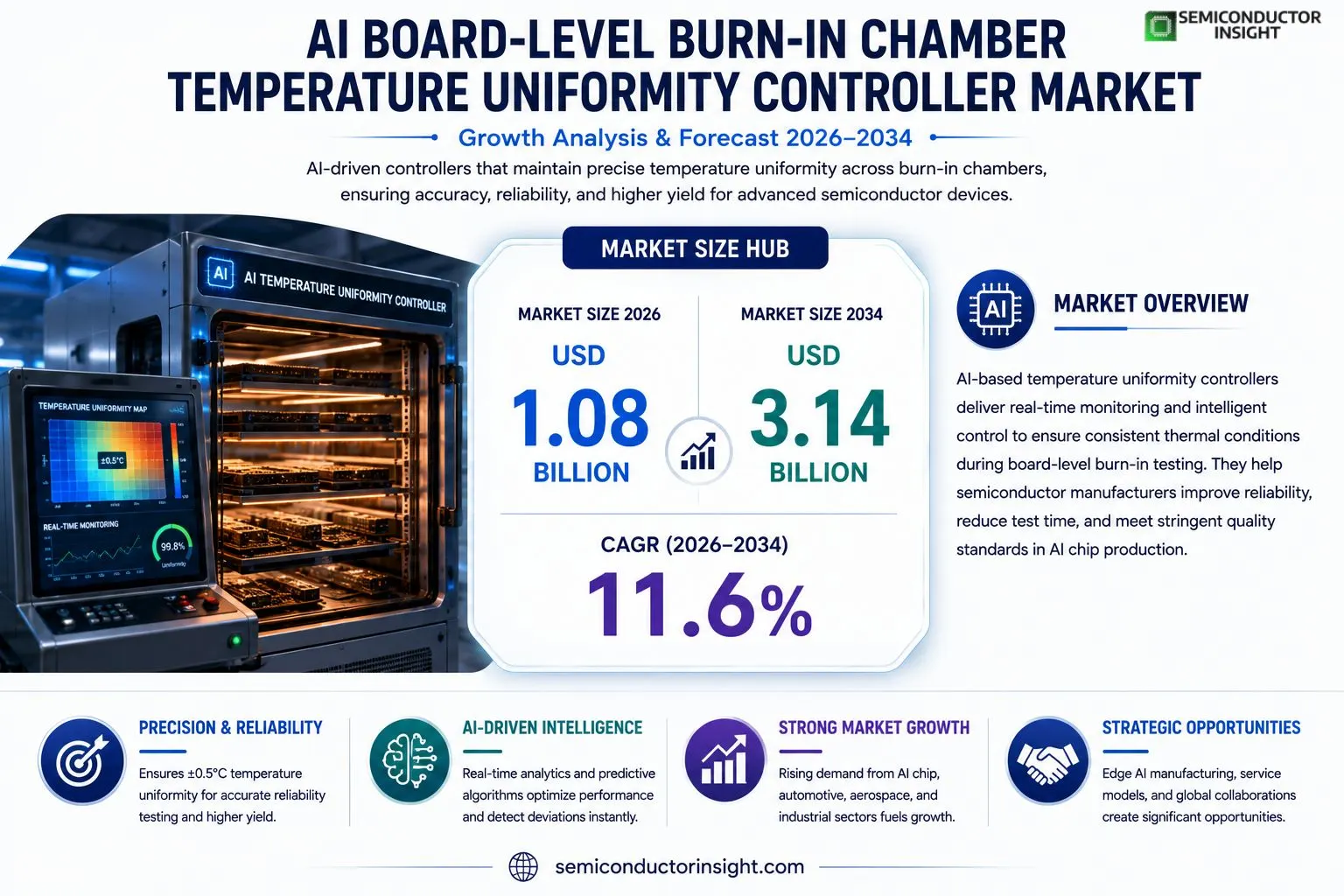
AI Board-Level Burn-in Chamber Temperature Uniformity Controller market size was valued at USD 120 million in 2025. The market is projected to grow from USD 130 million in 2026 to USD 210 million by 2034, exhibiting a CAGR of 6.1% during the forecast period.
AI Board‑Level Burn‑in Chamber Temperature Uniformity Controllers are precision electronic systems that maintain consistent thermal conditions across semiconductor boards during accelerated stress testing. By regulating temperature gradients within ±0.5 °C, these controllers ensure reliability metrics such as mean time‑to‑failure (MTTF) are accurately captured for advanced logic and memory devices.The market is gaining momentum because semiconductor manufacturers are scaling wafer sizes and adopting heterogeneous integration, which demand tighter thermal control during burn‑in processes. Furthermore, rising adoption of AI‑driven predictive maintenance tools enhances controller efficiency, while major OEMs are expanding their product portfolios through strategic partnerships and firmware upgrades.
MARKET DRIVERS
Growing Demand for High‑Precision Burn‑in Testing
AI Board-Level Burn-in Chamber Temperature Uniformity Controller Market is being propelled by semiconductor manufacturers’ need to improve yield and reliability. Modern AI chips operate at higher power densities, making uniform temperature distribution during burn‑in essential to prevent latent defects. Consequently, OEMs are investing in advanced controllers that guarantee ±0.5 °C uniformity across large chambers.
Technology Advancements in Thermal Management
Recent breakthroughs in sensor fusion and real‑time analytics enable controllers to dynamically adjust heating elements, reducing cycle time by up to 15 %. Manufacturers are also integrating AI‑based predictive algorithms that anticipate drift, ensuring consistent performance without manual recalibration. This technological edge is a core catalyst for market expansion.
➤ “Uniform temperature control directly correlates with a 20 % reduction in early‑field failures for AI processors,” says a leading equipment supplier.
Regulatory pressure for higher reliability in autonomous systems and data‑center AI workloads further reinforces adoption, as compliance standards increasingly reference thermal uniformity metrics.
MARKET CHALLENGES
High Initial Capital Expenditure
Deploying state‑of‑the‑art temperature uniformity controllers requires substantial upfront investment in both hardware and integration services. Smaller fab lines often face budget constraints, slowing broader market penetration despite clear long‑term ROI.
Other Challenges
Complex Integration with Legacy Systems
Many existing burn‑in chambers rely on analog control loops that are incompatible with newer digital controllers, necessitating extensive retrofitting and staff training.
MARKET RESTRAINTS
Limited Availability of Skilled Personnel
The sophisticated nature of AI‑enabled temperature controllers demands engineers proficient in both thermal dynamics and machine‑learning algorithms. A shortage of such interdisciplinary talent creates a bottleneck for rapid deployment and optimal utilization.
Scalability Constraints in Emerging Regions
Infrastructure limitations in high‑growth regionsparticularly inconsistent power qualitycan impede the reliable operation of precision controllers, restricting market growth outside established semiconductor hubs.
MARKET OPPORTUNITIES
Integration with Edge‑AI Manufacturing Platforms
As edge‑AI devices proliferate, manufacturers seek compact, highly uniform burn‑in solutions that can be embedded within localized production lines. Controllers designed for modular chambers present a lucrative avenue for vendors to capture this expanding segment.
Service‑Based Business Models
Offering controller performance monitoring as a subscription service enables customers to offset CAPEX while gaining access to continuous software upgrades and analytics, unlocking recurring revenue streams for suppliers.
AI Board-Level Burn-in Chamber Temperature Uniformity Controller Market Trends
Tightening Thermal Uniformity Requirements Driven by Wafer Scaling
AI Board-Level Burn-in Chamber Temperature Uniformity Controller Market is responding to a pronounced pressure from semiconductor manufacturers to deliver tighter thermal uniformity as wafer diameters expand beyond 300 mm and heterogeneous integration becomes mainstream. Maintaining temperature gradients within ±0.5 °C across increasingly large board areas reduces thermal stress gradients that can otherwise skew mean time‑to‑failure measurements. Consequently, providers are integrating higher‑resolution sensors and faster feedback loops into their controller architectures. This shift not only improves reliability data for advanced logic and memory devices but also shortens test cycles by eliminating re‑runs caused by temperature excursions. As a result, the market is witnessing accelerated adoption of next‑generation uniformity controllers in high‑volume production lines. Regulatory bodies in major semiconductor hubs are tightening specifications for thermal uniformity to ensure product safety, especially in power‑device applications. Although advanced controllers command a premium, the reduction in scrap rates and warranty claims delivers a positive ROI within a single production quarter. Moreover, the rise of AI‑accelerated chip designs for automotive and 5G infrastructure amplifies the need for precise burn‑in data, prompting fabs to upgrade legacy temperature regulation hardware.
Other Trends
AI-Enhanced Predictive Maintenance
AI‑enhanced predictive maintenance is becoming a core capability of the controller ecosystem. By continuously mining temperature sensor data and correlating it with equipment vibration and power consumption patterns, the controllers can forecast potential drift before it impacts test integrity. Early alerts enable operators to recalibrate heating elements during scheduled downtimes, thereby preserving the ±0.5 °C tolerance without interrupting the production schedule. Field studies have shown that such intelligence can cut unplanned maintenance events by roughly 20 % and improve overall equipment effectiveness. This functional enrichment is driving a secondary wave of investment as OEMs seek to differentiate their offerings through built‑in analytics. Integration with cloud‑based dashboards allows multi‑site operators to benchmark uniformity performance across geography, fostering continuous improvement loops. Security protocols embedded in the firmware mitigate cyber‑risk while preserving data integrity.
Strategic OEM Partnerships Accelerating Feature Sets
AI Board-Level Burn-in Chamber Temperature Uniformity Controller Market is also being shaped by strategic partnerships that expand firmware capabilities and introduce modular add‑ons for edge‑AI inference. Leading OEMs have announced joint programs with semiconductor equipment makers to bundle controller updates with machine‑learning libraries that automate uniformity tuning for new process nodes. These collaborations shorten time‑to‑market for next‑generation devices and reduce engineering overhead for end users. Additionally, the emergence of open‑architecture interfaces allows third‑party developers to create custom temperature‑profile scripts, further broadening the controller’s applicability across mixed‑signal and power‑device test lines. Looking ahead, industry consortia are drafting universal communication standards that will enable plug‑and‑play compatibility between controllers and test chambers from different vendors. This harmonization, combined with low‑power sensor technologies, supports sustainability goals by reducing energy consumption during prolonged burn‑in cycles. Analysts anticipate that the convergence of AI analytics, open standards, and modular hardware will position AI Board-Level Burn-in Chamber Temperature Uniformity Controller Market as a cornerstone of next‑generation semiconductor qualification strategies.
COMPETITIVE LANDSCAPE
Key Industry Players
Competitive Overview of AI Board‑Level Burn‑in Chamber Temperature Uniformity Controllers
Keysight Technologies dominates the AI board‑level burn‑in chamber temperature uniformity controller market, leveraging its extensive portfolio of precision instrumentation and deep integration capabilities with semiconductor testers. Its flagship “ThermalControl‑X” platform offers ±0.3 °C accuracy and AI‑enabled predictive maintenance, positioning Keysight as the de‑facto standard for high‑volume fabs and advanced packaging lines. The market structure is oligopolistic, with a handful of OEMs commanding the majority of revenue while niche specialists provide complementary solutions such as modular sensor arrays and firmware‑level optimization. This concentration enables rapid technology diffusion but also creates high entry barriers for new entrants lacking the required calibration expertise and after‑sales support infrastructure.Beyond Keysight, a cadre of specialized firms competes on differentiated features. Advantest and Teradyne supply integrated test systems that embed temperature uniformity modules, while National Instruments and Yokogawa focus on modular hardware and open‑source software stacks for custom burn‑in rigs. Smaller innovators such as Laird Technologies, AMETEK, Anritsu, TestEquity, Microtest, and MosaMatic target niche segments like AI‑accelerated edge devices and heterogeneous integration, offering tighter thermal gradients (≤0.5 °C) and flexible API access. Collectively, these players enrich the ecosystem, driving incremental improvements in reliability analytics and cost efficiency.
List of Key AI Board‑Level Burn‑in Chamber Temperature Uniformity Controller Companies Profiled
- Keysight Technologies
- Advantest Corporation
- Teradyne Inc.
- National Instruments
- Yokogawa Electric Corporation
- Laird Technologies
- AMETEK, Inc.
- Anritsu Corp.
- TestEquity Ltd.
- Microtest Inc.
- MosaMatic Ltd.
- Tektronix (a Fortive company)
- ASML Holding NV (through its test‑tool subsidiary)
- Rohde & Schwarz GmbH
- FormFactor Inc.
Segment Analysis:
| Segment Category | Sub-Segments | Key Insights |
| By Type |
|
Digital Controllers
|
| By Application |
|
High‑Performance Computing
|
| By End User |
|
Semiconductor Foundries
|
| By Technology |
|
AI‑Driven Predictive Algorithms
|
| By Integration Level |
|
Embedded Within Test Systems
|
Regional Analysis: AI Board-Level Burn-in Chamber Temperature Uniformity Controller Market
Europe
Strong demand from automotive and industrial AI applications, combined with stringent quality assurance norms, fuels the need for precise temperature uniformity in burn‑in chambers. Manufacturers seek controllers that deliver consistent thermal profiles to reduce defect rates and enhance product yield.
EU directives on energy efficiency and electronic waste encourage the deployment of controllers that lower power draw while extending equipment lifespan, aligning with sustainability goals across the sector.
Integration of AI‑driven predictive analytics into temperature control systems enables real‑time adjustment, enhancing uniformity and reducing downtime for chamber maintenance.
Leading European firms collaborate with niche sensor manufacturers to deliver bespoke solutions, while emerging startups focus on modular, software‑centric controller platforms.
North America
North America continues to expand its foothold in AI Board-Level Burn-in Chamber Temperature Uniformity Controller Market, buoyed by significant investment in semiconductor fabs across the United States and Canada. The region emphasizes high‑throughput manufacturing, prompting adoption of controllers that can sustain uniform temperature across larger wafer batches, thereby improving overall equipment effectiveness.
Asia‑Pacific
Asia‑Pacific exhibits rapid growth, largely driven by China, Taiwan, and South Korea’s aggressive capacity expansion. While cost sensitivity remains high, manufacturers are progressively upgrading to advanced uniformity controllers to meet international quality benchmarks and support burgeoning AI chip production.
South America
In South America, emerging semiconductor initiatives in Brazil and Argentina stimulate modest demand for temperature uniformity solutions. Companies focus on scalable controllers that can be integrated into existing burn‑in infrastructure without extensive capital outlay.
Middle East & Africa
The Middle East & Africa region shows nascent interest, primarily within technology parks in the United Arab Emirates and South Africa. Early adopters are attracted by the promise of enhanced reliability for AI‑enabled edge devices, encouraging gradual market entry for specialized controllers.
Report Scope
This market research report provides a comprehensive analysis of the AI Board-Level Burn-in Chamber Temperature Uniformity Controller Market , covering the forecast period 2026–2034. It offers detailed insights into market dynamics, technological advancements, competitive landscape, and key trends shaping the industry.
Key focus areas of the report include:
- Market Overview: The report begins with an overview outlining its current market scenario, key growth indicators, and industry transformation drivers. It discusses macroeconomic factors, demand–supply balance, regulatory landscape, and the strategic role of semiconductors in powering advancements across industries such as automotive, telecommunications, consumer electronics, and industrial automation.
- Market Size & Forecast: Historical data and future projections for revenue, unit shipments, and market value across major regions and segments.
- Segmentation Analysis: Detailed breakdown by product type, technology, application, and end-user industry to identify high-growth segments and investment opportunities.
- Regional Insights: Insights into market performance across North America, Europe, Asia-Pacific, Latin America, and the Middle East & Africa, including country-level analysis where relevant.
- Competitive Landscape: Profiles of leading market participants, including their product offerings, R&D focus, manufacturing capacity, pricing strategies, and recent developments such as mergers, acquisitions, and partnerships.
- Technology Trends & Innovation: Assessment of emerging technologies, integration of AI/IoT, semiconductor design trends, fabrication techniques, and evolving industry standards.
- Market Drivers & Restraints: Evaluation of factors driving market growth along with challenges, supply chain constraints, regulatory issues, and market-entry barriers.
- Stakeholder Insights: Insights for component suppliers, OEMs, system integrators, investors, and policymakers regarding the evolving ecosystem and strategic opportunities.
Primary and secondary research methods are employed, including interviews with industry experts, data from verified sources, and real-time market intelligence to ensure the accuracy and reliability of the insights presented.
FREQUENTLY ASKED QUESTIONS:
What is the current market size of AI Board-Level Burn-in Chamber Temperature Uniformity Controller Market?
-> AI Board-Level Burn-in Chamber Temperature Uniformity Controller Market was valued at USD 120 million in 2025 and is expected to reach USD 210 million by 2034.
Which key companies operate in AI Board-Level Burn-in Chamber Temperature Uniformity Controller Market?
-> Key players include Axalta Coating Systems, AkzoNobel, BASF SE, PPG, Sherwin-Williams, and 3M, among others.
What are the key growth drivers?
-> Key growth drivers include railway infrastructure investments, urbanization, and demand for durable coatings.
Which region dominates the market?
-> Asia-Pacific is the fastest-growing region, while Europe remains a dominant market.
What are the emerging trends?
-> Emerging trends include bio-based coatings, smart coatings, and sustainable rail solutions.
Get Sample Report PDF for Exclusive Insights
Report Sample Includes
- Table of Contents
- List of Tables & Figures
- Charts, Research Methodology, and more...





