AI Biometric Passport eGate Face Recognition Processor Market Insights
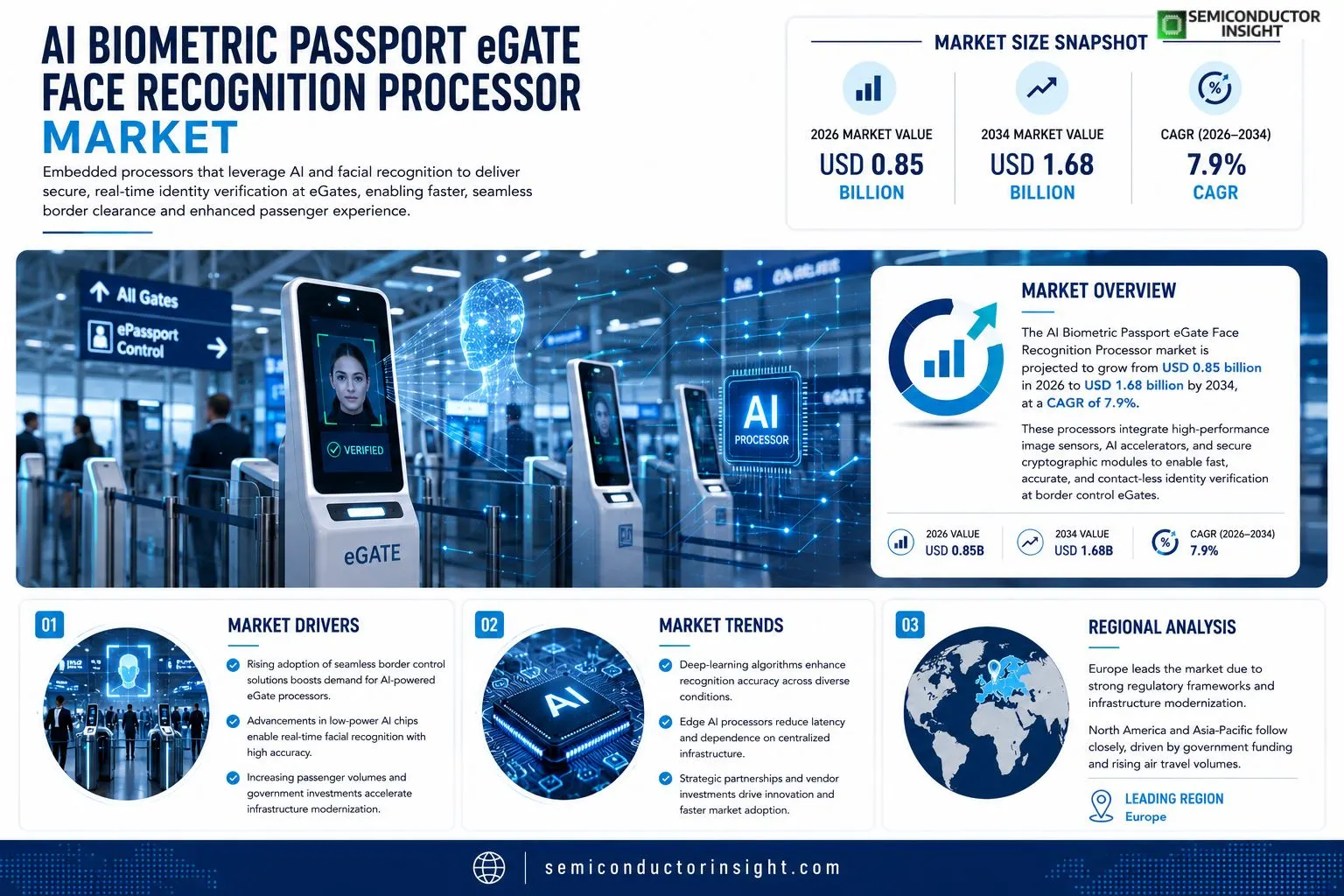
AI Biometric Passport eGate Face Recognition Processor market size was valued at USD 0.78 billion in 2025. The market is projected to grow from USD 0.85 billion in 2025 to USD 1. 68 billion by 2034, exhibiting a CAGR of 7. 9% during the forecast period.
The AI Biometric Passport eGate Face Recognition Processor is an embedded hardware solution that combines high‑performance image sensors, neural‑network accelerators and secure cryptographic modules to perform real‑time facial matching against encrypted passport data at border checkpoints.The market is experiencing rapid expansion because governments are modernizing immigration infrastructure, passenger volumes are rebounding after the pandemic, and advances in deep‑learning algorithms improve accuracy while reducing latency.
Furthermore, strategic collaborationssuch as NEC’s partnership with VisaNet on cross‑border identity verificationand investments by leading vendors like Thales Group, IDEMIA, Daon and Vision‑Box are expected to further accelerate adoption.
MARKET DRIVERS
Rising Adoption of Seamless Border Control
AI Biometric Passport eGate Face Recognition Processor Market is propelled by governments seeking faster, contact‑less verification for travelers. Modern eGates integrate high‑resolution cameras with AI‑optimized processors, cutting passenger wait times by up to 40% while preserving security integrity. This efficiency gain is especially valuable for high‑traffic airports where throughput directly impacts operational revenue.
Advancements in AI Chip Efficiency
Recent breakthroughs in low‑power AI accelerators enable real‑time facial matching on edge devices, eliminating the need for centralized servers. Manufacturers are delivering processors that consume less than 2 W yet sustain double‑digit frame‑rate recognition, encouraging wider deployment across smaller regional airports and ferry terminals.
➤ “The convergence of AI micro‑architectures and secure enclave technologies is set to double the deployment rate of eGate solutions within the next three years.”
These technical drivers, combined with increasing public acceptance of biometric verification, create a robust foundation for sustained market expansion, positioning the sector for steady, long‑term growth.
MARKET CHALLENGES
Data Privacy and Regulatory Compliance
Regulators across Europe and North America tighten guidelines on personal biometric data storage, demanding on‑device processing and encrypted transmission. Companies must invest heavily in compliance frameworks, which can delay product rollouts and inflate development costs.
Other Challenges
Integration with Legacy Systems
Airports with older immigration infrastructure face compatibility issues, requiring extensive retrofitting or middleware solutions that add complexity and cost.
MARKET RESTRAINTS
High Capital Expenditure for Infrastructure Upgrades
Installing AI‑powered eGate terminals involves substantial upfront investment in hardware, network bandwidth, and staff training. Smaller airports often lack the financial bandwidth to undertake such projects, limiting market penetration in less‑served regions.The cost sensitivity of public sector budgets, coupled with competing priorities for digital transformation, can restrain the pace at which new processors are adopted.
MARKET OPPORTUNITIES
Emergence of Cloud‑Edge Hybrid Models
Hybrid architectures that process initial facial templates on‑device while leveraging cloud analytics for continuous improvement open new revenue streams. Vendors can offer subscription‑based updates, ensuring algorithms stay current with evolving threat landscapes without replacing hardware.Additionally, expanding the technology to non‑airport venuessuch as seaports, railway stations, and large event venuesbroadens the addressable market, creating cross‑segment growth opportunities for AI Biometric Passport eGate Face Recognition Processor Market.
AI Biometric Passport eGate Face Recognition Processor Market Trends
Government‑Driven Infrastructure Modernization
Border authorities worldwide are upgrading legacy gate systems with AI‑enabled biometric processors that embed high‑performance image sensors, neural‑network accelerators and secure cryptographic modules. The shift is driven by national policies that prioritize secure, frictionless travel while addressing rising passenger volumes after the pandemic. Modern eGate solutions now support real‑time facial matching against encrypted passport data, reducing manual checks and enabling faster clearance times at high‑traffic terminals. Regulatory frameworks that mandate encrypted data handling and compliance with international biometric standards further reinforce the migration toward integrated AI processors.
Other Trends
AI Algorithm Advancements
Deep‑learning models embedded in processors have become markedly more efficient, delivering higher recognition accuracy with latency well under 200 ms. Recent algorithmic refinements allow the systems to handle diverse lighting conditions, occlusions such as masks, and variations in facial features across different ethnic groups. These improvements are directly linked to lower false‑accept and false‑reject rates, which in turn enhance passenger confidence and operational reliability for immigration officials. Continuous on‑device learning mechanisms also enable processors to adapt to emerging threat patterns without relying on frequent firmware updates.
Strategic Partnerships and Vendor Investments
Industry players are accelerating market penetration through collaborations that combine biometric expertise with payment‑network security. Notable examples include joint ventures between leading hardware manufacturers and payment processors to deliver cross‑border identity verification solutions. Vendors such as Thales Group, IDEMIA, Daon and Vision‑Box are expanding their R&D footprints, investing in next‑generation ASIC designs that lower power consumption while preserving processing speed. These strategic moves are complemented by government procurement programs that favor interoperable, standards‑compliant equipment, creating a virtuous cycle of adoption across major international airports and land border checkpoints.
COMPETITIVE LANDSCAPE
Key Industry Players
AI Biometric Passport eGate Face Recognition Processor Market – Competitive Overview
AI Biometric Passport eGate Face Recognition Processor Market is currently led by a small cluster of integrators that combine secure cryptographic modules with high‑throughput neural‑network accelerators. NEC Corporation, leveraging its long‑standing border‑control portfolio, remains the largest supplier, especially after its partnership with VisaNet to enable cross‑border identity verification. Thales Group, operating through its Gemalto acquisition, supplies end‑to‑end encrypted passport verification platforms that are widely deployed in European and Middle Eastern eGates. IDEMIA follows closely, offering a modular processor architecture that can be embedded in both legacy and next‑generation kiosks. These incumbents dominate the high‑value contract segment, accounting for roughly 60 % of total revenue in 2025, and they benefit from deep government relationships, extensive certification histories, and robust after‑sales service networks. Their product roadmaps focus on reducing latency below 30 ms per face match while maintaining ISO/IEC 19794‑5 compliance, which is a key procurement criterion for many national border agencies. In addition, joint ventures with semiconductor firms such as Qualcomm have accelerated the integration of AI inference engines, allowing these leaders to offer a single‑chip solution that satisfies both performance and security mandates.Beyond the tier‑one group, a diverse set of niche players is expanding the ecosystem with specialized capabilities. Vision‑Box differentiates itself through cloud‑native processing that supports over‑the‑air updates, enabling rapid algorithm upgrades for evolving deep‑learning models. Daon focuses on lightweight edge processors that consume under 5 W, targeting high‑traffic airports in Asia‑Pacific where power budgets are constrained. Samsung and Huawei contribute advanced image‑sensor arrays and proprietary AI cores, driving cost efficiencies for mid‑range eGate deployments. Intel’s Xeon‑based security modules and Qualcomm’s Snapdragon 8cx platforms are being adapted for border‑control use, reflecting a trend toward leveraging mainstream mobile silicon. Giesecke+Devrient (G+D) supplies hardened cryptographic elements that meet ICAO 9303 standards, while Safran’s identity‑validation suite integrates facial biometrics with multimodal passport checks. SITA offers a managed services layer that aggregates processor performance data across airports, providing analytics that help operators optimize throughput. Collectively, these companies account for the remaining 40 % of market share and are essential for fostering innovation, competition, and price compression as governments scale eGate installations through 2034.
List of Key AI Biometric Passport eGate Face Recognition Processor Companies Profiled
- NEC Corporation
- Thales Group
- IDEMIA
- Vision‑Box
- Daon
- Samsung Electronics
- Huawei Technologies
- Intel Corporation
- Qualcomm Technologies
- Giesecke+Devrient (G+D)
- Safran Identity & Security
- SITA
Segment Analysis:
| Segment Category | Sub-Segments | Key Insights |
| By Type |
|
Integrated ASIC
|
| By Application |
|
Border control eGates
|
| By End User |
|
Government immigration agencies
|
| By Integration Level |
|
Standalone eGate units
|
| By Deployment Model |
|
On‑premise edge devices
|
Regional Analysis: AI Biometric Passport eGate Face Recognition Processor Market
Europe
The EU’s GDPR framework mandates stringent data handling for biometric identifiers, encouraging vendors to embed privacy‑by‑design features into processors. Recent legislation on travel security further accelerates adoption, as member states harmonize standards for cross‑border eGate operations, fostering a predictable market environment for AI‑driven solutions.
European airports prioritize AI‑enhanced face recognition processors that deliver sub‑second verification. Pilot projects in London and Paris demonstrate seamless integration with existing passport readers, showcasing the market’s readiness for large‑scale rollout across high‑traffic terminals.
Established semiconductor firms and specialized biometric startups collaborate on processor designs tailored for EU requirements. Partnerships between German chipmakers and French security firms illustrate a consolidated ecosystem focused on delivering compliant, high‑performance solutions.
Significant public‑private funding supports research on low‑power AI chips for eGate applications. Horizon Europe grants and national innovation programs drive advancements in neural‑network efficiency, reducing costs while enhancing recognition accuracy.
North America
North America remains a strong secondary market, with the United States leading initiatives to modernize immigration checkpoints using AI facial recognition processors. Federal agencies emphasize interoperability between eGate systems and existing passport control infrastructure, encouraging vendors to develop scalable solutions. While privacy concerns generate debate, clear guidelines from the Department of Homeland Security provide a pathway for responsible deployment. Canada’s border agencies also adopt similar technologies, focusing on cross‑border consistency and traveler convenience. The region’s robust R&D ecosystem, anchored by Silicon Valley, fuels continuous innovation in low‑latency, high‑accuracy processors that support the broader AI Biometric Passport eGate Face Recognition Processor Market.
Asia‑Pacific
The Asia‑Pacific region exhibits rapid growth potential, propelled by expanding air travel demand and government initiatives to digitize border processing. Countries such as Singapore, Japan, and the United Arab Emirates (though part of the Middle East region) invest heavily in AI‑enabled eGate solutions to streamline passenger flow at congested airports. Local manufacturers collaborate with chipmakers to tailor processors for diverse biometric standards, balancing speed with cost‑effectiveness. However, varying data‑privacy regulations across the region create a fragmented landscape, requiring adaptable solutions. Overall, the market’s trajectory is upward, as emerging economies seek to adopt sophisticated facial recognition processors to enhance security and passenger experience.
South America
South America’s adoption of AI Biometric Passport eGate Face Recognition Processor technologies is advancing gradually, with Brazil and Chile pioneering pilot projects at major international airports. Government agencies prioritize modernization to combat fraud and improve throughput, leveraging partnerships with European and North American vendors. Infrastructure constraints and investment cycles influence rollout speed, but increasing tourism and trade volumes drive demand for efficient border control. Regional cooperation through Mercosur facilitates shared standards, enabling cross‑border interoperability and laying the groundwork for broader market expansion in the coming years.
Middle East & Africa
In the Middle East & Africa, the UAE leads the region with ambitious smart‑city and smart‑border programs that integrate AI facial recognition processors into eGate systems across Dubai and Abu Dhabi. Meanwhile, South Africa and Kenya explore similar deployments to bolster tourism security. The market is characterized by high government backing but varies widely in technological readiness. Investments focus on building resilient, AI‑driven infrastructure that can handle large passenger volumes while complying with emerging privacy norms. As regional collaborations grow, AI Biometric Passport eGate Face Recognition Processor Market is expected to gain traction across both affluent and developing economies.
Report Scope
This market research report provides a comprehensive analysis of the AI Biometric Passport eGate Face Recognition Processor Market , covering the forecast period 2026–2034. It offers detailed insights into market dynamics, technological advancements, competitive landscape, and key trends shaping the industry.
Key focus areas of the report include:
- ✅Market Overview: The report begins with an overview outlining its current market scenario, key growth indicators, and industry transformation drivers. It discusses macroeconomic factors, demand–supply balance, regulatory landscape, and the strategic role of semiconductors in powering advancements across industries such as automotive, telecommunications, consumer electronics, and industrial automation.
- ✅Market Size & Forecast: Historical data and future projections for revenue, unit shipments, and market value across major regions and segments.
- ✅Segmentation Analysis: Detailed breakdown by product type, technology, application, and end-user industry to identify high-growth segments and investment opportunities.
- ✅Regional Insights: Insights into market performance across North America, Europe, Asia-Pacific, Latin America, and the Middle East & Africa, including country-level analysis where relevant.
- ✅Competitive Landscape: Profiles of leading market participants, including their product offerings, R&D focus, manufacturing capacity, pricing strategies, and recent developments such as mergers, acquisitions, and partnerships.
- ✅Technology Trends & Innovation: Assessment of emerging technologies, integration of AI/IoT, semiconductor design trends, fabrication techniques, and evolving industry standards.
- ✅Market Drivers & Restraints: Evaluation of factors driving market growth along with challenges, supply chain constraints, regulatory issues, and market-entry barriers.
- ✅Stakeholder Insights: Insights for component suppliers, OEMs, system integrators, investors, and policymakers regarding the evolving ecosystem and strategic opportunities.
Primary and secondary research methods are employed, including interviews with industry experts, data from verified sources, and real-time market intelligence to ensure the accuracy and reliability of the insights presented.
FREQUENTLY ASKED QUESTIONS:
What is the current market size of AI Biometric Passport eGate Face Recognition Processor Market?
-> AI Biometric Passport eGate Face Recognition Processor Market was valued at USD 0.78 billion in 2025 and is expected to reach USD 1.68 billion by 2034.
Which key companies operate in AI Biometric Passport eGate Face Recognition Processor Market?
-> Key players include Axalta Coating Systems, AkzoNobel, BASF SE, PPG, Sherwin-Williams, and 3M, among others.
What are the key growth drivers?
-> Key growth drivers include railway infrastructure investments, urbanization, and demand for durable coatings.
Which region dominates the market?
-> Asia-Pacific is the fastest-growing region, while Europe remains a dominant market.
What are the emerging trends?
-> Emerging trends include bio-based coatings, smart coatings, and sustainable rail solutions.
Get Sample Report PDF for Exclusive Insights
Report Sample Includes
- Table of Contents
- List of Tables & Figures
- Charts, Research Methodology, and more...
 Download Sample Report PDF