AI-Based Wireless Access Point SoC Market Insights
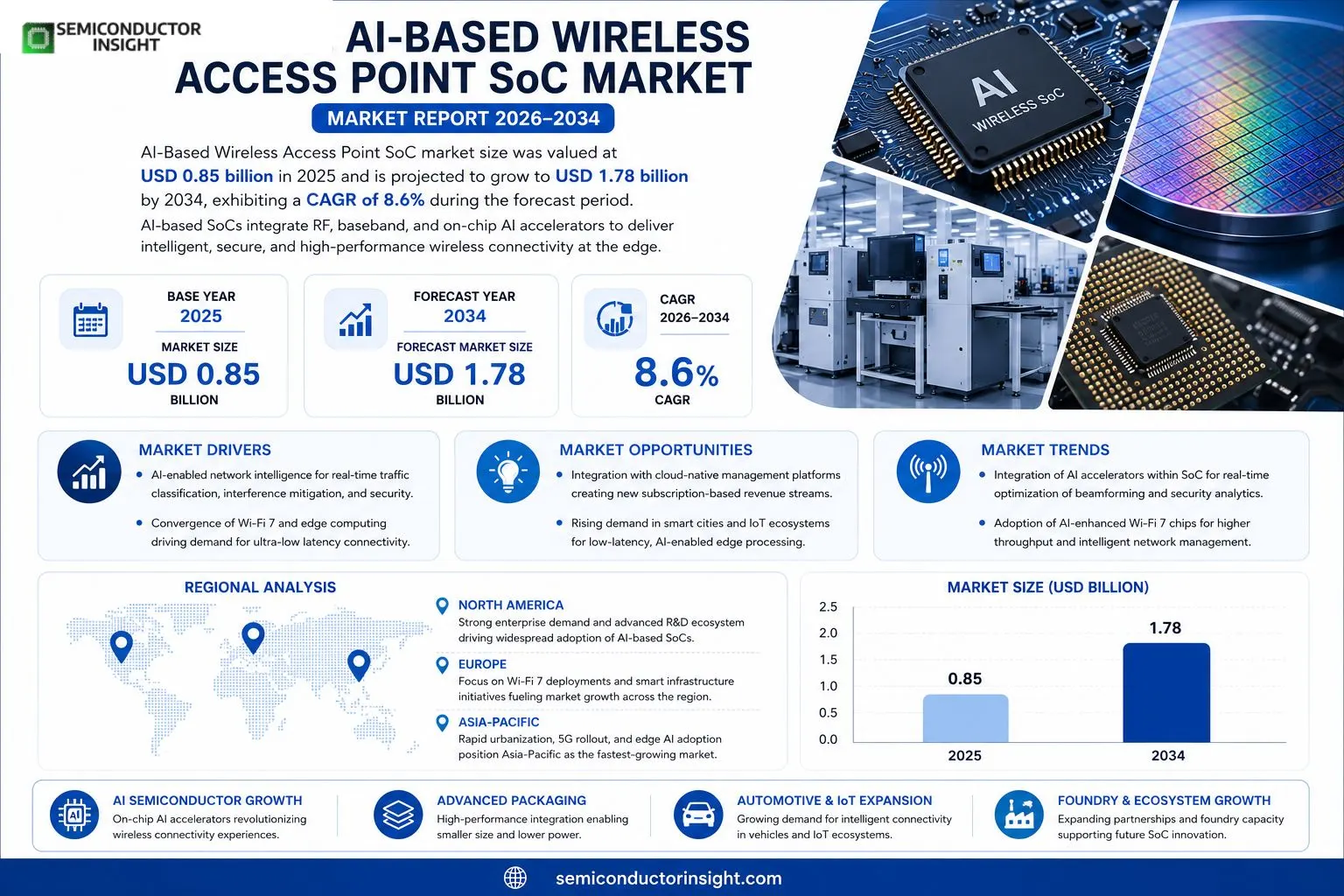
AI-Based Wireless Access Point SoC market size was valued at USD 0.85 billion in 2025. The market is projected to grow from USD 0.92 billion in 2025 to USD 1.78 billion by 2034, exhibiting a CAGR of 8.6% during the forecast period.
An AI‑Based Wireless Access Point System‑on‑Chip integrates radio‑frequency front‑end, baseband processing, and on‑board artificial‑intelligence accelerators that enable real‑time traffic classification, beamforming optimization, and security analytics within a single silicon die.\The sector is expanding because enterprises are upgrading campus networks for higher throughput and intelligent management, while edge‑computing deployments demand low‑latency Wi‑Fi solutions that can process data locally without cloud dependence; recent announcements from leading semiconductor firms on next‑generation AI‑enhanced Wi‑Fi 7 chips illustrate how product innovation fuels adoption.
MARKET DRIVERS
AI‑Enabled Network Intelligence
The integration of on‑chip AI engines empowers access points to perform real‑time traffic classification, interference mitigation, and client steering without relying on cloud latency. Enterprises that demand sub‑second response times are shifting budgets toward SoCs that embed these capabilities, accelerating demand across data‑center and campus deployments.
Convergence of Wi‑Fi 7 and Edge Computing
Wi‑Fi 7’s multi‑link operation and ultra‑low latency match the processing power of modern SoCs, creating a natural platform for edge AI workloads such as video analytics and IoT device management. The combined rollout of Wi‑Fi 7 routers and AI‑based SoCs is projected to push unit shipments past 1.2 million in 2023, a 15 % climb from the previous year.
➤ The ability to offload security‑policy enforcement to the silicon layer reduces overall network overhead by up to 30 % and shortens incident response cycles.
Vendor roadmaps now list AI‑driven power‑saving modes as a baseline feature, meaning that customers can expect up to 40 % lower energy consumption in dense deployments. This efficiency gain is becoming a decisive factor for operators facing rising electricity tariffs.
MARKET CHALLENGES
Talent Shortage in Embedded AI Development
Designing low‑power AI accelerators for wireless SoCs demands expertise that straddles RF engineering and machine‑learning optimization. Companies report extended time‑to‑market as they compete for a limited pool of engineers capable of delivering both high‑throughput inference and stringent regulatory compliance.
Other Challenges
Security Validation Overhead
Certification processes for AI‑enhanced radios now include additional threat‑model assessments, lengthening product qualification cycles by an average of 4‑6 months.
MARKET RESTRAINTS
Cost Sensitivity in Emerging Economies
While premium segments readily adopt AI‑based SoCs, price‑conscious buyers in developing regions continue to favor legacy chipsets that lack on‑board intelligence. The higher bill‑of‑materials for AI cores translates into a 20‑30 % price premium, limiting penetration where capex constraints dominate.Supply‑chain volatility, especially for high‑performance memory packages, adds another layer of uncertainty, occasionally forcing manufacturers to revert to older, less costly silicon generations.
MARKET OPPORTUNITIES
Vertical Integration with Cloud‑Native Management Platforms
Operators seeking end‑to‑end observability are pairing AI‑based SoCs with orchestration layers that expose real‑time performance metrics via open APIs. This synergy opens a revenue stream for OEMs that can bundle hardware with subscription‑based analytics services.Beyond enterprise backbones, the rise of smart‑city initiatives creates a demand for low‑power, AI‑enabled access points capable of processing video feeds and sensor data at the edge, reducing backhaul bandwidth requirements.Companies that invest early in modular AI coresallowing customers to upgrade inference capabilities via firmwarewill capture a growing share of retrofit projects, as network operators look to extend the lifespan of existing infrastructure without full hardware replacement.
AI-Based Wireless Access Point SoC Market Trends
Integration of AI Accelerators in SoC Architecture
The AI‑Based Wireless Access Point SoC market recorded a valuation of USD 0.85 billion in 2025, with estimates indicating a rise to roughly USD 0.92 billion later that year and a climb to USD 1.78 billion by 2034. This trajectory reflects manufacturers’ focus on embedding dedicated AI inference engines directly within the silicon die. By co‑locating radio‑frequency front‑ends, baseband processors, and AI cores, chip designers eliminate the latency associated with external processing, allowing real‑time traffic classification and dynamic beamforming adjustments. For network operators, the resulting efficiency translates into lower power consumption per access point and a measurable boost in user‑experience metrics, especially in dense enterprise environments.
Other Trends
Edge‑Computing Demand and Localized Processing
Enterprises upgrading campus infrastructures are increasingly deploying edge‑computing nodes that require immediate Wi‑Fi analytics without reliance on cloud back‑haul. The AI‑Based Wireless Access Point SoC market answers this need by delivering on‑board analytics capable of detecting anomalous traffic patterns and enforcing security policies at the edge. As organizations broaden their IoT footprints, the ability to process sensor data locally reduces bandwidth strain and mitigates privacy concerns, prompting network planners to prioritize SoCs that balance throughput with intelligent off‑load capabilities. This shift not only fuels adoption but also reshapes vendor roadmaps toward tighter integration of AI functions within the access‑point silicon.
Emergence of Wi‑Fi 7 and Security Analytics
Recent announcements from leading semiconductor firms highlight next‑generation Wi‑Fi 7 chips that incorporate AI‑enhanced modulation schemes and adaptive interference mitigation. The AI‑Based Wireless Access Point SoC market benefits from these advances, as manufacturers can now offer solutions that simultaneously deliver multi‑gigabit speeds and advanced threat detection. By leveraging on‑chip neural networks, devices can scrutinize packet payloads for ransomware signatures or rogue device fingerprints in milliseconds, a capability that was previously exclusive to dedicated gateway appliances. This convergence of ultra‑high‑speed connectivity and embedded security is prompting data‑center operators and large‑scale retailers to replace legacy access points, accelerating the overall market momentum.
COMPETITIVE LANDSCAPE
Key Industry Players
AI‑Based Wireless Access Point SoC Competitive Overview
Qualcomm, Broadcom and MediaTek dominate the AI‑enabled Wi‑Fi SoC arena, each leveraging deep silicon‑AI expertise and established Wi‑Fi 6/7 product pipelines. Qualcomm’s Snapdragon Wi‑Fi family couples adaptive beam‑forming with on‑chip tensor cores, allowing campus‑wide deployments to run inference locally and cut latency. Broadcom’s portfolio integrates a mature RF front‑end with a programmable AI engine, giving service providers a single‑die solution that scales from dense office floors to large‑venue installations. MediaTek, meanwhile, differentiates through cost‑effective integration, pairing AI‑driven traffic classification with aggressive power‑management features that appeal to budget‑conscious enterprises. Collectively these three firms command more than half of the revenue in the sector, shape the architectural standards for next‑generation access points, and set the tempo for feature introductions such as real‑time security analytics and predictive channel selection.Beyond the tier‑one group, a constellation of niche innovators enriches the competitive fabric. Intel, after bolstering its wireless portfolio, offers AI‑accelerated Wi‑Fi modules that integrate seamlessly with edge‑compute servers. NXP focuses on automotive‑grade reliability while extending AI inference to in‑vehicle connectivity hubs. Marvell’s Octeon line introduces heterogeneous cores that accelerate machine‑learning workloads directly on the access point. Realtek supplies highly integrated, cost‑sensitive solutions for SMB deployments, and Cypress (now part of Infineon) leverages its RF heritage to deliver robust security‑first SoCs. Additional players such as Skyworks, Qorvo, Lattice Semiconductor, Alpha Technologies and Sierra Wireless contribute specialized RF front‑ends, programmable logic or low‑power modules that address vertical niches, reinforcing a market that, while led by a few, remains diversified and innovation‑driven.
List of Key AI-Based Wireless Access Point SoC Companies Profiled
- Qualcomm
- Broadcom
- MediaTek
- Intel
- NXP Semiconductors
- Marvell Technology Group
- Realtek Semiconductor Corp.
- Infineon Technologies (Cypress)
- Skyworks Solutions
- Qorvo
- Lattice Semiconductor
- Alpha Technologies
- Sierra Wireless
Segment Analysis:
| Segment Category | Sub-Segments | Key Insights |
| By Type |
|
Enterprise‑grade segment drives the market due to its robust performance envelope and integrated AI acceleration:
|
| By Application |
|
Campus networking remains the leading application because institutions seek intelligent Wi‑Fi that can self‑optimize:
|
| By End User |
|
Large enterprises dominate because they demand scalable, AI‑driven Wi‑Fi solutions:
|
| By Deployment Environment |
|
Indoor deployments are the primary focus as they incorporate dense user environments where AI can continuously refine radio parameters:
|
| By AI Capability |
|
Advanced AI is emerging as the leading capability because it enables the SoC to anticipate network conditions:
|
Regional Analysis: AI-Based Wireless Access Point SoC Market
North America
Multinational corporations in the region are consolidating Wi‑Fi infrastructures to support hybrid work models, prompting a shift toward AI‑enabled AP SoCs that can auto‑optimize channel selection and enforce adaptive security policies without human intervention. The payoff is measured in reduced operational expense and higher employee productivity, which drives procurement cycles toward intelligent silicon solutions.
Silicon manufacturers leverage the region’s extensive IP‑core libraries to embed heterogeneous computing blocksdigital signal processing, inference accelerators, and secure enclaveswithin a single chip. This integration shortens bill‑of‑materials and accelerates time‑to‑market for AI‑driven access points, giving North American vendors a clear technical edge.
Data‑privacy statutes such as CCPA and emerging cybersecurity mandates require AP SoCs to enforce on‑device analytics, limiting the need for centralized processing. Vendors that embed compliance mechanisms directly into silicon avoid costly firmware updates and secure a competitive advantage in regulated sectors like finance and healthcare.
Established chipset players capitalize on long‑standing OEM relationships, while nimble start‑ups focus on niche AI workloads such as real‑time video analytics. The resulting ecosystem fosters a dual‑track strategy: incumbents defend market share with broad platform support, whereas challengers capture high‑margin segments that value specialized inference performance.
Europe
European adopters are channeling public‑sector funding into smart‑city projects, which creates demand for AP SoCs capable of on‑edge decision making. Tight spectrum regulations and a preference for open‑source firmware encourage vendors to embed flexible AI kernels that can be tuned to local compliance requirements. The continent’s fragmented market, however, necessitates region‑specific validation, pushing manufacturers to develop modular designs that address divergent radio standards while maintaining a unified software stack. This dynamic forces a balance between customization and economies of scale.
Asia‑Pacific
In Asia‑Pacific, the proliferation of dense residential complexes and the rollout of 5G‑enhanced Wi‑Fi solutions stimulate interest in AI‑augmented access‑point silicon that can manage massive device counts. Local manufacturers benefit from lower production costs, yet they must overcome perceived performance gaps relative to North American offerings. Strategic partnerships with AI software firms are emerging as a pathway to bridge that gap, allowing regional players to embed sophisticated analytics without heavy upfront R&D investment.
South America
South American markets are experiencing a gradual shift from legacy Wi‑Fi routers to AI‑enabled access points as enterprises modernize legacy infrastructures. Limited broadband penetration in rural areas drives a requirement for AP SoCs that can perform local spectrum sensing and traffic shaping, reducing reliance on backhaul capacity. Vendors that can deliver robust, low‑power silicon with on‑device learning capabilities are likely to secure early contracts with telecom operators expanding into underserved regions.
Middle East & Africa
The Middle East & Africa region combines high‑value hospitality and oil‑&‑gas installations with emerging smart‑infrastructure initiatives. Clients demand AP SoCs that guarantee reliability under extreme temperatures while offering AI‑based security analytics to protect critical assets. Limited local chip‑fab capacity drives reliance on imported silicon, prompting multinational suppliers to establish regional design centers that tailor AI models to specific use‑cases such as perimeter monitoring and predictive maintenance.
Report Scope
This market research report provides a comprehensive analysis of the AI-Based Wireless Access Point SoC Market , covering the forecast period 2026–2034. It offers detailed insights into market dynamics, technological advancements, competitive landscape, and key trends shaping the industry.
Key focus areas of the report include:
- Market Overview: The report begins with an overview outlining its current market scenario, key growth indicators, and industry transformation drivers. It discusses macroeconomic factors, demand–supply balance, regulatory landscape, and the strategic role of semiconductors in powering advancements across industries such as automotive, telecommunications, consumer electronics, and industrial automation.
- Market Size & Forecast: Historical data and future projections for revenue, unit shipments, and market value across major regions and segments.
- Segmentation Analysis: Detailed breakdown by product type, technology, application, and end-user industry to identify high-growth segments and investment opportunities.
- Regional Insights: Insights into market performance across North America, Europe, Asia-Pacific, Latin America, and the Middle East & Africa, including country-level analysis where relevant.
- Competitive Landscape: Profiles of leading market participants, including their product offerings, R&D focus, manufacturing capacity, pricing strategies, and recent developments such as mergers, acquisitions, and partnerships.
- Technology Trends & Innovation: Assessment of emerging technologies, integration of AI/IoT, semiconductor design trends, fabrication techniques, and evolving industry standards.
- Market Drivers & Restraints: Evaluation of factors driving market growth along with challenges, supply chain constraints, regulatory issues, and market-entry barriers.
- Stakeholder Insights: Insights for component suppliers, OEMs, system integrators, investors, and policymakers regarding the evolving ecosystem and strategic opportunities.
Primary and secondary research methods are employed, including interviews with industry experts, data from verified sources, and real-time market intelligence to ensure the accuracy and reliability of the insights presented.
FREQUENTLY ASKED QUESTIONS:
What is the current market size of AI-Based Wireless Access Point SoC Market?
-> AI-Based Wireless Access Point SoC Market was valued at USD 0.85 billion in 2025 and is expected to reach USD 1.78 billion by 2034.
Which key companies operate in AI-Based Wireless Access Point SoC Market?
-> Key players include Axalta Coating Systems, AkzoNobel, BASF SE, PPG, Sherwin-Williams, and 3M, among others.
What are the key growth drivers?
-> Key growth drivers include railway infrastructure investments, urbanization, and demand for durable coatings.
Which region dominates the market?
-> Asia-Pacific is the fastest-growing region, while Europe remains a dominant market.
What are the emerging trends?
-> Emerging trends include bio-based coatings, smart coatings, and sustainable rail solutions.
Get Sample Report PDF for Exclusive Insights
Report Sample Includes
- Table of Contents
- List of Tables & Figures
- Charts, Research Methodology, and more...
 Download Sample Report PDF