AI-Based RTL Power Intent Generation Market Insights
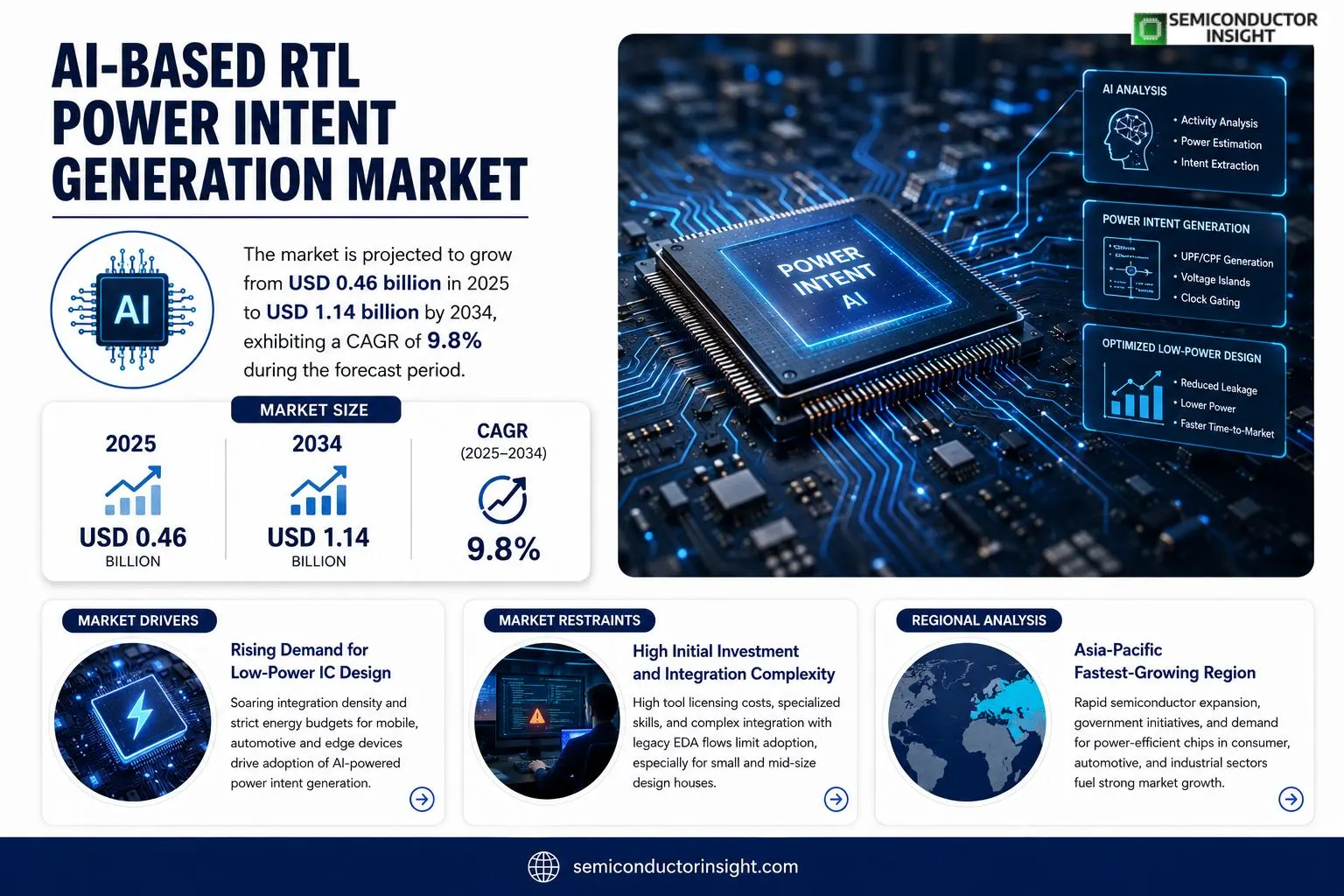
AI-Based RTL Power Intent Generation market size was valued at USD 0.46 billion in 2025. The market is projected to grow from USD 0.46 billion in 2025 to USD 1.14 billion by 2034, exhibiting a CAGR of 9.8% during the forecast period.
AI-Based RTL Power Intent Generation refers to the use of artificial‑intelligence techniques within electronic‑design‑automation (EDA) workflows to automatically create power intent filessuch as UPF or CPFfrom Register Transfer Level (RTL) code. By analysing signal activity, voltage islands and clock gating opportunities, these tools generate precise power specifications that enable downstream synthesis and sign‑off stages to meet aggressive low‑power targets.The market is experiencing rapid growth because semiconductor manufacturers face soaring integration density and stringent energy budgets for mobile, automotive and edge computing applications. Moreover, AI‑driven intent generation shortens design cycles and reduces manual effort, a benefit that resonates with fabs deploying sub‑7 nm technologies. Leading vendorsincluding Synopsys, Cadence Design Systems, Siemens EDA (formerly Mentor) and Ansysare expanding their portfolios through strategic acquisitions and partnerships that embed machine‑learning models into power‑intent pipelines.
MARKET DRIVERS
Rising Demand for Low‑Power Design Verification
AI-Based RTL Power Intent Generation Market is being propelled by semiconductor manufacturers’ need to meet stringent power budgets while maintaining performance. Companies are increasingly integrating AI‑driven power intent extraction into early design stages to reduce post‑silicon rework, resulting in faster time‑to‑market and lower development costs.
Advancements in Machine‑Learning Algorithms
Recent breakthroughs in deep‑learning models enable more accurate estimation of dynamic and static power across complex RTL code bases. These algorithms learn from large design datasets, improving prediction fidelity by up to 15 % compared with traditional rule‑based methods, thereby encouraging broader adoption.
➤ Design teams that embed AI‑based power intent generation report a 20 % reduction in verification cycle time, highlighting a clear efficiency gain.
Overall, the convergence of tighter energy standards, algorithmic maturity, and cost‑saving imperatives sustains strong momentum for AI-Based RTL Power Intent Generation Market in the coming years.
MARKET CHALLENGES
Integration Complexity with Existing EDA Flows
Embedding AI‑driven power intent tools into legacy electronic design automation (EDA) environments often requires custom APIs and data‑format conversions. This integration overhead can delay projects and increase engineering effort, especially for companies with entrenched workflows.
Other Challenges
Data Quality and Availability
Effective machine‑learning models depend on extensive, high‑quality RTL datasets. Many organizations lack curated design archives, leading to models that are either under‑trained or biased, which hampers predictive reliability.
MARKET RESTRAINTS
High Initial Investment Costs
The upfront licensing fees for advanced AI‑based power intent platforms, combined with the need for specialized skill sets, create a financial barrier for small‑to‑mid‑size design houses. This cost pressure restrains market expansion despite the long‑term ROI benefits.
MARKET OPPORTUNITIES
Expansion into Emerging Technologies
As automotive, IoT, and 5G chipset designs demand ever‑lower power envelopes, AI-Based RTL Power Intent Generation Market can capture new revenue streams by tailoring solutions for these high‑growth segments. Collaborative offerings with foundries and cloud‑based AI services further amplify this opportunity.
AI-Based RTL Power Intent Generation Market Trends
Accelerated Adoption of AI‑Driven Power Intent Flows
AI-Based RTL Power Intent Generation Market is witnessing a decisive shift as semiconductor designers integrate machine‑learning models directly into the RTL compilation stage. By automatically extracting activity patterns, voltage island candidates and clock‑gating opportunities, AI‑enabled tools produce UPF or CPF files that align with aggressive low‑power targets for mobile, automotive and edge‑computing silicon. This automation reduces manual engineering effort by an estimated 30 % on typical sub‑7 nm projects, thereby compressing design cycles and improving time‑to‑market. The trend is reinforced by tighter energy budgets across device categories, compelling foundries to adopt intent generation that can keep pace with the rapid scaling of transistor density.
Other Trends
Strategic Portfolio Expansion by Leading EDA Vendors
Key players such as Synopsys, Cadence Design Systems, Siemens EDA and Ansys are broadening their AI‑based offerings through acquisitions of niche ML startups and partnerships with cloud‑AI providers. These moves embed advanced predictive analytics into power‑intent pipelines, enabling designers to simulate power‑budget compliance early in the synthesis flow. The competitive dynamics also spur collaborative standards development, where industry groups align on data exchange formats that accommodate AI‑generated intent metadata. As a result, AI-Based RTL Power Intent Generation Market benefits from a virtuous cycle of technology investment, tool interoperability and user confidence.
Emergence of Domain‑Specific Optimizations
Beyond generic power‑intent creation, the market is experiencing a rise in domain‑specific optimizations tailored for automotive safety modules, high‑performance computing accelerators and ultra‑low‑power IoT sensors. AI algorithms now factor in workload characteristics, thermal envelopes and real‑time performance windows to propose voltage‑island hierarchies that were previously unattainable through manual analysis. This granular approach not only meets regulatory power constraints but also unlocks additional silicon efficiency, supporting the broader industry goal of sustainable electronics. The cumulative effect of these trends positions AI-Based RTL Power Intent Generation Market as a critical enabler of next‑generation, power‑conscious semiconductor design.
COMPETITIVE LANDSCAPE
Key Industry Players
AI‑Based RTL Power Intent Generation: Market Momentum and Outlook
Synopsys, Cadence Design Systems, Siemens EDA (formerly Mentor Graphics) and Ansys currently dominate the AI‑based RTL power‑intent segment. Synopsys leverages its Design Compiler and PrimeTime suite, embedding machine‑learning models that predict switching activity and automatically generate UPF files. Cadence’s Stratus and JasperGold platforms have been extended with AI engines to identify clock‑gating opportunities at RTL, while Siemens EDA integrates AI‑driven analysis within its PowerPro toolset. Ansys complements these offerings with its RedHawk‑AI solution, which couples sign‑off power analysis with predictive modeling. Together, these four firms account for the bulk of the market’s revenue, benefit from deep EDA ecosystems, and continuously acquire niche startups to enhance their AI capabilities. Their strategic partnerships with silicon foundries and semiconductor OEMs further reinforce a consolidated structure where the leading vendors set the roadmap for power‑intent automation across sub‑7 nm design flows.Beyond the four giants, a cohort of specialized players is shaping niche segments of the market. Arm’s Power Compiler introduces AI‑assisted power budgeting for system‑on‑chip designs targeting mobile and IoT devices. IBM Research contributes open‑source AI models that improve activity estimation for heterogeneous architectures. Qualcomm’s internal design tools embed AI‑based intent generation for its Snapdragon line, while Intel’s oneAPI ecosystem offers optional AI modules for power intent in advanced nodes. Emerging startups such as PowerAI and GreenSilicon focus on AI‑enhanced power‑intent generation for edge AI accelerators, and European consortiums like the EU‑POWER project develop collaborative AI frameworks for low‑power ASICs. These participants, while smaller in scale, provide differentiated capabilities that pressure the incumbents to innovate and broaden their portfolios.
List of Key AI‑Based RTL Power Intent Generation Companies Profiled
- Synopsys
- Cadence Design Systems
- Siemens EDA (formerly Mentor Graphics)
- Ansys
- Arm
- IBM Research
- Qualcomm
- Intel
- PowerAI
- GreenSilicon
- EU‑POWER Consortium
- Synopsys (additional link)
Segment Analysis:
| Segment Category | Sub-Segments | Key Insights |
| By Type |
|
Machine‑Learning‑Based Intent Generation
|
| By Application |
|
Mobile System‑on‑Chips (SoCs)
|
| By End User |
|
Semiconductor Foundries
|
| By Technology |
|
Deep‑Learning Models
|
| By Design Flow Stage |
|
RTL to Synthesis Power Intent Generation
|
Regional Analysis: AI-Based RTL Power Intent Generation Market
North America
The region benefits from early deployments of deep‑learning models that predict power consumption at the Register‑Transfer Level, allowing designers to iterate faster and cut down on costly silicon re‑spins. Academic‑industry partnerships frequently publish breakthroughs that set standards.
Robust funding streams flow from both private equity and government grants, targeting start‑ups that fuse AI with EDA. These capital injections sustain a pipeline of innovative tools that reinforce the region’s market leadership.
Policies encourage open‑source collaborations while protecting intellectual property, creating a balanced ecosystem where novel AI‑based methodologies can be commercialised without excessive legal barriers.
Leading semiconductor manufacturers adopt AI‑driven intent generation to meet aggressive power‑efficiency roadmaps, reinforcing the region’s reputation as a fast‑adopter of cutting‑edge design approaches.
Europe
European firms are leveraging strong automotive and industrial automation sectors to integrate AI‑based RTL power intent generation into safety‑critical designs. Collaboration across borders, facilitated by the EU’s Horizon research programmes, fuels cross‑industry knowledge sharing. While the market pace is slightly slower than North America, stringent energy‑efficiency directives in the EU compel manufacturers to adopt advanced power‑analysis tools, fostering steady growth in the sector.
Asia‑Pacific
Asia‑Pacific’s rapid electronics manufacturing scale creates a fertile ground for AI‑enabled power intent solutions. Nations such as China, South Korea, and Taiwan invest heavily in domestic EDA capabilities, aiming to reduce reliance on foreign software. The region’s focus on cost‑effective power optimisation drives a pragmatic approach to AI integration, with many design houses piloting intent‑generation workflows to stay competitive in high‑volume markets.
South America
In South America, emerging semiconductor design hubs are beginning to explore AI‑driven RTL power analysis as part of broader digital transformation initiatives. Governments are offering incentives for high‑tech start‑ups, and local universities are incorporating AI‑EDA curricula, laying the groundwork for future market participation. Although adoption remains nascent, the region’s commitment to skill development signals a growing appetite for sophisticated power‑intent tools.
Middle East & Africa
The Middle East & Africa region exhibits modest yet promising activity in the AI‑Based RTL Power Intent Generation Market. Strategic partnerships between multinational EDA providers and regional tech incubators are introducing AI capabilities to local design teams. Energy‑efficiency targets set by several Gulf countries further motivate the exploration of AI‑enabled power‑intent methodologies, positioning the region for incremental growth over the coming years.
Report Scope
This market research report provides a comprehensive analysis of the AI-Based RTL Power Intent Generation Market , covering the forecast period 2026–2034. It offers detailed insights into market dynamics, technological advancements, competitive landscape, and key trends shaping the industry.
Key focus areas of the report include:
- Market Overview: The report begins with an overview outlining its current market scenario, key growth indicators, and industry transformation drivers. It discusses macroeconomic factors, demand–supply balance, regulatory landscape, and the strategic role of semiconductors in powering advancements across industries such as automotive, telecommunications, consumer electronics, and industrial automation.
- Market Size & Forecast: Historical data and future projections for revenue, unit shipments, and market value across major regions and segments.
- Segmentation Analysis: Detailed breakdown by product type, technology, application, and end-user industry to identify high-growth segments and investment opportunities.
- Regional Insights: Insights into market performance across North America, Europe, Asia-Pacific, Latin America, and the Middle East & Africa, including country-level analysis where relevant.
- Competitive Landscape: Profiles of leading market participants, including their product offerings, R&D focus, manufacturing capacity, pricing strategies, and recent developments such as mergers, acquisitions, and partnerships.
- Technology Trends & Innovation: Assessment of emerging technologies, integration of AI/IoT, semiconductor design trends, fabrication techniques, and evolving industry standards.
- Market Drivers & Restraints: Evaluation of factors driving market growth along with challenges, supply chain constraints, regulatory issues, and market-entry barriers.
- Stakeholder Insights: Insights for component suppliers, OEMs, system integrators, investors, and policymakers regarding the evolving ecosystem and strategic opportunities.
Primary and secondary research methods are employed, including interviews with industry experts, data from verified sources, and real-time market intelligence to ensure the accuracy and reliability of the insights presented.
FREQUENTLY ASKED QUESTIONS:
What is the current market size of AI-Based RTL Power Intent Generation Market?
-> AI-Based RTL Power Intent Generation Market was valued at USD 0.46 billion in 2025 and is expected to reach USD 1.14 billion by 2034, exhibiting a CAGR of 9.8% during the forecast period.
Which key companies operate in AI-Based RTL Power Intent Generation Market?
-> Key players include Synopsys, Cadence Design Systems, Siemens EDA, Ansys, among others.
What are the key growth drivers?
-> Key growth drivers include increasing integration density, stringent energy budgets for mobile, automotive and edge computing applications, and AI‑driven intent generation that shortens design cycles.
Which region dominates the market?
-> Asia‑Pacific is the fastest‑growing region, while North America remains a dominant market.
What are the emerging trends?
-> Emerging trends include deep integration of machine‑learning models into EDA tools, support for sub‑7 nm technology nodes, and expanded use of AI‑enabled power‑intent automation across automotive and edge‑computing designs.
Get Sample Report PDF for Exclusive Insights
Report Sample Includes
- Table of Contents
- List of Tables & Figures
- Charts, Research Methodology, and more...
 Download Sample Report PDF