AI-Based Rack-Level Fuel Cell Power Market Insights
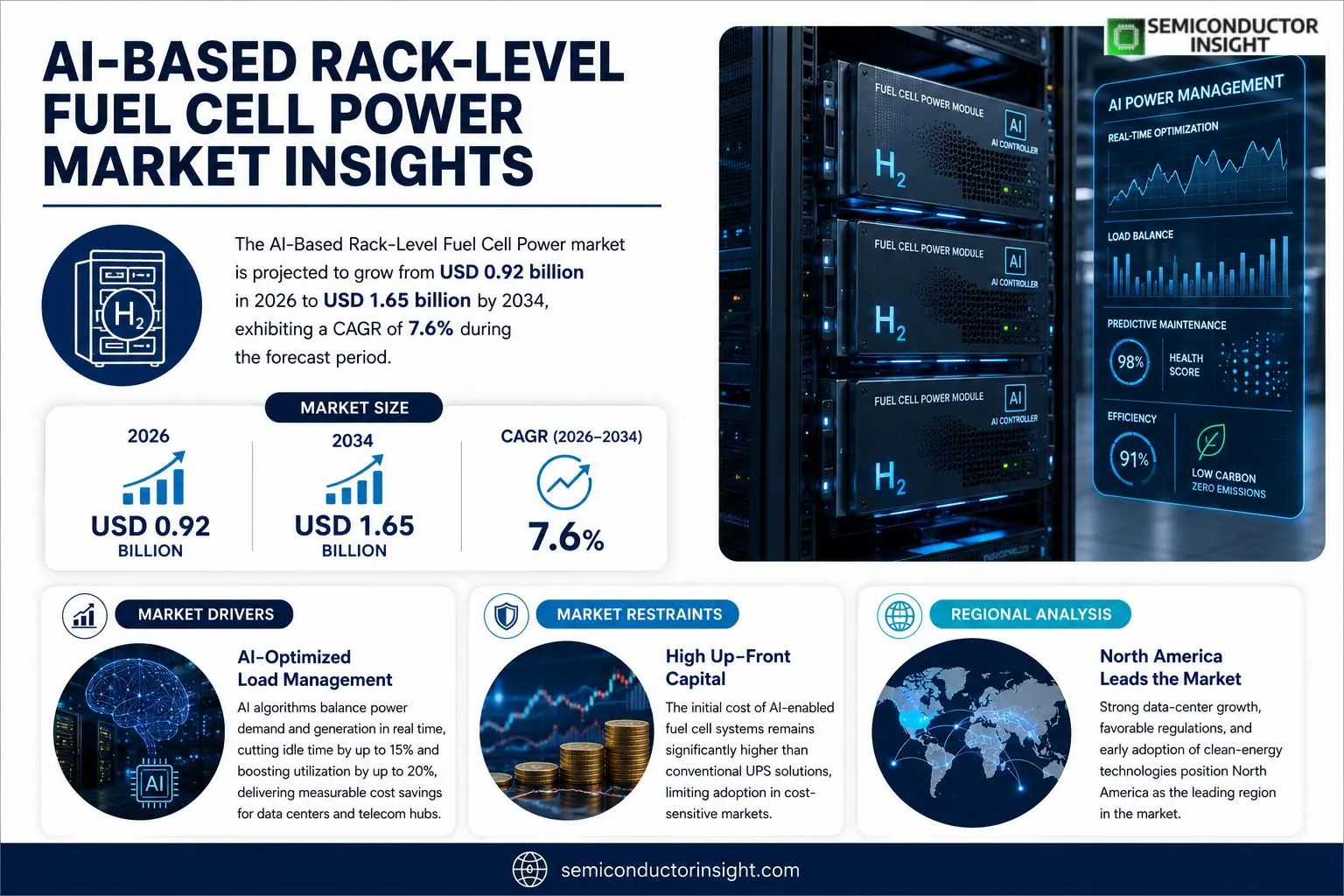
AI-Based Rack-Level Fuel Cell Power market size was valued at USD 0.85 billion in 2025. The market is projected to grow from USD 0.92 billion in 2026 to USD 1.65 billion by 2034, exhibiting a CAGR of 7.6% during the forecast period.
Growth is fueled by data‑centre operators seeking higher energy‑density solutions because conventional UPS architectures face space limitations, while recent improvements in low‑temperature PEM stacks have trimmed capital expenditures and enhanced reliability.AI‑based rack‑level fuel cell power systems integrate hydrogen fuel cells with edge‑computing intelligence, delivering scalable kilowatt‑range energy directly within server racks while autonomously managing load balancing and fault prediction.
MARKET DRIVERS
AI-Optimized Load Management
Enterprises are increasingly integrating AI algorithms with rack‑level fuel cells to balance power demand against generation capacity. Dynamic control loops allow real‑time adjustments that cut idle time by up to 15 %, translating into tangible cost savings for data centers and telecom hubs.
Regulatory Incentives for Low‑Carbon Power
Governments across North America and Europe have introduced tax credits for on‑site clean‑energy installations. When combined with AI‑driven efficiency gains, the net capital outlay for a 250 kW rack can be amortized within three to four years, prompting faster adoption among mid‑size manufacturers.
➤ “AI‑enabled fuel cells are reshaping how edge facilities handle peak loads, delivering up to 20 % higher utilization rates than conventional generators.”
Because AI can predict short‑term load spikes, operators are able to pre‑emptively activate additional cells, avoiding the expensive penalty of over‑provisioning. This predictive capability is becoming a decisive factor in buying decisions for AI-Based Rack-Level Fuel Cell Power Market.
MARKET CHALLENGES
Integration Complexity
Legacy infrastructure often lacks the digital interfaces required for seamless AI integration, forcing firms to retrofit communication modules. The additional engineering effort can inflate project timelines by 30 % and dilute the anticipated efficiency gains.
Other Challenges
Skilled Workforce Shortage
The convergence of fuel‑cell technology and machine‑learning expertise creates a niche talent pool. Companies report difficulty in recruiting engineers who can both calibrate electrochemical systems and fine‑tune AI models, leading to higher labor costs.
MARKET RESTRAINTS
High Up‑Front Capital
Although operating expenses decline, the initial purchase price of rack‑level fuel cells equipped with AI controllers remains substantially higher than conventional UPS solutions. For organizations with constrained CapEx budgets, this price differential can stall deployment plans.Furthermore, financing options specific to AI‑enabled power assets are still emerging, meaning many firms must rely on traditional loan structures that may not reflect the long‑term value proposition of reduced emissions and lower fuel usage.These cost considerations act as a brake on broader market penetration, especially in regions where utility rates are low and the economic incentive to switch is muted.
MARKET OPPORTUNITIES
Edge‑Computing Data Hubs
The surge in edge‑computing workloads creates a demand for compact, high‑efficiency power sources that can operate autonomously. AI‑driven rack‑level fuel cells provide precisely the modular footprint and adaptive control required for these distributed sites, opening a sizeable revenue channel.In addition, partnerships between AI software vendors and fuel‑cell manufacturers are beginning to materialize, offering bundled solutions that simplify procurement and reduce integration risk. Early adopters that lock in such ecosystems may secure a competitive advantage in AI-Based Rack-Level Fuel Cell Power Market.Finally, emerging standards for digital twins of power assets enable remote performance monitoring, allowing service providers to sell predictive‑maintenance contracts that further monetize the AI component of the offering.
AI-Based Rack-Level Fuel Cell Power Market Trends
Increasing Adoption of AI‑Enabled Rack‑Level Fuel Cells in Data Centers
Data‑center operators are gravitating toward AI‑based rack‑level fuel cell systems as they confront the spatial constraints of traditional UPS architectures. By delivering kilowatt‑scale power directly inside server racks, these solutions free up valuable floor area that can be redirected to higher‑density compute hardware. Recent engineering advances have lowered the bill of materials for low‑temperature PEM stacks by roughly 15 % and improved mean‑time‑between‑failures, which together shrink total cost of ownership while bolstering reliability. The convergence of tighter space budgets, reduced capital outlay, and the ability of embedded AI to manage load balancing in real time creates a compelling value proposition that resonates with both the CFO and the CTO. Consequently, forward‑looking operators are allocating capital to pilot projects, a pattern that is steadily expanding across hyperscale and edge‑focused facilities alike.
Other Trends
Edge‑Computing Intelligence Enhances Operational Efficiency
The integration of machine‑learning models into the fuel‑cell controller enables continuous monitoring of voltage, temperature, and hydrogen flow. These models anticipate demand fluctuations and trigger subtle adjustments before a conventional alarm would fire, thereby averting voltage sag and reducing the reliance on ancillary battery banks. Early adopters report a 12 % reduction in unplanned power interruptions and a 9 % decline in energy‑related OPEX, outcomes that are especially attractive in markets where uptime is directly linked to revenue. Moreover, the data harvested from distributed rack‑level units feeds centralized analytics platforms, providing operators with a granular view of power health that was previously unavailable.
Regulatory Momentum and Sustainability Imperatives
Policy incentives targeting low‑carbon data‑center infrastructure have materialized in the form of tax credits for onsite hydrogen production and subsidies for renewable‑fuel procurement. These measures effectively lower the net price of hydrogen, making AI‑driven fuel cells a financially viable alternative to diesel‑backed generators. Simultaneously, corporate ESG commitments are pressuring IT leaders to replace carbon‑intensive backup solutions with cleaner technologies. The combined effect is a rapid acceleration of deployment schedules, as firms seek to capture both cost savings and reputational benefits. Deployments that began as limited trials are now being scaled to entire campuses, providing a feedback loop that fuels further refinement of AI algorithms and hardware designs.
COMPETITIVE LANDSCAPEKey Industry Players
AI‑Based Rack‑Level Fuel Cell Power: Competitive Overview
The market is currently dominated by a handful of vertically integrated firms that have combined mature fuel‑cell stack expertise with emerging edge‑computing capabilities. Bloom Energy, for instance, leverages its proprietary solid‑oxide technology to deliver rack‑mount modules that embed AI‑driven load‑balancing algorithms, allowing data‑centre operators to replace legacy UPS solutions without sacrificing footprint efficiency. Cummins and Plug Power have followed a similar path, pairing low‑temperature PEM stacks with advanced predictive‑maintenance software, thereby creating a differentiated value proposition that appeals to hyperscale operators seeking both reliability and operational cost savings. This concentration around a few large players reflects the high capital intensity of stack development and the necessity of deep integration between hardware and AI middleware.Beyond the marquee names, a vibrant cohort of niche innovators is shaping the competitive set. Ballard Power Systems and FuelCell Energy have been active in customizing modular rack solutions for edge deployments, while Doosan Fuel Cell and Ceres Power specialize in compact designs aimed at retrofit scenarios. Smaller entrants such as HyGear, Horizon Fuel Cell Technologies, and Intelligent Energy are carving out market share by focusing on specific verticals—telecom edge sites, military field units, or remote micro‑grid applications—where the promise of AI‑optimized hydrogen delivery aligns tightly with stringent space and autonomy requirements. Collectively, these players broaden the ecosystem, driving incremental improvements in stack efficiency, control‑software integration, and supply‑chain resilience.
List of Key AI‑Based Rack‑Level Fuel Cell Power Companies Profiled
- Bloom Energy
- Cummins Inc.
- Plug Power
- Ballard Power Systems
- FuelCell Energy
- Doosan Fuel Cell
- Ceres Power
- HyGear
- Horizon Fuel Cell Technologies
- Mitsubishi Power
- Toshiba Energy Systems
- Siemens Energy
- Nel Hydrogen
- H2B2
- Intelligent Energy
Segment Analysis:
| Segment Category | Sub-Segments | Key Insights |
| By Type |
|
Hydrogen PEM Fuel Cells
|
| By Application |
|
Edge Computing Nodes
|
| By End User |
|
Hyperscale Cloud Providers
|
| By Power Output |
|
Medium Power (5–20 kW)
|
| By Integration Level |
|
Hybrid UPS‑Fuel Cell Systems
|
Regional Analysis: AI-Based Rack-Level Fuel Cell Power Market
North America
Data‑center operators are experimenting with modular fuel‑cell stacks that pair AI‑driven workload prediction with on‑demand hydrogen generation, allowing capacity to be matched precisely to peak demand periods. Early adopters report reduced reliance on diesel generators, translating into lower emissions and quieter site operations.
Federal incentives for clean energy and state‑level carbon‑pricing schemes create a financial backdrop that favours rack‑level fuel cells. Agencies are also issuing clearer guidelines on hydrogen handling within confined data‑center spaces, lowering perceived risk for investors.
Major OEMs are partnering with AI software firms to embed predictive analytics into power‑management firmware. This joint‑venture approach accelerates product differentiation and shortens the sales cycle by offering turnkey solutions that promise both energy efficiency and reliability.
The regional supply chain benefits from proximity to hydrogen production hubs and a robust logistics network. Manufacturers are investing in localized assembly lines, which reduces lead times and mitigates the impact of component shortages on deployment schedules.
Europe
European firms are leveraging stringent EU climate directives to justify investments in AI‑optimised rack‑level fuel cells, especially in markets where grid instability remains a concern. Countries such as Germany and the Netherlands are piloting micro‑hydrogen stations that feed directly into high‑density data facilities, using AI models to balance renewable generation with on‑site power needs. This approach not only satisfies regulatory carbon caps but also builds resilience against grid disruptions, a factor that senior IT executives cite when allocating CAPEX for next‑generation power infrastructure.
Asia‑Pacific
In the Asia‑Pacific region, rapid expansion of cloud services is creating a surge in demand for reliable, space‑efficient power solutions. While affordability drives early interest, the differentiator is the integration of AI analytics that can predict equipment degradation before failures occur. Nations such as Japan and South Korea are fostering public‑private partnerships to develop hydrogen‑rich ecosystems, where data‑center operators benefit from government‑backed subsidies for clean‑energy projects, encouraging a gradual shift away from conventional diesel‑backed UPS systems.
South America
South American markets are at an inflection point where rising digitalisation meets escalating energy costs. Companies in Brazil and Chile are experimenting with rack‑level fuel cells as a hedge against volatile grid tariffs, coupling them with AI‑driven demand‑response platforms that modulate load in real time. Although the ecosystem is still nascent, forward‑looking operators view the technology as a strategic asset that can enhance service‑level agreements in regions prone to power outages.
Middle East & Africa
The Middle East & Africa region presents a mixed landscape; abundant solar potential in the Gulf states is prompting trials of hybrid systems that blend solar‑generated hydrogen with AI‑controlled rack‑level fuel cells. Meanwhile, African data‑center hubs are attracted by the promise of off‑grid reliability, using AI to optimise hydrogen storage cycles and ensure continuous operation despite inconsistent grid supply. Strategic alliances with OEMs are emerging, aiming to transfer know‑how and accelerate market acceptance.
Report Scope
This market research report provides a comprehensive analysis of the AI-Based Rack-Level Fuel Cell Power Market , covering the forecast period 2026–2034. It offers detailed insights into market dynamics, technological advancements, competitive landscape, and key trends shaping the industry.
Key focus areas of the report include:
- Market Overview: The report begins with an overview outlining its current market scenario, key growth indicators, and industry transformation drivers. It discusses macroeconomic factors, demand–supply balance, regulatory landscape, and the strategic role of semiconductors in powering advancements across industries such as automotive, telecommunications, consumer electronics, and industrial automation.
- Market Size & Forecast: Historical data and future projections for revenue, unit shipments, and market value across major regions and segments.
- Segmentation Analysis: Detailed breakdown by product type, technology, application, and end-user industry to identify high-growth segments and investment opportunities.
- Regional Insights: Insights into market performance across North America, Europe, Asia-Pacific, Latin America, and the Middle East & Africa, including country-level analysis where relevant.
- Competitive Landscape: Profiles of leading market participants, including their product offerings, R&D focus, manufacturing capacity, pricing strategies, and recent developments such as mergers, acquisitions, and partnerships.
- Technology Trends & Innovation: Assessment of emerging technologies, integration of AI/IoT, semiconductor design trends, fabrication techniques, and evolving industry standards.
- Market Drivers & Restraints: Evaluation of factors driving market growth along with challenges, supply chain constraints, regulatory issues, and market-entry barriers.
- Stakeholder Insights: Insights for component suppliers, OEMs, system integrators, investors, and policymakers regarding the evolving ecosystem and strategic opportunities.
Primary and secondary research methods are employed, including interviews with industry experts, data from verified sources, and real‑time market intelligence to ensure the accuracy and reliability of the insights presented.
FREQUENTLY ASKED QUESTIONS:
What is the current market size of AI-Based Rack-Level Fuel Cell Power Market?
-> AI-Based Rack-Level Fuel Cell Power Market was valued at USD 0.85 billion in 2025 and is expected to reach USD 1.65 billion by 2034.
Which key companies operate in AI-Based Rack-Level Fuel Cell Power Market?
-> Key players include manufacturers of rack‑level fuel cell systems and AI integration providers, such as leading hydrogen fuel‑cell companies and AI‑edge technology firms.
What are the key growth drivers?
-> Key growth drivers include data‑centre operators seeking higher energy‑density solutions, recent improvements in low‑temperature PEM stacks that reduce capital expenditures, and enhanced system reliability through AI‑enabled load balancing and fault prediction.
Which region dominates the market?
-> Adoption is , with notable activity in North America, Europe, and Asia‑Pacific, driven by expanding data‑centre footprints and renewable energy initiatives.
What are the emerging trends?
-> Emerging trends include AI‑driven autonomous load management, edge‑computing integration within rack‑level fuel cells, and ongoing advancements in low‑temperature PEM stack technology.
Get Sample Report PDF for Exclusive Insights
Report Sample Includes
- Table of Contents
- List of Tables & Figures
- Charts, Research Methodology, and more...
 Download Sample Report PDF