AI-Based Functional Verification Coverage Closure Market Insights
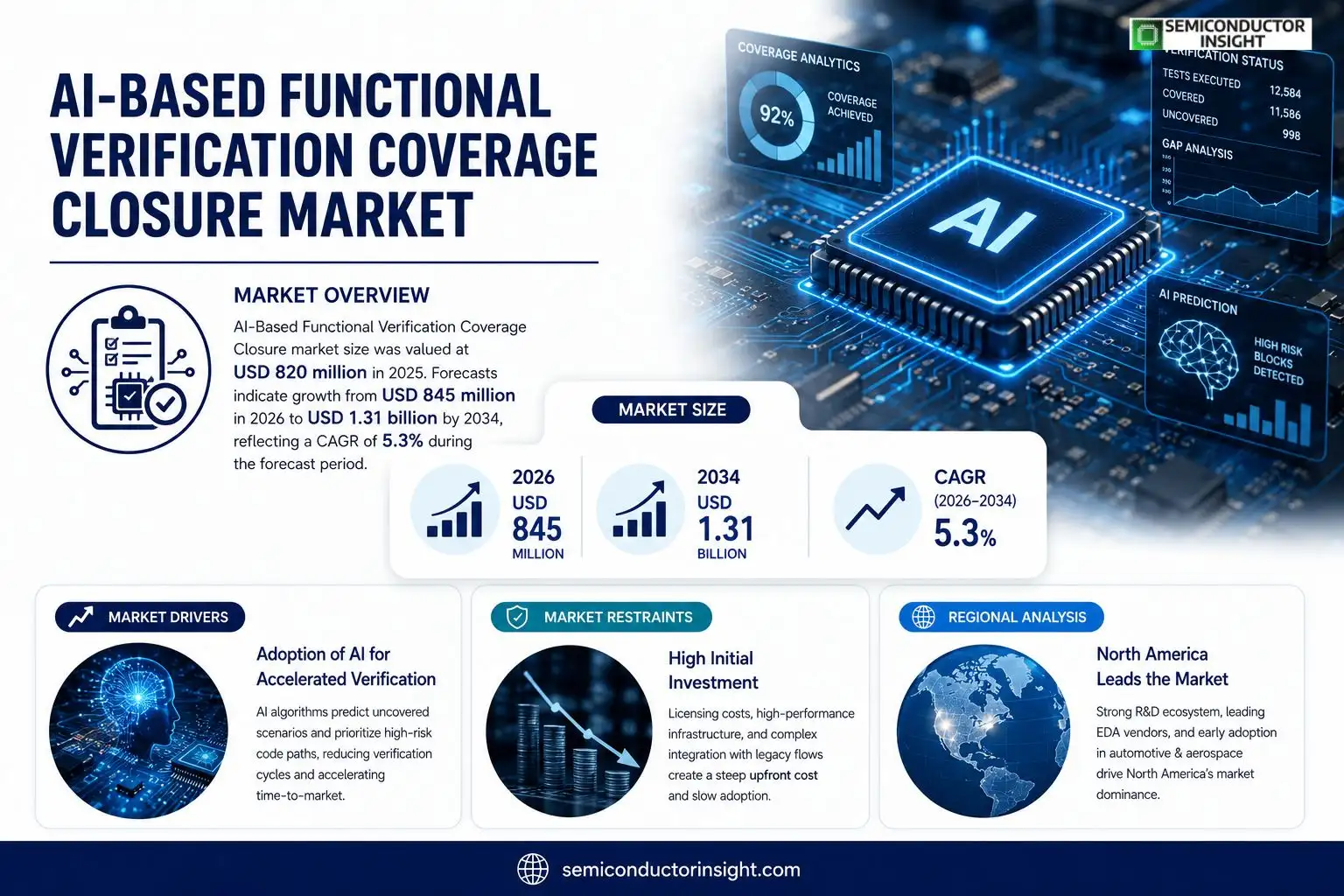
AI-Based Functional Verification Coverage Closure market size was valued at USD 820 million in 2025. Forecasts indicate growth from USD 845 million in 2026 to USD 1.31 billion by 2034, reflecting a CAGR of approximately 5.3% during the forecast period.
AI‑Based functional verification coverage closure describes the use of artificial‑intelligence techniquessuch as reinforcement learning and deep neural networksto automatically evaluate and close verification gaps in semiconductor designs. By analysing stimulus effectiveness and predicting uncovered scenarios, the approach directs test generation toward high‑risk logic blocks, thereby raising overall coverage percentages.The market is gaining momentum because design complexity continues to rise while time‑to‑market pressures intensify. Additionally, chip manufacturers are allocating larger budgets toward advanced verification suites, and leading vendors such as Cadence Design Systems, Synopsys Inc., and Siemens EDA are expanding their AI‑driven portfolios.
MARKET DRIVERS
Adoption of AI for Accelerated Verification
The surge in design complexity has forced semiconductor firms to seek automated solutions that can reduce verification cycles. AI‑Based Functional Verification Coverage Closure Market tools apply machine‑learning algorithms to predict uncovered test scenarios, allowing engineers to prioritize high‑risk code paths. This efficiency gain translates into faster time‑to‑market, a decisive advantage when product launches are tied to fiscal targets.
Integration with Agile Development Practices
Agile and DevOps methodologies demand continuous validation rather than periodic checkpoints. AI‑driven coverage closure platforms embed directly into CI/CD pipelines, delivering real‑time feedback on functional gaps. Companies that synchronize verification with iterative development reap lower rework costs and maintain tighter alignment between hardware and software teams.
➤ “Embedding AI in verification not only trims cycle time but also reshapes resource allocation, turning verification engineers into strategic analysts.”
Enterprises that couple these capabilities with robust data‑management frameworks can extract cross‑project insights, turning historical coverage data into a predictive asset. The resulting knowledge base becomes a competitive moat, especially for firms operating in hyper‑scale environments.
MARKET CHALLENGES
Skill Gap and Model Interpretability
Deploying sophisticated AI models requires data‑science proficiency that many verification teams lack. The opacity of deep‑learning predictions often leads to hesitation when engineers must justify coverage decisions to quality auditors. Bridging this expertise gap without inflating headcount remains a persistent hurdle.
Other Challenges
Regulatory Ambiguity
Standards for functional safety in domains such as automotive and aerospace are evolving, yet guidance on AI‑assisted verification is still fragmented. Organizations risk non‑compliance if they rely on opaque AI outputs without clear audit trails, prompting cautious adoption.
MARKET RESTRAINTS
High Initial Investment
Licensing fees for advanced AI verification suites, coupled with the need for high‑performance computing infrastructure, generate a steep upfront cost. Smaller OEMs often defer procurement until ROI can be demonstrably proven, slowing overall market penetration.In addition, the integration phase can extend project timelines as legacy verification environments must be retrofitted to accommodate AI APIs. This transitional friction dampens enthusiasm, especially among firms with tightly constrained development budgets.
MARKET OPPORTUNITIES
Emergence of Edge AI Verification
With microcontrollers moving toward on‑device intelligence, the demand for lightweight verification solutions that can operate at the edge is rising. Tailored AI models that run on constrained hardware promise to deliver coverage insights without offloading data to cloud resources, opening a niche for specialized vendors.Moreover, partnerships between AI verification vendors and EDA tool providers create bundled offerings that streamline workflow adoption. Such collaborations lower the integration barrier and position the AI‑Based Functional Verification Coverage Closure Market to capture a share of the expanding edge‑computing segment.
AI-Based Functional Verification Coverage Closure Market Trends
AI‑Enhanced Verification Gap Closure Accelerates Adoption
The AI-Based Functional Verification Coverage Closure Market is being reshaped by the relentless rise in semiconductor design intricacy. As chip architectures incorporate more layers of logic, traditional rule‑based testing struggles to keep pace with the volume of potential fault scenarios. Engineers are turning to reinforcement learning and deep neural networks because these methods can evaluate stimulus effectiveness in real‑time and steer test generation toward logic blocks that present the highest risk. This shift reduces verification cycles, cuts down on expensive silicon re‑spins, and aligns development timelines with aggressive product launch calendars. Companies that embed AI early in their verification flow are seeing higher coverage percentages without proportionally expanding test benches, a competitive advantage that is hard to ignore.
Other Trends
Vendor Consolidation and AI Portfolio Expansion
Major EDA vendorsCadence Design Systems, Synopsys Inc., and Siemens EDAare broadening their AI‑driven verification suites, effectively consolidating advanced functionality under fewer rooflines. Their recent releases integrate reinforcement‑learning engines that automate stimulus selection, while also providing dashboards that map uncovered scenarios to design modules. This convergence delivers a more seamless user experience, but it also raises entry barriers for smaller tool providers. For end users, the trend translates into reduced tool‑chain complexity and smoother licensing models, yet it pressures organizations to invest in training and up‑skilling to extract the full value of the AI components.
Reinforcement Learning Guides Stimulus Optimization
Within the AI-Based Functional Verification Coverage Closure Market, reinforcement learning has emerged as the technique most suited for dynamic stimulus optimization. By rewarding test patterns that uncover previously unseen logic pathways, the algorithm iteratively refines its own test generation strategy. Practitioners report that this approach shortens the time needed to achieve target coverage levels by several weeks compared with conventional methods. The business implication is clear: faster verification translates directly into shorter product development windows and lower overall R&D expense. As more design houses adopt this methodology, we anticipate a ripple effect where downstream verification stagessuch as system‑level validationalso benefit from the higher baseline coverage established at the functional level.
COMPETITIVE LANDSCAPEKey Industry Players
AI‑Based Functional Verification Coverage Closure – Competitive Overview
Cadence Design Systems, Synopsys Inc., and Siemens EDA dominate the verification ecosystem, each bundling AI modules with their legacy simulation and test‑generation suites. Cadence’s JasperAI leverages reinforcement‑learning to steer stimulus creation toward logic blocks that historically exhibit low coverage, while Synopsys’ VerifiAI incorporates deep‑learning predictors that estimate coverage gaps before simulation runs. Siemens, through its acquisition of Mentor Graphics, has integrated AI‑enhanced constraint solving into its Questa platform, allowing customers to compress verification cycles without sacrificing thoroughness. The concentration of these three vendors reflects a market where extensive IP libraries, long‑standing relationships with semiconductor OEMs, and the ability to fund advanced research translate into an entrenched competitive advantage. Their roadmaps increasingly feature cloud‑based verification services, a response to the growing need for scalable compute resources in chip design projects.Beyond the leading trio, a cohort of specialized firms and broader technology companies is reshaping the value chain. ANSYS and Keysight Technologies have introduced AI‑assisted test‑bench automation that appeals to design teams seeking rapid prototyping. IBM and NVIDIA contribute domain‑specific accelerators that reduce inference latency for coverage‑prediction models. Regional players such as Aldec and Verilab focus on modular plugins that can be inserted into existing verification flows, offering cost‑effective alternatives for midsize fabs. Start‑ups like Axiom and Edgecortix bring novel reinforcement‑learning architectures that promise higher coverage gains per simulation hour. The diversity of approachesfrom hardware‑centric acceleration to lightweight software add‑onscreates a competitive pressure that forces the incumbents to broaden their AI portfolios and to foster ecosystem partnerships.
List of Key AI‑Based Functional Verification Coverage Closure Companies Profiled
- Cadence Design Systems
- Synopsys Inc.
- Siemens EDA
- Mentor Graphics
- ANSYS
- Keysight Technologies
- IBM
- NVIDIA
- Intel
- ARM
- Aldec
- Verilab
- Axiom
- Edgecortix
- Toshiba
Segment Analysis:
| Segment Category | Sub-Segments | Key Insights |
| By Type |
|
Model‑Based Verification
|
| By Application |
|
ASIC Design
|
| By End User |
|
Semiconductor Manufacturers
|
| By Technology |
|
Reinforcement Learning
|
| By Deployment Phase |
|
Pre‑silicon Verification
|
Regional Analysis: AI-Based Functional Verification Coverage Closure Market
North America
Industry leaders allocate a sizable share of capital to AI‑based verification research, targeting reductions in cycle time and improvements in defect detection fidelity. Corporate labs collaborate with university groups to prototype novel coverage closure algorithms that can be rapidly commercialized.
The region boasts a dense concentration of AI engineers and verification specialists. This talent pool accelerates the translation of academic breakthroughs into production‑grade verification suites, shortening the innovation lag.
Alliances between EDA vendors, silicon foundries, and cloud service providers create integrated platforms where AI models can be trained on real‑world design data, delivering more accurate coverage predictions.
Safety‑critical applications demand exhaustive verification. Automakers and aerospace firms in North America are early adopters of AI‑enhanced coverage techniques, setting benchmarks that influence adjoining markets.
Europe
European semiconductor hubs such as Munich, Grenoble, and Dublin are weaving AI‑based verification into their design flows, motivated by stringent EU safety directives and a strong push toward sovereign technology. Collaborative research consortia funded by the European Commission emphasize explainable AI models, ensuring that verification outcomes can be audited for compliance. While investment levels trail North America, the region’s focus on standards harmonization and cross‑border data sharing positions it as a strategic secondary market, especially for automotive and industrial IoT sectors where regulatory alignment is critical.
Asia‑Pacific
The Asia‑Pacific landscape is characterized by rapid scaling of fab capacity and an emerging AI talent base in India, China, and South Korea. Companies are leveraging cost‑effective cloud infrastructures to train verification models on massive design datasets, accelerating time‑to‑market. Government incentives aimed at AI adoption in semiconductor design are catalyzing early trials of coverage closure tools, though integration maturity varies across the region. The competitive pressure to deliver high‑density chips for consumer electronics is prompting manufacturers to experiment with AI‑driven verification as a differentiator.
South America
South American markets remain nascent in the AI‑based verification arena, with Brazil and Chile leading modest pilot programs within university‑industry collaborations. Limited access to high‑performance computing resources has constrained large‑scale adoption, yet regional firms are exploring partnerships with North American vendors to bridge the capability gap. The primary driver is the desire to increase product reliability for automotive and telecom equipment destined for export, offering a foothold for future expansion as infrastructure improves.
Middle East & Africa
In the Middle East & Africa, investment in AI for semiconductor verification is largely concentrated in UAE and South Africa, where government‑backed innovation funds target high‑tech diversification. Projects focus on leveraging AI to validate security‑critical hardware for defense and smart‑city applications. While the market is still embryonic, the strategic emphasis on self‑reliance and emerging digital economies suggests a gradual uptake of AI‑based functional verification coverage closure solutions over the next decade.
Report Scope
This market research report provides a comprehensive analysis of the AI-Based Functional Verification Coverage Closure Market , covering the forecast period 2026–2034. It offers detailed insights into market dynamics, technological advancements, competitive landscape, and key trends shaping the industry.
Key focus areas of the report include:
- Market Overview: The report begins with an overview outlining its current market scenario, key growth indicators, and industry transformation drivers. It discusses macroeconomic factors, demand–supply balance, regulatory landscape, and the strategic role of semiconductors in powering advancements across industries such as automotive, telecommunications, consumer electronics, and industrial automation.
- Market Size & Forecast: Historical data and future projections for revenue, unit shipments, and market value across major regions and segments.
- Segmentation Analysis: Detailed breakdown by product type, technology, application, and end-user industry to identify high-growth segments and investment opportunities.
- Regional Insights: Insights into market performance across North America, Europe, Asia-Pacific, Latin America, and the Middle East & Africa, including country-level analysis where relevant.
- Competitive Landscape: Profiles of leading market participants, including their product offerings, R&D focus, manufacturing capacity, pricing strategies, and recent developments such as mergers, acquisitions, and partnerships.
- Technology Trends & Innovation: Assessment of emerging technologies, integration of AI/IoT, semiconductor design trends, fabrication techniques, and evolving industry standards.
- Market Drivers & Restraints: Evaluation of factors driving market growth along with challenges, supply chain constraints, regulatory issues, and market-entry barriers.
- Stakeholder Insights: Insights for component suppliers, OEMs, system integrators, investors, and policymakers regarding the evolving ecosystem and strategic opportunities.
Primary and secondary research methods are employed, including interviews with industry experts, data from verified sources, and real-time market intelligence to ensure the accuracy and reliability of the insights presented.
FREQUENTLY ASKED QUESTIONS:
What is the current market size of AI-Based Functional Verification Coverage Closure Market?
-> AI-Based Functional Verification Coverage Closure Market was valued at USD 820 million in 2025 and is expected to reach USD 1.31 billion by 2034, reflecting a CAGR of approximately 5.3% during the forecast period.
Which key companies operate in AI-Based Functional Verification Coverage Closure Market?
-> Key players include Cadence Design Systems, Synopsys Inc., Siemens EDA, among others.
What are the key growth drivers?
-> Key growth drivers include increasing design complexity, accelerating time‑to‑market pressure, higher budgets for advanced verification suites, and rapid adoption of AI‑driven verification technologies.
Which region dominates the market?
-> North America currently holds the largest market share, while Asia‑Pacific is the fastest‑growing region.
What are the emerging trends?
-> Emerging trends include integration of reinforcement learning and deep neural networks for test generation, AI‑assisted stimulus effectiveness analysis, and expanding AI‑driven verification portfolios by major EDA vendors.

Get Sample Report PDF for Exclusive Insights
Report Sample Includes
- Table of Contents
- List of Tables & Figures
- Charts, Research Methodology, and more...
 Download Sample Report PDF