AI-Based Chip Thermal Interface Material Dispensing Equipment Market Insights
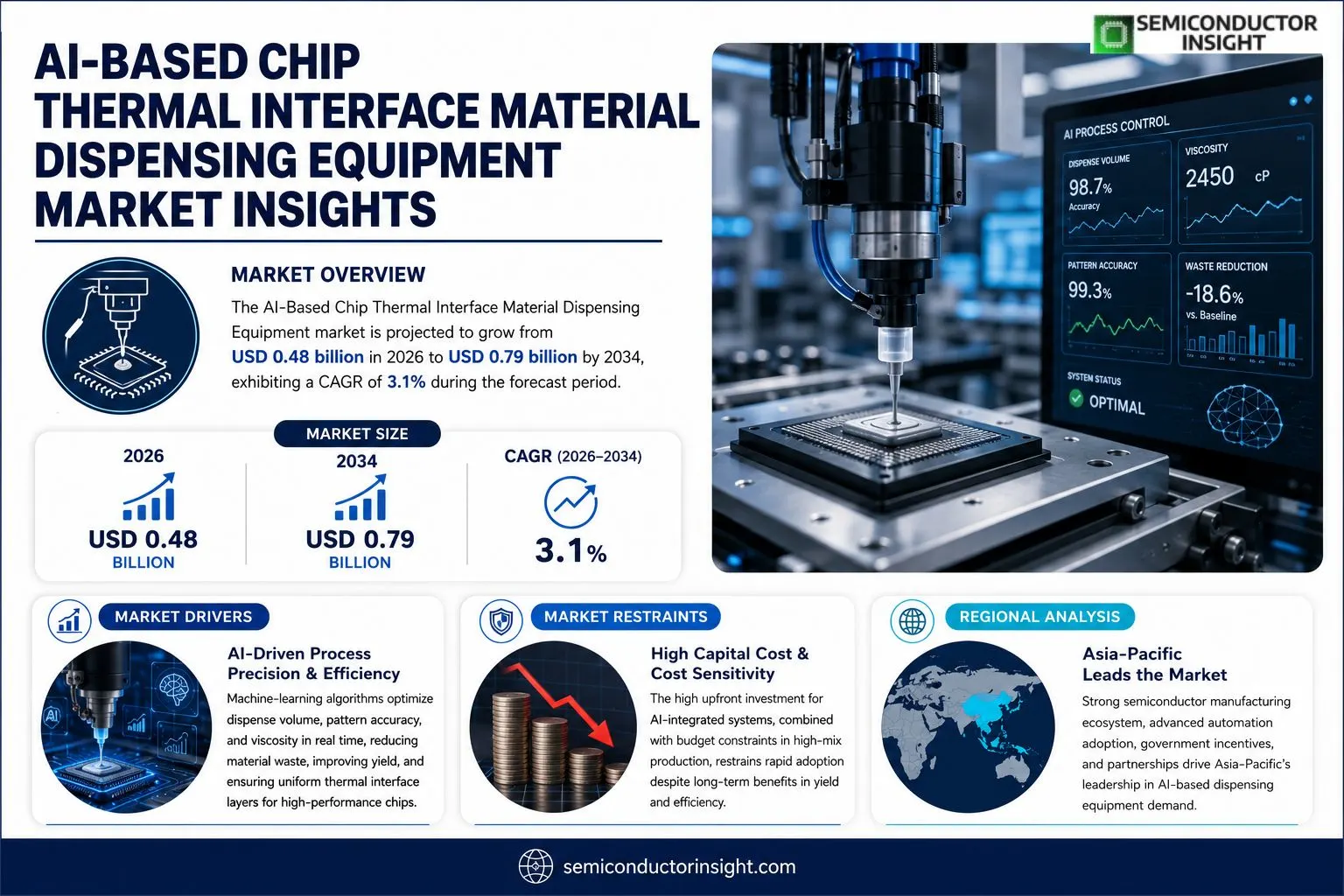
AI-Based Chip Thermal Interface Material Dispensing Equipment market size was valued at USD 0.46 billion in 2025. The market is projected to grow from USD 0.48 billion in 2026 to USD 0.79 billion by 2034, exhibiting a CAGR of 3.1% during the forecast period.
AI-Based Chip Thermal Interface Material Dispensing Equipment comprises precision dispensers that apply thermally conductive pastes or gels onto semiconductor chips using machine‑learning algorithms for volume control, pattern accuracy, and waste reduction. These systems integrate vision‑guided robotics with real‑time viscosity monitoring to ensure uniform thermal interface layers essential for high‑performance computing.The market gains momentum because manufacturers seek higher yield rates and lower thermal resistance as device architectures shrink. Meanwhile, rising adoption of advanced packaging such as fan‑out wafer‑level packaging pushes demand for automated dispensing solutions. Recent activity includes Kulicke & Soffa’s launch of an AI‑optimized dispenser platform in March 2024 and ASM International’s partnership with a leading AI software provider to enhance process analytics.
MARKET DRIVERS
Advances in AI‑Driven Process Control
Manufacturers are integrating machine‑learning algorithms into dispensing heads, enabling real‑time adjustment of slurry viscosity and deposition rate. This granular control reduces waste, shortens cycle time, and delivers a more uniform thermal interface, which in turn improves chip reliability under increasingly aggressive power densities.
Regulatory Push for Energy Efficiency
Stricter efficiency standards in data‑center and automotive sectors compel OEMs to seek superior thermal management solutions. AI‑based dispensing equipment can meet tighter tolerances without manual re‑calibration, allowing producers to certify compliance faster and at lower cost.
➤ The confluence of predictive analytics and precise material placement is reshaping equipment procurement cycles, shifting the focus from capital cost to total‑ownership value.
Consequently, end‑users are willing to allocate a larger share of CAPEX to systems that demonstrably lower scrap rates and extend product lifespans, fueling steady adoption of the AI-Based Chip Thermal Interface Material Dispensing Equipment Market.
MARKET CHALLENGES
Cost Sensitivity in High‑Mix Production
Small‑batch operations often hesitate to invest in sophisticated AI platforms because the amortization period extends beyond typical order horizons. Without clear short‑term ROI, budget committees may prioritize legacy dispensers that lack predictive capabilities.
Other Challenges
Supply‑Chain Volatility
Fluctuations in rare‑earth catalysts used for thermal interface materials can delay equipment calibration cycles, forcing manufacturers to hold safety stocks that erode margins.
Skill Gap
Deploying AI‑enhanced hardware demands data‑science expertise that many mid‑size fabs lack. Training programs are emerging, yet the learning curve slows full‑scale rollout and can result in sub‑optimal algorithm tuning.
MARKET RESTRAINTS
High Initial Capital Outlay
The upfront price tag for integrated AI sensors, edge computing modules, and precision actuators remains a barrier for cost‑constrained manufacturers. When budgeting cycles align with fiscal year ends, capital approval processes become even more stringent, curbing rapid market penetration.
MARKET OPPORTUNITIES
Modular AI Upgrades for Existing Lines
Vendors are introducing plug‑and‑play AI kits that retrofit conventional dispensers with predictive monitoring and autonomous error correction. This approach lowers entry cost while offering measurable gains in yield, presenting a compelling value proposition for plants seeking incremental modernization.
AI-Based Chip Thermal Interface Material Dispensing Equipment Market Trends
AI-Driven Precision Dispensing Responds to Shrinking Device Architectures
The relentless push toward smaller, more densely packed semiconductor packages forces manufacturers to tighten thermal budgets. In this environment, the AI-Based Chip Thermal Interface Material Dispensing Equipment Market delivers a decisive advantage: machine‑learning algorithms continuously adapt dispense volume and pattern based on real‑time viscosity readings, reducing material waste while preserving a uniform thermal layer. The resulting yield improvement and lower thermal resistance translate directly into higher throughput on assembly lines, a factor that differentiates early adopters from competitors still reliant on manual or rule‑based dispensers. As fan‑out wafer‑level packaging and heterogeneous integration become mainstream, the need for repeatable, high‑precision thermal interface application intensifies, making AI‑enhanced dispensers a practical necessity rather than a futuristic add‑on.
Other Trends
Integration of Vision‑Guided Robotics
Vision systems now sit alongside dispensing heads, feeding image data to the same neural network that controls material flow. This synergy enables on‑the‑fly correction of misalignment, ensuring every paste droplet lands within micrometer tolerances. The operational impact is noticeable on defect‑rate metrics: factories report a measurable drop in thermal interface failures after deploying vision‑assisted machines, which in turn lowers rework costs and shortens time‑to‑market for high‑performance compute modules.
Strategic Partnerships Accelerate Process Analytics
Recent moves by industry players illustrate how collaboration fuels market momentum. In March 2024, Kulicke & Soffa introduced a dispenser platform that embeds proprietary AI models for predictive maintenance, allowing operators to anticipate nozzle wear before it affects product quality. Concurrently, ASM International announced a partnership with a leading AI software provider to enrich its dispensing suite with advanced analytics dashboards. These alliances signal a shift from isolated equipment sales toward integrated solutions that blend hardware precision with software intelligence, giving manufacturers a clearer view of process health and enabling continuous improvement cycles.
COMPETITIVE LANDSCAPEKey Industry Players
AI‑Driven Dispensing Solutions Redefine Thermal Management
Kulicke & Soffa dominates the high‑volume segment, leveraging its long‑standing presence in semiconductor assembly to embed AI‑enhanced metering and vision‑guided robotics into its new dispenser platform launched in early 2024. The company’s entrenched relationships with leading foundries allow rapid field trials, translating into a measurable lift in first‑pass yield for advanced packaging customers. By aligning its algorithmic control loop with real‑time viscosity sensing, Kulicke & Soffa offers a compelling value proposition: reduced material waste, tighter thermal resistance tolerances, and a step‑change in throughput that smaller rivals struggle to match.Beyond the market leader, a cluster of specialized firms is carving out niches with differentiated technology stacks. ASM International has partnered with an AI software specialist to embed predictive analytics into its fluid‑handling modules, targeting fan‑out wafer‑level packaging lines where pattern fidelity is paramount. Nordson Corporation supplies precision dispensers that couple machine‑learning‑based flow‑control with modular cartridge designs, appealing to contract manufacturers that prioritize flexibility. Tokyo Electron, CMC Materials, and Heraeus each bring proprietary thermal pastes and sensor suites, creating bundled solutions that lock in customers through integrated performance guarantees. Smaller innovators such as Caplena, Microtronic, and Mattson Technology focus on ultra‑low‑volume, high‑accuracy applications, using edge‑AI to compensate for limited production scales while maintaining competitive cost structures.
List of Key AI‑Based Chip Thermal Interface Material Dispensing Equipment Companies Profiled
- Kulicke & Soffa
- ASM International
- Nordson Corporation
- Tokyo Electron
- CMC Materials
- Heraeus
- Caplena
- Microtronic
- Mattson Technology
- 3M
- Applied Materials
- Kulicke & Soffa
Segment Analysis:
| Segment Category | Sub-Segments | Key Insights |
| By Type |
|
Viscosity‑Controlled Dispensers
|
| By Application |
|
Advanced Packaging
|
| By End User |
|
Semiconductor Foundries
|
| By Automation Level |
|
Fully Automated Systems
|
| By Integration Capability |
|
Integrated Process Lines
|
Regional Analysis: AI-Based Chip Thermal Interface Material Dispensing Equipment Market
Asia‑Pacific
Local fabs are piloting deep‑learning models that differentiate between acceptable and sub‑optimal material beads in real time. The resulting closed‑loop control trims excess waste and guarantees uniform spread, an advantage that directly impacts yield in high‑volume production.
Several nations have introduced fiscal incentives to spur automation in electronics manufacturing. The subsidies lower the effective cost of AI‑enhanced dispensing rigs, encouraging mid‑size players to upgrade from legacy manually‑controlled equipment.
Proximity to component suppliers shortens lead times for specialised thermal interface materials. This geographic advantage enables rapid prototyping of dispensing parameters, which in turn shortens time‑to‑market for next‑generation chips.
Universities across the region now offer joint programmes in machine learning and precision engineering, producing graduates who can immediately contribute to refining dispensing workflows and algorithmic tuning.
North America
The North American landscape reflects a mature market where legacy equipment vendors are retrofitting AI modules onto existing dispensing platforms. Customer demand centres on traceability and compliance with stringent quality standards, prompting firms to embed blockchain‑based data logs that capture every dispensing event. While adoption rates are steadier than in Asia‑Pacific, the willingness to pay premium prices for validated AI solutions sustains a healthy revenue stream. Moreover, the continent’s strong venture‑capital ecosystem supports start‑ups that specialise in predictive maintenance for dispensing heads, adding a layer of service‑oriented revenue for equipment manufacturers.
Europe
European players approach the AI‑Based Chip Thermal Interface Material Dispensing Equipment Market with a focus on sustainability and regulatory alignment. Energy‑efficiency metrics are embedded into AI optimisation routines, ensuring that dispensing cycles consume minimal power while maintaining precision. The region’s rigorous environmental directives encourage OEMs to select equipment that can demonstrably reduce material waste. Collaborative research initiatives between automotive clusters and AI firms are also accelerating the rollout of thermally‑optimized modules for electric‑vehicle power electronics, a niche that is gaining strategic importance.
South America
In South America, market momentum is driven by expanding consumer electronics assembly hubs that seek cost‑effective automation to stay competitive. Companies are adopting modular AI dispensers that can be scaled according to production volume, allowing incremental investment as demand grows. The primary challenge remains the limited local expertise in AI calibration, prompting firms to rely on remote support services from overseas vendors, which in turn creates a new revenue channel for software‑as‑a‑service offerings.
Middle East & Africa
The Middle East & Africa region is at an early stage of adoption, yet strategic government programmes aimed at diversifying economies are catalysing interest in high‑precision manufacturing. Pilot projects in smart‑city infrastructure and aerospace component assembly are showcasing the value of AI‑enabled dispensing for reliability under extreme temperature conditions. Although the talent pipeline is still developing, partnerships with European technology firms are accelerating knowledge transfer, laying the groundwork for a more robust market presence in the next decade.
Report Scope
This market research report provides a comprehensive analysis of the AI-Based Chip Thermal Interface Material Dispensing Equipment Market , covering the forecast period 2026–2034. It offers detailed insights into market dynamics, technological advancements, competitive landscape, and key trends shaping the industry.
Key focus areas of the report include:
- Market Overview: The report begins with an overview outlining its current market scenario, key growth indicators, and industry transformation drivers. It discusses macroeconomic factors, demand–supply balance, regulatory landscape, and the strategic role of semiconductors in powering advancements across industries such as automotive, telecommunications, consumer electronics, and industrial automation.
- Market Size & Forecast: Historical data and future projections for revenue, unit shipments, and market value across major regions and segments.
- Segmentation Analysis: Detailed breakdown by product type, technology, application, and end-user industry to identify high-growth segments and investment opportunities.
- Regional Insights: Insights into market performance across North America, Europe, Asia-Pacific, Latin America, and the Middle East & Africa, including country-level analysis where relevant.
- Competitive Landscape: Profiles of leading market participants, including their product offerings, R&D focus, manufacturing capacity, pricing strategies, and recent developments such as mergers, acquisitions, and partnerships.
- Technology Trends & Innovation: Assessment of emerging technologies, integration of AI/IoT, semiconductor design trends, fabrication techniques, and evolving industry standards.
- Market Drivers & Restraints: Evaluation of factors driving market growth along with challenges, supply chain constraints, regulatory issues, and market-entry barriers.
- Stakeholder Insights: Insights for component suppliers, OEMs, system integrators, investors, and policymakers regarding the evolving ecosystem and strategic opportunities.
Primary and secondary research methods are employed, including interviews with industry experts, data from verified sources, and real-time market intelligence to ensure the accuracy and reliability of the insights presented.
FREQUENTLY ASKED QUESTIONS:
What is the current market size of AI-Based Chip Thermal Interface Material Dispensing Equipment Market?
-> AI-Based Chip Thermal Interface Material Dispensing Equipment Market was valued at USD 0.46 billion in 2025 and is expected to reach USD 0.79 billion by 2034.
Which key companies operate in AI-Based Chip Thermal Interface Material Dispensing Equipment Market?
-> Key players information is not specified in the provided source.
What are the key growth drivers?
-> Growth is driven by manufacturers’ need for higher yield rates, lower thermal resistance, and the rising adoption of advanced packaging such as fan‑out wafer‑level packaging, which increase demand for automated, AI‑enabled dispensing solutions.
Which region dominates the market?
-> Regional dominance is not detailed in the available data.
What are the emerging trends?
-> Emerging trends include the integration of AI‑optimized dispenser platforms (e.g., Kulicke & Soffa’s March 2024 launch) and partnerships enhancing process analytics (e.g., ASM International’s collaboration with an AI software provider).
Get Sample Report PDF for Exclusive Insights
Report Sample Includes
- Table of Contents
- List of Tables & Figures
- Charts, Research Methodology, and more...
 Download Sample Report PDF