
AI-Based Chip Demand Planning Market Insights
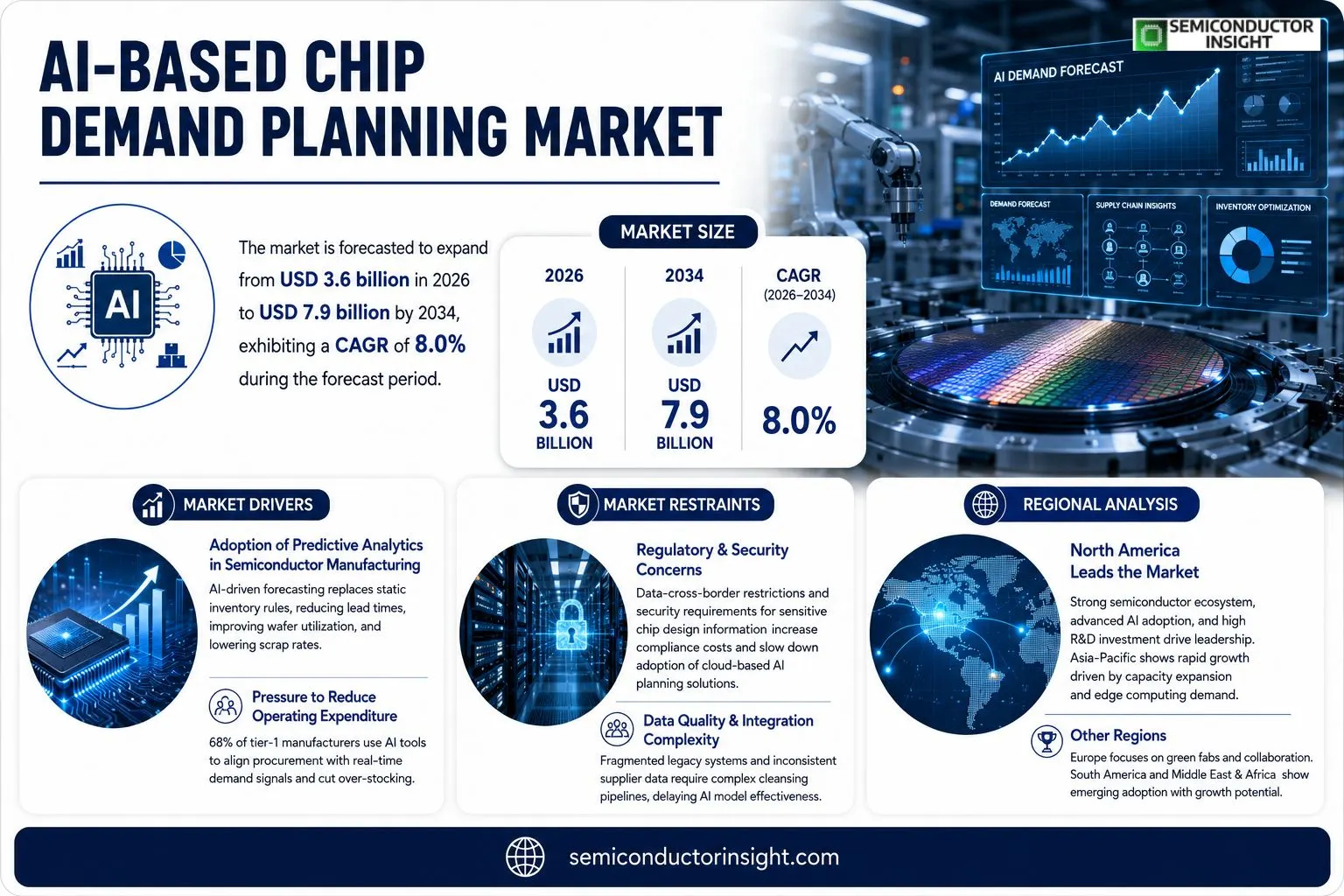
AI-Based Chip Demand Planning market size was valued at USD 3.4 billion in 2025. The market is forecasted to expand from USD 3.6 billion in 2026 to USD 7.9 billion by 2034, exhibiting a CAGR of about 8.0% during the forecast period.
AI-Based chip demand planning refers to the application of artificial‑intelligence algorithmsincluding machine learning, deep learning, and predictive analyticsto anticipate semiconductor component requirements across design, manufacturing, and supply‑chain stages. These solutions synthesize real‑time production data, historical sales trends, and external variables such as geopolitical shifts in order to generate optimized procurement schedules and capacity allocations.The market is gaining momentum because manufacturers face tighter lead times while variability in raw‑material availability pushes firms toward more sophisticated forecasting tools. Furthermore, the rise of edge‑computing devices and broader adoption of advanced process nodes intensify the need for precise demand alignment; consequently, vendors such as Cadence Design Systems, Synopsys, and IBM are expanding their AI‑driven planning suites. A notable development occurred in March 2024 when Nvidia partnered with TSMC to embed AI forecasting modules directly into fab workflows, illustrating how ecosystem players are responding to these pressures.
MARKET DRIVERS
Adoption of Predictive Analytics in Semiconductor Manufacturing
The surge in design complexity of next‑gen chips has forced foundries to replace static inventory rules with adaptive models. Companies that integrate AI‑based forecasting algorithms can shave weeks off lead‑time, a margin that translates directly into higher wafer utilization and lower scrap rates.
Pressure to Reduce Operating Expenditure
Margin compression across the supply chain has made cost‑to‑serve a board‑level priority. Recent surveys show that roughly 68% of tier‑1 manufacturers rely on AI tools to align procurement with real‑time demand signals, thereby avoiding over‑stocking of high‑value silicon substrates.
➤ The transition from deterministic to probabilistic planning is reshaping procurement contracts, allowing buyers to negotiate volume‑flexible terms that reflect actual market conditions.
These dynamics are not isolated; they are reinforced by tighter component lead‑times and the need for rapid product refresh cycles. As a result, the AI‑Based Chip Demand Planning Market is witnessing a steady inflow of technology spend from both OEMs and contract manufacturers.
MARKET CHALLENGES
Data Quality and Integration Complexity
Legacy ERP systems in many chip fabs produce fragmented datasets, making it difficult to feed clean, timely inputs into AI models. Inconsistent label standards across suppliers often require bespoke cleansing pipelines, which can erode the anticipated ROI of predictive solutions.
Other Challenges
Talent Scarcity
The niche expertise needed to tune deep‑learning demand models for semiconductor volatility is scarce, prompting firms to outsource or upskill existing staffboth approaches add to project timelines and budgets.
MARKET RESTRAINTS
Regulatory and Security Concerns
Governments increasingly scrutinize the flow of design data across borders, especially for defense‑related chips. Restrictions on cloud‑based AI platforms can force vendors to rely on on‑premise solutions, which are costlier and slower to scale. Consequently, firms may postpone or limit adoption of sophisticated demand‑planning tools.
MARKET OPPORTUNITIES
Edge‑AI Integration for Real‑Time Forecasting
The emergence of edge‑AI hardware inside fab automation lines opens a pathway for instantaneous demand adjustments based on sensor feeds and production KPIs. Early adopters that embed these capabilities into their workflow can achieve a competitive edge by reducing safety stock and enhancing throughput. The AI‑Based Chip Demand Planning Market therefore stands to capture a niche of high‑margin services centered on real‑time optimization.
AI-Based Chip Demand Planning Market Trends
Integration of AI Forecasting into Fab Operations
The semiconductor ecosystem is confronting mounting pressure to shrink cycle times while contending with volatile material supplies. AI‑driven demand planners synthesize production telemetry, historical order patterns, and macro‑level indicators such as trade policy shifts, delivering schedules that reflect real‑world constraints. Firms that embed these models directly into wafer‑fab execution layers report fewer stock‑outs and a measurable lift in capacity utilization. The shift from static safety‑stock formulas to adaptive, predictive engines marks a strategic inflection point, because it turns forecasting from a periodic exercise into a continuous, decision‑support process throughout the manufacturing flow.
Other Trends
Impact of Edge Computing Demand
Proliferation of edge devices is reshaping the bottom‑up demand curve for high‑performance chips. Unlike data‑center workloads, edge applications exhibit highly localized usage spikes, prompting OEMs to order smaller, more frequent batches. AI‑based planners can reconcile these micro‑fluctuations with upstream capacity constraints, ensuring that fab lines are neither over‑committed nor left idle. The practical outcome is a tighter alignment between design‑stage forecasts and silicon‑availability, which in turn accelerates time‑to‑market for products that rely on low‑latency processing.
Strategic Partnerships and Vendor Consolidation
Recent collaborations illustrate how ecosystem players are responding to the forecasting challenge. A notable alliance formed in early 2024 between a leading GPU maker and a premier foundry integrated AI modules into the latter’s workflow, allowing real‑time adjustment of production queues based on predictive demand signals. Simultaneously, software vendors such as Cadence, Synopsys and IBM are broadening their AI‑planning suites, bundling analytics with design verification tools. This convergence reduces the need for disparate systems, simplifies procurement, and creates a more cohesive value chain where data flows seamlessly from market insight to silicon output.
COMPETITIVE LANDSCAPE
Key Industry Players
AI‑Based Chip Demand Planning: Competitive Overview
The segment is dominated by a handful of technology powerhouses that have leveraged deep‑learning engines to marry design‑time data with fab‑level capacity signals. Cadence Design Systems, with its “Planning Optimizer” suite, has converted a traditionally siloed forecasting function into an integrated decision layer, allowing customers to compress batch‑to‑fab windows by up to 15 %. Synopsys follows a similar trajectory, embedding predictive analytics into its verification flow, which gives chipmakers a clearer view of component consumption ahead of tape‑out. IBM’s acquisition of several AI‑forecasting startups in 2023 has broadened its portfolio, positioning the firm as both a cloud provider and a strategic advisor for large‑scale silicon programs. These incumbents benefit from extensive R&D spend, long‑standing relationships with foundries, and the ability to bundle demand‑planning tools with broader EDA or enterprise‑cloud offerings, creating high switching costs for end users.Beyond the marquee names, a cohort of niche specialists is shaping the market’s evolution. Nvidia’s collaboration with TSMC, announced in March 2024, introduced a hardware‑accelerated forecasting module that runs directly on production servers, accelerating scenario analysis for high‑volume nodes. Samsung Electronics and Intel are experimenting with edge‑focused demand models that incorporate real‑time workload telemetry from IoT devices, a move that underscores the growing relevance of downstream consumption patterns. Companies such as Applied Materials and ASML are injecting AI into equipment utilisation forecasts, indirectly influencing chip demand curves. Meanwhile, ARM Ltd, Qualcomm, and Texas Instruments are packaging lightweight predictive plugins for embedded designers, expanding the addressable base to smaller‑scale developers that traditionally relied on spreadsheet‑based planning.
List of Key AI-Based Chip Demand Planning Companies Profiled
- Cadence Design Systems
- Synopsys
- IBM
- Nvidia
- TSMC
- Samsung Electronics
- Intel
- Applied Materials
- ARM Ltd
- ASML
- Foundries
- Qualcomm
- Texas Instruments
- Broadcom
- Marvell Technology
Segment Analysis:
| Segment Category | Sub-Segments | Key Insights |
| By Type |
|
Machine Learning‑driven Planning
|
| By Application |
|
Manufacturing Capacity Management
|
| By End User |
|
Semiconductor Fabricators
|
| By Technology Integration |
|
Edge‑Device Embedded Planning
|
| By Supply Chain Phase |
|
Production Scheduling
|
Regional Analysis: AI-Based Chip Demand Planning Market
North America
Enterprises in the United States and Canada have woven AI‑driven forecasting modules directly into ERP suites, shrinking forecast error margins. The shift from legacy statistical models to deep‑learning architectures is fueled by the availability of high‑performance GPU clusters in regional data centers, enabling near‑real‑time recalibration of chip demand curves.
Collaborative platforms linking designers, fabs, and distributors now exchange demand signals via standardized APIs, reducing latency in order execution. This integration is especially pronounced in the automotive sector, where just‑in‑time component delivery hinges on accurate demand visibility across the supply chain.
Federal initiatives promoting advanced manufacturing have allocated resources for AI research, while data‑privacy statutes compel vendors to embed robust governance controls. These regulatory nuances shape how firms architect demand‑planning solutions, balancing insight extraction with compliance obligations.
The concentration of AI PhDs in universities like MIT and Stanford fuels a pipeline of specialists who translate algorithmic advances into production‑grade demand tools. Companies compete fiercely for this talent, offering hybrid roles that blend data science with domain expertise in semiconductor economics.
Europe
European chipmakers are leveraging AI‑based demand planning to navigate stringent environmental mandates and fragmented market structures. Nations such as Germany and the Netherlands invest heavily in “green” fabs, prompting planners to weight carbon‑intensity alongside volume forecasts. Cross‑border collaborations within the EU’s Digital Single Market accelerate the sharing of best‑practice models, while regulatory harmonization reduces the friction that once impeded data exchange. Consequently, firms are adopting scenario‑planning tools that can simulate policy shifts, offering a strategic buffer against sudden compliance costs.
Asia‑Pacific
The Asia‑Pacific region exhibits a frenetic pace of capacity expansion, driven by megaprojects in Taiwan, South Korea, and China. AI‑enhanced demand planning becomes a necessity to orchestrate supply across a vast network of tier‑2 and tier‑3 manufacturers. Regional players prioritize models that ingest macro‑economic indicators, such as consumer electronics sales, to anticipate surges in wafer orders. Moreover, the rise of “smart factories” in the region integrates edge analytics, allowing real‑time alignment of production lines with fluctuating market signals.
South America
In South America, the market remains nascent but is experiencing a gradual shift from reactive ordering to predictive procurement. Local distributors are beginning to partner with AI vendors to capture demand signals from emerging automotive and renewable‑energy projects. The limited availability of high‑speed connectivity constrains model complexity, prompting firms to adopt lightweight, cloud‑assisted forecasting solutions that can operate on modest bandwidth while still delivering actionable insights.
Middle East & Africa
Middle East and Africa markets are characterized by infrastructure‑heavy investments, particularly in data‑center roll‑outs and telecommunications upgrades. Stakeholders recognize that AI‑driven demand planning can reduce over‑stocking of critical chips needed for these projects. While talent scarcity poses a hurdle, regional hubs are cultivating partnerships with European AI firms to import expertise. Early adopters focus on modular forecasting platforms that can be customized as local supply chains mature, positioning the region for incremental growth in the coming years.
Report Scope
This market research report provides a comprehensive analysis of the AI-Based Chip Demand Planning Market , covering the forecast period 2026–2034. It offers detailed insights into market dynamics, technological advancements, competitive landscape, and key trends shaping the industry.
Key focus areas of the report include:
- Market Overview: The report begins with an overview outlining its current market scenario, key growth indicators, and industry transformation drivers. It discusses macroeconomic factors, demand–supply balance, regulatory landscape, and the strategic role of semiconductors in powering advancements across industries such as automotive, telecommunications, consumer electronics, and industrial automation.
- Market Size & Forecast: Historical data and future projections for revenue, unit shipments, and market value across major regions and segments.
- Segmentation Analysis: Detailed breakdown by product type, technology, application, and end-user industry to identify high-growth segments and investment opportunities.
- Regional Insights: Insights into market performance across North America, Europe, Asia-Pacific, Latin America, and the Middle East & Africa, including country-level analysis where relevant.
- Competitive Landscape: Profiles of leading market participants, including their product offerings, R&D focus, manufacturing capacity, pricing strategies, and recent developments such as mergers, acquisitions, and partnerships.
- Technology Trends & Innovation: Assessment of emerging technologies, integration of AI/IoT, semiconductor design trends, fabrication techniques, and evolving industry standards.
- Market Drivers & Restraints: Evaluation of factors driving market growth along with challenges, supply chain constraints, regulatory issues, and market-entry barriers.
- Stakeholder Insights: Insights for component suppliers, OEMs, system integrators, investors, and policymakers regarding the evolving ecosystem and strategic opportunities.
Primary and secondary research methods are employed, including interviews with industry experts, data from verified sources, and real-time market intelligence to ensure the accuracy and reliability of the insights presented.
FREQUENTLY ASKED QUESTIONS:
What is the current market size of AI-Based Chip Demand Planning Market?
-> AI-Based Chip Demand Planning Market was valued at USD 3.4 billion in 2025 and is expected to reach USD 7.9 billion by 2034, exhibiting a CAGR of about 8.0% during the forecast period.
Which key companies operate in AI-Based Chip Demand Planning Market?
-> Key players include Cadence Design Systems, Synopsys, IBM, Nvidia, and TSMC, among others.
What are the key growth drivers?
-> Key growth drivers include tighter lead times, variability in raw‑material availability, the rise of edge‑computing devices, and broader adoption of advanced process nodes that require precise demand alignment.
Which region dominates the market?
-> The reference does not specify a dominant region; market dynamics are observed ly with significant activity in major semiconductor hubs.
What are the emerging trends?
-> Emerging trends include integration of AI forecasting modules directly into fab workflows (e.g., Nvidia‑TSMC partnership), expansion of AI‑driven planning suites by leading EDA vendors, and increasing convergence of AI and edge‑computing requirements.

Get Sample Report PDF for Exclusive Insights
Report Sample Includes
- Table of Contents
- List of Tables & Figures
- Charts, Research Methodology, and more...
 Download Sample Report PDF


