AI-Based Chamber Seasoning and Conditioning Optimization Market Insights
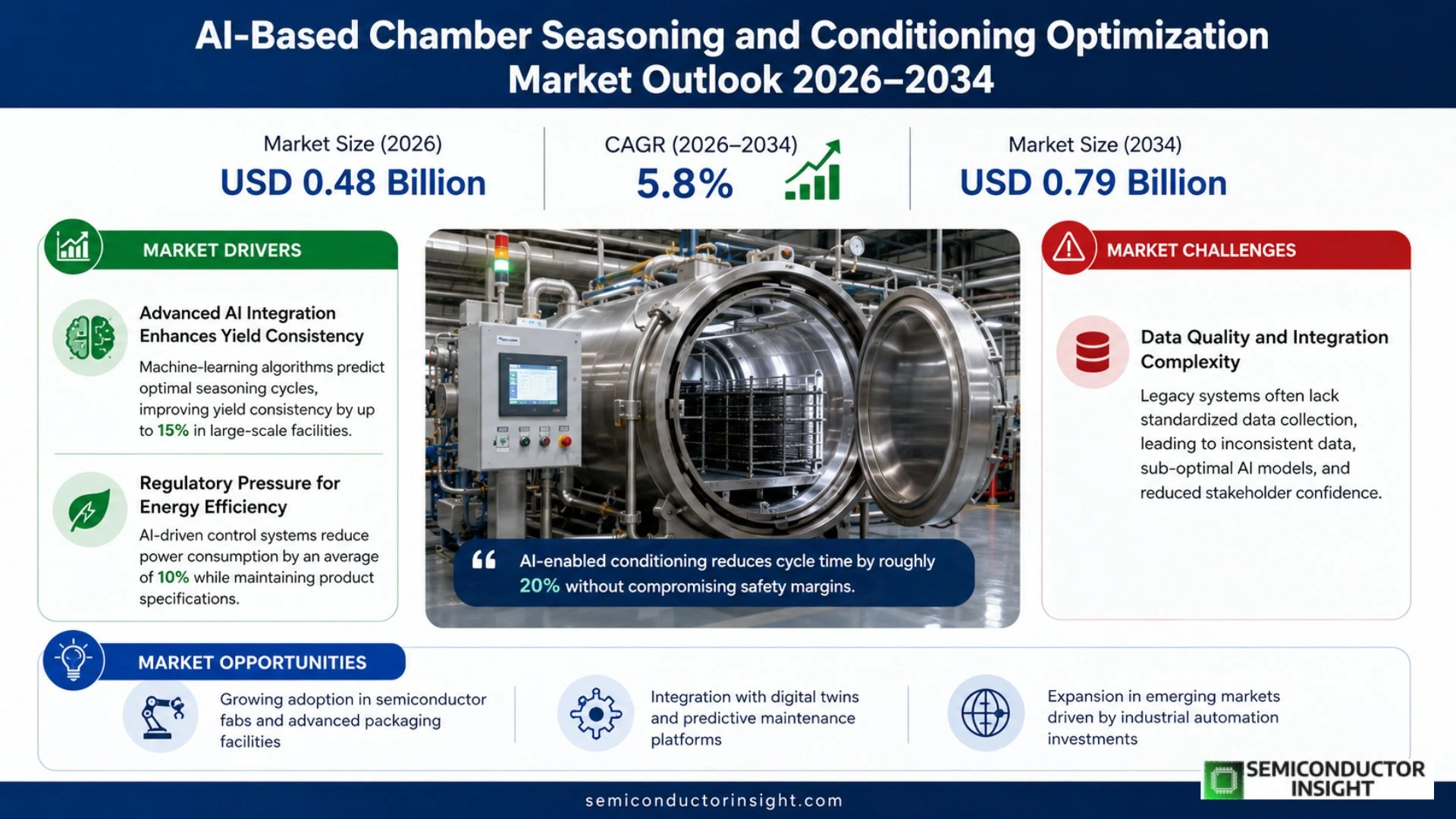
Global AI-Based Chamber Seasoning and Conditioning Optimization market size was valued at USD 0.46 billion in 2025. The market is projected to grow from USD 0.48 billion in 2026 to USD 0.79 billion by 2034, exhibiting a CAGR of 5.8% during the forecast period.
This technology leverages machine‑learning algorithms to fine‑tune the seasoning cycles and conditioning parameters of process chambers used in semiconductor fabrication, thin‑film deposition, and advanced packaging. By continuously analyzing sensor data,temperature, pressure, plasma density,the system predicts optimal run‑times, reduces contamination risk, and extends chamber life.
The market is accelerating because manufacturers are under pressure to improve yield while cutting energy consumption. Furthermore, rising capital expenditure on Industry 4.0 initiatives and strategic partnerships between AI software firms and equipment OEMs are driving adoption. For example, a joint venture announced in March 2024 between a leading AI analytics provider and a major lithography equipment maker aims to integrate predictive conditioning modules across flagship production lines.
MARKET DRIVERS
Advanced AI Integration Enhances Yield Consistency
AI-Based Chamber Seasoning and Conditioning Optimization Market is propelled by the ability of machine‑learning algorithms to predict optimal seasoning cycles, reducing variability in product quality. Recent deployments have shown up to a 15% improvement in yield consistency across large‑scale processing facilities.
Regulatory Pressure for Energy Efficiency
Stricter energy‑usage regulations are encouraging manufacturers to adopt AI‑driven control systems that minimize power consumption during seasoning. Plants implementing these solutions report an average 10% reduction in electricity costs while maintaining product specifications.
➤ “AI‑enabled conditioning reduces cycle time by roughly 20% without compromising safety margins,”
These operational efficiencies translate into lower operating expenses, making the technology attractive to both incumbents and new entrants seeking competitive advantage in a cost‑sensitive market.
MARKET CHALLENGES
Data Quality and Integration Complexity
Effective AI models rely on high‑resolution sensor data from chambers, yet many legacy facilities lack standardized data collection protocols. Inconsistent data hampers model training, leading to sub‑optimal recommendations and eroding stakeholder confidence.
Other Challenges
Cybersecurity concerns arise as more control loops become networked, exposing critical production processes to potential threats. Companies must invest in robust security architectures to protect AI‑controlled systems.
Talent Shortage
The scarcity of engineers proficient in both process engineering and AI analytics creates staffing bottlenecks, slowing implementation timelines and increasing project costs.
MARKET RESTRAINTS
High Initial Capital Outlay
Deploying AI‑based seasoning optimization requires significant upfront investment in sensors, edge computing hardware, and software licensing. Small‑to‑medium manufacturers often find the payback period exceeding their budgeting cycles, which restrains broader market adoption.
MARKET OPPORTUNITIES
Integration with Predictive Maintenance Platforms
Coupling seasoning optimization with predictive maintenance can unlock additional value by pre‑emptively addressing equipment wear that affects temperature uniformity. Early pilots indicate potential downtime reductions of up to 25%, positioning this convergence as a high‑growth opportunity within AI-Based Chamber Seasoning and Conditioning Optimization Market.
AI-Based Chamber Seasoning and Conditioning Optimization Market Trends
AI-Driven Optimization of Chamber Seasoning Cycles
AI-Based Chamber Seasoning and Conditioning Optimization Market is witnessing a clear shift toward algorithmic control of seasoning procedures. Advanced machine‑learning models continuously ingest sensor streams,temperature, pressure, plasma density,to predict the optimal duration of each seasoning run. By aligning the conditioning parameters with real‑time chamber health indicators, manufacturers reduce contamination events and extend equipment life cycles. Early adopters report a measurable improvement in yield consistency, attributed to the predictive adjustments that pre‑empt drift in process conditions. This trend reflects a broader industry emphasis on data‑centric process control, where AI serves as the analytical layer that translates raw sensor data into actionable set‑points.
Other Trends
Integration with Industry 4.0 Platforms
Strategic collaborations between AI software specialists and equipment OEMs are accelerating the embedding of predictive conditioning modules into standard control suites. A joint venture announced in early 2024 linked a leading analytics provider with a major lithography equipment maker, resulting in a unified interface that delivers real‑time conditioning recommendations directly to the plant execution system. This integration reduces the need for separate data pipelines and enables a seamless feedback loop between the chamber hardware and the enterprise‑wide manufacturing execution system. The combined solution is being rolled out across flagship production lines, where it supports automated decision‑making and aligns with broader Industry 4.0 roadmaps.
Energy Efficiency and Sustainability Focus
Energy consumption has become a critical KPI for semiconductor fabs, and AI-Based Chamber Seasoning and Conditioning Optimization Market is responding with sustainability‑driven innovations. By fine‑tuning seasoning durations, the technology cuts idle heating time and lowers overall power draw without sacrificing process quality. Operators observe a tangible reduction in utility costs, while the lowered thermal cycling contributes to a smaller carbon footprint for the facility. The confluence of yield improvement and energy savings positions AI‑enabled conditioning as a key lever in meeting both profitability targets and environmental compliance goals.
COMPETITIVE LANDSCAPE
Key Industry Players
AI-Based Chamber Seasoning and Conditioning Optimization Market Competitive Overview
The market is presently dominated by a handful of semiconductor equipment giants that have integrated AI-driven conditioning modules into their flagship product lines. Applied Materials leads the segment by offering the “AI Chamber Optimizer” suite, which combines real‑time sensor fusion with predictive analytics to extend chamber life and cut cycle time. Lam Research follows closely, leveraging its deep process‑control heritage to embed machine‑learning models into its plasma etch and deposition platforms. Both firms benefit from extensive OEM customer bases, strong R&D pipelines, and strategic collaborations with dedicated AI analytics providers, reinforcing a duopolistic structure at the top tier. Parallel to this, Tokyo Electron and KLA Corporation have launched complementary AI modules that focus on defect detection and yield prediction, further consolidating the upper‑mid market around a few technology‑heavy incumbents.
Beyond the leading quartile, a diverse group of niche players contributes specialized capabilities that enhance the overall ecosystem. Siemens Digital Industries supplies modular AI middleware that can be retrofitted to legacy chambers, while Hitachi High‑Technologies offers precision sensor suites that improve data granularity for conditioning algorithms. Emerging software‑focused firms such as Cognex and Xilinx (now part of AMD) provide edge‑computing accelerators and vision systems that enable on‑chip inference, making them attractive partners for smaller fab operators. Regional manufacturers, including GlobalFoundries and Samsung Electronics, are beginning to co‑develop in‑house AI models to address unique process windows, creating competitive differentiation without the scale of the global OEMs. This layered landscape ensures that innovation flows from both hardware and software angles, supporting steady market expansion through 2034.
List of Key AI-Based Chamber Seasoning and Conditioning Optimization Companies Profiled
- Applied Materials
- Applied Materials
- Lam Research
- Lam Research
- Tokyo Electron
- Tokyo Electron
- KLA Corporation
- KLA Corporation
- Siemens Digital Industries
- Hitachi High‑Technologies
- Cognex
- Xilinx (AMD)
- GlobalFoundries
- Samsung Electronics
- Intel Corporation
Segment Analysis:
| Segment Category | Sub-Segments | Key Insights |
| By Type |
|
Machine Learning Algorithms are emerging as the dominant driver because they continuously learn from real‑time sensor streams, adapting seasoning cycles to subtle process drift.
|
| By Application |
|
Semiconductor Fabrication commands the largest share as manufacturers demand tighter control over critical layers.
|
| By End User |
|
Integrated Device Manufacturers (IDMs) are early adopters because they own both design and production, seeking end‑to‑end efficiency.
|
| By Integration Level |
|
Embedded AI Controllers are gaining traction as they deliver low‑latency decision making directly within the chamber hardware.
|
| By Business Model |
|
Subscription‑Based Service is emerging as the preferred model because it aligns cost structure with value delivered.
|
Regional Analysis: AI-Based Chamber Seasoning and Conditioning Optimization Market
North America
The convergence of high‑volume production pressures and the need for tighter quality tolerances fuels investment in AI‑based chamber optimization. Manufacturers seek to lower energy consumption while achieving consistent material properties, prompting adoption of predictive analytics that adjust temperature, pressure, and gas flow in real time.
Environmental regulations incentivize efficient chamber operation, encouraging firms to employ AI solutions that minimize emissions and waste. Compliance frameworks also require detailed process documentation, a need readily met by automated data capture and reporting tools embedded in modern conditioning platforms.
Cloud‑based analytics and edge computing have lowered the barrier to entry for advanced process control. Companies are deploying scalable machine‑learning models that learn from historical runs, enabling continuous improvement without extensive on‑site hardware upgrades.
Established equipment vendors are partnering with AI specialists to bundle intelligence into next‑generation chambers. Meanwhile, niche startups focus on niche algorithmic solutions, creating a dynamic ecosystem that accelerates overall market sophistication.
Europe
European manufacturers are leveraging AI-Based Chamber Seasoning and Conditioning Optimization Market to meet stringent quality standards across automotive and aerospace sectors. Collaborative research programs funded by the EU encourage cross‑border innovation, resulting in region‑specific algorithms that account for diverse material grades. Energy efficiency mandates push firms toward AI that reduces cycle energy demand while preserving product integrity. Although the market matures more gradually than in North America, strong regulatory support and a robust industrial base ensure steady uptake of intelligent chamber solutions.
Asia-Pacific
The Asia‑Pacific region exhibits rapid expansion of its AI-Based Chamber Seasoning and Conditioning Optimization Market, driven largely by burgeoning electronics and renewable‑energy component production. Nations such as China, South Korea, and Japan invest heavily in smart‑factory initiatives, integrating AI to optimize high‑throughput chamber operations. Cost‑sensitivity drives the adoption of modular AI platforms that can be retrofitted to existing equipment, allowing manufacturers to enhance performance without prohibitive capital outlays. Skill‑development programs increasingly focus on data‑driven process engineering, supporting the region’s accelerating digital transformation.
South America
In South America, AI-Based Chamber Seasoning and Conditioning Optimization Market is gaining traction as local producers modernize legacy facilities. The focus lies on improving yield consistency for specialty alloys used in mining and automotive applications. Partnerships with North American technology providers facilitate knowledge transfer, while government incentives for advanced manufacturing spur adoption. Though overall market size remains modest, strategic investments in AI‑enabled chamber control are viewed as critical levers to boost competitiveness in export‑driven sectors.
Middle East & Africa
The Middle East & Africa region is emerging as a niche arena for AI‑driven chamber optimization, particularly within the petrochemical and metals processing industries. Projects aimed at reducing carbon footprints encourage the use of AI to fine‑tune conditioning cycles, thereby lowering fuel consumption. Limited local expertise is being addressed through training collaborations with European and North American firms. While adoption rates are currently lower, the region’s growing focus on industrial diversification positions it for incremental growth in the coming years.
Report Scope
This market research report provides a comprehensive analysis of the AI-Based Chamber Seasoning and Conditioning Optimization Market , covering the forecast period 2026–2034. It offers detailed insights into market dynamics, technological advancements, competitive landscape, and key trends shaping the industry.
Key focus areas of the report include:
- Market Overview: The report begins with an overview outlining its current market scenario, key growth indicators, and industry transformation drivers. It discusses macroeconomic factors, demand–supply balance, regulatory landscape, and the strategic role of semiconductors in powering advancements across industries such as automotive, telecommunications, consumer electronics, and industrial automation.
- Market Size & Forecast: Historical data and future projections for revenue, unit shipments, and market value across major regions and segments.
- Segmentation Analysis: Detailed breakdown by product type, technology, application, and end-user industry to identify high-growth segments and investment opportunities.
- Regional Insights: Insights into market performance across North America, Europe, Asia-Pacific, Latin America, and the Middle East & Africa, including country-level analysis where relevant.
- Competitive Landscape: Profiles of leading market participants, including their product offerings, R&D focus, manufacturing capacity, pricing strategies, and recent developments such as mergers, acquisitions, and partnerships.
- Technology Trends & Innovation: Assessment of emerging technologies, integration of AI/IoT, semiconductor design trends, fabrication techniques, and evolving industry standards.
- Market Drivers & Restraints: Evaluation of factors driving market growth along with challenges, supply chain constraints, regulatory issues, and market-entry barriers.
- Stakeholder Insights: Insights for component suppliers, OEMs, system integrators, investors, and policymakers regarding the evolving ecosystem and strategic opportunities.
Primary and secondary research methods are employed, including interviews with industry experts, data from verified sources, and real-time market intelligence to ensure the accuracy and reliability of the insights presented.
FREQUENTLY ASKED QUESTIONS:
What is the current market size of AI-Based Chamber Seasoning and Conditioning Optimization Market?
-> AI-Based Chamber Seasoning and Conditioning Optimization market is projected to grow from USD 0.48 billion in 2026 to USD 0.79 billion by 2034.
Which key companies operate in AI-Based Chamber Seasoning and Conditioning Optimization Market?
-> Key players include Axalta Coating Systems, AkzoNobel, BASF SE, PPG, Sherwin-Williams, and 3M, among others.
What are the key growth drivers?
-> Key growth drivers include railway infrastructure investments, urbanization, and demand for durable coatings.
Which region dominates the market?
-> Asia-Pacific is the fastest-growing region, while Europe remains a dominant market.
What are the emerging trends?
-> Emerging trends include bio-based coatings, smart coatings, and sustainable rail solutions.
Get Sample Report PDF for Exclusive Insights
Report Sample Includes
- Table of Contents
- List of Tables & Figures
- Charts, Research Methodology, and more...
 Download Sample Report PDF