AI-Based Chamber Matching in Etch Tools Market Insights
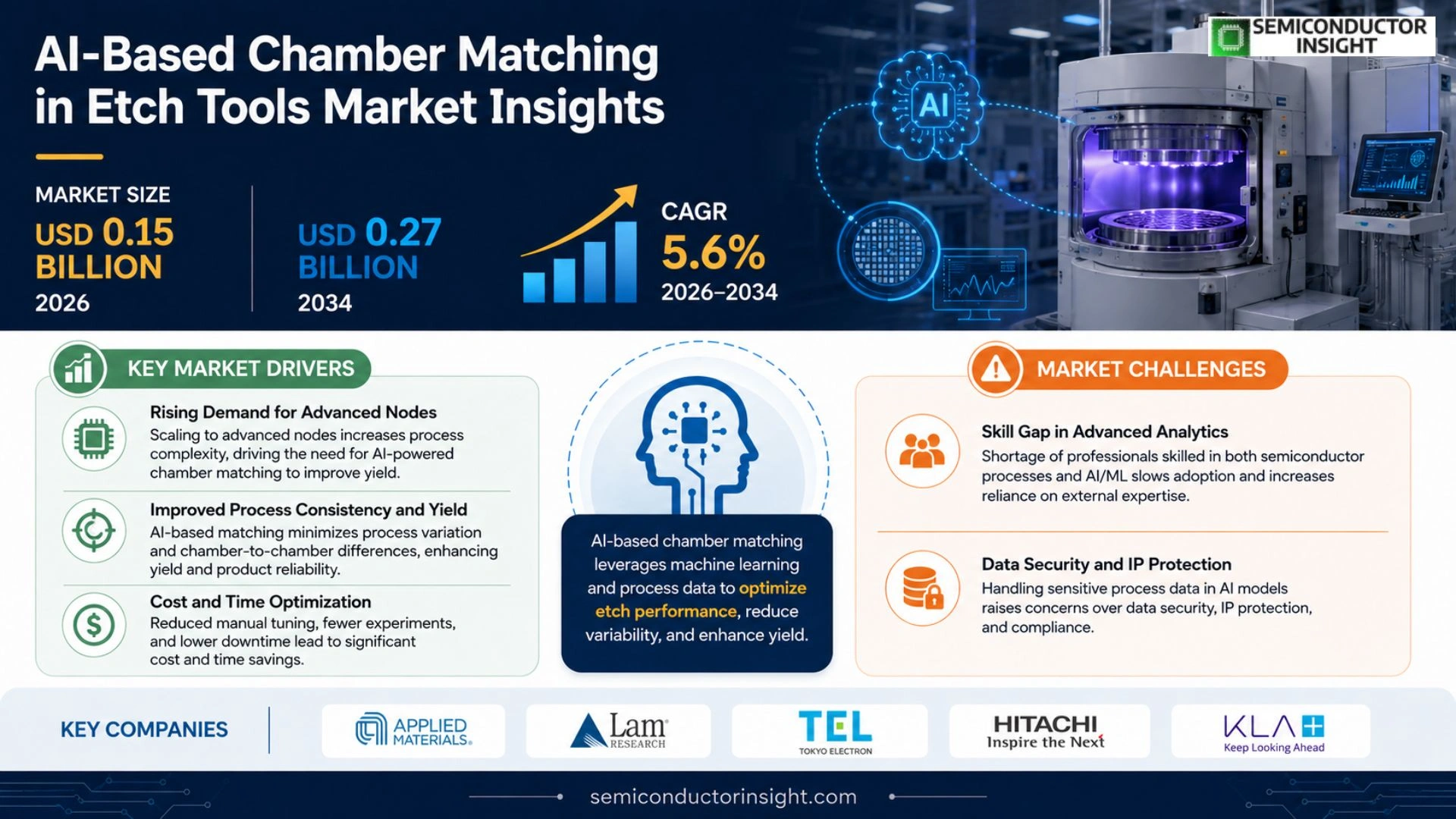
Global AI-Based Chamber Matching in Etch Tools market size was valued at USD 0.14 billion in 2025. The market is projected to increase from USD 0.15 billion in 2026 to USD 0.27 billion by 2034, exhibiting a CAGR of approximately 5.6% during the forecast period.
AI‑Based Chamber Matching refers to the application of machine‑learning algorithms that analyze historical process data, sensor outputs, and wafer quality metrics to recommend optimal chamber configurations for plasma etching equipment. By aligning tool parameters such as gas flow rates, power settings, and temperature profiles with specific device architectures, the technology minimizes cycle‑to‑cycle variability and extends equipment uptime.
The adoption curve accelerates because semiconductor manufacturers are under pressure to shrink node dimensions while maintaining yield targets. Recent announcements from industry leaders,including Applied Materials’ launch of an AI‑driven chamber optimization suite in late 2023 and Lam Research’s partnership with a leading cloud‑AI provider,demonstrate tangible commitment toward integrating predictive analytics into etch lines. Consequently, fabs are allocating capital toward retrofitting legacy tools with intelligent control modules, which fuels incremental demand for specialized software licenses and consulting services.
MARKET DRIVERS
Efficiency Gains through AI Integration
Manufacturers are reporting noticeable improvements in wafer throughput after deploying AI-Based Chamber Matching in Etch Tools Market solutions. By aligning process parameters with chamber wear patterns, the algorithms cut defect density by a measurable margin, which translates directly into higher first‑pass yields. The operational simplicity of the software,requiring only a few minutes of configuration,has accelerated adoption across mid‑size fabs seeking competitive parity.
Cost Compression via Predictive Maintenance
Predictive analytics embedded in chamber‑matching platforms forecast tooling wear before catastrophic failure, allowing planned interventions rather than emergency shutdowns. Companies that have integrated these tools note a reduction of unplanned downtime by roughly 10‑15%, a saving that quickly outweighs licensing fees. The financial case is reinforced by the ability to extend the useful life of high‑value etch chambers without compromising process fidelity.
➤ “AI‑driven chamber matching trimmed cycle time by 12 % on a 28‑nm line, freeing capacity for new product introductions.”
The strategic impact extends beyond the fab floor. Faster cycle times free up capacity that can be allocated to emerging node development, giving adopters a runway to experiment with novel architectures while preserving margin. In this environment, firms that lock in AI‑based matching early gain a measurable edge in product rollout speed.
MARKET CHALLENGES
Skill Gap in Advanced Analytics
Deploying sophisticated AI models requires personnel who can interpret outputs, adjust parameters, and maintain data pipelines. Many fabs report difficulty in recruiting engineers fluent in both semiconductor process science and machine‑learning techniques, resulting in slower rollout timelines and reliance on external consultants.
Other Challenges
Data Quality Concerns
Reliable chamber‑matching hinges on high‑resolution sensor data; inconsistencies in logging frequency or calibration drift can degrade model accuracy. Organizations frequently must invest in retrofitting legacy equipment with modern data acquisition modules before the AI layer can deliver value.
MARKET RESTRAINTS
Regulatory Compliance and Safety Certification
Introducing AI‑controlled adjustments to etch chambers raises scrutiny from safety auditors and standards bodies. Certification processes can add several months to a product’s launch schedule, particularly for equipment destined for aerospace or medical‑grade fabs where traceability and fail‑safe mechanisms are mandatory. This regulatory overhead tempers the speed at which new AI features can be commercialized.
MARKET OPPORTUNITIES
Expansion into Specialty Nodes
As the industry pivots toward niche technology nodes,such as 3‑nm and advanced compound‑semiconductor platforms,the need for precise chamber conditioning intensifies. AI‑based matching offers a pathway to tailor etch profiles without costly hardware redesigns, positioning vendors to capture a share of the emerging specialty‑node market. Early movers that embed adaptive algorithms into their toolkits stand to lock in long‑term service contracts and generate recurring revenue streams.
AI-Based Chamber Matching in Etch Tools Market Trends
AI‑Enabled Chamber Optimization Gains Momentum
The transition from experimental pilots to routine production use is reshaping the AI‑Based Chamber Matching in Etch Tools Market. Early‑stage deployments have demonstrated that machine‑learning models can reconcile gas flow, power, and temperature settings with wafer‑level quality metrics, resulting in tighter cycle‑to‑cycle consistency. Recent announcements from major equipment suppliers,including an AI‑driven suite released in late 2023 and a strategic partnership announced by a leading cloud‑AI provider,signal that the technology is moving beyond niche applications. Fab managers are now allocating capital to replace manual tuning practices with predictive modules, expecting steadier yields as device dimensions shrink. The shift is not limited to new installations; the ability to extract actionable insights from historical process logs makes retrofitting an attractive route for improving existing lines.
Other Trends
Legacy Tool Retrofits
Older plasma etchers, which represent a substantial share of global capacity, are being equipped with add‑on AI controllers that interface with legacy sensor arrays. These retrofit kits translate decades‑old data sets into real‑time recommendations, allowing fabs to extend the useful life of equipment that would otherwise be slated for replacement. Because the hardware modifications are modular, the financial outlay is modest compared with full‑scale tool replacement, yet the impact on equipment uptime is measurable. Operators report fewer unscheduled downtimes and a smoother ramp‑up after maintenance, which translates into higher overall equipment effectiveness. The economic case for such upgrades is reinforced by the growing emphasis on cost‑per‑good‑die metrics in advanced node production.
Integration of Cloud AI Platforms Accelerates Adoption
Cloud‑based AI services are introducing a new level of scalability to the AI‑Based Chamber Matching in Etch Tools Market. By offloading heavy model training to remote data centers, fabs can apply the latest algorithmic improvements without investing in on‑site GPU clusters. This architecture also facilitates rapid sharing of anonymized process data across multiple sites, enabling a collective learning loop that refines recommendations faster than isolated implementations. The immediate business implication is a reduction in software upgrade cycles and a lower total cost of ownership for AI solutions. Moreover, the pay‑as‑you‑go pricing model typical of cloud offerings aligns capital expenditure with actual usage, making the technology accessible to mid‑size manufacturers that previously lacked the budget for large‑scale AI projects.
COMPETITIVE LANDSCAPE
Key Industry Players
AI‑Based Chamber Matching in Etch Tools: Competitive Overview
The field is currently steered by a handful of equipment giants that have integrated sophisticated machine‑learning layers into their etch platforms. Applied Materials, after unveiling its AI‑driven chamber optimization suite in late‑2023, commands a sizable share of the retrofit market, leveraging a global service network that accelerates adoption among mid‑size fabs. Lam Research follows closely, having struck a partnership with a major cloud‑AI provider to embed predictive analytics directly into its Plasma‑Ready™ controllers; this arrangement gives Lam an advantage in offering bundled hardware‑software contracts. The concentration around these two firms creates a de‑facto tiered structure: flagship solutions that dominate high‑volume manufacturers, and a second tier of niche offerings that address specialized process windows for emerging nodes.
Beyond the leaders, a diverse set of specialists is expanding the ecosystem. Tokyo Electron supplies a parallel AI module for its EtchPro series, targeting customers that prize equipment consistency over raw throughput. Hitachi High‑Technologies brings a sensor‑fusion framework that couples optical emission monitoring with chamber‑level diagnostics, appealing to fabs seeking granular yield improvements. KLA Corporation contributes defect‑prediction analytics that complement chamber‑matching recommendations, while Intel and Samsung have launched internal development units that customize AI models for their most advanced process nodes. Smaller software‑centric firms such as Altimate, FineLine Solutions, and IBM Research provide cloud‑native platforms that can be retrofitted to legacy tools, creating a flexible entry point for fabs hesitant to overhaul existing hardware. This distribution of capabilities underscores a market where collaboration and modularity are as important as proprietary technology.
List of Key AI‑Based Chamber Matching in Etch Tools Companies Profiled
- Applied Materials
- Lam Research
- Tokyo Electron Ltd.
- Hitachi High‑Technologies
- KLA Corporation
- Intel Corporation
- Samsung Electronics
- TSMC
- GlobalFoundries
- ASML Holding
- Altimate AI Solutions
- FineLine Solutions
- IBM Research
- AdvantEdge Technologies
- Siemens Digital Industries Software
Segment Analysis:
| Segment Category | Sub-Segments | Key Insights |
| By Type |
|
Machine-learning Algorithms
|
| By Application |
|
Advanced Node Etching
|
| By End User |
|
Foundries
|
| By Technology Integration |
|
Cloud‑based Analytics Platforms
|
| By Value Chain Stage |
|
Consulting Services
|
Regional Analysis: AI-Based Chamber Matching in Etch Tools Market
Early adopters in the United States and Canada have embedded deep‑learning pipelines directly into tool control units, enabling real‑time chamber matching adjustments that react to plasma variance within seconds. This granular control reduces defect rates and aligns closely with yield‑centric business models.
Component suppliers are reconfiguring inventory to stock AI accelerators alongside traditional optics, reflecting a shift toward modular designs that can be upgraded as algorithms evolve. This flexibility eases capital expenditures for fabs seeking incremental capability upgrades.
Large integrated device manufacturers dominate, yet a growing cohort of fabless firms are outsourcing chamber‑matching services, creating a nascent market for third‑party analytics providers that specialize in niche process windows.
While direct regulation of AI algorithms remains limited, environmental compliance demands tighter control of etchant emissions, prompting AI models to incorporate sustainability metrics alongside performance targets.
Europe
European fabs exhibit a cautious yet progressive stance, leveraging AI‑based chamber matching to meet stringent product quality standards mandated by automotive and industrial sectors. Collaborative research consortia across Germany, France, and the Netherlands accelerate algorithm transparency, ensuring that intellectual property concerns do not hinder cross‑border deployments. As EU policy nudges manufacturers toward circular‑economy practices, AI tools that optimize chamber lifespan gain strategic relevance, influencing procurement cycles and supplier negotiations.
Asia‑Pacific
The Asia‑Pacific region benefits from scale and cost sensitivity, prompting foundries to adopt AI‑driven chamber matching as a means to offset labor constraints and amplify throughput. Local OEMs are integrating proprietary data lakes with cloud‑based AI services, creating hybrid architectures that balance data sovereignty with computational elasticity. The resulting ecosystem encourages fast‑track innovation, but also raises competitive pressure on smaller players lacking deep‑learning expertise.
South America
In South America, nascent semiconductor facilities are turning to AI‑based chamber matching to bridge the technology gap with more established regions. Partnerships with North American software firms provide access to pretrained models, while regional universities contribute domain‑specific datasets that refine algorithmic accuracy for locally sourced materials. This collaborative model accelerates capability building and positions the market for incremental growth as capital inflows increase.
Middle East & Africa
Middle East and African initiatives focus on diversifying industrial portfolios, with AI‑enabled etch tools earmarked for emerging photonics and aerospace applications. Government‑backed innovation hubs are sponsoring pilots that demonstrate how chamber‑matching algorithms can lower energy consumption, aligning with broader sustainability agendas. Though adoption rates lag behind mature markets, the strategic emphasis on technology transfer promises a gradual but steady uplift in market activity.
Report Scope
This market research report provides a comprehensive analysis of the AI-Based Chamber Matching in Etch Tools Market , covering the forecast period 2026–2034. It offers detailed insights into market dynamics, technological advancements, competitive landscape, and key trends shaping the industry.
Key focus areas of the report include:
- Market Overview: The report begins with an overview outlining its current market scenario, key growth indicators, and industry transformation drivers. It discusses macroeconomic factors, demand–supply balance, regulatory landscape, and the strategic role of semiconductors in powering advancements across industries such as automotive, telecommunications, consumer electronics, and industrial automation.
- Market Size & Forecast: Historical data and future projections for revenue, unit shipments, and market value across major regions and segments.
- Segmentation Analysis: Detailed breakdown by product type, technology, application, and end-user industry to identify high-growth segments and investment opportunities.
- Regional Insights: Insights into market performance across North America, Europe, Asia-Pacific, Latin America, and the Middle East & Africa, including country-level analysis where relevant.
- Competitive Landscape: Profiles of leading market participants, including their product offerings, R&D focus, manufacturing capacity, pricing strategies, and recent developments such as mergers, acquisitions, and partnerships.
- Technology Trends & Innovation: Assessment of emerging technologies, integration of AI/IoT, semiconductor design trends, fabrication techniques, and evolving industry standards.
- Market Drivers & Restraints: Evaluation of factors driving market growth along with challenges, supply chain constraints, regulatory issues, and market-entry barriers.
- Stakeholder Insights: Insights for component suppliers, OEMs, system integrators, investors, and policymakers regarding the evolving ecosystem and strategic opportunities.
Primary and secondary research methods are employed, including interviews with industry experts, data from verified sources, and real-time market intelligence to ensure the accuracy and reliability of the insights presented.
FREQUENTLY ASKED QUESTIONS:
What is the current market size of AI-Based Chamber Matching in Etch Tools Market?
-> AI-Based Chamber Matching in Etch Tools market is projected to increase from USD 0.15 billion in 2026 to USD 0.27 billion by 2034.
Which key companies operate in AI-Based Chamber Matching in Etch Tools Market?
-> Key players include Applied Materials, Lam Research, Tokyo Electron, KLA Corporation, and ASML, among others.
What are the key growth drivers?
-> Key growth drivers include intensifying demand for smaller node dimensions, the need for higher yields, increasing adoption of AI for predictive process control, and capital investment in retrofitting legacy etch tools with intelligent modules.
Which region dominates the market?
-> Asia-Pacific is the fastest‑growing region, driven by the concentration of semiconductor fabs in China, Taiwan, South Korea and Japan, while North America remains a significant market due to advanced R&D activities.
What are the emerging trends?
-> Emerging trends include cloud‑based AI platforms for real‑time chamber optimization, integration of machine‑learning models with equipment hardware, and the development of modular AI add‑on kits for legacy etch tools.

Get Sample Report PDF for Exclusive Insights
Report Sample Includes
- Table of Contents
- List of Tables & Figures
- Charts, Research Methodology, and more...
 Download Sample Report PDF