AI-Based Adaptive Test Flow Reduction for Mixed-Signal ICs Market Insights
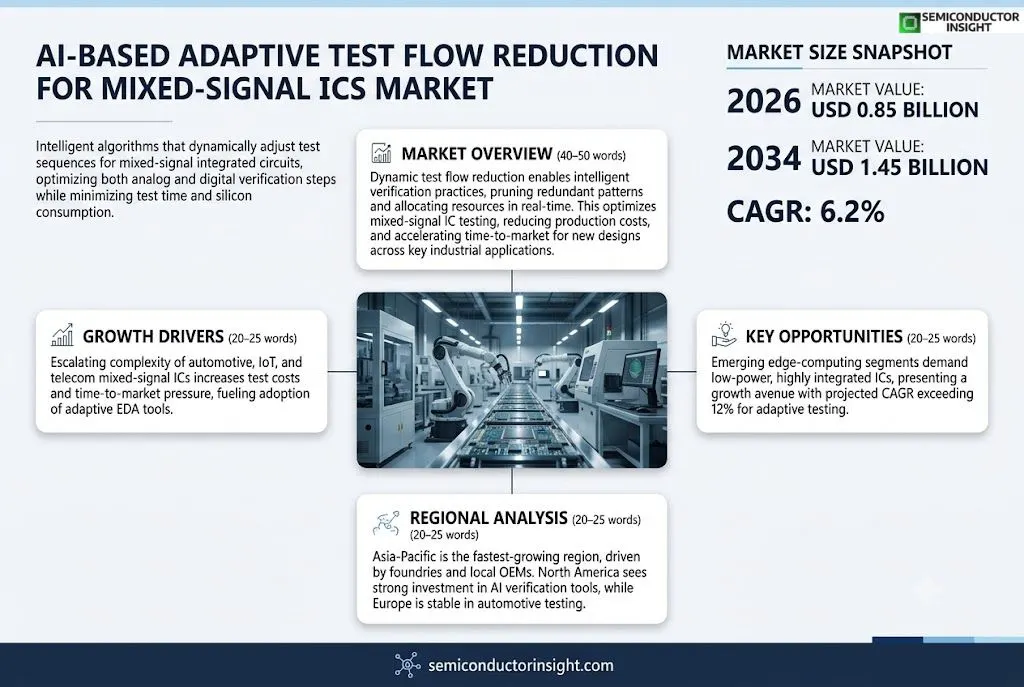
AI-Based Adaptive Test Flow Reduction for Mixed-Signal ICs market size was valued at USD 0.85 billion in 2025. The market is projected to grow from USD 0.85 billion in 2025 to USD 1.45 billion by 2034, exhibiting a CAGR of 6.2% during the forecast period.
AI‑Based Adaptive Test Flow Reduction refers to intelligent algorithms that dynamically adjust test sequences for mixed‑signal integrated circuits, optimizing both analog and digital verification steps while minimizing test time and silicon consumption. By leveraging machine learning models trained on historical test data, these solutions can predict failure hotspots, prune redundant vectors, and re‑allocate resources in real time, thereby improving yield and reducing overall development cost.The market is experiencing rapid growth due to several factors, including escalating design complexity of mixed‑signal ICs, heightened pressure to shorten time‑to‑market, and increasing adoption of AI‑driven EDA tools across semiconductor fabs. Furthermore, rising demand for automotive electronics and IoT devices drives manufacturers to seek cost‑effective testing strategies. Initiatives by key players such as Cadence Design Systems, Synopsys Inc., and Siemens EDA are expected to fuel expansion; recent collaborations between these firms and leading foundries aim to integrate adaptive test flow modules directly into production pipelines.
MARKET DRIVERS
Increasing Complexity of Mixed‑Signal Designs
The rapid integration of analog and digital blocks in automotive, IoT and telecom chips has elevated test time and cost. AI‑Based Adaptive Test Flow Reduction for Mixed‑Signal ICs Market addresses this pressure by automatically tailoring test vectors, delivering up to 30% cycle‑time savings while preserving defect coverage.
Demand for Faster Time‑to‑Market
Product launch windows are shrinking, especially for 5G and autonomous‑vehicle modules. Companies adopting AI‑driven test optimization report a 15% reduction in silicon‑validation lead time, enabling earlier revenue capture and improved competitive positioning.
➤ “Adaptive test flow cuts debug effort by half, freeing engineering resources for next‑generation features.”
Regulatory pressures for reliability, coupled with rising test‑equipment costs, further motivate fabs to explore intelligent test solutions. The convergence of AI expertise and mixed‑signal testing creates a compelling value proposition that fuels market growth.
MARKET CHALLENGES
Data Quality and Model Robustness
Effective AI‑based adaptation relies on high‑fidelity historical test data. Inconsistencies in legacy datasets can impair model training, leading to sub‑optimal vector selection and potential yield risks.
Other Challenges
Integration with Legacy Test Platforms
Many design houses operate entrenched test ecosystems. Seamlessly embedding adaptive algorithms without disrupting existing workflows requires extensive customization and skilled personnel, raising implementation barriers.
MARKET RESTRAINTS
High Up‑Front Investment
The deployment of AI‑enabled test platforms necessitates upfront capital for hardware upgrades, software licensing, and staff training. Small‑to‑mid‑size fabs often perceive these costs as prohibitive, limiting broader adoption despite long‑term efficiency gains.
MARKET OPPORTUNITIES
Emerging Edge‑Computing Segments
Edge‑computing devices demand low‑power, highly integrated mixed‑signal ICs. The need for rapid, cost‑effective testing in this fast‑growing segment presents a significant growth avenue for AI‑Based Adaptive Test Flow Reduction for Mixed‑Signal ICs Market, with projected CAGR exceeding 12% through 2032.
AI-Based Adaptive Test Flow Reduction for Mixed-Signal ICs Market Trends
Intelligent Test Sequence Optimization
The adoption of AI‑Based Adaptive Test Flow Reduction for Mixed‑Signal ICs is reshaping verification practices across semiconductor fabs. By continuously learning from historical test data, the algorithms prioritize high‑risk vectors, prune redundant patterns, and dynamically allocate test resources. This intelligent sequencing shortens test cycles, reduces silicon consumption, and lifts overall yield without compromising defect coverage. Companies are reporting noticeable reductions in test time, often translating into lower production costs and faster time‑to‑market for new designs. The approach also aligns with broader industry moves toward model‑driven verification, where predictive analytics replace exhaustive manual test banks. Furthermore, the seamless handoff between design intent and test execution is facilitated by standardized data models, which reduces manual configuration effort and improves traceability across product revisions. Analysts observe that early‑stage adoption is accelerating as foundries incorporate the technology into their qualification pipelines, leading to measurable improvements in first‑pass yield.
Other Trends
Automotive and IoT Influence
Automotive electronics and the expanding Internet of Things ecosystem are major catalysts for the AI‑Based Adaptive Test Flow Reduction for Mixed‑Signal ICs Market. Modern vehicles integrate dozens of mixed‑signal chips for power management, sensor fusion, and advanced driver‑assist systems, each requiring rigorous validation under tight cost constraints. Likewise, IoT devices demand low‑power, high‑reliability analog‑digital interfaces that must be qualified quickly to keep pace with rapid product cycles. In both domains, manufacturers face pressure to minimize test silicon while maintaining safety‑critical performance, making adaptive test flow solutions particularly valuable. Early adopters report that predictive hotspot detection enables targeted stress testing, which shortens validation windows and reduces the overall bill‑of‑materials for test hardware. Regulatory frameworks such as ISO 26262 for automotive safety are increasingly referencing robust verification methods, prompting designers to embed adaptive testing early in the development flow. The resulting reduction in silicon waste also aligns with sustainability goals, as fewer test dies translate into lower material consumption per volume.
Consolidation of AI‑EDA Platforms
The competitive landscape reflects a convergence of traditional EDA vendors and specialist AI firms. Leaders such as Cadence Design Systems, Synopsys Inc., and Siemens EDA have announced joint development programs with major foundries to embed adaptive test modules directly into production toolchains. These collaborations aim to streamline data exchange between design and test environments, ensuring that learned models are continuously refreshed with silicon‑level feedback. As the ecosystem matures, smaller startups focusing on niche machine‑learning kernels are also gaining traction through strategic partnerships. Overall, the AI‑Based Adaptive Test Flow Reduction for Mixed‑Signal ICs Market is expected to sustain its momentum, driven by the relentless push for lower cost, higher yield, and shorter development cycles across automotive and IoT segments. Looking ahead, cloud‑based analytics platforms are expected to host shared model repositories, enabling smaller design houses to leverage collective intelligence without heavy upfront investment. Such democratization of AI capabilities could further compress validation timelines and support the industry’s broader shift toward greener manufacturing practices.
COMPETITIVE LANDSCAPE
Key Industry Players
AI‑Based Adaptive Test Flow Reduction for Mixed‑Signal ICs Market Overview
Cadence Design Systems anchors the market with its comprehensive AI‑driven verification suite, which integrates adaptive test flow modules directly into its Virtuoso and Spectre ecosystems. Synopsys follows closely, leveraging its PrimeTime and Custom Designer platforms to offer predictive failure analysis that trims redundant test vectors while preserving yield. Siemens EDA (formerly Mentor Graphics) differentiates through a tightly coupled hardware‑software co‑simulation environment, allowing foundries to embed real‑time test‑flow adjustments on the production line. The dominance of these three firms creates a tiered structure: a handful of large vendors supply end‑to‑end solutions, while a secondary tier of specialized tool providers focuses on niche analog‑digital integration challenges.Beyond the incumbents, a growing cohort of niche players is expanding the competitive set. Keysight Technologies contributes precision measurement instrumentation that feeds high‑resolution data into machine‑learning models. Ansys offers advanced simulation‑based test reduction for RF‑mixed‑signal blocks. Teradyne and Advantest provide high‑throughput tester platforms increasingly equipped with AI analytics for vector pruning. National Instruments supplies flexible data‑acquisition frameworks that can be customized for adaptive testing pipelines. Emerging firms such as TestScience, Xilinx (through its adaptive verification IP), and Caduceus Labs are also gaining traction by bundling AI algorithms with cloud‑native test orchestration services.
List of Key AI-Based Adaptive Test Flow Reduction for Mixed-Signal ICs Companies Profiled
- Cadence Design Systems
- Synopsys Inc.
- Siemens EDA
- Keysight Technologies
- ANSYS, Inc.
- Teradyne, Inc.
- Advantest Corporation
- National Instruments Corporation
Segment Analysis:
Segment Category |
Sub-Segments | Key Insights |
| By Type |
|
Algorithmic Adaptive Test
|
| By Application |
|
Automotive Electronics
|
| By End User |
|
Fab Test Engineers
|
| By Integration Model |
|
Embedded AI Module
|
| By Value Proposition |
|
Cost Reduction
|
Regional Analysis: AI-Based Adaptive Test Flow Reduction for Mixed-Signal ICs Market
North America
Strategic drivers in North America combine the push for reduced product development cycles with the need to manage rising test costs. Companies adopt AI‑based adaptive test flow to concentrate testing effort on critical paths, decreasing overall test time while maintaining reliability standards. The emphasis on sustainability also motivates the adoption of smarter test strategies that lower energy consumption during verification.
Innovation landscape is characterized by close collaboration between silicon vendors and AI software firms. Joint efforts yield proprietary models that learn from historical test data, enabling predictive adjustments to test vectors in real time. This synergy accelerates the rollout of adaptive test suites across multiple mixed‑signal platforms, fostering a culture of continuous improvement.
Regulatory bodies in the United States and Canada have issued guidance encouraging risk‑based verification, aligning with adaptive test principles. While formal standards for AI‑assisted testing are evolving, industry consortia are drafting best‑practice frameworks that promote data integrity and model transparency, easing adoption across safety‑critical applications.
The talent pool is shifting toward engineers skilled in both mixed‑signal design and data science. Academic programs are integrating machine‑learning curricula tailored to semiconductor test, while companies invest in upskilling initiatives. This hybrid expertise accelerates the deployment of adaptive test flows, ensuring that the workforce can translate algorithmic insights into actionable test strategies.
Europe
Europe maintains a robust presence in AI-Based Adaptive Test Flow Reduction for Mixed-Signal ICs Market, driven by its strong automotive and industrial automation sectors. Leading design houses in Germany, France, and the United Kingdom are experimenting with adaptive test algorithms to align with stringent emission and safety regulations. Collaborative research projects funded by the European Union promote cross‑border data sharing, allowing manufacturers to build comprehensive failure models that span multiple product families. While the region emphasizes compliance and standardization, the gradual integration of AI into test flows reflects a cautious yet steady progression toward more efficient verification cycles.
Asia-Pacific
The Asia‑Pacific region emerges as a high‑growth hub for AI-Based Adaptive Test Flow Reduction for Mixed‑Signal ICs Market, powered by rapid commercialization of consumer electronics and 5G infrastructure. Semiconductor fabs in Taiwan, South Korea, and Singapore are incorporating adaptive testing to cope with escalating design complexity and intense cost pressures. Local OEMs benefit from close proximity to foundries, facilitating rapid feedback loops where AI‑driven test data is fed directly into design revisions. Government initiatives supporting smart manufacturing and digital transformation further accelerate the adoption of adaptive test platforms. Although the market is still maturing, the confluence of technology readiness and aggressive product road‑maps positions Asia‑Pacific as a catalyst for advancement.
South America
South America, anchored by Brazil and Mexico, is beginning to explore the AI-Based Adaptive Test Flow Reduction for Mixed‑Signal ICs Market as manufacturers target the region’s growing automotive and renewable energy sectors. Early adopters focus on leveraging adaptive test techniques to offset limited test equipment inventories, optimizing utilization through predictive test sequencing. Partnerships with North American technology providers introduce advanced AI models, while local universities contribute research on data‑driven test optimization. Although infrastructure constraints pose challenges, the region’s emphasis on cost efficiency and faster time‑to‑market fosters a budding interest in adaptive testing solutions.
Middle East & Africa
The Middle East & Africa region presents a nascent yet promising landscape for AI-Based Adaptive Test Flow Reduction for Mixed‑Signal ICs Market, largely driven by emerging semiconductor assembly facilities and increasing demand for smart devices. In the United Arab Emirates and South Africa, companies are piloting AI‑enhanced test workflows to improve yield predictability amidst constrained testing budgets. Regional trade initiatives encourage technology transfer from established markets, allowing local firms to adopt adaptive test strategies without extensive R&D investment. While the market remains in its infancy, the focus on digital transformation and alignment with best practices suggests a gradual, upward trajectory in adoption over the coming years.
Report Scope
This market research report provides a comprehensive analysis of the AI-Based Adaptive Test Flow Reduction for Mixed-Signal ICs Market , covering the forecast period 2026–2034. It offers detailed insights into market dynamics, technological advancements, competitive landscape, and key trends shaping the industry.
Key focus areas of the report include:
- Market Overview: The report begins with an overview outlining its current market scenario, key growth indicators, and industry transformation drivers. It discusses macroeconomic factors, demand–supply balance, regulatory landscape, and the strategic role of semiconductors in powering advancements across industries such as automotive, telecommunications, consumer electronics, and industrial automation.
- Market Size & Forecast: Historical data and future projections for revenue, unit shipments, and market value across major regions and segments.
- Segmentation Analysis: Detailed breakdown by product type, technology, application, and end-user industry to identify high-growth segments and investment opportunities.
- Regional Insights: Insights into market performance across North America, Europe, Asia-Pacific, Latin America, and the Middle East & Africa, including country-level analysis where relevant.
- Competitive Landscape: Profiles of leading market participants, including their product offerings, R&D focus, manufacturing capacity, pricing strategies, and recent developments such as mergers, acquisitions, and partnerships.
- Technology Trends & Innovation: Assessment of emerging technologies, integration of AI/IoT, semiconductor design trends, fabrication techniques, and evolving industry standards.
- Market Drivers & Restraints: Evaluation of factors driving market growth along with challenges, supply chain constraints, regulatory issues, and market-entry barriers.
- Stakeholder Insights: Insights for component suppliers, OEMs, system integrators, investors, and policymakers regarding the evolving ecosystem and strategic opportunities.
Primary and secondary research methods are employed, including interviews with industry experts, data from verified sources, and real-time market intelligence to ensure the accuracy and reliability of the insights presented.
FREQUENTLY ASKED QUESTIONS:
What is the current market size of AI-Based Adaptive Test Flow Reduction for Mixed-Signal ICs Market?
-> AI-Based Adaptive Test Flow Reduction for Mixed-Signal ICs Market was valued at USD 0.85 billion in 2025 and is expected to reach USD 1.45 billion by 2034.
Which key companies operate in AI-Based Adaptive Test Flow Reduction for Mixed-Signal ICs Market?
-> Key players include Cadence Design Systems, Synopsys Inc., Siemens EDA, among others.
What are the key growth drivers?
-> Key growth drivers include escalating design complexity of mixed‑signal ICs, pressure to shorten time‑to‑market, and adoption of AI‑driven EDA tools.
Which region dominates the market?
-> Asia-Pacific is the fastest‑growing region, while Europe remains a dominant market.
What are the emerging trends?
-> Emerging trends include AI‑enhanced model‑based testing, cloud‑based verification platforms, and real‑time adaptive test flow integration.
Get Sample Report PDF for Exclusive Insights
Report Sample Includes
- Table of Contents
- List of Tables & Figures
- Charts, Research Methodology, and more...
 Download Sample Report PDF