AI Audio and Video Chip Market Insights
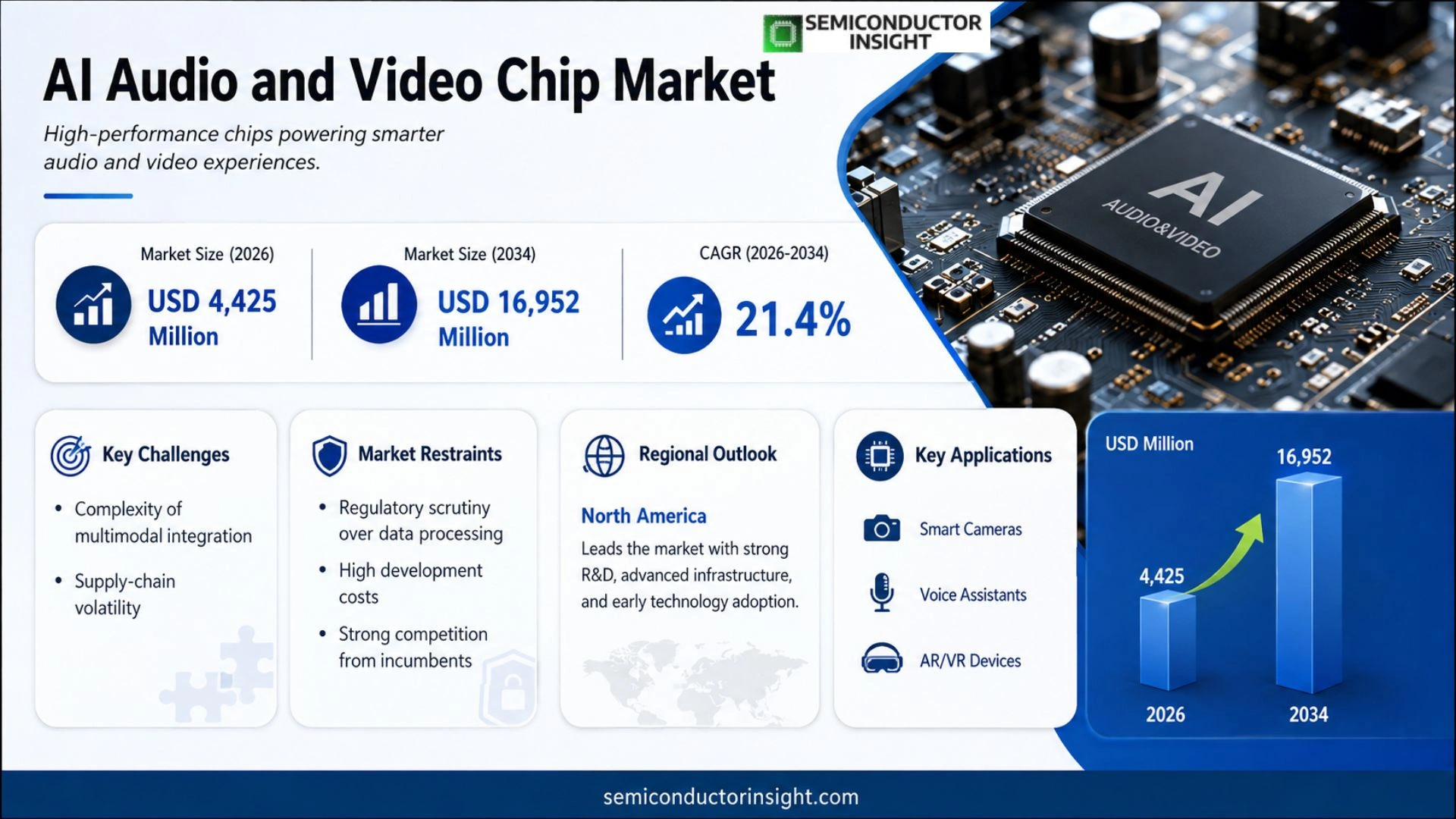
AI Audio and Video Chip market will grow from USD 4,425 million in 2026 to USD 16,952 million by 2034, exhibiting a CAGR of 21.4% during the forecast period.
AI audio and video chips are a class of edge semiconductors that combine sound capture, voice front‑end processing, image sensing, image‑signal processing, video encoding/decoding and neural‑network inference on a single
MARKET DRIVERS
Rising Demand for Edge‑AI Processing
Enterprises are relocating inference workloads from data centers to edge devices to cut latency and bandwidth costs. This shift fuels the need for specialized AI audio and video chip solutions that can execute neural‑network models locally. Manufacturers that embed these chips into cameras, smart speakers, and wearables gain a tangible performance edge, prompting OEMs to prioritize integration.
Proliferation of Immersive Media Formats
Streaming platforms and gaming ecosystems have embraced 8K video, spatial audio, and real‑time avatar rendering. Delivering such high‑fidelity experiences requires hardware capable of parallel processing and low‑power consumption,attributes that modern AI chips provide. Consequently, content creators are incentivized to select chipsets that guarantee seamless decoding and up‑mixing, accelerating adoption across the supply chain.
➤ “By 2028, more than 60 % of new consumer devices will ship with at least one AI‑accelerated audio or video processor.”
Investment funds are allocating capital toward start‑ups that offer proprietary AI‑optimized silicon. The capital influx not only spurs R&D but also shortens time‑to‑market for innovative designs, reinforcing the upward trajectory of AI Audio and Video Chip Market.
MARKET CHALLENGES
Complexity of Multimodal Integration
Designers must reconcile divergent data streams,audio, video, and sometimes sensor inputs,within a single silicon footprint. Balancing power budgets while maintaining algorithmic accuracy stretches engineering resources. Companies lacking deep expertise in both signal processing and AI risk product delays, which erodes confidence among downstream partners.
Other Challenges
Supply‑Chain Volatility
Component shortages, particularly for high‑performance memory and advanced lithography equipment, create bottlenecks. Manufacturers that cannot secure a reliable feedstock may experience fluctuating lead times, compelling customers to seek alternative suppliers.
MARKET RESTRAINTS
Regulatory Scrutiny over Data Processing
Legislations such as data‑localization rules and privacy mandates impose stringent requirements on on‑device AI inference. Chip makers must certify that their hardware can enforce encryption and audit trails without sacrificing performance. The added compliance burden raises development costs, deterring smaller players from entering the market.
Another restraint stems from the high upfront capital expenditure associated with cutting‑edge fab facilities. Companies that rely on third‑party foundries face price premiums, which can compress margins for end‑product manufacturers.
Lastly, entrenched incumbents in the broader semiconductor arena maintain strong relationships with key OEMs, making it difficult for newcomers to secure design‑win opportunities without offering a clear cost or functionality advantage.
MARKET OPPORTUNITIES
Customized AI Pipelines for Automotive Infotainment
The automotive sector is expanding its in‑cabin experience through voice assistants, gesture‑based controls, and high‑definition rear‑seat entertainment. Tailoring AI audio and video chips to meet automotive-grade reliability and temperature specifications opens a lucrative niche. Suppliers that bundle software stacks with silicon can lock in long‑term contracts, delivering recurring revenue streams.
Another promising avenue lies in Edge‑AI for Remote Healthcare, where real‑time video analysis and ambient sound monitoring support tele‑diagnostics. Chipsets optimized for low latency and low power consumption align with the strict regulatory and operational demands of medical devices, presenting a growth corridor for firms willing to navigate compliance pathways.
AI Audio and Video Chip Market Trends
Edge Intelligence Integration Fuels Chip Evolution
AI Audio and Video Chip Market is reshaping edge device architectures as manufacturers replace legacy multimedia SoCs with chips that embed sound capture, image sensing, and neural inference on a single die. Valued at $4,425 million in 2025, the market is forecasted to reach $16,952 million by 2034, reflecting relentless pressure to keep processing local, cut bandwidth, and lower power draw. Chip designers are concentrating on ultra‑low‑power always‑on blocks, on‑sensor AI for image pipelines, and secure boot mechanisms that satisfy emerging data‑privacy rules. Alongside hardware advances, the proliferation of ready‑made AI models and open‑source toolchains lowers the barrier for system integrators to embed sophisticated perception capabilities. This shift enables devices,from smart speakers to autonomous‑driving cameras,to recognise wake words, filter background noise, decode HDR video, and run object‑detection models without touching the cloud.
Other Trends
Convergence of Audio, Video, and AI Functions
The most visible development is the tight convergence of audio, video, and AI functions onto a unified silicon platform. Earlier generations handled either codec acceleration or basic voice activation; today’s parts host multi‑microphone arrays, noise‑cancellation DSPs, high‑dynamic‑range ISP blocks, and NPU cores that share memory bandwidth. By co‑locating these modules, manufacturers reduce board‑level complexity and achieve latency under a few milliseconds for tasks such as wake‑word detection followed by on‑device speech‑to‑text. The shared memory architecture also simplifies model deployment, allowing a single trained network to serve both audio wake‑word detection and visual object classification, which in turn shortens development cycles for multi‑modal products. Suppliers such as Ambarella, Sony, and MediaTek illustrate the trend by shipping vision processors that embed AI‑enhanced ISP alongside video encoders, while Qualcomm’s latest Snapdragon integrates a dedicated audio NPU.
Regulatory Pressures and Supply‑Chain Realignment
Regulatory frameworks are turning compliance into a baseline requirement rather than an optional feature. The EU’s AI Act and Cyber Resilience Act demand secure boot, tamper‑evident updates, and documented data‑handling practices for any device that processes audio or video locally. Manufacturers that embed these safeguards into their silicon gain immediate entry to European and North‑American markets, while peers lacking such capabilities face certification delays. At the same time, the design ecosystem is consolidating around a few regions,United States, Japan, South Korea, Taiwan, and mainland China,where advanced process nodes and AI‑centric EDA tools are readily available. This concentration pushes smaller vendors toward niche special‑purpose sensors, whereas platform players expand their portfolio with end‑to‑end SDKs, accelerating time‑to‑market for automotive and industrial clients. Consequently, customers are willing to accept higher average selling prices for chips that promise longer product lifecycles and compliance‑ready designs.
COMPETITIVE LANDSCAPE
Key Industry Players
AI Audio‑Video Chip Market – Competitive Overview
The market is anchored by a handful of silicon giants that have transitioned from traditional multimedia SoCs to integrated edge‑intelligence platforms. Qualcomm, MediaTek and Samsung dominate the consumer‑grade segment by leveraging massive R&D budgets to combine ultra‑low‑power audio front‑ends, vision processors and on‑device neural engines in a single package. Their advantage lies not only in silicon performance but also in the breadth of software toolchains, reference designs and developer ecosystems that lower time‑to‑market for OEMs. Ambarella and Hailo have carved out leadership in high‑performance vision chips for surveillance cameras and autonomous‑driving perception, offering dedicated NPU blocks that accelerate object detection while keeping power draw under tight budgets. The convergence of audio, video and AI functions in these firms creates a de‑facto platform layer, compelling system integrators to favor suppliers that can guarantee silicon, firmware and security updates across product lifecycles.
Beyond the dominant tier, a diverse set of niche players sustains innovation in specialized form factors and regional markets. Sony’s on‑sensor AI approach supplies premium imaging modules for professional cameras, whereas Renesas and Texas Instruments focus on industrial‑grade MCUs that embed modest AI capabilities for predictive maintenance. Companies such as Himax, Realtek and Synaptics address the mid‑range smart‑speaker and ear‑bud segments with cost‑optimized audio AI cores. Emerging Chinese designers,including Ingenic, Rockchip and Allwinner,are expanding the affordable edge segment for smart home devices, leveraging foundry partnerships to compete on price while gradually enhancing AI inference stacks. This layered ecosystem ensures that customers can select a solution that matches power, performance and pricing constraints, fostering a competitive environment that rewards both scale and specialization.
List of Key AI Audio and Video Chip Companies Profiled
- Qualcomm
- MediaTek
- Samsung Electronics
- Ambarella
- Hailo Technologies
- Sony Group Corporation
- Renesas Electronics Corporation
- Texas Instruments Incorporated
- NXP Semiconductors
- STMicroelectronics
- Himax Technologies, Inc.
- Realtek Semiconductor Corp.
- Synaptics Incorporated
- Allwinner Technology
- Rockchip
Segment Analysis:
| Segment Category | Sub-Segments | Key Insights |
| By Type |
|
Integrated Audio‑Video AI Chips are becoming the cornerstone of edge intelligence:
|
| By Application |
|
Monitoring Equipment (Smart Cameras & Security) drives market momentum:
|
| By End User |
|
Industrial & Robotics emerges as a high‑value segment:
|
| By Integration Level |
|
Embedded NPUs in MPUs attract designers seeking balanced performance:
|
| By Security & Privacy Features |
|
Secure Boot Enabled is increasingly a market prerequisite:
|
Regional Analysis: AI Audio and Video Chip Market
North America
Companies are pursuing aggressive M&A to acquire niche AI‑audio IP while bolstering video‑codec expertise. Private‑equity funds target start‑ups that demonstrate differentiated low‑power architectures, fostering a consolidation wave that reshapes the competitive hierarchy.
Advanced packaging facilities in the United States and Canada mitigate bottlenecks in wafer processing. Firms are diversifying substrate sources and securing long‑term material agreements to shield production from geopolitical volatility.
Emerging guidance on AI transparency influences chip‑level auditability. Export‑control revisions specifically address high‑performance video encoders, prompting manufacturers to embed compliance modules within silicon designs.
Adaptive audio processing for AR/VR headsets and on‑vehicle infotainment systems drives demand for chips that blend neural inference with real‑time video stitching, expanding the market beyond traditional consumer electronics.
Europe
Europe leverages its strong automotive engineering base to embed AI audio and video functionality into next‑generation driver‑assistance platforms. German and French manufacturers prioritize chips that can process multi‑camera feeds and directional sound cues without relying on external servers, aligning with the EU’s emphasis on data sovereignty. Additionally, the region’s collaborative research initiatives, funded through Horizon Europe, accelerate prototypes that fuse spatial audio rendering with real‑time video analytics for immersive media experiences. While supply constraints persist, strategic partnerships with Taiwanese fabs provide a buffer, allowing European firms to maintain a competitive edge in AI Audio and Video Chip Market.
Asia‑Pacific
The Asia‑Pacific arena exhibits a heterogeneous landscape, with China’s massive consumer electronics volume driving high‑density AI audio‑video integration, while Japan and South Korea focus on precision video encoding for premium displays. Mobile carriers in the region are rolling out 5G‑enabled devices that demand on‑device AI processing to minimize latency, prompting chipset designers to prioritize power‑efficient neural accelerators. Government incentives in China encourage local fab expansion, yet export‑control tensions push some firms to diversify design houses across the Pacific. Consequently, the region’s agility in scaling production and tailoring solutions keeps it at the forefront of AI Audio and Video Chip Market evolution.
South America
In South America, Brazil’s burgeoning digital entertainment sector fuels interest in cost‑effective AI audio and video solutions that can be integrated into low‑priced smartphones and smart TVs. Local OEMs favor chips offering a balanced trade‑off between performance and energy consumption, reflecting the region’s limited access to high‑end power infrastructure. Collaborative programs between regional universities and multinational vendors nurture home‑grown talent, gradually reducing reliance on imported design services. Although market depth remains modest, these grassroots initiatives position South America as an emerging contributor to the broader AI Audio and Video Chip Market.
Middle East & Africa
The Middle East & Africa market is shaped by ambitious smart‑city projects, particularly in the United Arab Emirates and Saudi Arabia, where AI‑enhanced surveillance and immersive media installations are gaining traction. Demand centers on chips capable of processing multi‑stream video feeds while delivering spatial audio for public‑address systems. Limited domestic fabrication leads to a heavy import orientation, motivating regional distributors to forge long‑term supply agreements with North American and Asian manufacturers. Regulatory attention on data privacy is intensifying, compelling vendors to embed encryption and AI‑audit features directly into silicon, thereby influencing the strategic direction of AI Audio and Video Chip Market in the region.
Report Scope
This market research report provides a comprehensive analysis of the AI Audio and Video Chip Market , covering the forecast period 2026–2034. It offers detailed insights into market dynamics, technological advancements, competitive landscape, and key trends shaping the industry.
Key focus areas of the report include:
- Market Overview: The report begins with an overview outlining its current market scenario, key growth indicators, and industry transformation drivers. It discusses macroeconomic factors, demand–supply balance, regulatory landscape, and the strategic role of semiconductors in powering advancements across industries such as automotive, telecommunications, consumer electronics, and industrial automation.
- Market Size & Forecast: Historical data and future projections for revenue, unit shipments, and market value across major regions and segments.
- Segmentation Analysis: Detailed breakdown by product type, technology, application, and end-user industry to identify high-growth segments and investment opportunities.
- Regional Insights: Insights into market performance across North America, Europe, Asia-Pacific, Latin America, and the Middle East & Africa, including country-level analysis where relevant.
- Competitive Landscape: Profiles of leading market participants, including their product offerings, R&D focus, manufacturing capacity, pricing strategies, and recent developments such as mergers, acquisitions, and partnerships.
- Technology Trends & Innovation: Assessment of emerging technologies, integration of AI/IoT, semiconductor design trends, fabrication techniques, and evolving industry standards.
- Market Drivers & Restraints: Evaluation of factors driving market growth along with challenges, supply chain constraints, regulatory issues, and market-entry barriers.
- Stakeholder Insights: Insights for component suppliers, OEMs, system integrators, investors, and policymakers regarding the evolving ecosystem, and strategic opportunities.
Primary and secondary research methods are employed, including interviews with industry experts, data from verified sources, and real-time market intelligence to ensure the accuracy and reliability of the insights presented.
FREQUENTLY ASKED QUESTIONS:
What is the current market size of AI Audio and Video Chip Market?
-> AI Audio and Video Chip market will grow from USD 4,425 million in 2026 to USD 16,952 million by 2034, exhibiting a CAGR of 21.4%
Which key companies operate in AI Audio and Video Chip Market?
-> Key players include Ambarella, Inc., Synaptics Incorporated, XMOS Ltd., NXP Semiconductors, Texas Instruments Incorporated, Hailo Technologies Ltd., Qualcomm, Intel, Infineon Technologies, STMicroelectronics, Amlogic, Sony Group Corporation, Renesas Electronics Corporation, Socionext Inc., Samsung Electronics Co., Ltd., DEEPX Co., Ltd., Mobilint, Inc., Telechips Inc., MediaTek, Himax Technologies, Inc., Novatek Microelectronics Corp., Realtek Semiconductor Corp., Rockchip, Allwinner Technology, Beijing Ingenic IC Co., Ltd., Huawei Technologies Co., Ltd.
What are the key growth drivers?
-> Key growth drivers include the convergence of audio, video, AI and system security, rising demand for edge‑intelligence in smart cameras, speakers, automotive and industrial automation, and the need for low‑latency, low‑power on‑device processing.
Which region dominates the market?
-> Asia-Pacific leads in shipment volume and revenue growth, while North America remains a major market for advanced AI chip designs.
What are the emerging trends?
-> Emerging trends include on‑sensor AI, AI‑powered ISP, NPU acceleration, secure boot, ultra‑low‑power always‑on operation, and integrated audio‑video AI system‑on‑chips.
Get Sample Report PDF for Exclusive Insights
Report Sample Includes
- Table of Contents
- List of Tables & Figures
- Charts, Research Methodology, and more...