AI-Assisted SiC Crystal Growth for AI Power Devices Market Insights
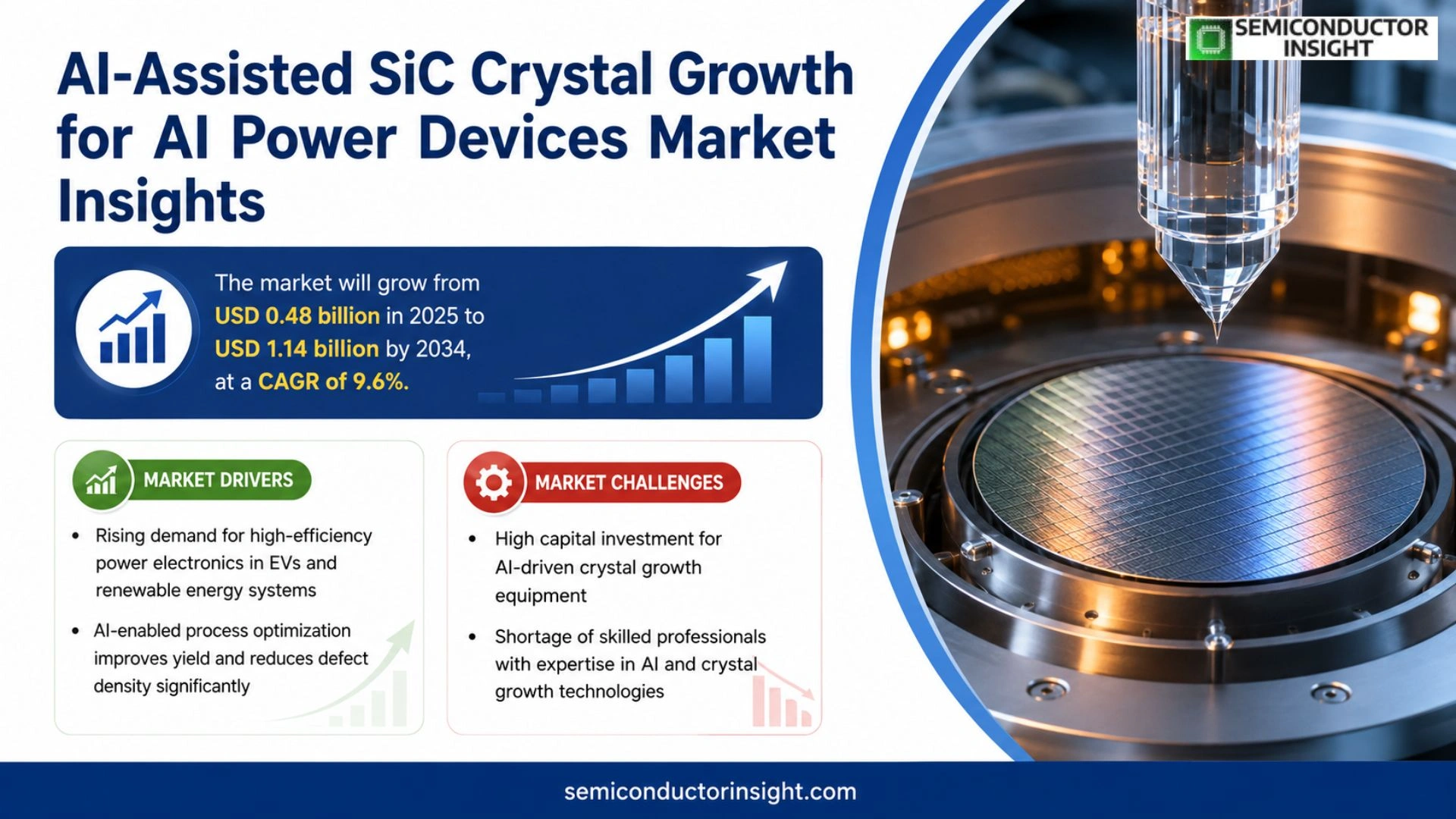
Global AI-assisted Sic Crystal Growth for AP Power Devices market size was valued at USD 0.48 billion in 2025 and will rise from USD 0.48 billion in 2025 to USD 1.14 billion by 2034, exhibiting a CAGR of 9.6% during the forecast period.
AI‑assisted silicon‑carbide (SiC) crystal growth combines machine‑learning models with traditional physical vapor transport or chemical vapor deposition processes to optimise temperature gradients, gas flow dynamics and defect suppression in real time. By analysing sensor streams and historical run data, the system predicts optimal nucleation conditions, reduces wafer‑break rates and shortens cycle times,critical attributes for power devices that must operate under high voltage and temperature stress.
The market accelerates because semiconductor manufacturers allocate increasing capital toward high‑efficiency power conversion solutions for data‑center AI accelerators and electric‑vehicle drivetrains. Moreover, recent collaborations such as Wolfspeed’s partnership with an AI‑software firm in early 2024 have demonstrated measurable yield improvements of up to 15 percent. Established players,including Infineon Technologies, ON Semiconductor and STMicroelectronics,are expanding their portfolios with AI‑driven process control suites, reinforcing the commercial momentum of this niche segment.
MARKET DRIVERS
Rising Demand for High‑Efficiency Power Electronics
The surge in electric‑vehicle adoption and renewable‑energy integration forces manufacturers to seek devices that can handle higher voltages with lower conduction losses. Silicon‑carbide (SiC) substrates meet these criteria, and AI‑assisted crystal growth accelerates yield, making large‑scale deployment financially viable.
AI‑Enabled Process Optimization
Machine‑learning algorithms analyze real‑time furnace data, pinpointing temperature gradients that traditionally cause dislocations. By correcting these anomalies on the fly, producers cut scrap rates by double‑digit percentages, directly boosting profit margins.
➤ “Integrating AI into SiC crystal growth has reduced defect density from 5 × 10⁴ cm⁻² to under 1 × 10³ cm⁻² in pilot plants.”
These operational gains dovetail with stricter efficiency standards worldwide, prompting OEMs to specify AI‑assisted SiC components for next‑generation AI power devices. The combined effect fuels a tangible upward shift in market activity.
MARKET CHALLENGES
Capital Intensity of Advanced Equipment
Deploying AI‑driven crystal growth stations requires multi‑million‑dollar investments in high‑precision heaters, sensor arrays, and computing infrastructure. Smaller suppliers often lack the balance sheet depth to fund such upgrades, limiting competitive breadth.
Other Challenges
Talent Gap
The convergence of semiconductor processing and data science creates a niche talent pool. Firms struggle to recruit engineers proficient in both crystal growth physics and AI model development, slowing adoption cycles.
MARKET RESTRAINTS
Regulatory Hurdles in New Materials
Certification bodies have yet to formalize testing protocols for AI‑enhanced SiC crystals, extending approval timelines for aerospace and automotive applications. This regulatory lag reduces the speed at which innovative products can reach end‑users.
Furthermore, export controls on advanced semiconductor equipment in certain jurisdictions restrict cross‑border technology transfer, compelling producers to establish redundant facilities, which inflates overall cost structures.
These constraints collectively dampen the pace of market expansion, especially for firms operating in highly regulated regions.
MARKET OPPORTUNITIES
Expansion of Edge‑Computing Power Supplies
Edge devices for AI inference demand compact, high‑density power modules. AI‑assisted SiC crystal growth delivers substrates capable of operating at higher switching frequencies, enabling smaller form factors without sacrificing thermal performance.
The convergence of 5G rollout and industrial IoT creates a sizable addressable market for these compact power solutions. Early movers that align product roadmaps with AI‑driven SiC advancements can capture premium pricing.
Additionally, collaborations between semiconductor foundries and AI software firms are emerging, offering joint development programs that accelerate time‑to‑market for bespoke AI power devices.
AI-Assisted SiC Crystal Growth for AI Power Devices Market Trends
AI-Enabled Process Optimization Accelerates Yield Improvements
The integration of machine‑learning algorithms into silicon‑carbide (SiC) crystal growth has shifted the technology from a largely empirical practice to a data‑centric operation. Real‑time analysis of temperature gradients, gas flow patterns and defect formation enables the system to adjust parameters on the fly, reducing wafer‑break incidents and shortening each growth cycle. For manufacturers of AI power devices, where voltage tolerance and thermal resilience are non‑negotiable, these efficiency gains translate directly into higher production volumes and lower per‑unit cost.
Other Trends
Strategic Alliances Between SiC Foundries and AI Software Specialists
Early‑2024 saw a notable partnership in which a leading SiC wafer producer joined forces with an AI‑software firm to embed predictive analytics into its vapor‑transport reactors. The collaboration reported yield lifts of around fifteen percent, a figure that validates the commercial relevance of algorithm‑driven process control. Such alliances are prompting other incumbents to seek similar arrangements, creating a cascade of technology transfer across the supply chain.
Broadening Portfolio of AI Power Devices by Established Semiconductor Companies
Companies such as Infineon, ON Semiconductor and STMicroelectronics have begun to embed AI‑assisted SiC growth capabilities within their broader product roadmaps. By offering customers a tighter link between crystal quality and device performance, these firms are positioning themselves to capture the rising demand for high‑efficiency converters in data‑center accelerators and electric‑vehicle drivetrains. Their move signals a strategic shift: rather than treating SiC crystal production as a commodity service, they are treating it as a differentiated lever for device reliability.
COMPETITIVE LANDSCAPE
Key Industry Players
AI‑Assisted SiC Crystal Growth for AI Power Devices
Wolfspeed remains the benchmark supplier, having integrated an AI‑driven control layer into its physical vapor transport lines. The partnership forged in early 2024 with a specialized AI‑software firm enabled real‑time adjustment of temperature gradients and gas chemistry, delivering yield lifts that translate into measurable cost savings for data‑center and electric‑vehicle OEMs. Wolfspeed’s breadth of 150‑mm SiC wafer capacity and its willingness to embed machine‑learning algorithms in the equipment stack give it a distinct advantage in shaping the value chain, from raw material procurement to final device shipment.
Beyond the market leader, a cohort of established and emerging firms is intensifying competition. Infineon Technologies and ON Semiconductor have each launched AI‑enabled process modules that sit atop conventional CVD reactors, targeting niche high‑voltage segments such as rail‑to‑rail converters. STMicroelectronics, ROHM Semiconductor and NXP Semiconductors are leveraging their extensive device portfolios to cross‑sell AI‑enhanced SiC wafers to automotive power‑train customers. Meanwhile, regional players such as Mitsubishi Electric, Sumitomo Electric, Toshiba and Renesas Electronics are investing in joint R&D ventures to tailor defect‑prediction models for their domestic markets. The diversification of capabilities across these companies creates a fragmented yet progressive competitive environment where collaboration and proprietary algorithm development are both critical success factors.
List of Key AI‑Assisted SiC Crystal Growth for AI Power Devices Companies Profiled
- Wolfspeed
- Infineon Technologies
- ON Semiconductor
- STMicroelectronics
- ROHM Semiconductor
- NXP Semiconductors
- Mitsubishi Electric
- Sumitomo Electric
- Toshiba
- Renesas Electronics
- Texas Instruments
- Globalfoundries
- Analog Devices
- Microchip Technology
- Skyworks Solutions
Segment Analysis:
| Segment Category | Sub-Segments | Key Insights |
| By Type |
|
Machine‑Learning Optimized Growth
|
| By Application |
|
Data‑Center AI Accelerators
|
| By End User |
|
Semiconductor Fabricators
|
| By Process Integration |
|
Closed‑Loop AI Control Loops
|
| By Device Category |
|
SiC MOSFETs for AI Power Modules
|
Regional Analysis: AI-Assisted SiC Crystal Growth for AI Power Devices Market
The EU’s climate‑focused directives incentivise high‑efficiency power modules, directly translating into demand for SiC technologies. Subsidies targeting energy‑intensive industries lower the cost barrier for AI‑enhanced crystal growth equipment, nudging manufacturers toward faster adoption cycles.
Proximity to leading silicon carbide wafer producers shortens logistics timelines, allowing AI‑driven process tweaks to be implemented in near‑real time. This geographic synergy reduces inventory pressure and reinforces just‑in‑time manufacturing models.
Collaborative consortia linking universities, start‑ups and incumbents create a fertile ground for algorithmic innovation. Shared testbeds accelerate validation of AI‑controlled growth parameters, delivering incremental yield improvements across the value chain.
Tier‑2 automotive suppliers and data‑center operators are prioritising SiC modules that can be fine‑tuned via AI. Their procurement strategies increasingly demand proof of AI‑enabled quality assurance, reshaping supplier selection criteria.
North America
The United States continues to leverage its robust venture ecosystem to back AI‑centric SiC startups, yet the market is tempered by fragmented standards among state‑level energy initiatives. Manufacturers that can integrate AI analytics with existing silicon carbide fabs gain a competitive edge, especially in the aerospace and defense sectors where reliability metrics are non‑negotiable. Strategic partnerships with cloud‑service providers are emerging, allowing real‑time process monitoring across geographically dispersed plants.
Asia‑Pacific
In Asia‑Pacific, rapid industrialisation fuels demand for power‑efficient solutions, while government‑backed semiconductor programmes lower entry costs for AI‑assisted equipment. The region’s labor cost advantages enable extensive pilot runs, but intellectual‑property concerns can hinder cross‑border technology transfer. Companies that embed AI within proprietary growth chambers are better positioned to protect know‑how and capture high‑margin contracts in automotive electrification projects.
South America
South American markets are still nascent, with adoption largely driven by renewable‑energy projects that require resilient power converters. Limited local SiC manufacturing capacity forces reliance on imports, making AI‑optimised growth processes attractive for cost‑sensitive operators. Partnerships with European firms are beginning to surface, offering technology licences that could accelerate domestic capability building.
Middle East & Africa
The Middle East’s focus on grid modernisation and the emergence of data‑center hubs in South Africa create pockets of opportunity for AI‑enhanced SiC crystal growth. Energy‑intensive desalination plants and oil‑field automation are early adopters, seeking the efficiency gains promised by AI‑tuned processes. However, a scarcity of specialised talent necessitates joint‑venture models that combine regional market insight with external technical expertise.
Report Scope
This market research report provides a comprehensive analysis of the AI-Assisted SiC Crystal Growth for AI Power Devices Market , covering the forecast period 2026–2034. It offers detailed insights into market dynamics, technological advancements, competitive landscape, and key trends shaping the industry.
Key focus areas of the report include:
- Market Overview: The report begins with an overview outlining its current market scenario, key growth indicators, and industry transformation drivers. It discusses macroeconomic factors, demand–supply balance, regulatory landscape, and the strategic role of semiconductors in powering advancements across industries such as automotive, telecommunications, consumer electronics, and industrial automation.
- Market Size & Forecast: Historical data and future projections for revenue, unit shipments, and market value across major regions and segments.
- Segmentation Analysis: Detailed breakdown by product type, technology, application, and end-user industry to identify high-growth segments and investment opportunities.
- Regional Insights: Insights into market performance across North America, Europe, Asia-Pacific, Latin America, and the Middle East & Africa, including country-level analysis where relevant.
- Competitive Landscape: Profiles of leading market participants, including their product offerings, R&D focus, manufacturing capacity, pricing strategies, and recent developments such as mergers, acquisitions, and partnerships.
- Technology Trends & Innovation: Assessment of emerging technologies, integration of AI/IoT, semiconductor design trends, fabrication techniques, and evolving industry standards.
- Market Drivers & Restraints: Evaluation of factors driving market growth along with challenges, supply chain constraints, regulatory issues, and market-entry barriers.
- Stakeholder Insights: Insights for component suppliers, OEMs, system integrators, investors, and policymakers regarding the evolving ecosystem and strategic opportunities.
Primary and secondary research methods are employed, including interviews with industry experts, data from verified sources, and real-time market intelligence to ensure the accuracy and reliability of the insights presented.
FREQUENTLY ASKED QUESTIONS:
What is the current market size of AI-Assisted SiC Crystal Growth for AI Power Devices Market?
-> AI-assisted Sic Crystal Growth for AP Power Devices market will rise from USD 0.48 billion in 2025 to USD 1.14 billion by 2034, exhibiting a CAGR of 9.6%
Which key companies operate in AI-Assisted SiC Crystal Growth for AI Power Devices Market?
-> Key players include Infineon Technologies, ON Semiconductor, STMicroelectronics, and Wolfspeed (Cree), among others.
What are the key growth drivers?
-> Key growth drivers include rising demand for high‑efficiency power conversion in AI data‑center accelerators and electric‑vehicle drivetrain applications, increased capital investment by semiconductor manufacturers, and the performance benefits of AI‑enhanced process control.
Which region dominates the market?
-> North America and Asia‑Pacific are the most active regions, driven by major semiconductor fabs and strong EV adoption, while Europe also shows significant uptake.
What are the emerging trends?
-> Emerging trends include integration of machine‑learning models for real‑time defect suppression, AI‑driven yield optimization, and collaborative partnerships between AI‑software firms and silicon‑carbide manufacturers.
Get Sample Report PDF for Exclusive Insights
Report Sample Includes
- Table of Contents
- List of Tables & Figures
- Charts, Research Methodology, and more...
 Download Sample Report PDF