AI-Assisted Mixed-Signal Design Validation Market Insights
AI‑assisted mixed‑signal design validation market size was valued at USD 0.48 billion in 2025. The market will increase from USD 0.52 billion in 2025 to USD 1.10 billion by 2034, reflecting a CAGR of 8.7 % during the forecast period.
This segment encompasses software and services that combine artificial‑intelligence algorithms with mixed‑signal circuit verification tools, enabling automated detection of timing violations, noise coupling, and power‑grid anomalies across analog‑digital interfaces.Key capabilities include predictive failure analysis, adaptive test‑pattern generation, and cloud‑based collaborative validation environments.The upward trajectory stems from rising adoption of IoT devices, autonomous vehicles and wearable electronics that rely on tightly integrated analog‑digital blocks.Manufacturers are accelerating R&D spend on AI‑driven verification platforms; for example, in March 2024 Cadence announced a partnership with NVIDIA’s AI research unit to embed deep‑learning models into its Virtuoso suite.Simultaneously, semiconductor foundries are offering design‑for‑verification services that bundle AI analytics with silicon prototypes.These developments broaden the addressable market while encouraging incumbents such as Siemens EDA and Synopsys to expand their portfolio offerings.
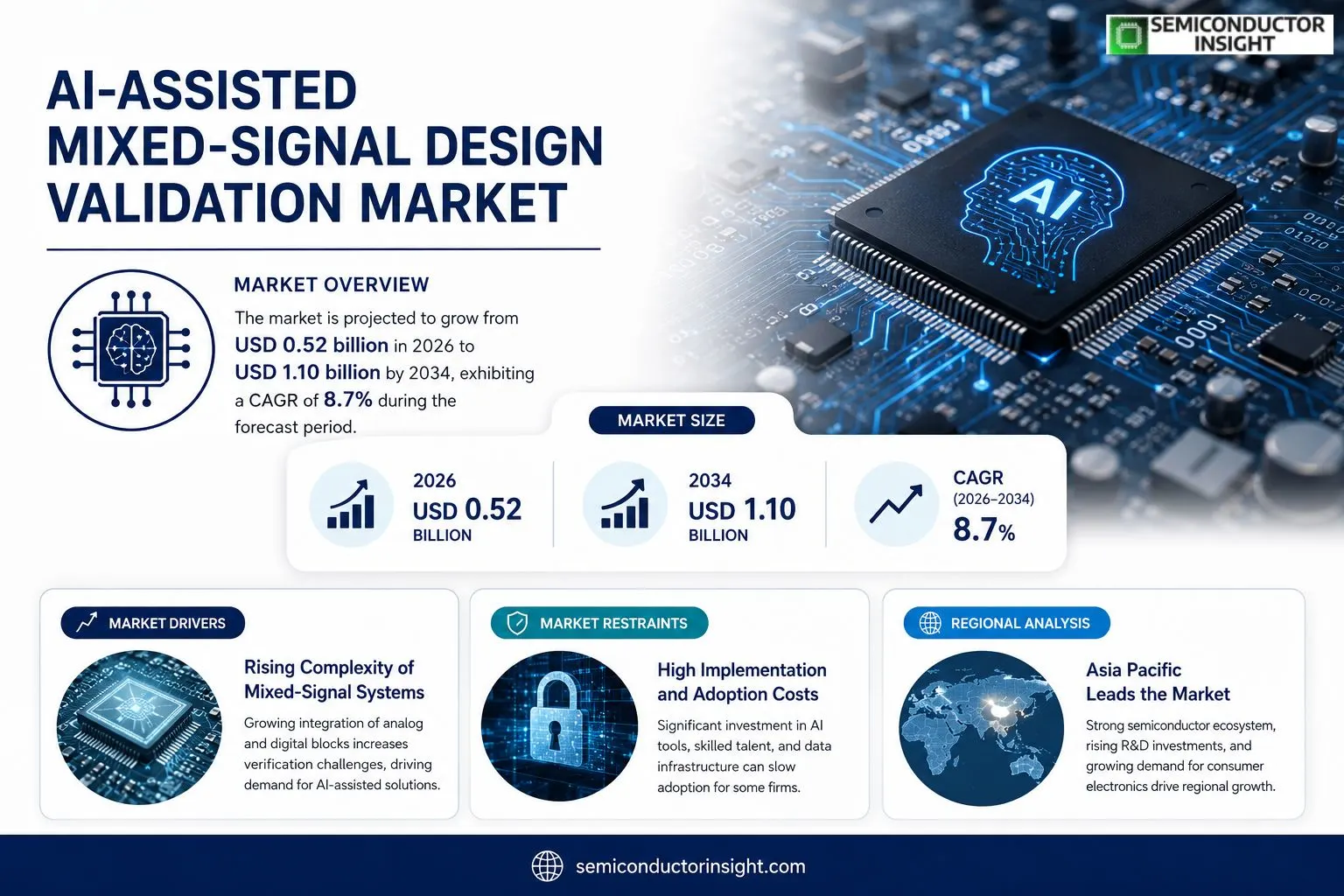
MARKET DRIVERS
Rising Complexity of Mixed‑Signal Systems
Design teams are grappling with increasingly intricate analog‑digital interfaces, where traditional verification loops become time‑consuming. AI‑Assisted Mixed‑Signal Design Validation Market tools shorten these loops by automating signal integrity checks, allowing engineers to focus on architecture rather than manual debugging.
AI‑Enabled Efficiency Gains
Machine‑learning algorithms now predict failure modes before silicon is fabricated, trimming prototype cycles by up to 30 %. This efficiency translates into lower development budgets and faster time‑to‑market, a compelling proposition for firms competing on innovation speed.
➤ Early adopters report a 20 % reduction in validation overhead after integrating AI‑driven analytics into their design flow.
Manufacturers are also leveraging these platforms to meet tighter regulatory timelines, as automated compliance checks reduce the risk of costly redesigns. The cumulative effect is a noticeable shift toward AI‑centric validation strategies across the industry.
MARKET CHALLENGES
Talent Shortage in AI‑Enhanced Verification
Even the most sophisticated validation suites demand engineers who understand both mixed‑signal design and data‑science techniques. Companies report difficulty filling roles that blend these skill sets, which slows adoption rates despite clear functional benefits.
Other Challenges
Integration with Legacy Toolchains
Many design houses rely on entrenched EDA environments; retrofitting AI modules often requires extensive API development and workflow redesign, raising upfront costs and causing temporary productivity dips.
MARKET RESTRAINTS
High Capital Expenditure for AI Platforms
Licensing fees for advanced AI verification platforms remain steep, especially for small and midsize enterprises. The financial barrier discourages broader market penetration and limits the ecosystem to well‑funded players.Moreover, the required computational infrastructureGPU clusters or specialized inference hardware adds layers of expense that many organizations are reluctant to shoulder without guaranteed ROI.These cost considerations temper the pace at which the AI‑Assisted Mixed‑Signal Design Validation Market can achieve mass adoption, keeping it clustered around high‑value segments.
MARKET OPPORTUNITIES
Expansion into Automotive and IoT Segments
The surge in automotive electronics and edge‑connected devices creates a fertile ground for AI‑enabled validation. Both sectors demand ultra‑reliable mixed‑signal performance, presenting a clear opening for vendors to tailor solutions that address safety‑critical standards.Additionally, the emergence of cloud‑based validation services lowers the entry threshold for smaller firms, allowing them to outsource compute‑intensive AI analyses without investing in on‑premise hardware.Strategic partnerships with semiconductor foundries could further accelerate adoption, as foundry‑level validation APIs embed AI checks directly into the manufacturing pipeline, unlocking new revenue streams for software providers.
AI-Assisted Mixed-Signal Design Validation Market Trends
AI Integration Drives Validation Efficiency
The convergence of artificial‑intelligence algorithms with mixed‑signal verification tools is reshaping how designers tackle timing violations, noise coupling, and power‑grid irregularities. By embedding predictive failure models directly into the validation flow, engineers can isolate defect patterns before silicon tape‑out, cutting iteration cycles dramatically. This shift is most evident in sectors such as IoT, autonomous transportation, and wearable electronics, where analog‑digital interfaces must meet stringent latency and reliability targets. The ability of AI‑assisted platforms to generate adaptive test patterns on the fly means that verification resources are allocated where they matter most, translating into measurable cost avoidance for product development programs. Consequently, the AI‑Assisted Mixed-Signal Design Validation Market is gaining traction among firms that prioritize time‑to‑market speed without sacrificing design robustness.
Other Trends
Collaborative Cloud‑Based Validation
Recent announcements illustrate a clear movement toward cloud‑native validation environments. In early 2024, a leading EDA vendor partnered with a major AI research unit to fuse deep‑learning models into its flagship circuit‑design suite, enabling remote teams to run large‑scale simulations from a shared workspace. This approach removes the need for on‑premise hardware clusters, lowers entry barriers for smaller design houses, and fosters real‑time co‑engineering across geographic boundaries. For the AI‑Assisted Mixed-Signal Design Validation Market, the implication is twofold: service providers can monetize subscription‑based access to high‑performance compute, while end users benefit from continuous updates that incorporate the latest algorithmic enhancements without disruptive upgrades.
Foundry Services Broaden Verification Portfolios
Semiconductor foundries are extending their value proposition by bundling AI‑driven analytics with prototype silicon runs. Design‑for‑verification offerings now include automated extraction of performance hotspots, followed by AI‑suggested layout adjustments that reduce parasitic effects. This integration shortens the feedback loop between silicon validation and design correction, a critical advantage for high‑volume automotive and industrial applications where design revisions are costly. Established players such as Siemens EDA and Synopsys are responding by expanding their AI‑enhanced toolchains to cover the full lifecycle, from schematic capture through sign‑off. The broader industry impact is the creation of a more iterative, data‑centric design culture that leverages AI insights to sustain competitive advantage.
COMPETITIVE LANDSCAPE
Key Industry Players
AI‑Assisted Mixed‑Signal Design Validation Market – Competitive Overview
Cadence Design Systems dominates the validation arena, leveraging its Virtuoso suite to embed deep‑learning models that surface timing violations and noise coupling in real time. The firm’s recent alliance with NVIDIA’s AI research unit has transformed its analog‑digital workflow, allowing customers to tap cloud‑scaled inference engines without leaving the design environment. Synopsys follows closely, repurposing its DVE and Verdi platforms with AI‑enhanced pattern generation that trims verification cycles for automotive ASICs. Siemens EDA, buoyed by a legacy in circuit simulation, has integrated predictive failure analytics into its Calibre ecosystem, positioning itself as a one‑stop shop for both pre‑silicon and post‑fabrication checks. Collectively, these incumbents shape a market structure where a handful of large EDA vendors control the core technology stack, while specialist firms supply complementary analytics and cloud services.Beyond the tier‑one vendors, a diverse set of niche players is sharpening the competitive edge. Ansys contributes high‑fidelity electromagnetic solvers that feed AI models with richer field data, improving anomaly detection for RF‑intensive mixed‑signal blocks. Keysight Technologies offers AI‑driven test‑equipment integration that automates power‑grid stress scenarios across prototype labs. MathWorks extends its Simulink environment with machine‑learning blocks that generate adaptive test patterns for wearables and IoT chips. National Instruments and NVIDIA’s AI Cloud Platform provide collaborative validation workspaces, enabling distributed teams to iterate on verification models in parallel. Meanwhile, semiconductor manufacturers such as Qualcomm, Analog Devices, and Texas Instruments are launching design‑for‑verification services that bundle AI analytics with silicon prototypes, creating a hybrid ecosystem where fab‑side insights directly influence software tool development.
List of Key AI‑Assisted Mixed‑Signal Design Validation Companies Profiled
- Cadence Design Systems
- Synopsys
- Siemens EDA
- Ansys
- Keysight Technologies
- MathWorks
- National Instruments
- NVIDIA AI Cloud Platform
- Qualcomm
- Analog Devices
- Texas Instruments
- Arm Holdings
- TSMC Design‑for‑Verification Services
- Intel Integrated Validation
- IBM Quantum‑Enhanced Verification
Segment Analysis:
| Segment Category | Sub-Segments | Key Insights |
| By Type |
|
Software Solutions
|
| By Application |
|
IoT Devices
|
| By End User |
|
Semiconductor Designers
|
| By Technology |
|
Deep Learning Algorithms
|
| By Deployment Model |
|
Cloud‑Based Platforms
|
Regional Analysis: AI-Assisted Mixed-Signal Design Validation Market
North America
The convergence of high‑frequency analog interfaces with AI‑enhanced verification tools is reducing manual test‑bench time. Design houses value the ability to predict silicon performance across process corners without costly silicon prototypes, which directly influences budgeting and scheduling decisions.
Standards bodies are beginning to reference AI‑based validation outcomes in compliance documentation, especially for safety‑critical automotive and medical devices. This shift encourages vendors to certify their algorithms against emerging guidelines.
Early adopters in telecommunications have integrated AI modules into their validation pipelines within two product cycles, while mid‑tier consumer electronics firms are following a lag of roughly one cycle, reflecting differing risk appetites.
Vendors that combine deep analog knowledge with robust AI frameworks command premium pricing, whereas pure‑play AI firms are pursuing partnerships to gain credibility in the mixed‑signal niche.
Europe
European design firms are leveraging the AI‑Assisted Mixed‑Signal Design Validation Market to meet stringent emissions and safety directives that differ across the EU. The region’s emphasis on sustainability drives a preference for validation solutions that can simulate power‑efficiency scenarios early in the design stage. Moreover, collaborative research programs funded by the European Union foster cross‑border knowledge exchange, enabling smaller players to access advanced AI models without large R&D spend. Consequently, the market sees a steady inflow of niche providers targeting automotive and industrial automation segments where compliance costs are paramount.
Asia-Pacific
In Asia‑Pacific, the surge of fab‑centric ecosystems accelerates demand for AI‑enhanced verification as manufacturers strive to optimize yield across heterogeneous process technologies. Companies in Japan and South Korea combine legacy analog expertise with emerging AI platforms to address the performance gap created by ultra‑dense integration. Meanwhile, fast‑growing markets such as India and Vietnam rely on cost‑effective AI tools to offset limited access to high‑end test equipment. The regional narrative is therefore shaped by a blend of high‑tech innovation and pragmatic cost management, encouraging tool vendors to offer tiered licensing models.
South America
South American adopters view AI‑Assisted Mixed‑Signal Design Validation as a pathway to bridge the talent gap that has long constrained local semiconductor initiatives. By automating repetitive validation tasks, firms can allocate scarce engineering resources to higher‑value activities like custom IP development. Additionally, regional trade agreements are prompting multinational corporations to establish design centers that require compatible validation workflows, fostering a modest but consistent rise in demand for interoperable AI solutions.
Middle East & Africa
The Middle East & Africa region is gradually embracing AI‑driven validation as part of broader digital transformation agendas championed by sovereign wealth funds and national technology ministries. In the United Arab Emirates, government‑backed accelerators are funding pilots that integrate AI validation into aerospace and defense projects, where reliability is non‑negotiable. African markets, while still nascent, are beginning to recognize the cost‑saving potential of AI tools in mitigating the need for extensive physical prototyping, particularly within emerging telecommunications infrastructure programs.
Report Scope
This market research report provides a comprehensive analysis of the AI-Assisted Mixed-Signal Design Validation Market , covering the forecast period 2026–2034. It offers detailed insights into market dynamics, technological advancements, competitive landscape, and key trends shaping the industry.
Key focus areas of the report include:
- Market Overview: The report begins with an overview outlining its current market scenario, key growth indicators, and industry transformation drivers. It discusses macroeconomic factors, demand–supply balance, regulatory landscape, and the strategic role of semiconductors in powering advancements across industries such as automotive, telecommunications, consumer electronics, and industrial automation.
- Market Size & Forecast: Historical data and future projections for revenue, unit shipments, and market value across major regions and segments.
- Segmentation Analysis: Detailed breakdown by product type, technology, application, and end-user industry to identify high-growth segments and investment opportunities.
- Regional Insights: Insights into market performance across North America, Europe, Asia-Pacific, Latin America, and the Middle East & Africa, including country-level analysis where relevant.
- Competitive Landscape: Profiles of leading market participants, including their product offerings, R&D focus, manufacturing capacity, pricing strategies, and recent developments such as mergers, acquisitions, and partnerships.
- Technology Trends & Innovation: Assessment of emerging technologies, integration of AI/IoT, semiconductor design trends, fabrication techniques, and evolving industry standards.
- Market Drivers & Restraints: Evaluation of factors driving market growth along with challenges, supply chain constraints, regulatory issues, and market-entry barriers.
- Stakeholder Insights: Insights for component suppliers, OEMs, system integrators, investors, and policymakers regarding the evolving ecosystem and strategic opportunities.
Primary and secondary research methods are employed, including interviews with industry experts, data from verified sources, and real-time market intelligence to ensure the accuracy and reliability of the insights presented.
FREQUENTLY ASKED QUESTIONS:
What is the current market size of AI-Assisted Mixed-Signal Design Validation Market?
-> AI-Assisted Mixed-Signal Design Validation Market was valued at USD 0.48 billion in 2025 and is expected to reach USD 1.10 billion by 2034. The forecasted CAGR is 8.7 % over the period.
Which key companies operate in AI-Assisted Mixed-Signal Design Validation Market?
-> Key players include Cadence Design Systems, Synopsys Inc., Siemens EDA, Ansys, Keysight Technologies, and Mentor Graphics (Siemens), among others.
What are the key growth drivers?
-> Key growth drivers include rising adoption of IoT devices, autonomous vehicles, wearable electronics, and the increasing complexity of analog‑digital integration that demands advanced verification solutions.
Which region dominates the market?
-> North America currently holds the largest market share, while Asia‑Pacific is emerging as the fastest‑growing region driven by strong semiconductor design activity.
What are the emerging trends?
-> Emerging trends include AI‑driven predictive verification, cloud‑based collaborative validation platforms, integration of digital‑twin concepts, and the use of machine‑learning models for noise and power‑grid anomaly detection.
Get Sample Report PDF for Exclusive Insights
Report Sample Includes
- Table of Contents
- List of Tables & Figures
- Charts, Research Methodology, and more...
 Download Sample Report PDF