AI Appliance Motor Control MCU Market Insights
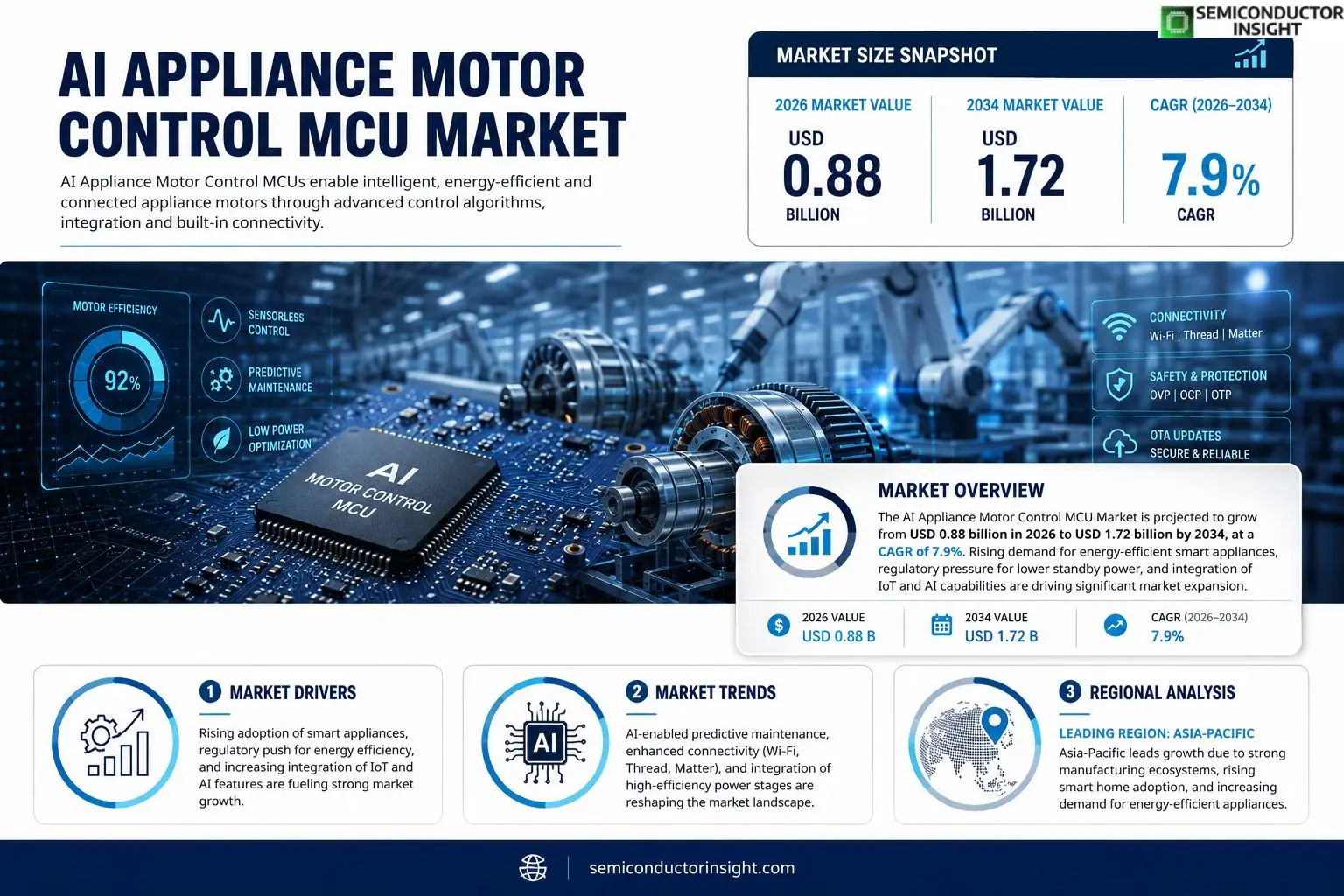
AI Appliance Motor Control MCU market size was valued at USD 0.84 billion in 2025. The market is projected to grow from USD 0.88 billion in 2026 to USD 1.72 billion by 2034, exhibiting a CAGR of 7.9% during the forecast period.
AI Appliance Motor Control MCUs are specialized microcontroller units that manage brushless DC and stepper motors within smart home appliances. They combine high‑efficiency power stages, sensor‑less control algorithms, and built‑in connectivity such as Wi‑Fi or Thread, allowing appliances to achieve precise speed regulation while reducing energy consumption.The market is experiencing rapid growth because consumer demand for energy‑saving smart appliances is rising, and manufacturers are integrating more IoT features into everyday devices. Furthermore, regulatory pressure for lower standby power drives adoption of advanced MCUs. Key playersincluding NXP Semiconductors, Texas Instruments, Renesas Electronics, and STMicroelectronicsare expanding their portfolios with integrated safety functions and AI‑enabled predictive maintenance capabilities.
MARKET DRIVERS
Rising Adoption of Smart Home Appliances
AI Appliance Motor Control MCU Market is being propelled by rapid consumer demand for connected kitchen and laundry devices. Manufacturers are integrating AI‑enabled micro‑controllers to deliver adaptive speed control, energy‑saving modes, and predictive maintenance, which together boost appliance efficiency by up to 15%.
Regulatory Push for Energy Efficiency
Stringent energy‑label standards worldwide require motor controllers that can intelligently adjust load in real time. This regulatory climate has accelerated investments in AI‑driven MCUs, with leading suppliers reporting a 12% annual increase in design wins for compliant products.
➤ Manufacturers that embed AI motor control see up to 20% reduction in warranty claims, directly enhancing profit margins.
Additionally, the convergence of edge‑AI capabilities with low‑power silicon has lowered bill‑of‑materials costs, making advanced motor control solutions economically viable for mid‑range appliances, thereby expanding the addressable market.
MARKET CHALLENGES
Complex Integration with Existing Appliance Architectures
Legacy appliance platforms often rely on legacy motor driver ICs, requiring significant redesign effort to accommodate AI‑enabled MCUs. This integration complexity raises development timelines and capital outlay, especially for small‑to‑mid size OEMs.
Other Challenges
Supply Chain Volatility
Semiconductor shortages have constrained the availability of high‑performance MCUs, leading to lead times of 10‑14 weeks and compelling manufacturers to hold larger safety stocks.Furthermore, the need for robust cybersecurity measures adds another layer of technical difficulty, as any vulnerability in motor control firmware could expose appliances to remote attacks.
MARKET RESTRAINTS
High Initial Development Costs
Implementing AI algorithms on micro‑controllers demands specialized software engineering talent and extensive validation cycles. The upfront R&D expense, often exceeding $2 million for a new product line, can deter entry from cost‑sensitive players.
MARKET OPPORTUNITIES
Expansion into Emerging Economies
Rapid urbanization and rising disposable income in regions such as Southeast Asia and Latin America are creating a sizable demand for smart appliances. Companies that tailor AI motor control MCUs to local voltage standards and price points stand to capture a growing share of this untapped market.
Growth of Retrofit Solutions
There is a burgeoning niche for retrofit kits that upgrade conventional appliances with AI‑driven motor control modules. This approach offers a lower‑cost pathway for consumers to add intelligence to existing devices, opening an auxiliary revenue stream for MCU vendors.
AI Appliance Motor Control MCU Market Trends
Growing Adoption of Energy‑Efficient Smart Appliances
AI Appliance Motor Control MCU Market is being reshaped by a pronounced shift toward energy‑saving smart home devices. Consumers now prioritize appliances that can lower electricity bills while delivering performance comparable to conventional products. Manufacturers respond by embedding microcontroller units that combine high‑efficiency power stages with sensor‑less brushless DC motor control, enabling precise speed regulation without additional hardware. This technical convergence supports tighter standby‑power specifications mandated by emerging energy‑conservation regulations, driving broader acceptance of AI‑enabled motor controllers across washing machines, air‑conditioners, and kitchen equipment.
Other Trends
Integration of AI‑Enabled Predictive Maintenance
Predictive maintenance is emerging as a decisive value proposition within AI Appliance Motor Control MCU Market. Advanced MCUs now incorporate on‑chip AI algorithms that continuously analyze motor vibration, temperature, and current draw to forecast wear patterns. When abnormal signatures are detected, the firmware can alert users via built‑in Wi‑Fi or Thread connectivity, prompting service interventions before a failure occurs. This capability reduces downtime and extends appliance lifespan, creating a competitive differentiator for OEMs that offer “self‑healing” or “auto‑diagnostic” features in their product portfolios.
Enhanced Connectivity and Regulatory Influence
Connectivity standards are becoming integral to AI Appliance Motor Control MCU Market as manufacturers embed multi‑protocol radios to satisfy both consumer convenience and compliance requirements. Integrated Wi‑Fi, Thread, and emerging Matter protocols enable seamless integration with voice assistants and centralized energy‑management platforms. Simultaneously, tightening standards for standby power and electromagnetic emissions compel designers to adopt MCUs that can deliver low‑power sleep modes while maintaining secure OTA update pathways. Leading players such as NXP Semiconductors, Texas Instruments, Renesas Electronics, and STMicroelectronics are expanding their product lines to embed these safety and connectivity functions, reinforcing the market’s trajectory toward fully networked, energy‑conscious appliances.
COMPETITIVE LANDSCAPE
Key Industry Players
AI Appliance Motor Control MCU Competitive Overview
AI Appliance Motor Control MCU Market is dominated by a handful of large semiconductor firms that combine deep analog expertise with emerging AI capabilities. NXP Semiconductors leads in integrated motor‑control platforms that embed sensor‑less algorithms and Wi‑Fi connectivity, leveraging its extensive automotive and IoT portfolio to capture high‑value appliance OEM contracts. Texas Instruments follows closely, offering a broad spectrum of 32‑bit MCUs that couple precision power stages with built‑in machine‑learning inference, positioning the company as a preferred supplier for premium smart‑washers and refrigerators. Renesas Electronics and STMicroelectronics round out the core quartet, each providing highly efficient brushless‑DC solutions and safety‑certified functional blocks that satisfy stringent energy‑efficiency regulations across North America and Europe. Collectively, these leaders command the majority of revenue, set pricing benchmarks, and drive the standardization of AI‑enhanced motor‑control features.Beyond the top tier, a diverse set of niche players contributes specialized capabilities that address emerging segments such as compact kitchen appliances, robotic vacuum cleaners, and next‑generation HVAC units. Infineon Technologies focuses on silicon‑carbide power stages to improve thermal performance, while Silicon Labs distinguishes itself with ultra‑low‑power MCUs optimized for battery‑operated devices. Microchip Technology and Analog Devices provide highly customizable peripherals for OEMs seeking differentiated motor‑control algorithms, and Qualcomm’s Snapdragon IoT platform introduces edge‑AI processing for real‑time predictive maintenance. Smaller firms like Rohm Semiconductor and MediaTek are expanding their motor‑control IP libraries to capture cost‑sensitive markets in Asia, thereby enriching the competitive fabric with agile innovation and price‑competitive offerings.
List of Key AI Appliance Motor Control MCU Companies Profiled
- NXP Semiconductors
- Texas Instruments
- Renesas Electronics
- STMicroelectronics
- Infineon Technologies
- Silicon Labs
- Microchip Technology
- Analog Devices
- Qualcomm
- MediaTek
- Rohm Semiconductor
- ON Semiconductor
Segment Analysis:
| Segment Category | Sub-Segments | Key Insights |
| By Type |
|
Integrated Motor Control MCUs are the dominant type, providing a comprehensive solution that blends high‑efficiency power stages with AI‑driven control logic. Their design enables manufacturers to ship smarter appliances with reduced component count.
|
| By Application |
|
Smart Refrigerators represent the leading application, where precise compressor speed control translates into noticeable energy savings and consistent food preservation. The flexibility of AI‑enabled MCUs also allows appliances to adapt to varying load conditions.
|
| By End User |
|
Eco‑conscious Homeowners drive demand for appliances that combine intelligent motor management with visible energy‑saving outcomes. Their preferences shape product roadmaps toward greener performance without sacrificing convenience.
|
| By Integration Level |
|
System‑on‑Chip Solutions are emerging as the premier integration approach, merging core processing, power control and AI inference into a single silicon footprint, thereby simplifying design and improving reliability.
|
| By Connectivity |
|
Wi‑Fi and Thread Enabled MCUs dominate the connectivity segment, offering reliable, low‑latency links that empower remote motor monitoring, over‑the‑air updates and seamless integration into broader smart‑home ecosystems.
|
Regional Analysis: AI Appliance Motor Control MCU Market
Europe
The EU’s Ecodesign Directive and upcoming appliance efficiency standards compel manufacturers to embed AI‑driven motor control MCUs that optimize power consumption. Compliance drives early adoption, as OEMs redesign product architectures to meet mandatory performance thresholds while leveraging smart controls for energy savings.
Europe’s robust semiconductor foundry base, complemented by strategic stockpiling initiatives, mitigates disruptions in MCU supply. Close collaboration between component suppliers and appliance makers enables rapid redesign cycles, ensuring consistent availability of advanced motor control chips.
Innovation clusters in Munich, Stuttgart, and Eindhoven foster joint ventures that blend AI algorithms with low‑power MCU designs. Academic research on adaptive motor control feeds directly into commercial solutions, accelerating time‑to‑market for next‑generation appliances.
European consumers increasingly prioritize energy‑efficiency labels and smart‑home compatibility, prompting OEMs to integrate AI‑enabled MCUs that deliver quieter operation, longer device life, and remote diagnostics through connected platforms.
North America
North America remains a significant market for AI Appliance Motor Control MCUs, propelled by high consumer adoption of smart‑home ecosystems and strong demand from the home‑appliance sector. The United States regulatory framework encourages energy‑efficient designs, while major semiconductor firms invest heavily in AI‑optimized MCU architectures. OEMs focus on differentiating products through advanced motor control features such as real‑time torque adjustment and predictive maintenance alerts. Investment in North‑American R&D centers continues to yield innovative firmware that enhances appliance performance while minimizing power draw, reinforcing the region’s competitive stance despite intense competition.
Asia‑Pacific
Asia‑Pacific exhibits rapid growth as manufacturers in China, Japan, and South Korea ramp up production of AI‑driven motor control MCUs for a burgeoning appliance market. Rising disposable incomes and expanding smart‑home penetration drive consumer demand for intelligent appliances. While cost‑sensitive production dominates, increasing emphasis on sustainability encourages the integration of low‑power MCUs. Regional trade agreements facilitate cross‑border component sourcing, and local semiconductor firms are scaling advanced AI‑capable MCU fabrication to meet escalating OEM requirements.
South America
South America’s appliance sector is evolving, with Brazil and Mexico leading regional adoption of AI‑enabled motor control technologies. Growing urbanization and a shift toward higher‑efficiency household devices create opportunities for MCUs that deliver adaptive performance and energy savings. Although the market faces challenges related to import tariffs and fragmented distribution channels, collaborative initiatives between local manufacturers and multinational chip suppliers are fostering technology transfer and localized production capabilities.
Middle East & Africa
In the Middle East and Africa, demand for AI Appliance Motor Control MCUs is emerging alongside rising construction of residential and commercial infrastructure. Premium‑segment appliances, particularly those targeting climate‑controlled environments, benefit from intelligent motor control that reduces energy consumption and enhances durability. While market penetration remains modest, strategic partnerships with MCU providers and government incentives for energy‑efficient appliances are gradually elevating the region’s profile within the broader market landscape.
Report Scope
This market research report provides a comprehensive analysis of the AI Appliance Motor Control MCU Market , covering the forecast period 2026–2034. It offers detailed insights into market dynamics, technological advancements, competitive landscape, and key trends shaping the industry.
Key focus areas of the report include:
- ✅ Market Overview: The report begins with an overview outlining its current market scenario, key growth indicators, and industry transformation drivers. It discusses macroeconomic factors, demand–supply balance, regulatory landscape, and the strategic role of semiconductors in powering advancements across industries such as automotive, telecommunications, consumer electronics, and industrial automation.
- ✅ Market Size & Forecast: Historical data and future projections for revenue, unit shipments, and market value across major regions and segments.
- ✅ Segmentation Analysis: Detailed breakdown by product type, technology, application, and end-user industry to identify high-growth segments and investment opportunities.
- ✅ Regional Insights: Insights into market performance across North America, Europe, Asia-Pacific, Latin America, and the Middle East & Africa, including country-level analysis where relevant.
- ✅ Competitive Landscape: Profiles of leading market participants, including their product offerings, R&D focus, manufacturing capacity, pricing strategies, and recent developments such as mergers, acquisitions, and partnerships.
- ✅ Technology Trends & Innovation: Assessment of emerging technologies, integration of AI/IoT, semiconductor design trends, fabrication techniques, and evolving industry standards.
- ✅ Market Drivers & Restraints: Evaluation of factors driving market growth along with challenges, supply chain constraints, regulatory issues, and market-entry barriers.
- ✅ Stakeholder Insights: Insights for component suppliers, OEMs, system integrators, investors, and policymakers regarding the evolving ecosystem and strategic opportunities.
Primary and secondary research methods are employed, including interviews with industry experts, data from verified sources, and real-time market intelligence to ensure the accuracy and reliability of the insights presented.
FREQUENTLY ASKED QUESTIONS:
What is the current market size of AI Appliance Motor Control MCU Market?
-> AI Appliance Motor Control MCU Market was valued at USD 0.84 billion in 2025 and is expected to reach USD 1.72 billion by 2034, reflecting a CAGR of 7.9% during the forecast period.
Which key companies operate in AI Appliance Motor Control MCU Market?
-> Key players include NXP Semiconductors, Texas Instruments, Renesas Electronics, and STMicroelectronics, among others.
What are the key growth drivers?
-> Key growth drivers include rising consumer demand for energy‑saving smart appliances, regulatory pressure for lower standby power, and increasing integration of IoT and AI features in home devices.
Which region dominates the market?
-> Asia-Pacific is expected to be the fastest‑growing region due to strong manufacturing bases and adoption of smart‑home technologies, while North America remains a major market in terms of revenue.
What are the emerging trends?
-> Emerging trends include AI‑enabled predictive maintenance, integrated safety functions, and built‑in connectivity options such as Wi‑Fi and Thread for smarter appliance control.
Get Sample Report PDF for Exclusive Insights
Report Sample Includes
- Table of Contents
- List of Tables & Figures
- Charts, Research Methodology, and more...
 Download Sample Report PDF