
Market Insights
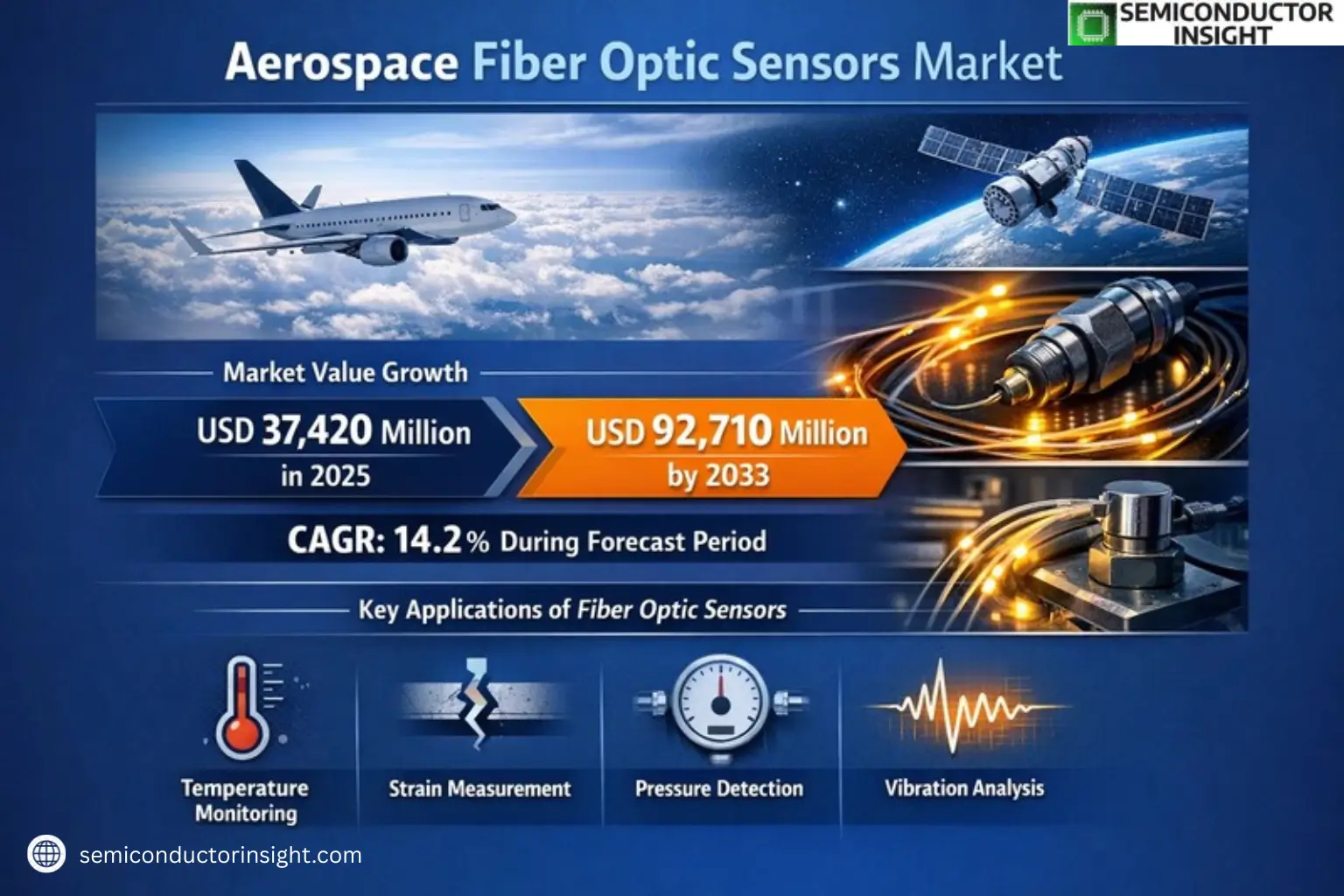
Global Aerospace Fiber Optic Sensors Market was valued at USD 37,420 million in 2025 and is projected to reach USD 92,710 million by 2033, exhibiting a CAGR of 14.2% during the forecast period.
Fiber optic sensors are advanced devices used in aerospace applications to measure parameters such as temperature, strain, pressure, and vibration with high precision. These sensors leverage optical fibers to transmit data, offering advantages like electromagnetic interference immunity, lightweight design, and durability in harsh environments. The market primarily includes temperature sensors, pressure sensors, strain sensors, and other specialized variants.
The growth of this market is driven by increasing demand for real-time structural health monitoring in aircraft, advancements in sensor technology, and stringent safety regulations in the aerospace sector. Key players such as Honeywell, Opsens Industrial, and Omron dominate the market with a combined share exceeding 40%. North America leads regional adoption due to strong aerospace manufacturing activity, while Asia-Pacific shows rapid growth potential fueled by expanding aviation infrastructure.
MARKET DRIVERS
Growing Demand for Lightweight Aircraft Components
Aerospace Fiber Optic Sensors Market is driven by the increasing demand for lightweight materials in aircraft manufacturing. These sensors offer significant weight reduction compared to traditional electrical sensors, aligning with fuel efficiency goals in modern aviation. With over 60% of aircraft manufacturers prioritizing weight reduction, adoption rates are accelerating.
Advancements in Sensor Technology
Recent breakthroughs in fiber optic sensor technology have enhanced their durability in extreme aerospace conditions. Improved signal processing algorithms now enable real-time structural health monitoring with 98% accuracy, driving adoption across commercial and military applications.
Increased defense spending globally, particularly in next-generation aircraft programs, is creating substantial demand for reliable fiber optic sensor solutions.
MARKET CHALLENGES
High Installation and Calibration Costs
The specialized installation requirements for aerospace fiber optic sensors result in 30-40% higher upfront costs compared to conventional systems. Precision calibration demands expert technicians, creating bottlenecks in large-scale deployments.
Other Challenges
Integration with Legacy Systems
Retrofitting older aircraft with fiber optic sensors requires extensive modification, with 65% of MRO operators citing compatibility issues as their primary concern.
MARKET RESTRAINTS
Stringent Certification Requirements
The aerospace industry’s rigorous certification processes delay fiber optic sensor implementation by 12-18 months on average. Each sensor type requires separate FAA and EASA approvals, significantly extending time-to-market for new solutions.
MARKET OPPORTUNITIES
Emerging UAV and eVTOL Markets
The rapid expansion of unmanned aerial vehicles and electric vertical takeoff aircraft presents a USD 2.3 billion opportunity for aerospace fiber optic sensors. These platforms demand lightweight, EMI-resistant sensing solutions that fiber optics uniquely provide.
Smart Manufacturing Integration
Industry 4.0 adoption in aerospace manufacturing is creating demand for embedded fiber optic sensors that enable real-time production monitoring. Over 45% of new production facilities now incorporate these sensors in their factory acceptance testing protocols.
MAIN TITLE HERE () Trends
Rapid Market Expansion Driven by Aviation Safety Requirements
Global Aerospace Fiber Optic Sensors Market is projected to grow from USD 37.4 billion in 2025 to USD 92.7 billion by 2033, representing a 14.2% CAGR. This growth is primarily fueled by increasing aviation safety regulations and the need for real-time structural health monitoring in aircraft. Temperature sensors currently dominate the product segment with 40% market share due to their critical role in engine and airframe monitoring systems.
Other Trends
Regional Market Concentration
North America leads the Aerospace Fiber Optic Sensors Market with 25% share, followed by China and Europe jointly holding 40%. This distribution reflects regional aviation industry maturity and military aerospace investments. The Asia-Pacific region shows the fastest growth potential due to expanding commercial aviation fleets.
Technology Advancements in Sensing Applications
Recent innovations focus on multi-parameter fiber optic sensors capable of simultaneous strain, temperature and pressure measurement. Leading manufacturers like Honeywell and Omron are developing compact sensors for next-gen aircraft with improved signal processing capabilities. Health monitoring for airframes remains the dominant application segment, followed closely by engine monitoring systems.
Industry Consolidation and Competitive Landscape
The top five Aerospace Fiber Optic Sensors manufacturers hold over 40% market share, indicating moderate consolidation. Key players are investing in R&D for distributed sensing systems and expanding service offerings. The market sees growing demand for sensors with enhanced durability in extreme aerospace environments and electromagnetic interference resistance.
Regulatory Drivers and Future Outlook
Stringent aviation safety standards from FAA and EASA continue to drive sensor adoption. Future growth opportunities exist in UAV systems and space applications, with fiber optic sensors offering weight advantages over traditional alternatives. The market will likely see increased integration with IoT platforms for predictive maintenance solutions.
COMPETITIVE LANDSCAPE
Key Industry Players
Aerospace Fiber Optic Sensors Market Dominated by Sensor Specialists and Industrial Giants
Aerospace Fiber Optic Sensors Market is led by established industrial conglomerates and specialized sensor manufacturers, with Honeywell, Opsens Industrial, and Omron collectively holding over 40% market share. These companies dominate through advanced R&D capabilities, extensive aerospace industry partnerships, and comprehensive product portfolios covering temperature, pressure, and strain sensing applications. The market exhibits moderate consolidation, with top players focusing on mergers and acquisitions to expand their aerospace sensor solutions.
Niche specialists like FISO Technologies and Proximion AB are gaining traction with high-performance distributed sensing systems for aircraft health monitoring. Regional players such as Technica Optical Components (Europe) and IFOS (North America) command strong positions in their respective markets with customized sensing solutions. Emerging competitors are accelerating innovation in miniaturization and multi-parameter sensing capabilities to address evolving aerospace requirements.
List of Key Aerospace Fiber Optic Sensors Companies Profiled
- Honeywell International Inc.
- Opsens Industrial
- Omron Corporation
- Micron Optics
- FISO Technologies Inc.
- Proximion AB
- Technica Optical Components LLC
- Technobis Group
- Smart Fibres Ltd
- Intelligent Fiber Optic Systems (IFOS)
- Luna Innovations
- FBGS Technologies
- Wuhan Zhiyuan Optoelectronics Technology
- HBM Test and Measurement
- Keyence Corporation
Segment Analysis:
| Segment Category | Sub-Segments | Key Insights |
| By Type |
|
Temperature Sensors
|
| By Application |
|
Health Monitoring for Airframes
|
| By End User |
|
Commercial Aviation
|
| By Aircraft Type |
|
Wide-body Aircraft
|
| By Technology |
|
Single-mode Sensors
|
Regional Analysis: Aerospace Fiber Optic Sensors Market
The U.S. defense sector accounts for the largest share of fiber optic sensor deployments, with extensive use in fighter jets, UAVs, and missile systems. Aircraft modernization programs prioritize fiber optic technologies for their EMI resistance and lightweight properties.
Boeing and Airbus operations in North America are increasingly incorporating fiber optic sensors in next-generation aircraft. The technology’s ability to reduce wiring complexity makes it ideal for modern composite airframe designs prevalent in new aircraft models.
Research institutions like NASA and leading aerospace universities collaborate with sensor manufacturers to develop advanced distributed fiber optic sensing systems. These partnerships drive breakthroughs in real-time structural monitoring and predictive maintenance solutions.
FAA regulations mandating enhanced aircraft monitoring systems create a favorable environment for fiber optic sensor adoption. Certification processes for aerospace-grade sensors in North America set global benchmarks that influence other regional markets.
Europe
Europe maintains a strong position in the aerospace fiber optic sensors market, supported by Airbus operations and stringent aviation safety standards. The region’s focus on reducing aircraft emissions drives adoption of lightweight fiber optic sensing systems. Collaborative European defense projects actively incorporate distributed fiber optic networks for comprehensive aircraft monitoring. Research initiatives under Horizon Europe are advancing sensor technologies for extreme aerospace environments.
Asia-Pacific
Asia-Pacific emerges as the fastest-growing market for aerospace fiber optic sensors, fueled by expanding commercial aviation fleets and defense modernization programs. China’s aviation industry leads regional demand, with increasing domestic aircraft production integrating advanced sensing technologies. Japan and South Korea contribute specialized fiber optic solutions for aerospace applications, supported by strong electronics manufacturing capabilities.
Middle East & Africa
The Middle East shows growing adoption of aerospace fiber optic sensors, particularly in commercial aviation hubs like Dubai and Doha. Airlines and MRO providers in the region prioritize advanced monitoring systems to maintain expanding fleets. Defense applications remain limited but show potential with increasing military aircraft procurements across GCC countries.
South America
South America represents a niche market for aerospace fiber optic sensors, with Brazil as the primary adopter through Embraer’s aircraft production. Regional growth is constrained by limited defense budgets but benefits from technology transfer agreements with North American and European aerospace manufacturers.
Report Scope
This market research report provides a comprehensive analysis of the Aerospace Fiber Optic Sensors Market , covering the forecast period 2025–2033. It offers detailed insights into market dynamics, technological advancements, competitive landscape, and key trends shaping the industry.
Key focus areas of the report include:
- Market Overview: The report begins with an overview outlining its current market scenario, key growth indicators, and industry transformation drivers. It discusses macroeconomic factors, demand–supply balance, regulatory landscape, and the strategic role of fiber optic sensors in aerospace applications such as health monitoring for airframes, engines, and external environments.
- Market Size & Forecast: Historical data and future projections for revenue, unit shipments, and market value across major regions and segments.
- Segmentation Analysis: Detailed breakdown by product type (Temperature Sensor, Pressure Sensors, Strain Sensor, Others), application, and end-user industry to identify high-growth segments and investment opportunities.
- Regional Insights: Insights into market performance across North America, Europe, Asia-Pacific, Latin America, and the Middle East & Africa, including country-level analysis where relevant.
- Competitive Landscape: Profiles of leading market participants, including their product offerings, R&D focus, manufacturing capacity, pricing strategies, and recent developments such as mergers, acquisitions, and partnerships.
- Technology Trends & Innovation: Assessment of emerging technologies, integration of advanced sensing solutions, and evolving industry standards.
- Market Drivers & Restraints: Evaluation of factors driving market growth along with challenges, supply chain constraints, regulatory issues, and market-entry barriers.
- Stakeholder Insights: Insights for component suppliers, OEMs, system integrators, investors, and policymakers regarding the evolving ecosystem and strategic opportunities.
Primary and secondary research methods are employed, including interviews with industry experts, data from verified sources, and real-time market intelligence to ensure the accuracy and reliability of the insights presented.
FREQUENTLY ASKED QUESTIONS:
What is the current market size of Aerospace Fiber Optic Sensors Market?
-> Aerospace Fiber Optic Sensors Market was valued at USD 37,420 million in 2025 and is projected to reach USD 92,710 million by 2033, exhibiting a CAGR of 14.2% during the forecast period.
Which key companies operate in Aerospace Fiber Optic Sensors Market?
-> Key players include Micron, Opsens Industrial, Honeywell, Omron, FISO Technologies Inc., Proximion AB, Technica Optical Components, Technobis, Smart Fibres, and IFOS, among others.
What are the key growth drivers?
-> Key growth drivers include increasing demand for aircraft health monitoring systems, advancements in fiber optic sensor technology, and stringent aerospace safety regulations.
Which region dominates the market?
-> North America is the largest market with a share of about 25%, followed by China and Europe, which together account for about 40% of the market.
What are the emerging trends?
-> Emerging trends include development of miniature sensors, integration of IoT in aerospace monitoring systems, and increasing adoption of temperature and strain sensors.

Get Sample Report PDF for Exclusive Insights
Report Sample Includes
- Table of Contents
- List of Tables & Figures
- Charts, Research Methodology, and more...
 Download Sample Report PDF


