MARKET INSIGHTS
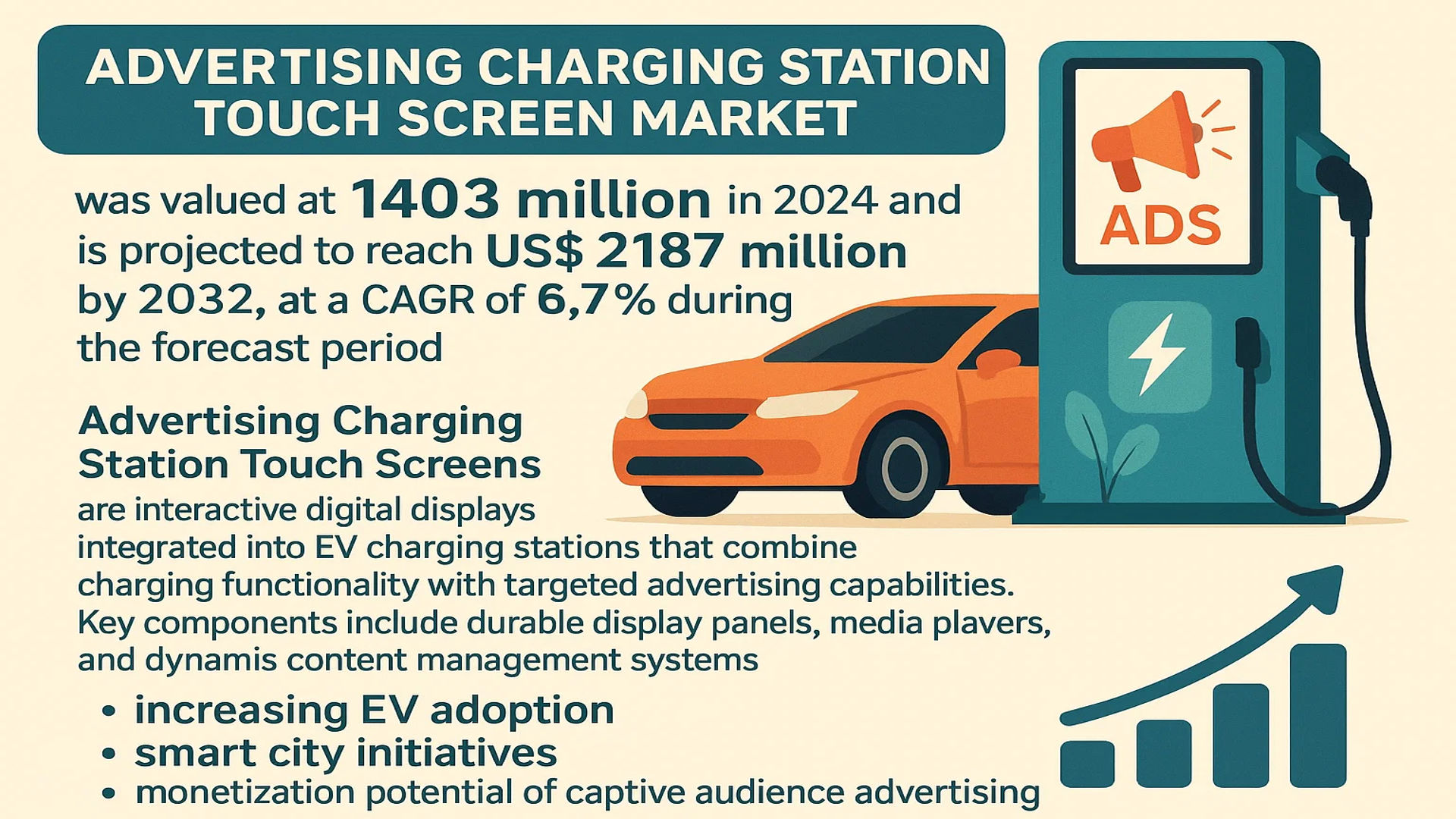
The global Advertising Charging Station Touch Screen Market was valued at 1403 million in 2024 and is projected to reach US$ 2187 million by 2032, at a CAGR of 6.7% during the forecast period.
Advertising Charging Station Touch Screens are interactive digital displays integrated into EV charging stations that combine charging functionality with targeted advertising capabilities. These systems typically feature high-resolution capacitive or resistive touch screens that allow users to interact with charging interfaces while viewing promotional content. Key components include durable display panels, media players, and dynamic content management systems.
The market growth is driven by increasing EV adoption, smart city initiatives, and the monetization potential of captive audience advertising. Capacitive touch screens dominate the market due to their superior responsiveness and multi-touch capabilities, particularly in public charging locations. Key players like 3M, Zytronic, and GreenTouch are investing in advanced display technologies to enhance user engagement and advertising effectiveness at charging points.
MARKET DYNAMICS
MARKET DRIVERS
Rapid Expansion of Electric Vehicle Infrastructure Driving Adoption
The global push towards electric vehicle adoption is creating substantial demand for charging infrastructure, with advertising charging station touch screens emerging as a key component. Governments worldwide are implementing aggressive EV adoption targets, with over 30 countries announcing plans to phase out internal combustion engine vehicles by 2030-2040. This transition is driving massive investments in charging infrastructure, projected to exceed $50 billion globally by 2025. Digital charging stations with touch screens offer municipalities and businesses dual benefits – essential charging capabilities combined with revenue-generating advertising opportunities. The integration of contactless payment systems and real-time data display functionality in these screens further enhances their value proposition.
Advancements in Interactive Display Technologies Creating New Possibilities
Technological innovation in touch screen displays is revolutionizing the advertising charging station market. Modern capacitive touch screens now offer superior durability, with some models rated for over 1 million touches and outdoor visibility in direct sunlight exceeding 1,000 nits brightness. These advancements enable reliable operation in harsh environments while maintaining vibrant advertisement displays. The integration of AI-powered facial recognition and audience analytics allows for targeted advertising, increasing engagement rates by up to 300% compared to static displays. Furthermore, the development of energy-efficient OLED touch screens has reduced power consumption by approximately 40%, making them ideal for sustainable charging infrastructure projects where energy optimization is critical.
Growing Smart City Initiatives Creating Favorable Market Conditions
Smart city development programs across urban centers worldwide are incorporating advertising charging stations as part of their digital infrastructure strategies. Municipalities recognize these installations as self-sustaining assets that provide both essential services and community engagement platforms. The global smart city market, valued at over $400 billion, is allocating significant portions of its budget to interactive public infrastructure. Touch screen charging stations serve as ideal IoT endpoints for smart city networks, collecting valuable foot traffic data while displaying real-time city information, emergency alerts, and local business promotions. This multifunctionality is making them increasingly attractive to urban planners and municipal budget committees evaluating ROI on public infrastructure investments.
MARKET RESTRAINTS
High Initial Deployment Costs Limiting Widespread Adoption
While advertising charging stations offer long-term monetization potential, their substantial upfront costs remain a significant barrier to mass deployment. A single high-end touch screen charging station unit can cost between $5,000-$15,000 depending on screen size and functionality. This pricing places the technology out of reach for many small businesses and municipalities with constrained budgets. Even with potential advertising revenue sharing models, the payback period often exceeds 3-5 years, deterring risk-averse investors. Additional expenses including installation, maintenance contracts, and content management systems further increase the total cost of ownership, making it challenging to achieve positive ROI in markets with lower foot traffic volumes.
Technical Complexity and Maintenance Requirements Creating Operational Challenges
The sophisticated nature of touch screen charging stations introduces multiple operational challenges that can hinder market growth. These systems combine high-voltage charging equipment with sensitive display technology, requiring specialized technicians for installation and repairs. Vandalism and weathering in outdoor installations account for nearly 25% of annual maintenance costs, with screen replacements being particularly expensive. Software complexity is another concern, as stations must simultaneously manage power distribution, user authentication, advertising content rotation, and data collection – all while maintaining cybersecurity protections. The integration of multiple subsystems creates potential points of failure that can undermine reliability and user experience.
Regulatory Uncertainties Around Public Advertising Spaces
Municipal regulations governing digital out-of-home advertising present another restraint on market expansion. Many cities have strict zoning laws that limit the placement and size of advertising displays in public spaces. Emerging concerns about digital distraction and light pollution have led some jurisdictions to impose brightness restrictions or curfews on illuminated signs. Privacy regulations also complicate the deployment of audience measurement technologies, with some regions requiring explicit consent for facial recognition or dwell time tracking. These regulatory hurdles create a complex patchwork of compliance requirements that vary significantly between markets, increasing the legal and administrative burden on operators looking to scale deployments across multiple locations.
MARKET OPPORTUNITIES
Integration With Retail Environments Creating New Revenue Streams
The retail sector represents a significant growth opportunity for advertising charging stations, particularly in high-traffic locations like shopping malls, airports, and entertainment venues. Forward-thinking retailers are recognizing these installations as valuable customer engagement tools that can increase dwell time by an average of 15-20 minutes per visit. Innovative implementations combine charging functionality with digital wayfinding, promotional offers, and loyalty program integrations – creating seamless omnichannel experiences. Some premium brands are experimenting with AR-enhanced screens that allow users to virtually try products while their devices charge. As retailers increasingly prioritize experiential elements in their physical locations, charging stations with advanced touch screens are becoming essential components of store layouts.
Development of Subscription-Based Content Models
The emergence of subscription-based content platforms presents another promising opportunity for market expansion. Some operators are experimenting with premium content tiers that offer ad-free experiences or exclusive media access in exchange for monthly fees. Educational institutions are adopting this model for campus charging stations, providing students with access to course materials, event calendars, and institutional news through the touch interface. Similarly, transportation hubs are implementing paid content portals that combine charging with entertainment options like news feeds, games, and video streaming. These innovative monetization approaches help diversify revenue beyond traditional advertising, making charging station deployments financially viable in lower-traffic locations.
Advancements in Sustainable Materials Reducing Environmental Impact
Growing emphasis on sustainability is driving innovation in charging station materials and manufacturing processes. Manufacturers are developing units with recycled aluminum frames, solar-powered operation, and biodegradable screen components to appeal to environmentally conscious buyers. Some cutting-edge models incorporate kinetic energy harvesting, converting user interactions with the touch screen into supplemental power. These green innovations align with corporate sustainability initiatives and help secure preferential treatment in municipal procurement processes that increasingly factor in environmental impact assessments. As sustainability requirements tighten globally, eco-friendly charging station designs will gain competitive advantage in both public and private sector markets.
MARKET CHALLENGES
Intense Competition From Alternative Advertising Channels
The advertising charging station market faces stiff competition from established and emerging digital out-of-home media formats. Mobile device penetration exceeding 80% in developed markets gives smartphone-based advertising unparalleled reach, while digital billboards offer larger visual impact at comparable CPM rates. New technologies like augmented reality and projection mapping are creating immersive ad experiences that challenge the value proposition of touch screen stations. To remain competitive, charging station operators must demonstrate superior engagement metrics and conversion rates while keeping advertising costs attractive to brands. The need to continuously prove ROI against these alternative channels creates ongoing pressure on pricing and technological innovation within the sector.
Rapid Technological Obsolescence Increasing Refresh Costs
The fast pace of display technology advancement presents significant challenges for charging station operators. Touch screen capabilities that were cutting-edge three years ago now appear dated compared to consumer device standards, reducing user engagement. Charging protocols are similarly evolving, with new standards like USB-C Power Delivery and wireless charging creating compatibility issues for installed bases. This rapid obsolescence cycle forces operators to either accept diminishing returns from aging equipment or make substantial capital investments in frequent hardware refreshes. The dilemma is particularly acute in public sector deployments where budget cycles and procurement processes are ill-suited to the tech industry’s innovation tempo, potentially leaving municipalities locked into outdated solutions.
Data Privacy Concerns Limiting Audience Analytics Potential
While advanced audience measurement capabilities represent a key value proposition for advertising charging stations, growing privacy regulations are limiting data collection opportunities. Stricter laws like GDPR and CCPA require explicit opt-in for many forms of behavioral tracking, with penalty risks for non-compliance. Public skepticism about surveillance technologies has made some location owners hesitant to deploy systems with facial recognition or detailed user profiling. These constraints force operators to balance the need for actionable analytics with privacy considerations, often resulting in less granular data than advertisers prefer. Developing privacy-compliant yet still effective measurement methodologies remains an ongoing challenge for the industry as it seeks to demonstrate advertising effectiveness to brand partners.
ADVERTISING CHARGING STATION TOUCH SCREEN MARKET TRENDS
Integration of Advanced Interactive Displays to Dominate Market Evolution
The global advertising charging station touch screen market is witnessing a paradigm shift with the increasing incorporation of high-definition interactive displays into charging solutions. These multitouch-enabled screens not only serve device charging purposes but also function as dynamic advertising platforms, creating new revenue streams for businesses. Advances in capacitive touch technology have improved response times to under 5ms while maintaining 98% touch accuracy, significantly enhancing user engagement. Furthermore, the integration of AI-driven content optimization algorithms ensures advertisements are precisely targeted based on real-time user demographics and behavior patterns.
Other Trends
Rise of Smart City Infrastructure
The proliferation of smart city initiatives across major urban centers is accelerating the deployment of advertising charging stations. Municipalities are increasingly recognizing these units as dual-purpose infrastructure, combining EV charging with digital out-of-home (DOOH) advertising capabilities. Leading smart city projects in Asia are allocating 12-15% of their annual digital infrastructure budgets toward interactive charging stations, with installations growing at 23% year-over-year in high-traffic areas.
Retail Sector Adoption for Enhanced Customer Engagement
Retail chains across North America and Europe are rapidly adopting interactive charging kiosks as part of their omnichannel marketing strategies. These units demonstrate 40% higher engagement rates compared to traditional digital signage when placed in shopping malls and transit hubs. The premium segment featuring 4K resolution screens and facial recognition technology now accounts for over 35% of B2B sales in this sector, with average dwell times increasing by 2.5 minutes per user interaction. This trend is further supported by the growing implementation of NFC-enabled proximity marketing through charging interfaces.
COMPETITIVE LANDSCAPE
Key Industry Players
Innovation and Strategic Expansion Drive Market Leadership in Touch Screen Solutions
The global Advertising Charging Station Touch Screen Market is moderately fragmented, featuring a dynamic mix of multinational corporations, regional leaders, and emerging technology specialists. As demand for interactive charging solutions surges, companies are leveraging technological expertise, strategic collaborations, and geographic diversification to secure competitive advantages.
With the market projected to grow at a CAGR of 6.7% through 2032, key players like GreenTouch and 3M dominate through extensive product portfolios and established distribution networks. Notably, GreenTouch has expanded its capacitive touch screen solutions for high-traffic public charging stations, while 3M’s diversified electronics segment strengthens its foothold in both North American and Asian markets.
The competitive intensity increased in 2024 as Chinese manufacturers like Shenzhen Xintai Technology and ShenZhen Ever Glory Photoelectric gained market share through cost-competitive offerings. However, these firms now prioritize R&D to match the premium touch responsiveness and durability standards set by Western counterparts. Meanwhile, European specialists such as Zytronic differentiate through proprietary projection capacitive technology, particularly for outdoor charging station applications.
Strategic movements are reshaping the landscape: DMC Co., Ltd. recently acquired a touch panel manufacturer to vertically integrate production, while Cinotop Electronics formed partnerships with EV charging network operators. Such initiatives highlight how companies are adapting to the dual demand for both advertising monetization and seamless user experience in charging infrastructure.
List of Key Advertising Charging Station Touch Screen Companies
- GreenTouch (Global)
- 3M (U.S.)
- DMC Co., Ltd. (South Korea)
- Dunmore Corporation (U.S.)
- ShenZhen Ever Glory Photoelectric Co.,Ltd (China)
- Cinotop Electronics Co. Ltd. (Taiwan)
- Nantong Chariot Information Tech Co.,Ltd (China)
- Zytronic (UK)
- Shenzhen MercedesTechnology Co., Ltd. (China)
- Visual Planet Limited (UK)
- Innovative Technology Solutions (U.S.)
- Fujian Wiwo Electronic Technology Co., Ltd. (China)
Segment Analysis:
By Type
Capacitive Touch Screen Segment Dominates Due to Superior User Experience and High Durability
The market is segmented based on type into:
- Capacitive Touch Screen
- Subtypes: Projected Capacitive (PCAP), Surface Capacitive, and others
- Resistive Touch Screen
- Infrared Touch Screen
- Surface Acoustic Wave Touch Screen
- Others
By Application
Charging Pile in Public Areas Segment Leads Due to Increasing Infrastructure Development
The market is segmented based on application into:
- Charging Pile in Residential Areas
- Charging Pile in Public Areas
- Commercial Complexes
- Transportation Hubs
- Others
By Technology
Interactive Advertising Displays Gain Traction Due to Enhanced Customer Engagement
The market is segmented based on technology into:
- Single-Touch Screens
- Multi-Touch Screens
- Gesture Recognition Systems
- Others
By Screen Size
Medium-Sized Screens (15″-32″) Preferred for Optimal Visibility and Space Efficiency
The market is segmented based on screen size into:
- Small (Below 15″)
- Medium (15″-32″)
- Large (Above 32″)
Regional Analysis: Advertising Charging Station Touch Screen Market
Asia-Pacific
The Asia-Pacific region dominates the global advertising charging station touch screen market, driven by rapid urbanization and expanding EV infrastructure. China leads adoption with over 1.2 million public charging points as of 2024, creating massive demand for interactive advertising displays. Local manufacturers like ShenZhen Ever Glory Photoelectric and Cinotop Electronics benefit from government subsidies supporting smart city initiatives. While capacitive touch screens dominate due to superior responsiveness, cost-sensitive markets still utilize resistive variants. Japan and South Korea follow closely, with advanced digital signage integration in charging stations, though growth faces challenges from strict content regulations and data privacy laws.
North America
North America’s market growth is propelled by increasing EV penetration (projected 35 million EVs by 2030) and high advertiser spending on captive-audience platforms. The U.S. accounts for 78% of regional revenue, with key players like 3M and GreenTouch supplying durable outdoor-rated touch screens. Regulatory focus on ADA compliance drives innovation in accessible interface design. However, fragmented charging networks and inconsistent municipal advertising policies create deployment complexities. Canada shows promising growth through public-private partnerships, while Mexico’s market remains nascent due to infrastructure gaps.
Europe
Europe’s mature advertising charging station market thrives on sustainability-focused regulations and high EV adoption rates (24% of new car sales in 2024). Germany and France lead deployment, with touch screens incorporating renewable energy integrations. EU directives on digital out-of-home advertising shape content management systems, favoring suppliers like Zytronic with GDPR-compliant solutions. The UK market faces post-Brexit component sourcing challenges, while Nordic countries pioneer solar-powered stations with low-temperature operable displays. Resistance from traditional media operators occasionally slows expansion in urban centers.
South America
South America represents an emerging market, with Brazil accounting for 62% of regional installations. Growth is constrained by economic volatility but supported by rising EV incentives in Chile and Colombia. Touch screen adoption leans toward budget-friendly resistive models, though premium locations in São Paulo and Buenos Aires deploy capacitive versions. Advertising revenue models struggle with low CPM rates, while infrastructure bottlenecks limit station deployments. Chinese manufacturers dominate supply chains through cost advantages, squeezing local producers.
Middle East & Africa
The MEA region shows patchy growth, with UAE and Saudi Arabia driving 73% of market activity through luxury development projects. Extreme climate conditions necessitate specialized screen coatings, creating opportunities for suppliers like Dunmore. South Africa’s market grows slowly due to electricity reliability issues, while North African nations prioritize basic charging infrastructure over advertising features. Religious advertising restrictions in GCC countries limit content diversity, though tourism hubs like Dubai leverage multilingual interactive displays extensively.
Report Scope
This market research report provides a comprehensive analysis of the global and regional Advertising Charging Station Touch Screen markets, covering the forecast period 2024–2032. It offers detailed insights into market dynamics, technological advancements, competitive landscape, and key trends shaping the industry.
Key focus areas of the report include:
- Market Size & Forecast: Historical data and future projections for revenue, unit shipments, and market value across major regions and segments. The global market was valued at USD 1403 million in 2024 and is projected to reach USD 2187 million by 2032, growing at a CAGR of 6.7%.
- Segmentation Analysis: Detailed breakdown by product type (capacitive vs. resistive touch screens), application (residential vs. public charging piles), and end-user industry to identify high-growth segments.
- Regional Outlook: Insights into market performance across North America, Europe, Asia-Pacific, Latin America, and Middle East & Africa. The U.S. and China represent key growth markets.
- Competitive Landscape: Profiles of 20+ leading manufacturers including GreenTouch, 3M, DMC Co., Ltd., and Zytronic, covering their market share, product portfolios, and strategic initiatives.
- Technology Trends: Assessment of touch screen innovations, integration with EV charging infrastructure, and emerging display technologies.
- Market Drivers & Restraints: Analysis of factors including EV adoption rates, smart city initiatives, and regulatory policies impacting market growth.
- Stakeholder Analysis: Strategic insights for touch screen manufacturers, charging station operators, advertisers, and infrastructure developers.
The research methodology combines primary interviews with industry experts and analysis of verified market data from regulatory bodies, company financials, and trade associations.
FREQUENTLY ASKED QUESTIONS:
What is the current market size of Global Advertising Charging Station Touch Screen Market?
-> Advertising Charging Station Touch Screen Market was valued at 1403 million in 2024 and is projected to reach US$ 2187 million by 2032, at a CAGR of 6.7% during the forecast period.
Which key companies operate in this market?
-> Leading players include GreenTouch, 3M, DMC Co., Ltd., ShenZhen Ever Glory Photoelectric, Zytronic, and Cinotop Electronics.
What are the key growth drivers?
-> Primary drivers include rising EV adoption, smart city development, and increasing demand for interactive advertising platforms at charging stations.
Which region dominates the market?
-> Asia-Pacific shows the fastest growth, while North America currently leads in technological adoption.
What are the emerging trends?
-> Key trends include integration of AI-powered advertising, multi-touch displays, and solar-powered charging stations with digital signage.

Get Sample Report PDF for Exclusive Insights
Report Sample Includes
- Table of Contents
- List of Tables & Figures
- Charts, Research Methodology, and more...
 Download Sample Report PDF