Advanced Ceramic Dielectrics Market Insights
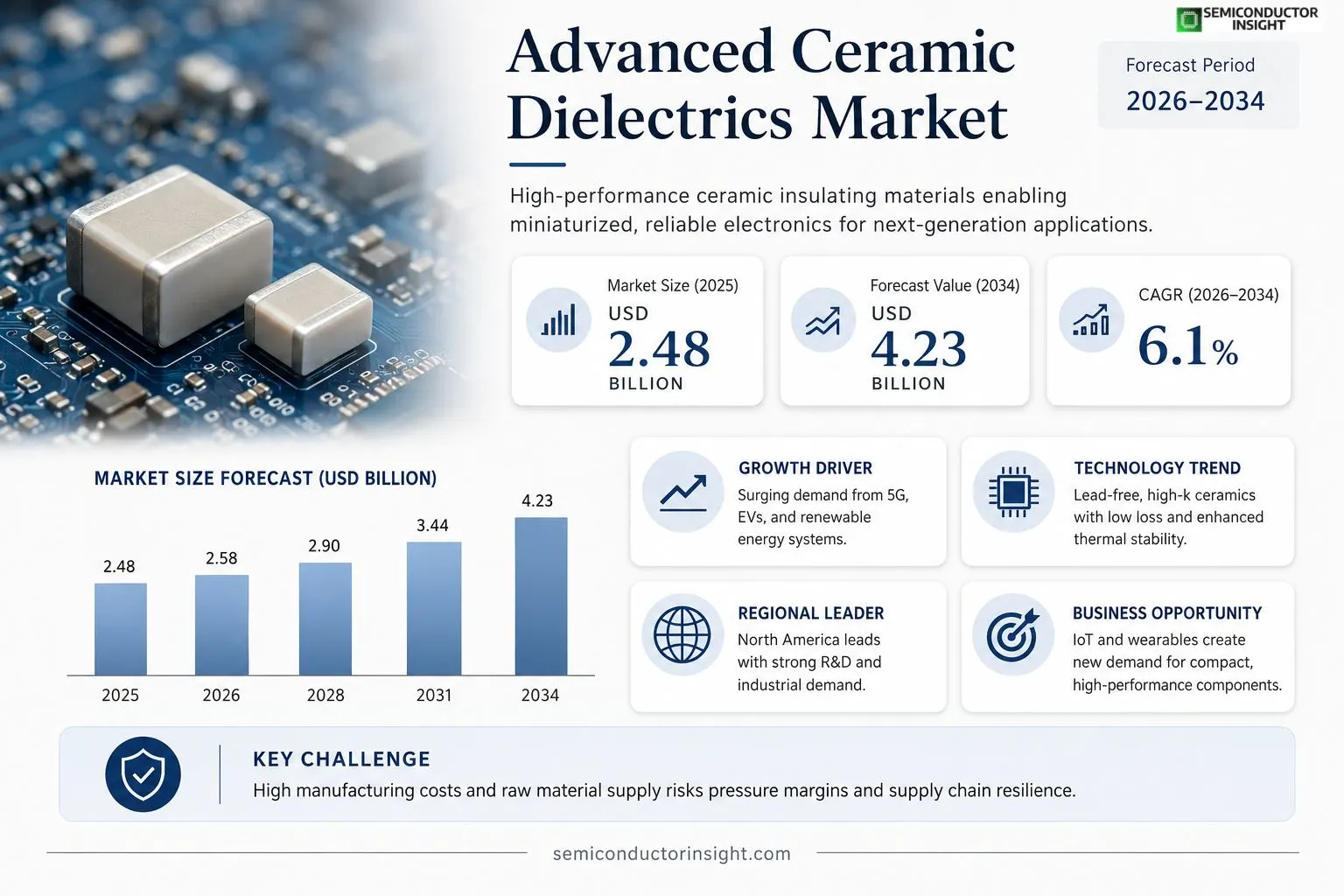
advanced ceramic dielectrics market size was valued at USD 2.48 billion in 2025. The market is projected to grow from USD 2.58 billion in 2025 to USD 4.23 billion by 2034, exhibiting a CAGR of 6.1% during the forecast period.
Advanced ceramic dielectrics are high‑performance insulating materials engineered from sintered oxide ceramics such as barium titanate, magnesium aluminate spinel, and lead‑free perovskites. Their superior dielectric constant, low loss tangent, and thermal stability make them essential for miniaturized capacitors, resonators, and high‑frequency communication modules.The market is gaining momentum because automotive electrification, renewable‑energy converters, and fifth‑generation wireless infrastructure demand compact yet reliable dielectric components. Furthermore, stringent environmental regulations are driving the shift toward lead‑free formulations, while ongoing R&D investments from key players accelerate material innovation.
MARKET DRIVERS
Rising Demand in High‑Performance Electronics
Advanced Ceramic Dielectrics Market is being propelled by the rapid expansion of 5G infrastructure, electric vehicles, and renewable energy systems, all of which require components that can operate at higher frequencies and temperatures. Manufacturers are increasingly adopting ceramic dielectric materials for their superior thermal stability and low loss characteristics, driving robust growth across the sector.
Stringent Energy‑Efficiency Regulations
Governments worldwide are implementing stricter energy‑efficiency standards for consumer appliances and industrial equipment. This regulatory pressure is encouraging device makers to integrate advanced ceramic dielectrics, which offer higher capacitance per volume and lower leakage currents, thereby aligning product designs with compliance requirements.
➤ “Ceramic dielectrics deliver a unique combination of high dielectric constant and temperature resilience, essential for next‑generation power electronics.”
Additionally, ongoing research collaborations between academia and industry are delivering novel ceramic formulations with improved reliability, further solidifying the market’s growth trajectory and reinforcing confidence among end‑users.
MARKET CHALLENGES
High Manufacturing Costs
The production of high‑purity ceramic dielectrics involves complex sintering processes and precise material controls, resulting in elevated capital expenditures. Smaller suppliers often struggle to achieve economies of scale, limiting their ability to compete on price against larger incumbents.
Other Challenges
Supply Chain Vulnerabilities
Raw material shortages, particularly for rare‑earth oxides, can cause lead‑time extensions and price volatility, affecting the overall resilience of Advanced Ceramic Dielectrics Market.
MARKET RESTRAINTS
Technical Integration Barriers
Integrating ceramic dielectric components into existing circuit designs often requires redesign of layout and packaging, creating additional engineering overhead. This complexity can deter OEMs from rapid adoption, especially in sectors with short product lifecycles.
MARKET OPPORTUNITIES
Emerging Applications in IoT and Wearables
The surge in Internet‑of‑Things (IoT) devices and wearable technology presents a fertile ground for Advanced Ceramic Dielectrics Market. These applications demand miniaturized components with high capacitance and low power consumption, attributes that advanced ceramics can uniquely satisfy, opening new revenue streams for manufacturers willing to innovate.
Advanced Ceramic Dielectrics Market Trends
Automotive Electrification Accelerates Adoption
In the past few years, the shift toward electric drivetrains has created a robust demand for high‑performance insulating components. Advanced ceramic dielectrics, with their high dielectric constant and low loss characteristics, enable compact capacitor architectures that meet the space‑constrained designs of battery‑management systems and power‑inverter modules. Manufacturers are integrating these ceramics into voltage‑regulation circuits to improve efficiency and thermal resilience, reducing overall system weight while maintaining safety standards. The convergence of tighter emissions regulations and consumer preference for zero‑emission vehicles has reinforced this trend, prompting suppliers to qualify new ceramic formulations for automotive qualification processes. As a result, the supply chain is witnessing increased collaboration between material scientists and automotive OEMs to tailor dielectric properties for specific voltage and frequency requirements.
Other Trends
Lead‑Free Formulations Gain Traction
Environmental legislation across major regions now restricts the use of lead‑based ceramics in electronic assemblies. In response, research teams are focusing on barium‑titanate‑based and magnesium‑aluminate spinel systems that deliver comparable permittivity without hazardous constituents. These lead‑free compositions also exhibit enhanced thermal stability, making them suitable for high‑temperature power‑electronics in renewable‑energy converters. Industry pilots have reported up to a 15 % reduction in dielectric loss when substituting traditional leaded materials, translating into longer component lifespans and lower failure rates under cyclic thermal loading. Market participants are scaling up production lines to meet the growing requirement for environmentally compliant dielectrics, while simultaneously securing patents on novel synthesis routes that lower sintering temperatures and improve grain uniformity.
5G and High‑Frequency Wireless Expansion
The rollout of fifth‑generation (5G) networks and the emergence of millimeter‑wave applications demand dielectric materials that can operate reliably at frequencies exceeding 20 GHz. Advanced ceramic dielectrics provide the low loss tangent and stable permittivity needed for resonators, filters, and antenna substrates in these high‑frequency domains. Companies are engineering perovskite‑derived ceramics with controlled grain boundaries to minimize dielectric dispersion, thereby supporting the tighter bandwidth tolerances required by 5G infrastructure. This technical progress is also spilling over into emerging IoT devices, where miniaturized, high‑Q components are essential for maintaining signal integrity. The combined pressure from telecom equipment manufacturers and device makers is driving a steady increase in the adoption of these specialized ceramic solutions within Advanced Ceramic Dielectrics Market.
COMPETITIVE LANDSCAPEKey Industry Players
Advanced Ceramic Dielectrics Market Competitive Overview
The market is currently dominated by a few multinational firms that possess deep R&D capabilities and integrated supply chains for high‑performance ceramic capacitors. Murata Manufacturing leads with its proprietary barium titanate formulations, while TDK Corporation and Kyocera Corporation follow closely, leveraging scale to serve automotive electrification and 5G infrastructure. These leaders benefit from strong patents, extensive production capacity, and strategic partnerships with semiconductor OEMs, establishing a classic oligopolistic structure where market share is concentrated among the top three players.Beyond the core incumbents, a diverse set of niche specialists is expanding the value chain. Companies such as Ferrotec, CeramTec, and NGK Insulators focus on lead‑free perovskite and spinel ceramics for renewable‑energy converters. Smaller innovators like Shinagawa Seiki, Taiyo Yuden, and H.C. Starck specialize in ultra‑low loss materials for high‑frequency resonators, often collaborating with research institutions. This secondary tier adds depth to the ecosystem, driving material differentiation and supporting emerging applications despite their relatively modest revenues.
List of Key Advanced Ceramic Dielectrics Companies Profiled
- Murata Manufacturing
- TDK Corporation
- Kyocera Corporation
- Ferrotec
- CeramTec
- NGK Insulators
- H.C. Starck
- Shinagawa Seiki
- Taiyo Yuden
- CoorsTek
- Research Center for Advanced Ceramics (RRC)
- Sumitomo Chemical
- Samsung Electro‑Mechanics
Segment Analysis:
| Segment Category | Sub-Segments | Key Insights |
| By Type |
|
Lead‑free Perovskite Dielectrics
|
| By Application |
|
Miniaturized Capacitors
|
| By End User |
|
Automotive
|
| By Material Composition |
|
Multi‑phase Nanocomposites
|
| By Performance Requirement |
|
Low Loss Tangent
|
Regional Analysis: North America
United States
The telecommunications sector is a major driver of demand for advanced ceramic dielectrics in the United States, particularly for high-frequency applications in 5G and future network technologies. The need for miniaturized and high-performance components is constantly evolving, creating opportunities for innovative ceramic solutions.
The stringent requirements of the aerospace and defense industries necessitate the use of robust and reliable ceramic dielectrics. These materials are employed in applications such as radar systems, electronic warfare equipment, and satellite communications, where performance and durability are paramount.
Advanced ceramic dielectrics play a crucial role in semiconductor manufacturing, serving as substrates, insulators, and packaging materials. The increasing complexity of microchips and the demand for higher processing speeds are driving the adoption of advanced ceramic solutions.
The growing sophistication of automotive electronics, including advanced driver-assistance systems (ADAS) and electric vehicle (EV) technology, is creating new avenues for advanced ceramic dielectrics in the US market.
Europe
Europe represents the second largest market for advanced ceramic dielectrics. The region benefits from a strong industrial base and a focus on sustainable technologies. Key applications include automotive electronics, industrial automation, and renewable energy systems. Government regulations promoting energy efficiency and environmental protection are also contributing to market growth. The European market is characterized by a strong emphasis on innovation and collaboration between research institutions and industry players. The increasing adoption of electric vehicles and the development of advanced power electronics are key drivers. Furthermore, the region’s commitment to high-quality manufacturing standards supports the demand for premium ceramic dielectrics. The competitive landscape in Europe is diverse, with a mix of established players and emerging startups focused on niche applications.
Asia-Pacific
The Asia-Pacific region is poised for significant growth in Advanced Ceramic Dielectrics Market. Driven by rapid industrialization, increasing electronics production, and substantial investments in infrastructure, countries like China, Japan, and South Korea are leading the demand. The electronics manufacturing hub in Asia-Pacific is a major consumer of these materials, fueling growth across various sectors, including consumer electronics, telecommunications, and automotive. Government initiatives promoting technological self-sufficiency and attracting foreign investment further support market expansion. While competition is intense, particularly from domestic players, the region offers substantial opportunities for global suppliers. Asia-Pacific presents a dynamic and rapidly evolving market for advanced ceramic dielectrics, with a strong focus on cost-effectiveness and scalability.
South America
South America represents a smaller but growing market for advanced ceramic dielectrics. The increasing development of industrial sectors, particularly in Brazil and Argentina, is driving demand for these materials in applications like telecommunications infrastructure and industrial equipment. The region’s mining industry also utilizes advanced ceramic dielectrics in specialized equipment. While the market is still developing, there is potential for growth as infrastructure investments increase and technological adoption expands. Challenges include logistical complexities and economic fluctuations, but the long-term outlook remains positive.
Middle East & Africa
The Middle East and Africa represent emerging markets for advanced ceramic dielectrics. Significant investments in infrastructure development, particularly in the telecommunications and energy sectors, are creating opportunities for growth. The increasing adoption of renewable energy technologies and the expansion of data centers are further driving demand. While these markets are smaller compared to North America and Asia-Pacific, their growth potential is considerable. Government initiatives aimed at diversifying economies and fostering technological advancement are expected to boost the adoption of advanced ceramic dielectrics in the coming years.
Report Scope
This market research report provides a comprehensive analysis of the Advanced Ceramic Dielectrics Market , covering the forecast period 2026–2034. It offers detailed insights into market dynamics, technological advancements, competitive landscape, and key trends shaping the industry.
Key focus areas of the report include:
- Market Overview: The report begins with an overview outlining its current market scenario, key growth indicators, and industry transformation drivers. It discusses macroeconomic factors, demand–supply balance, regulatory landscape, and the strategic role of semiconductors in powering advancements across industries such as automotive, telecommunications, consumer electronics, and industrial automation.
- Market Size & Forecast: Historical data and future projections for revenue, unit shipments, and market value across major regions and segments.
- Segmentation Analysis: Detailed breakdown by product type, technology, application, and end-user industry to identify high-growth segments and investment opportunities.
- Regional Insights: Insights into market performance across North America, Europe, Asia-Pacific, Latin America, and the Middle East & Africa, including country-level analysis where relevant.
- Competitive Landscape: Profiles of leading market participants, including their product offerings, R&D focus, manufacturing capacity, pricing strategies, and recent developments such as mergers, acquisitions, and partnerships.
- Technology Trends & Innovation: Assessment of emerging technologies, integration of AI/IoT, semiconductor design trends, fabrication techniques, and evolving industry standards.
- Market Drivers & Restraints: Evaluation of factors driving market growth along with challenges, supply chain constraints, regulatory issues, and market-entry barriers.
- Stakeholder Insights: Insights for component suppliers, OEMs, system integrators, investors, and policymakers regarding the evolving ecosystem and strategic opportunities.
Primary and secondary research methods are employed, including interviews with industry experts, data from verified sources, and real-time market intelligence to ensure the accuracy and reliability of the insights presented.
FREQUENTLY ASKED QUESTIONS:
What is the current market size of Advanced Ceramic Dielectrics Market?
-> Advanced Ceramic Dielectrics Market was valued at USD 2.48 billion in 2025 and is expected to reach USD 4.23 billion by 2034, representing a CAGR of 6.1% during the forecast period.
Which key companies operate in Advanced Ceramic Dielectrics Market?
-> Key players include Axalta Coating Systems, AkzoNobel, BASF SE, PPG, Sherwin-Williams, and 3M, among others.
What are the key growth drivers?
-> Key growth drivers include railway infrastructure investments, urbanization, and demand for durable coatings.
Which region dominates the market?
-> Asia-Pacific is the fastest-growing region, while Europe remains a dominant market.
What are the emerging trends?
-> Emerging trends include bio-based coatings, smart coatings, and sustainable rail solutions.

Get Sample Report PDF for Exclusive Insights
Report Sample Includes
- Table of Contents
- List of Tables & Figures
- Charts, Research Methodology, and more...
 Download Sample Report PDF