
Market Insights
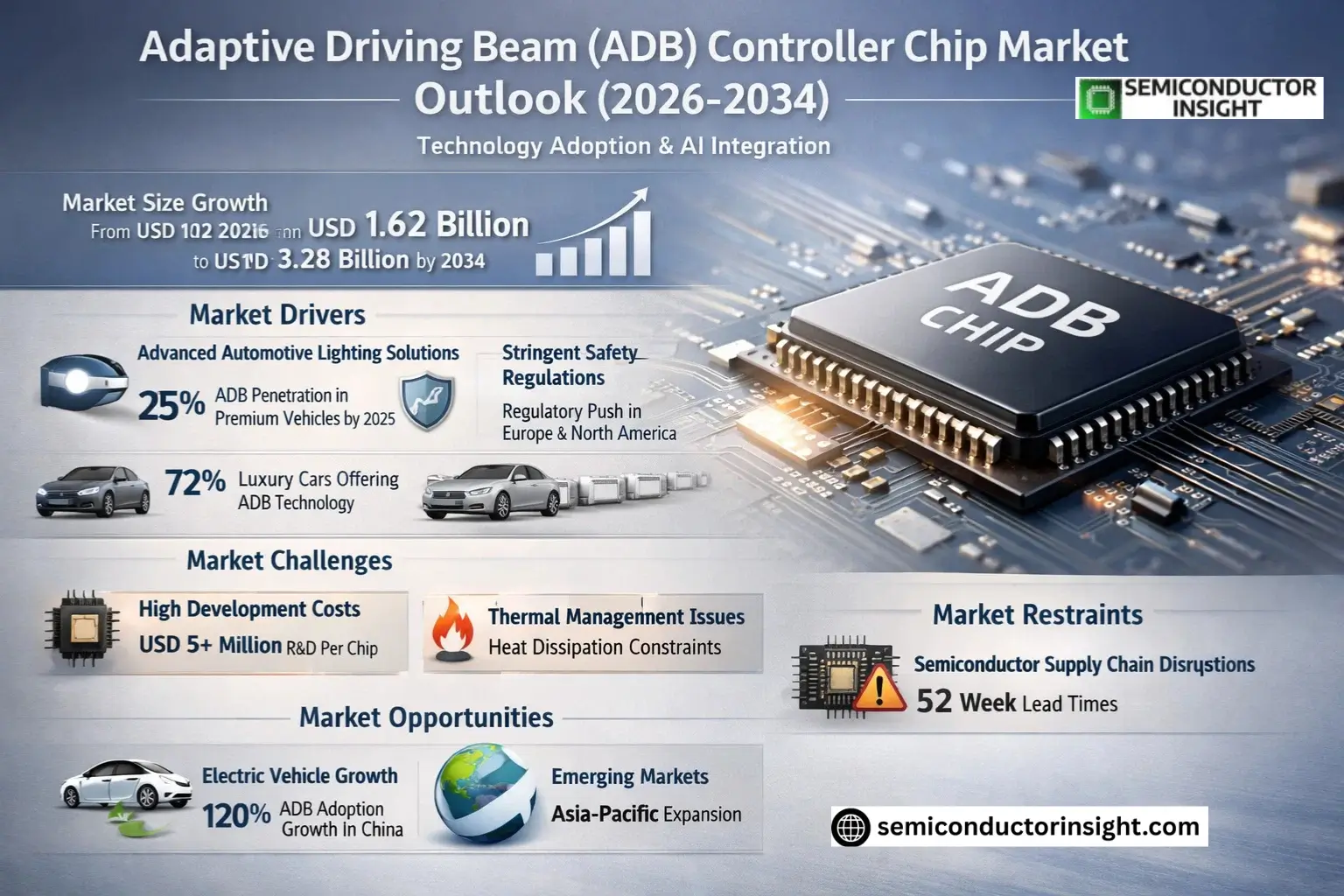
Global Adaptive Driving Beam (ADB) Controller Chip Market size was valued at USD 1.45 billion in 2025. The market is projected to grow from USD 1.62 billion in 2026 to USD 3.28 billion by 2034, exhibiting a CAGR of 9.7% during the forecast period.
Adaptive Driving Beam (ADB) Controller Chips are semiconductor components designed to enhance automotive lighting systems by intelligently adjusting high-beam illumination patterns based on real-time driving conditions. These chips enable dynamic light distribution, improving visibility while minimizing glare for oncoming traffic a critical safety feature in modern vehicles.
The market growth is driven by increasing regulatory approvals for ADB technology, rising demand for advanced driver assistance systems (ADAS), and automakers’ focus on night-time driving safety solutions. Key players like NXP Semiconductors and Infineon Technologies are expanding their ADB controller portfolios, with recent developments including chipset integrations for next-generation matrix LED headlights.
MARKET DRIVERS
Growing Demand for Advanced Automotive Lighting Solutions
Adaptive Driving Beam (ADB) Controller Chip Market is experiencing robust growth due to increasing adoption of smart lighting systems in modern vehicles. Automotive manufacturers are prioritizing ADB technology to enhance night-time visibility while minimizing glare for oncoming drivers. Global ADB penetration rate is expected to reach 25% in premium vehicle segments by 2025.
Stringent Vehicle Safety Regulations
Government mandates for improved road safety are accelerating ADB controller chip adoption. Regulatory bodies in Europe and North America have approved ADB systems, with similar regulations under development in emerging markets. This regulatory push creates sustained demand for high-performance ADB controller chips.
Automakers increasingly view ADB systems as a competitive differentiator, with 72% of luxury vehicle models now offering the technology as standard or optional equipment.
MARKET CHALLENGES
High Development and Implementation Costs
The complex architecture of Adaptive Driving Beam systems requires specialized controller chips with advanced processing capabilities. The R&D investment for a single ADB controller chip design can exceed USD 5 million, creating barriers for smaller semiconductor manufacturers.
Other Challenges
Thermal Management Constraints
ADB controller chips must operate reliably in extreme automotive environments while maintaining precise beam pattern control, requiring innovative heat dissipation solutions that add to system complexity.
MARKET RESTRAINTS
Supply Chain Disruptions in Semiconductor Industry
Global chip shortage continues to impact ADB controller production, with lead times stretching to 52 weeks for certain components. Automotive-grade semiconductors face particular supply constraints due to stringent quality requirements.
MARKET OPPORTUNITIES
Emerging Markets and Electric Vehicle Adoption
The rapid growth of electric vehicle production creates new opportunities for ADB controller chip manufacturers, as EV makers prioritize energy-efficient lighting solutions. Asia-Pacific markets show particularly strong growth potential, with China’s ADB adoption rate increasing by 120% year-over-year.
Adaptive Driving Beam (ADB) Controller Chip Market Trends
Growing Demand for Smart Automotive Lighting Systems
The automotive industry is witnessing increased adoption of Adaptive Driving Beam (ADB) Controller Chips due to rising safety concerns and regulatory requirements. These intelligent chips dynamically adjust headlight beams to prevent glare for oncoming vehicles while maintaining optimal illumination. Leading manufacturers are developing advanced matrix control chips that enable precise beam shaping for enhanced night driving safety.
Other Trends
Technological Advancements in Controller Chips
Recent developments in ADB Controller Chip technology focus on improving energy efficiency and integration capabilities. New generations of chips now support multiple lighting zones with higher resolution control, enabling smoother beam transitions. Integration with vehicle sensor networks allows for real-time adaptation to driving conditions, road geometry, and traffic patterns.
Regional Market Developments
Asia-Pacific shows strong growth potential in the ADB Controller Chip market, with China emerging as a key manufacturing and consumption hub. European and North American markets continue to lead in technology adoption due to stringent vehicle safety regulations. The increasing production of premium vehicles in these regions further drives demand for advanced lighting control solutions.
Competitive Landscape Shifts
The market is seeing growing competition between semiconductor giants and specialized automotive chip manufacturers. Companies like TI, Infineon, and NXP are expanding their ADB product portfolios, while regional players in Asia are gaining market share through competitive pricing. Strategic partnerships between chip makers and automotive OEMs are becoming increasingly common to develop customized solutions.
Application-Specific Innovation Trends
ADB Controller Chips are finding new applications beyond traditional headlights, including integration with daytime running lamps and fog lighting systems. The development of chip solutions for electric vehicles is creating additional growth opportunities, as EV manufacturers prioritize energy-efficient lighting solutions to maximize battery performance.
COMPETITIVE LANDSCAPE
Key Industry Players
Technological Leaders Dominate ADB Controller Chip Market with ~60% Revenue Share
Adaptive Driving Beam (ADB) Controller Chip Market is consolidated with semiconductor giants Texas Instruments (TI), Infineon Technologies, and NXP Semiconductors collectively holding over 45% market share. TI leads with advanced matrix control chip solutions optimized for premium automotive lighting systems, while Infineon dominates in Europe with its integrated ADAS-compatible chipsets. NXP maintains strong OEM relationships through its SAF4000 series specifically designed for adaptive headlight applications.
Specialized players like Zhuhai Geehy and Macroblock are gaining traction in the Chinese market through cost-competitive constant current control chips. Emerging innovators such as Indiemicro are focusing on compact chip designs for electric vehicles, while Samsung leverages its display technology expertise for high-resolution LED matrix solutions. The market sees increasing competition from automotive semiconductor specialists like Renesas and STMicroelectronics expanding their ADB portfolios.
List of Key Adaptive Driving Beam (ADB) Controller Chip Companies Profiled
- Texas Instruments (TI)
- Infineon Technologies
- Samsung Semiconductor
- NXP Semiconductors
- Renesas Electronics
- STMicroelectronics
- ON Semiconductor
- ROHM Semiconductor
- Zhuhai Geehy
- Macroblock
- Indiemicro
- Analog Devices
- Maxim Integrated
- Microchip Technology
- Toshiba Electronic Devices
Segment Analysis:
| Segment Category | Sub-Segments | Key Insights |
| By Type |
|
Matrix Control Chip emerges as the dominant segment in ADB solutions due to:
|
| By Application |
|
Car Headlight applications demonstrate strongest adoption due to:
|
| By End User |
|
OEMs represent the primary channel for ADB adoption because:
|
| By Technology |
|
LED-Based ADB technology dominates the market as it offers:
|
| By Vehicle Class |
|
Premium/Luxury Vehicles lead in ADB controller chip adoption due to:
|
Regional Analysis: Adaptive Driving Beam (ADB) Controller Chip Market
Europe’s General Safety Regulation mandates advanced lighting systems, creating immediate demand for ADB controller chips. The 2022 vehicle lighting standards update specifically encourages adoption across all vehicle classes.
Concentrated automotive supply chains in Germany’s Ruhr Valley and Czech Republic facilitate rapid prototyping and testing of new ADB chip designs with tier-1 lighting system suppliers.
European semiconductor firms pioneer low-latency ADB processors capable of real-time beam adjustment, leveraging automotive-grade machine learning accelerators for complex road scenarios.
Luxury automakers like BMW and Mercedes-Benz drive demand for high-performance ADB chips with superior thermal management and extended operational lifetimes.
North America
The North American Adaptive Driving Beam controller chip market thrives on progressive safety regulations and consumer demand for advanced driver assistance systems. U.S. NHTSA approvals have recently expanded ADB applications beyond premium segments, stimulating competition among chip providers. The region sees growing integration of ADB processors with LiDAR systems in next-gen autonomous vehicles. California-based semiconductor startups are introducing AI-optimized chips that reduce power consumption while maintaining precise beam control, addressing range concerns in electric vehicles.
Asia-Pacific
Asia-Pacific demonstrates the fastest growth in ADB chip adoption, fueled by expanding luxury vehicle sales and local semiconductor manufacturing capabilities. Japanese automakers lead in compact ADB controller designs, while Chinese suppliers develop cost-competitive solutions for mass-market vehicles. Korea’s ecosystem benefits from vertical integration between chipmakers and automotive lighting manufacturers. Regional variations in roadway conditions drive demand for adaptive chips capable of handling dense urban environments and rural terrains.
South America
The nascent ADB controller chip market in South America shows potential through partnerships between global suppliers and regional automakers. Brazil’s updated vehicle safety norms create baseline demand, while premium import vehicles drive awareness. Economic constraints currently limit penetration, but growing middle-class vehicle ownership presents long-term opportunities for affordable ADB solutions.
Middle East & Africa
This emerging region shows selective adoption of ADB technologies, primarily in luxury vehicle imports and official fleets. Extreme climate conditions necessitate specialized chip designs with enhanced thermal resistance. Middle Eastern markets demonstrate particular interest in ADB systems compatible with desert driving conditions, creating niche opportunities for customized solutions.
Report Scope
This market research report provides a comprehensive analysis of the Adaptive Driving Beam (ADB) Controller Chip Market , covering the forecast period 2025–2034. It offers detailed insights into market dynamics, technological advancements, competitive landscape, and key trends shaping the industry.
Key focus areas of the report include:
- Market Overview: The report begins with an overview outlining its current market scenario, key growth indicators, and industry transformation drivers. It discusses macroeconomic factors, demand–supply balance, regulatory landscape, and the strategic role of semiconductors in powering advancements across industries such as automotive lighting systems and intelligent vehicle technologies.
- Market Size & Forecast: Historical data and future projections for revenue, unit shipments, and market value across major regions and segments.
- Segmentation Analysis: Detailed breakdown by product type, technology, application, and end-user industry to identify high-growth segments and investment opportunities.
- Regional Insights: Insights into market performance across North America, Europe, Asia-Pacific, Latin America, and the Middle East & Africa, including country-level analysis where relevant.
- Competitive Landscape: Profiles of leading market participants, including their product offerings, R&D focus, manufacturing capacity, pricing strategies, and recent developments such as mergers, acquisitions, and partnerships.
- Technology Trends & Innovation: Assessment of emerging technologies, integration of AI/IoT, semiconductor design trends, fabrication techniques, and evolving industry standards.
- Market Drivers & Restraints: Evaluation of factors driving market growth along with challenges, supply chain constraints, regulatory issues, and market-entry barriers.
- Stakeholder Insights: Insights for component suppliers, OEMs, system integrators, investors, and policymakers regarding the evolving ecosystem and strategic opportunities.
Primary and secondary research methods are employed, including interviews with industry experts, data from verified sources, and real-time market intelligence to ensure the accuracy and reliability of the insights presented.
FREQUENTLY ASKED QUESTIONS:
What is the current market size of Adaptive Driving Beam (ADB) Controller Chip Market?
-> Adaptive Driving Beam (ADB) Controller Chip Market size was valued at USD 1.45 billion in 2025. The market is projected to grow from USD 1.62 billion in 2026 to USD 3.28 billion by 2034, exhibiting a CAGR of 9.7% during the forecast period.
Which key companies operate in Adaptive Driving Beam (ADB) Controller Chip Market?
-> Key players include TI, Infineon, Samsung, NXP, Indie, Zhuhai Geehy, Macroblock, and Indiemicro. In 2025, Global top five players had approximately % revenue share.
What are the key applications of ADB Controller Chips?
-> Key applications include car headlights (high beam optimization), daytime running lamps, and other automotive lighting systems to improve night driving safety and comfort.
Which region leads in market growth?
-> Asia-Pacific shows strong growth potential, with China projected to reach USD million by 2034, while North America (particularly the US) holds significant market share.
What are the main product segments?
-> The market is segmented into Matrix Control Chips (projected to reach USD million by 2034), Constant Current Control Chips, and others.
Get Sample Report PDF for Exclusive Insights
Report Sample Includes
- Table of Contents
- List of Tables & Figures
- Charts, Research Methodology, and more...
 Download Sample Report PDF