MARKET INSIGHTS
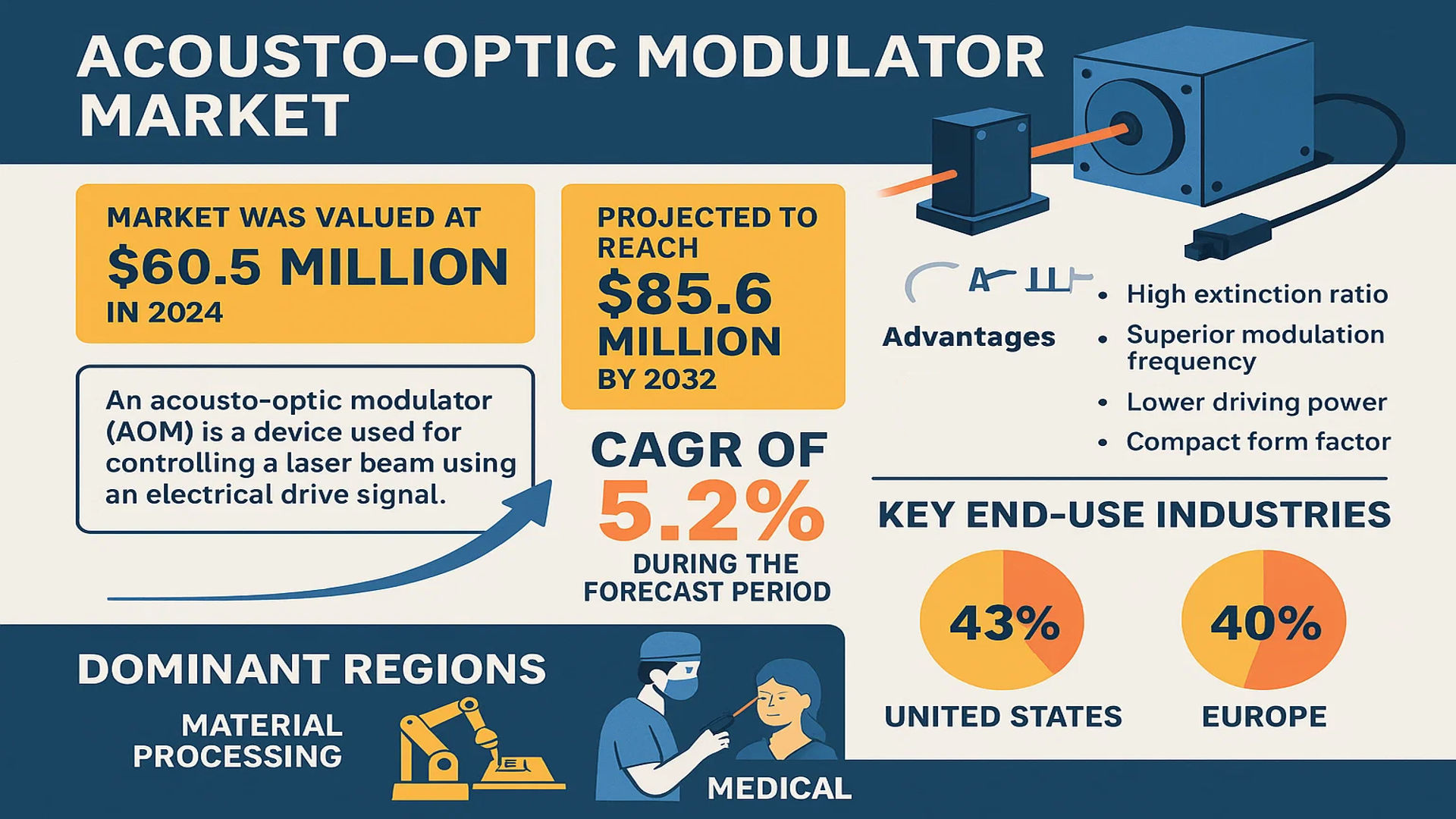
The global Acousto-Optic Modulator Market was valued at 60.5 million in 2024 and is projected to reach US$ 85.6 million by 2032, at a CAGR of 5.2% during the forecast period.
An acousto-optic modulator (AOM) is a device used for controlling the power, frequency, or spatial direction of a laser beam with an electrical drive signal. It operates based on the acousto-optic effect, which is the modification of a material’s refractive index by the oscillating mechanical pressure of a sound wave. These devices are critical for applications requiring precise laser beam manipulation, offering advantages such as a high extinction ratio (>1000:1), superior modulation frequency, lower driving power, and a more compact form factor compared to electro-optic or mechanical alternatives.
The market’s growth is primarily driven by increasing demand from key end-use industries, particularly material processing and medical applications like surgery and aesthetic treatments. The United States and Europe are the dominant consumption regions, holding market shares of 43% and 40% respectively, due to their advanced technological infrastructure. The industry is highly concentrated, with the top three manufacturers—Gooch & Housego, Brimrose, and Isomet Corporation—collectively accounting for approximately 88% of the global sales market share.
MARKET DYNAMICS
MARKET DRIVERS
Expansion of Laser-Based Technologies Across Industries to Propel Market Growth
The global acousto-optic modulator market is experiencing robust growth driven by the widespread adoption of laser-based technologies across multiple sectors. In material processing, AOMs are integral for precise laser control in applications such as cutting, welding, and engraving, with the industrial laser market projected to exceed 25 billion dollars by 2028. The medical field, particularly laser surgery and aesthetic treatments, relies heavily on these modulators for their ability to deliver controlled, high-frequency laser pulses. Furthermore, the rising demand for high-resolution imaging and displays in consumer electronics and automotive sectors is accelerating AOM integration. The versatility of acousto-optic modulators in modulating beam intensity, frequency, and direction with nanosecond precision makes them indispensable in advancing laser applications, thereby fueling consistent market expansion.
Advancements in Research and Development Activities to Boost Demand
Research and development activities across scientific and industrial domains are significantly contributing to the growth of the acousto-optic modulator market. In scientific research, AOMs are critical components in spectroscopy, quantum computing, and optical trapping techniques, enabling precise manipulation of laser beams. The global investment in quantum technology research has surpassed 30 billion dollars, underscoring the importance of high-precision optical components like AOMs. Additionally, the expansion of photonics and optoelectronics research in academic and corporate settings is driving demand for reliable modulation solutions. The ability of acousto-optic modulators to operate at high frequencies with minimal distortion supports cutting-edge experiments and innovations, making them a preferred choice in R&D laboratories worldwide.
Increasing Adoption in Defense and Aerospace Applications to Drive Market Expansion
The defense and aerospace sectors are emerging as key drivers for the acousto-optic modulator market, owing to the need for advanced laser systems in targeting, communication, and surveillance. AOMs are utilized in laser rangefinders, Lidar systems, and free-space optical communication due to their high-speed modulation capabilities and reliability in harsh environments. The global defense spending on electro-optical and infrared systems is estimated to grow at a compound annual growth rate of over 5%, highlighting the increased investment in laser-based technologies. Moreover, the miniaturization of AOMs allows for integration into portable and airborne systems, enhancing their applicability in modern defense solutions. This trend is expected to sustain market growth as nations continue to upgrade their technological capabilities.
Furthermore, strategic collaborations between key market players and defense contractors are anticipated to accelerate innovation and adoption.
➤ For instance, recent developments in airborne Lidar systems for terrain mapping and threat detection have significantly increased the procurement of high-performance acousto-optic modulators.
Additionally, the integration of AOMs in satellite communication systems for beam steering and signal modulation presents further growth avenues, aligning with the global push for enhanced space exploration and security infrastructure.
MARKET CHALLENGES
High Initial Costs and Complex Manufacturing Processes to Hinder Market Penetration
Despite the growing demand, the acousto-optic modulator market faces significant challenges related to high production costs and intricate manufacturing techniques. The fabrication of AOMs requires specialized materials like tellurium dioxide and lithium niobate, which are expensive and subject to supply chain volatility. The precision engineering involved in achieving high extinction ratios and modulation frequencies further escalates costs, making these devices less accessible for budget-conscious applications. Additionally, the need for customized solutions in niche sectors often leads to prolonged development cycles and higher per-unit expenses. These factors collectively pose a barrier to entry for small and medium-sized enterprises, limiting broader market adoption.
Other Challenges
Technical Limitations in High-Power Applications
Acousto-optic modulators exhibit performance constraints when deployed in high-power laser systems, primarily due to thermal effects and material limitations. At power levels exceeding 10 watts, issues such as thermal lensing and diffraction efficiency degradation become prevalent, reducing modulation accuracy and device lifespan. This restricts their use in industrial applications requiring high-power lasers, such as heavy-duty material processing and large-scale manufacturing.
Competition from Alternative Technologies
The market faces intense competition from electro-optic modulators and mechanical modulation systems, which offer advantages in specific scenarios. Electro-optic modulators, for example, provide faster response times for certain applications, while mechanical systems are often preferred for their simplicity in low-frequency operations. This competitive landscape pressures AOM manufacturers to continuously innovate and justify their value proposition, adding complexity to market growth strategies.
MARKET RESTRAINTS
Limited Bandwidth and Frequency Response Constraints to Restrict Market Growth
Acousto-optic modulators, while highly effective for many applications, face inherent limitations in bandwidth and frequency response that can deter adoption in advanced technological systems. The operating bandwidth of typical AOMs ranges between 50 MHz and 200 MHz, which may be insufficient for ultra-high-speed optical communication and next-generation computing applications requiring gigahertz-level modulation. Additionally, the frequency response is influenced by the acoustic travel time across the optical beam, introducing delays that can affect real-time modulation precision. These constraints are particularly problematic in fields like telecommunications and high-frequency trading, where nanosecond accuracy is paramount. As a result, potential users may opt for alternative technologies offering broader bandwidth capabilities, thereby restraining market growth.
Moreover, the design complexity involved in extending bandwidth without compromising other performance metrics, such as diffraction efficiency and insertion loss, adds to the challenge. Manufacturers must invest significantly in research to overcome these physical limitations, which can slow down product development and increase costs.
Furthermore, the rising demand for miniaturized components in portable devices exacerbates these restraints, as reducing size often adversely impacts bandwidth and thermal management. These technical hurdles collectively limit the expansion of the acousto-optic modulator market into high-growth, cutting-edge applications.
MARKET OPPORTUNITIES
Emerging Applications in Quantum Computing and Photonics to Unlock New Growth Avenues
The rapid advancement of quantum computing and integrated photonics presents significant opportunities for the acousto-optic modulator market. Quantum computing systems require precise control of qubits using laser beams, where AOMs are employed for their ability to provide rapid and accurate modulation with minimal phase noise. The global quantum computing market is projected to grow at a compound annual growth rate of over 25%, driven by increased investments from both public and private sectors. Similarly, the photonics industry is expanding into areas such as silicon photonics and optical interconnects, where AOMs play a crucial role in signal processing and routing. These emerging fields demand high-performance optical components, creating a lucrative niche for AOM manufacturers to explore and capitalize on.
Additionally, the development of hybrid modulation systems combining acousto-optic and electro-optic technologies offers potential for innovation, addressing bandwidth limitations while leveraging the strengths of both approaches. Collaborations between research institutions and industry players are likely to accelerate the development of next-generation AOMs tailored for these advanced applications.
Furthermore, government initiatives and funding programs supporting quantum technology and photonics research are expected to provide sustained opportunities. For example, national strategies aimed at achieving technological sovereignty in critical areas are driving procurement and innovation, thereby benefiting the acousto-optic modulator market.
ACOUSTO-OPTIC MODULATOR MARKET TRENDS
Increasing Demand for High-Precision Laser Systems in Material Processing
The global market for acousto-optic modulators is experiencing significant growth driven by the escalating demand for high-precision laser systems in advanced material processing applications. Industries such as semiconductor manufacturing, microelectronics, and automotive are increasingly adopting laser-based processes for cutting, welding, drilling, and marking with micron-level accuracy. AOMs play a critical role in these systems by providing precise control over laser beam parameters, including intensity, frequency, and direction. The material processing segment accounted for approximately 32% of the total AOM market revenue in 2024, reflecting its dominant position. Furthermore, the integration of AOMs with ultrafast lasers has enabled processing of heat-sensitive materials with minimal thermal damage, expanding their application scope in biomedical device manufacturing and photovoltaic cell production. The transition towards Industry 4.0 and smart manufacturing facilities has further accelerated the adoption of these sophisticated laser control systems.
Other Trends
Advancements in Medical and Biomedical Applications
The medical sector is emerging as a significant growth driver for acousto-optic modulators, particularly in surgical and therapeutic applications. AOMs are increasingly being integrated into medical laser systems for procedures requiring precise energy delivery and spatial control, such as ophthalmic surgeries, dermatological treatments, and minimally invasive surgeries. The medical application segment is projected to grow at a compound annual growth rate of approximately 6.8% from 2024 to 2032, outpacing the overall market growth. This accelerated growth is primarily driven by the increasing adoption of laser-based medical technologies and the development of new therapeutic approaches. Additionally, research institutions are utilizing AOM-equipped systems for advanced biomedical imaging techniques, including multiphoton microscopy and optogenetics, where precise temporal control of laser pulses is essential for studying biological processes at cellular and molecular levels.
Technological Innovations and Miniaturization
Continuous technological innovations are reshaping the acousto-optic modulator market, with manufacturers focusing on developing devices with higher modulation bandwidths, improved thermal stability, and reduced form factors. The industry has witnessed a notable shift toward fiber-coupled AOMs, which accounted for nearly 58% of the market share in 2024, as they offer better integration capabilities with modern laser systems and reduced alignment complexities. Recent developments include AOMs capable of handling higher optical powers exceeding 10 watts while maintaining diffraction efficiency above 85%. Furthermore, the miniaturization of AOM components has enabled their integration into portable medical devices and compact scientific instruments. Manufacturers are also investing in developing AOMs with customized acoustic frequencies ranging from 40 MHz to 500 MHz to cater to diverse application requirements across different laser wavelengths and power levels.
COMPETITIVE LANDSCAPE
Key Industry Players
Market Leaders Focus on Technological Innovation and Geographic Expansion
The global acousto-optic modulator market exhibits a highly concentrated structure, dominated by a few key players who collectively command significant market share. This concentration is primarily driven by the specialized nature of the technology, which requires substantial expertise in optoelectronics and precision manufacturing. The competitive landscape is characterized by intense R&D activities, strategic partnerships, and continuous product development to cater to evolving application demands across material processing, medical systems, and scientific research.
Gooch & Housego PLC (G&H) stands as the undisputed market leader, holding approximately 70% of the global sales market share in 2024. This dominant position is attributed to their extensive product portfolio, which spans both fiber-coupled and free-space AOMs, and their strong global distribution network. Their recent acquisition of A-A Opto-Electronic in 2022 further solidified their technological capabilities and market reach, particularly in the European and North American markets.
Brimrose Corporation of America follows as a significant player with a 14% market share, renowned for its innovative designs in high-frequency modulators. The company has carved a strong niche in defense and research applications, leveraging its patented technology to deliver devices with superior performance characteristics. Their growth is further supported by strategic contracts with government research institutions and leading universities.
Meanwhile, Isomet Corporation maintains a stable position with a 4% market share, focusing on reliability and custom solutions for industrial laser systems. Their strength lies in long-standing relationships with OEMs in the laser printing and material processing sectors. However, the broader competitive environment includes several other technologically adept firms striving to increase their presence.
Companies such as AA Opto-Electronic (now part of G&H), A·P·E GmbH, and IntraAction Corp compete by specializing in specific application segments or regional markets. For instance, A·P·E GmbH has gained recognition in ultrafast laser applications common in European research labs, while IntraAction Corp has a strong foothold in Q-switching applications for North American manufacturers. Furthermore, Lightcomm Technology Co., Ltd. represents a growing competitive force from Asia, focusing on cost-competitive solutions for high-volume applications like laser displays and consumer electronics manufacturing.
Overall, competition is intensifying as companies invest heavily in developing modulators with higher bandwidth, better thermal stability, and improved reliability. Market participants are also expanding their geographic footprints to capture growth in emerging economies, particularly in the Asia-Pacific region, where laser-based manufacturing is rapidly advancing.
List of Key Acousto-Optic Modulator Companies Profiled
- Gooch & Housego PLC (U.K.)
- Brimrose Corporation of America (U.S.)
- Isomet Corporation (U.S.)
- AA Opto-Electronic Company (France)
- A·P·E GmbH (Germany)
- IntraAction Corp (U.S.)
- Lightcomm Technology Co.,Ltd (China)
Segment Analysis:
By Type
Fiber-Coupled Acousto-Optic Modulators Segment Dominates the Market Due to Superior Integration Capabilities and High Reliability
The market is segmented based on type into:
- Fiber-Coupled Acousto-Optic Modulators
- Subtypes: Single-frequency, Multi-frequency, and others
- Free-Space Acousto-Optic Modulators
- Subtypes: Standard, High-power, and others
By Application
Material Processing Segment Leads Due to High-Precision Laser Control Requirements in Industrial Manufacturing
The market is segmented based on application into:
- Material Processing
- Medical (Surgery, Beauty)
- Laser Printing
- Laser Imaging and Displays
- Research
By End User
Industrial Manufacturing Segment Holds Significant Share Due to Automation and Precision Engineering Demands
The market is segmented based on end user into:
- Industrial Manufacturing
- Healthcare and Medical
- Research and Academic Institutions
- Consumer Electronics
- Others
By Modulation Frequency
High-Frequency Modulators Segment Gains Traction for Advanced Telecommunications and Data Processing Applications
The market is segmented based on modulation frequency into:
- Low-Frequency Modulators (<100 MHz)
- Medium-Frequency Modulators (100 MHz – 500 MHz)
- High-Frequency Modulators (>500 MHz)
Regional Analysis: Acousto-Optic Modulator Market
North America
North America, particularly the United States, is the dominant region in the global Acousto-Optic Modulator (AOM) market, holding a significant 43% market share. This leadership is driven by a robust ecosystem of advanced research institutions, a strong defense sector, and substantial investment in laser-based technologies. The region benefits from the presence of key manufacturers like Isomet Corporation and IntraAction Corp, which supply high-performance modulators to critical industries. Demand is primarily fueled by applications in scientific research, medical devices (particularly in surgical and aesthetic laser systems), and defense-related laser systems. Stringent quality standards and a culture of technological innovation compel the adoption of high-extinction-ratio, fiber-coupled AOMs, which offer superior performance for precision applications. While the market is mature, continuous advancements in fields like quantum computing and biomedical imaging present sustained growth opportunities.
Europe
Europe represents the second-largest market for AOMs, accounting for approximately 40% of global consumption. The region’s strength lies in its highly developed industrial and research infrastructure, particularly in Germany, the UK, and France. European manufacturers, such as A·P·E GmbH, are renowned for their precision engineering and innovation in free-space modulators. The market is significantly driven by the automotive industry (for material processing and LiDAR), biomedical research, and industrial manufacturing. Furthermore, strong public and private funding for photonics research under initiatives like the European Horizon programmes fosters demand for advanced AOMs. A key characteristic of the European market is a strong preference for high-quality, reliable components that comply with rigorous EU regulations, supporting steady demand from established end-users.
Asia-Pacific
The Asia-Pacific region is the fastest-growing market for Acousto-Optic Modulators, propelled by rapid industrialization, expanding manufacturing capabilities, and increasing investments in research and development. While historically a volume-driven market with cost sensitivity, there is a clear and accelerating shift towards the adoption of higher-performance modulators. This growth is led by China, Japan, and South Korea, where burgeoning electronics, telecommunications, and laser printing industries are major consumers. Countries like China are not only large consumers but are also becoming significant manufacturing hubs, with companies like Lightcomm Technology expanding their global footprint. The region’s growth is further amplified by government initiatives supporting high-tech manufacturing and the local production of photonic components, reducing reliance on imports and making advanced AOMs more accessible.
South America
The AOM market in South America is nascent but shows potential for gradual growth. The region’s economic landscape, marked by periods of volatility, currently limits large-scale investment in high-end photonic equipment. Market activity is concentrated in a few key research universities and industrial applications within larger economies like Brazil and Argentina. The primary applications are often in academic research and niche industrial material processing. The adoption of advanced AOMs is hindered by budget constraints and a less developed local supply chain, leading to a higher reliance on imports. However, as industrial automation and technology sectors continue to develop, long-term demand for precision laser control components is expected to slowly increase.
Middle East & Africa
The market for Acousto-Optic Modulators in the Middle East & Africa is in its very early stages of development. Demand is sporadic and primarily linked to specific, high-value projects in the energy sector, university research labs, and medical facilities in more developed nations like Israel, Saudi Arabia, and the UAE. There is minimal local manufacturing, making the region almost entirely dependent on imports from North American, European, and Asian suppliers. The growth trajectory is tied to broader economic diversification efforts and investments in technology and education infrastructure. While not a significant volume market currently, strategic investments in sectors like healthcare and telecommunications could create future opportunities for AOM suppliers targeting these specialized applications.
Report Scope
This market research report provides a comprehensive analysis of the global and regional Acousto-Optic Modulator markets, covering the forecast period 2025–2032. It offers detailed insights into market dynamics, technological advancements, competitive landscape, and key trends shaping the industry.
Key focus areas of the report include:
- Market Size & Forecast: Historical data and future projections for revenue, unit shipments, and market value across major regions and segments.
- Segmentation Analysis: Detailed breakdown by product type, technology, application, and end-user industry to identify high-growth segments and investment opportunities.
- Regional Outlook: Insights into market performance across North America, Europe, Asia-Pacific, Latin America, and the Middle East & Africa, including country-level analysis where relevant.
- Competitive Landscape: Profiles of leading market participants, including their product offerings, R&D focus, manufacturing capacity, pricing strategies, and recent developments such as mergers, acquisitions, and partnerships.
- Technology Trends & Innovation: Assessment of emerging technologies, integration of AI/IoT, semiconductor design trends, fabrication techniques, and evolving industry standards.
- Market Drivers & Restraints: Evaluation of factors driving market growth along with challenges, supply chain constraints, regulatory issues, and market-entry barriers.
- Stakeholder Analysis: Insights for component suppliers, OEMs, system integrators, investors, and policymakers regarding the evolving ecosystem and strategic opportunities.
Primary and secondary research methods are employed, including interviews with industry experts, data from verified sources, and real-time market intelligence to ensure the accuracy and reliability of the insights presented.
FREQUENTLY ASKED QUESTIONS:
What is the current market size of Global Acousto-Optic Modulator Market?
-> Acousto-Optic Modulator Market was valued at 60.5 million in 2024 and is projected to reach US$ 85.6 million by 2032, at a CAGR of 5.2% during the forecast period.
Which key companies operate in Global Acousto-Optic Modulator Market?
-> Key players include Gooch&Housego, Brimrose, Isomet Corporation, AA Opto-Electronic Company, A·P·E GmbH, IntraAction Corp, and Lightcomm Technology Co.,Ltd, among others.
What are the key growth drivers?
-> Key growth drivers include increasing demand for laser-based material processing, advancements in medical laser applications, and expanding research activities in photonics.
Which region dominates the market?
-> North America holds the largest market share at 43%, followed by Europe with 40%.
What are the emerging trends?
-> Emerging trends include miniaturization of AOM devices, integration with fiber optics, and development of high-frequency modulators for advanced scientific research.

Get Sample Report PDF for Exclusive Insights
Report Sample Includes
- Table of Contents
- List of Tables & Figures
- Charts, Research Methodology, and more...
 Download Sample Report PDF