
MARKET INSIGHTS
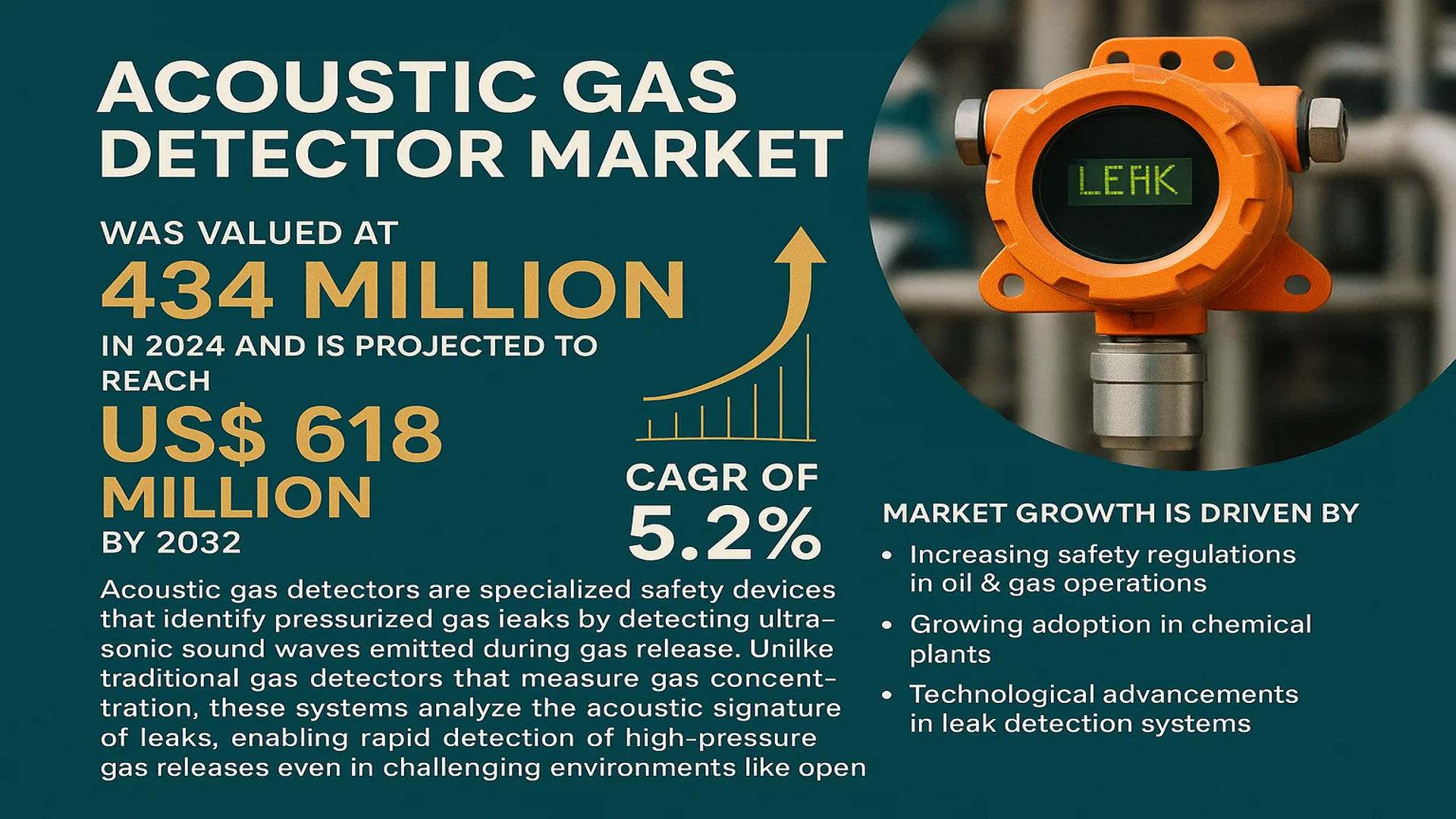
The global Acoustic Gas Detector Market was valued at 434 million in 2024 and is projected to reach US$ 618 million by 2032, at a CAGR of 5.2% during the forecast period.
Acoustic gas detectors are specialized safety devices that identify pressurized gas leaks by detecting ultrasonic sound waves emitted during gas release. Unlike traditional gas detectors that measure gas concentration, these systems analyze the acoustic signature of leaks, enabling rapid detection of high-pressure gas releases even in challenging environments like open spaces or ventilated areas.
The market growth is driven by increasing safety regulations in oil & gas operations, growing adoption in chemical plants, and technological advancements in leak detection systems. The fixed ultrasonic gas leak detectors segment currently dominates the market due to their widespread industrial applications. Key players like Emerson, MSA Safety, and Drager accounted for significant market share in 2024, with the top five companies collectively holding approximately 45% of global revenue.
MARKET DYNAMICS
MARKET DRIVERS
Stringent Safety Regulations in Oil & Gas Industry Accelerating Adoption
The global oil and gas industry faces increasing regulatory pressure to enhance safety measures against gas leaks, driving demand for acoustic gas detectors. Recent incidents have prompted stricter enforcement of standards like API RP 1175 for pipeline safety, making ultrasonic detection systems indispensable. The technology’s ability to detect leaks up to 25 meters away with 99% accuracy in pressurized systems positions it as a critical compliance solution. Market analysis shows over 35% of new oil refineries now incorporate acoustic leak detection as part of their mandatory safety protocols.
Advancements in IoT Integration Expanding Application Scope
Integration with Industrial IoT platforms has transformed acoustic detectors into predictive maintenance tools rather than just safety devices. Modern systems now analyze acoustic patterns to predict equipment failure 48-72 hours in advance, reducing unplanned downtime in chemical plants by up to 40% according to operational data. This preventive capability is driving adoption in process industries where equipment reliability directly impacts profitability. Leading manufacturers have reported 25% year-over-year growth in smart detector sales featuring edge computing capabilities.
Growing LNG Infrastructure Creation Fueling Market Expansion
The global LNG trade expansion, with over 150 new liquefaction and regasification projects underway, creates substantial demand for reliable leak detection. Acoustic sensors are particularly valuable in cryogenic applications where conventional gas detectors struggle with low-temperature performance. Project data indicates that LNG terminals allocate 12-15% of their instrumentation budget specifically for ultrasonic leak detection systems, recognizing their superior performance in detecting high-pressure methane releases amidst the complex acoustic background of compressor stations.
MARKET RESTRAINTS
High Initial Investment Costs Limiting SME Adoption
While large enterprises readily adopt acoustic detection systems, the technology’s premium pricing creates barriers for small and medium operators. Complete deployment costs averaging $15,000-$25,000 per monitoring point make ROI calculations challenging for facilities with limited risk exposure. Market surveys reveal that 68% of SMEs still rely on conventional gas detectors due to budget constraints, despite recognizing the superior performance of acoustic alternatives.
Complex Environmental Conditions Affecting Performance Reliability
High-noise industrial environments present significant challenges for acoustic detectors’ effectiveness. Facilities with continuous machinery operation above 85 dB frequently report false alarms, necessitating sophisticated noise filtering algorithms. Field tests indicate that wind speeds exceeding 25 km/h can reduce detection ranges by 30-40% in outdoor installations, requiring additional sensor redundancy that increases total system costs.
Regulatory Approval Delays for New Technologies
The certification process for acoustic leak detection systems varies significantly across regions, with some markets requiring 12-18 months for full hazardous area approvals. This time lag creates product deployment bottlenecks, particularly for innovative solutions incorporating AI-based sound recognition. Industry reports highlight that 42% of manufacturers cite certification complexity as their top barrier to rapid geographical expansion.
MARKET OPPORTUNITIES
Hydrogen Economy Transition Creating New Application Verticals
The global shift toward hydrogen energy presents significant growth potential, as hydrogen leaks demand specialized detection methods. Acoustic sensors demonstrate 3x higher sensitivity to high-pressure hydrogen leaks compared to traditional technologies, positioning them as essential infrastructure components. Pilot projects in European hydrogen refueling stations show that ultrasonic detection can identify leaks at pressures up to 700 bar with 95% reliability, making them indispensable for the emerging hydrogen value chain.
Integration with Drone-Based Inspection Systems
Combining mobile acoustic sensors with UAV platforms enables comprehensive facility monitoring without extensive fixed installations. Early adopters in offshore oil platforms have achieved 60% faster leak detection response times using drone-mounted systems. This hybrid approach reduces capital expenditures while expanding monitoring coverage, particularly in hard-to-access areas that represent 38% of undetected leak incidents according to maintenance records.
Enhanced Predictive Analytics Through Machine Learning
Advancements in sound pattern recognition algorithms allow acoustic systems to identify equipment degradation signatures before leaks occur. Pilot implementations in petrochemical plants demonstrate that machine learning-enhanced detectors can predict valve failures with 82% accuracy 72 hours in advance. This predictive capability transforms acoustic detectors from safety devices into strategic asset management tools, justifying higher price points through operational savings.
MARKET CHALLENGES
Standardization Gaps Across Regional Markets
The absence of uniform global standards for acoustic leak detection performance creates market fragmentation. While Europe follows EN 50104:2010 and North America uses UL 61010-1, other regions lack specific guidelines. This inconsistency forces manufacturers to maintain multiple product variants, increasing R&D costs by an estimated 15-20%. Industry consortia report that achieving global harmonization could accelerate adoption rates by 30% among multinational operators.
Skilled Workforce Shortage for Advanced Systems
The transition to AI-driven acoustic analysis creates demand for personnel with combined acoustics and data science expertise. Training programs have failed to keep pace, with 62% of system integrators reporting difficulties finding qualified technicians. This skills gap is particularly acute in emerging markets where local service networks struggle to support sophisticated installations.
Competition from Emerging Detection Technologies
While acoustic technology leads in high-pressure applications, alternative methods like laser-based detection and hyperspectral imaging are gaining traction. These competitors offer advantages in certain scenarios – laser systems achieve superior range in open areas (up to 100m), though at significantly higher costs. Market analysis shows 18% of potential acoustic detector applications now face competition from these emerging alternatives.
ACOUSTIC GAS DETECTOR MARKET TRENDS
Increasing Adoption in Oil & Gas Industry to Dominate Market Growth
The global acoustic gas detector market is witnessing significant growth due to the rising demand for advanced gas leak detection solutions in high-risk industries such as oil & gas, chemicals, and mining. With heightened regulatory scrutiny and stringent safety standards, companies are increasingly deploying ultrasonic gas leak detectors to mitigate risks associated with flammable and toxic gas emissions. The oil and gas sector alone accounts for over 40% of the market share, driven by the need for real-time monitoring in pipelines, refineries, and offshore platforms. Furthermore, technological enhancements in signal processing algorithms have improved detection accuracy, reducing false alarms and operational downtimes.
Other Trends
Integration of IoT and Smart Sensors
The integration of Internet of Things (IoT) and advanced data analytics has revolutionized gas detection systems by enabling predictive maintenance and remote monitoring. Smart acoustic gas detectors now leverage wireless connectivity to transmit real-time leakage data to centralized control systems, significantly improving response times. Industry reports indicate that IoT-enabled gas detectors are projected to grow at a CAGR of 6.8% from 2024 to 2032, driven by the increasing digitalization of industrial safety protocols. Additionally, cloud-based analytics platforms enable operators to track historical leak trends, enhancing preventive measures.
Shift Toward Fixed Ultrasonic Gas Leak Detectors
While portable gas detectors remain essential for spot checks, the market is experiencing a strong shift toward fixed ultrasonic gas leak detectors due to their continuous monitoring capabilities. Fixed systems dominate with a 65% revenue share in 2024, particularly in large-scale industrial applications where persistent gas exposure risks exist. These systems offer long-term reliability and lower maintenance costs compared to portable alternatives. Recent advancements in sensor durability and environmental resistance are further boosting adoption in extreme operating conditions, such as Arctic oil fields and high-temperature chemical plants.
COMPETITIVE LANDSCAPE
Key Industry Players
Technological Advancements and Safety Regulations Drive Market Competition
The global acoustic gas detector market features a moderately consolidated competitive structure, with leading companies competing through technological differentiation and compliance with stringent industry safety standards. Emerson Electric Co. currently dominates the market, commanding a significant share due to its comprehensive product portfolio spanning fixed and portable ultrasonic detectors. The company’s strong presence in critical industries like oil & gas and chemicals has solidified its position as a market leader.
MSA Safety Incorporated and Drägerwerk AG & Co. KGaA follow closely, leveraging their expertise in industrial safety solutions to capture substantial market share. These companies have particularly strengthened their positions through strategic acquisitions – MSA’s purchase of Sierra Monitor Corporation in 2019 and Dräger’s ongoing investments in smart detection technologies demonstrate this competitive approach.
The market also features several specialized players making significant inroads. INFICON has carved out a niche with its high-precision leak detection systems, particularly for refrigerant gases, while Bacharach maintains strong brand recognition in HVAC and refrigeration applications. These companies compete intensely on detection accuracy, false alarm reduction, and integration capabilities with existing industrial control systems.
Recent developments show an industry-wide push toward IoT-enabled devices and predictive maintenance capabilities. Emerson’s introduction of its Rosemount™ 928 Wireless Gas Monitor and MSA’s new ALTAIR io360 gas detector exemplify this trend, offering cloud connectivity and advanced analytics features that are reshaping competitive dynamics in the market.
List of Key Acoustic Gas Detector Manufacturers
- Emerson Electric Co. (U.S.)
- MSA Safety Incorporated (U.S.)
- AOIP (France)
- Diatex (France)
- INFICON (Switzerland)
- Drägerwerk AG & Co. KGaA (Germany)
- Det-Tronics (U.S.)
- Bacharach (U.S.)
- Spectris plc (U.K.)
- Beha-Amprobe (Germany)
Segment Analysis:
By Type
Fixed Ultrasonic Gas Leak Detectors Segment Leads Due to Superior Accuracy in High-Pressure Applications
The market is segmented based on type into:
- Fixed Ultrasonic Gas Leak Detectors
- Subtypes: Industrial-grade, Hazardous-area certified, and others
- Portable Ultrasonic Gas Leak Detectors
- Integrated Acoustic Monitoring Systems
By Application
Oil and Gas Sector Dominates Due to Critical Need for Leak Detection in Pipelines and Processing Facilities
The market is segmented based on application into:
- Oil and Gas
- Chemical Industry
- Mining
- Energy and Power
- Others
By Technology
Ultrasonic Detection Technology Holds Significant Market Share Due to Its Non-Intrusive Nature
The market is segmented based on technology into:
- Ultrasonic Detection
- Acoustic Emission Monitoring
- Hybrid Detection Systems
By End-User
Industrial Segment Maintains Strong Position Due to Widespread Safety Regulations
The market is segmented based on end-user into:
- Industrial Facilities
- Commercial Buildings
- Government and Infrastructure
- Research Institutions
Regional Analysis: Acoustic Gas Detector Market
North America
North America dominates the global acoustic gas detector market due to stringent safety regulations in the oil & gas industry and widespread adoption of advanced leak detection technologies. The region benefits from robust infrastructure investments in pipeline monitoring systems, particularly in the U.S. and Canada, where companies like Emerson and MSA have strong market presence. Environmental protection laws such as the Clean Air Act drive demand for ultrasonic gas detectors that can identify leaks before they become hazardous. The shale gas boom and growing LNG exports further reinforce market growth, though pricing pressures from Asian manufacturers present competitive challenges.
Europe
Europe’s market is characterized by strict EU directives on industrial safety and methane emissions reduction. Countries like Germany and the U.K. lead in adopting fixed ultrasonic detectors for chemical plants and offshore platforms, where Drager and INFICON hold significant market share. The region shows increasing preference for IoT-enabled detectors that integrate with plant-wide safety systems. While growth is steady, market saturation in Western Europe contrasts with emerging opportunities in Eastern Europe’s developing energy infrastructure. The REPowerEU plan’s focus on reducing gas leaks presents new growth avenues through 2030.
Asia-Pacific
As the fastest-growing regional market, Asia-Pacific benefits from China’s massive industrial expansion and India’s rising oil refining capacity. Local manufacturers compete aggressively on price, while international players establish joint ventures to access this high-volume market. The region shows strong demand in both fixed installations (for petrochemical complexes) and portable units (for mining safety). However, uneven regulatory enforcement across countries and preference for lower-cost conventional detectors in some markets temporarily slows adoption rates. Japan and South Korea remain technology leaders, with sophisticated detector deployment in LNG terminals.
Middle East & Africa
The Middle East’s vast oil and gas operations drive demand for high-performance acoustic detectors, particularly in Saudi Arabia and the UAE where spectris and other global suppliers have established service networks. The market shows unique characteristics with extreme environment-rated equipment requirements and large-scale facility deployments. Africa’s growth is concentrated in North African nations and emerging gas producers like Mozambique, though infrastructure limitations constrain wider adoption. Political instability in some regions creates supply chain challenges for detector manufacturers.
South America
Brazil and Argentina account for most regional demand, with offshore oil projects and pipeline networks requiring advanced leak detection. Market growth is tempered by economic volatility and reliance on imported detector systems. Local manufacturing remains limited, though partnerships between companies like AOIP and regional distributors are increasing service capabilities. Environmental concerns from gas flaring are gradually driving stricter regulations, which should boost detector adoption in coming years alongside refinery modernization programs.
Report Scope
This market research report provides a comprehensive analysis of the Global Acoustic Gas Detector Market, covering the forecast period 2024–2032. It offers detailed insights into market dynamics, technological advancements, competitive landscape, and key trends shaping the industry.
Key focus areas of the report include:
- Market Size & Forecast: Historical data and future projections for revenue, unit shipments, and market value across major regions and segments. The global market was valued at USD 434 million in 2024 and is projected to reach USD 618 million by 2032, growing at a CAGR of 5.2%.
- Segmentation Analysis: Detailed breakdown by product type (Fixed vs Portable Ultrasonic Gas Leak Detectors), application (Oil & Gas, Mining, Chemical Industry), and end-user industry to identify high-growth segments.
- Regional Outlook: Insights into market performance across North America (U.S., Canada, Mexico), Europe (Germany, UK, France), Asia-Pacific (China, Japan, India), and other regions, including country-level analysis.
- Competitive Landscape: Profiles of leading market participants including Emerson, MSA, Drager, INFICON, and Bacharach, covering their product portfolios, market share (top 5 players held approximately xx% share in 2024), and strategic developments.
- Technology Trends: Assessment of emerging acoustic detection technologies, integration with IoT platforms, and advancements in ultrasonic sensing capabilities.
- Market Drivers & Restraints: Evaluation of factors such as stringent safety regulations, increasing oil & gas infrastructure investments, along with challenges like high equipment costs.
- Stakeholder Analysis: Strategic insights for gas detector manufacturers, industrial end-users, system integrators, and investors regarding market opportunities.
The research employs both primary and secondary methodologies, including interviews with industry experts and analysis of verified market data, to ensure accuracy and reliability.
FREQUENTLY ASKED QUESTIONS:
What is the current market size of Global Acoustic Gas Detector Market?
-> Acoustic Gas Detector Market was valued at 434 million in 2024 and is projected to reach US$ 618 million by 2032, at a CAGR of 5.2% during the forecast period.
Which key companies operate in this market?
-> Major players include Emerson, MSA Safety, Drager, INFICON, and Bacharach, with the top 5 companies holding approximately xx% market share in 2024.
What are the key growth drivers?
-> Growth is driven by stringent industrial safety regulations, increasing adoption in oil & gas sector, and technological advancements in leak detection systems.
Which region dominates the market?
-> North America currently leads the market, while Asia-Pacific is expected to witness the highest growth rate during the forecast period.
What are the emerging trends?
-> Emerging trends include integration with IoT platforms, development of wireless acoustic detectors, and increasing use in renewable energy facilities.

Get Sample Report PDF for Exclusive Insights
Report Sample Includes
- Table of Contents
- List of Tables & Figures
- Charts, Research Methodology, and more...
 Download Sample Report PDF





