
AC Power Generators Market Insights
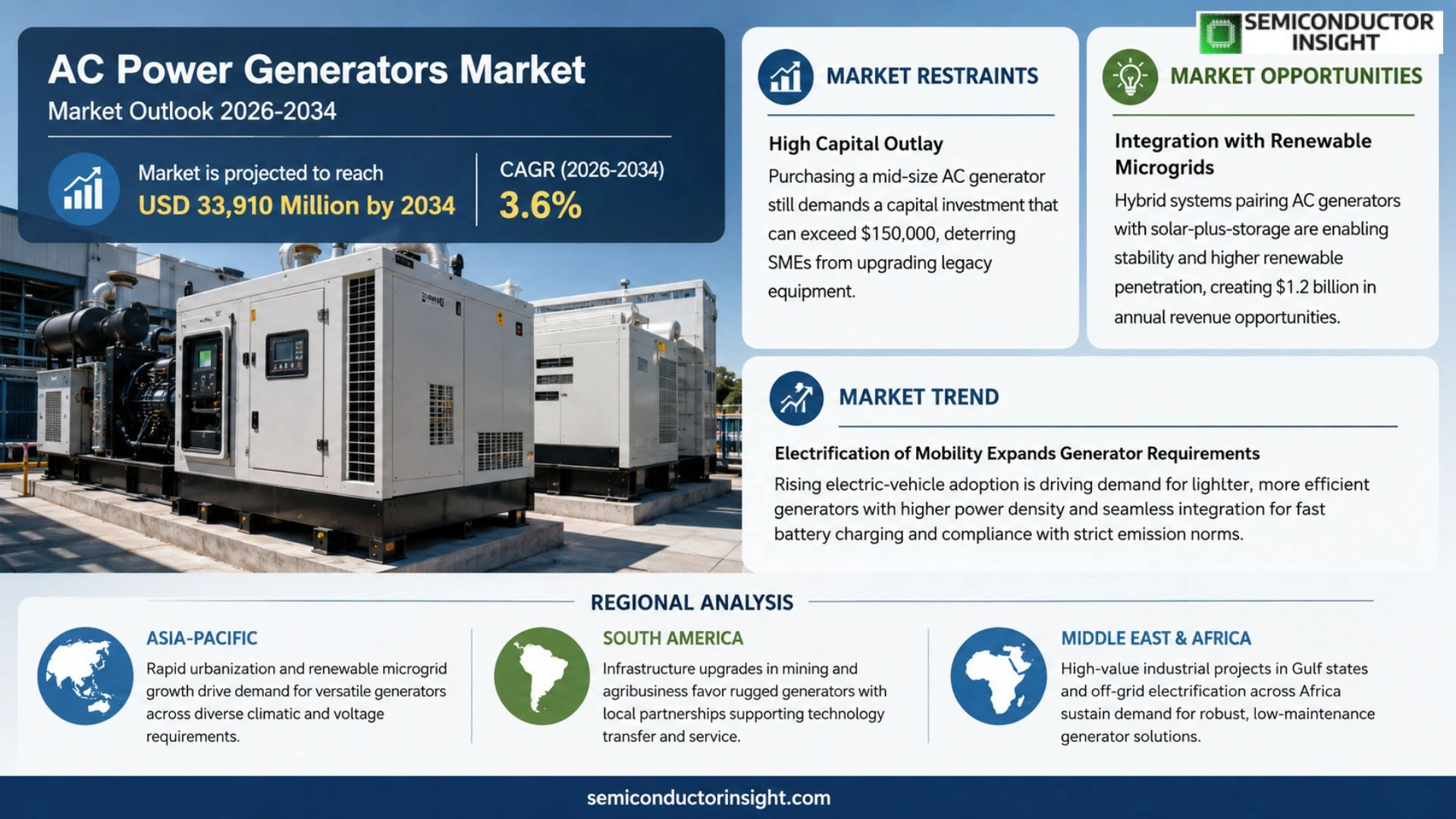
AC Power Generators market was valued at USD 26,677 million in 2025 and is projected to reach USD 33,910 million by 2034, exhibiting a CAGR of 3.6% during the forecast period.
AC power generators are electrical devices that convert mechanical energy into alternating current (AC) electrical energy. Typically, an external power source such as an engine, water turbine, or wind unit drives the rotor to rotate, inducing alternating current in the stator windings. Their operating principle relies on electromagnetic induction, generating electromotive force when a magnetic field moves relative to a conductor.
The market is experiencing steady growth because global electricity demand continues to rise, automotive electrification intensifies, and industrial users seek higher efficiency solutions. Recent product launches emphasize lightweight designs for vehicles and intelligent control for industrial sets. Leading manufacturers,including GE, Siemens, Caterpillar, Hitachi and Bosch,are expanding portfolios with high‑efficiency synchronous and induction generators to meet these evolving requirements.
MARKET DRIVERS
Rising Demand for Reliable Backup Power
AC Power Generators Market is buoyed by an expanding need for uninterrupted electricity in data centres, hospitals, and remote industrial sites. As digital services become mission‑critical, customers are willing to allocate budget for generators that guarantee uptime during grid disturbances. This willingness translates into a 4 % year‑over‑year increase in unit shipments across North America and Europe.
Shift Toward Low‑Emission Technologies
Environmental regulations are prompting manufacturers to replace diesel‑driven units with Tier 4‑compliant and hybrid AC generators. The transition not only reduces carbon output but also opens new revenue streams for OEMs that can certify engines under stricter emissions standards. Analysts note that portfolios emphasizing low‑emission models have captured roughly 12 % of market share in the last twelve months.
➤ Customers increasingly view generator procurement as a strategic resilience investment rather than a purely cost‑driven purchase.
Consequently, service contracts and predictive‑maintenance packages have become pivotal revenue levers. Companies that bundle hardware with long‑term monitoring solutions are seeing contract renewal rates exceed 80 %, reinforcing the profitability of ancillary services within AC Power Generators Market.
MARKET CHALLENGES
Supply Chain Volatility
Recent geopolitical tensions have compressed the availability of critical components such as high‑efficiency alternators and electronic control modules. Lead times for these parts have stretched from 4 weeks to upwards of 10 weeks, squeezing manufacturer margins and delaying delivery commitments for end users.
Other Challenges
Regulatory Compliance
Stringent certification regimes in the EU and China require continual redesign of fuel‑injection systems. Compliance costs have risen by an estimated 6 % annually, pressuring OEMs to allocate a larger portion of R&D budgets toward testing rather than new product development.
MARKET RESTRAINTS
High Capital Outlay
Purchasing a mid‑size AC generator still demands a capital investment that can exceed $150,000, a figure that deters small‑to‑medium enterprises from upgrading legacy equipment. Financing hurdles, combined with the long payback horizon for backup assets, restrain broader market penetration despite the operational benefits highlighted earlier.
MARKET OPPORTUNITIES
Integration with Renewable Microgrids
Hybrid configurations that pair AC generators with solar‑plus‑storage installations are emerging as a high‑value niche. Utilities and industrial parks are piloting systems where generators act as firm‑capacity back‑stops, enabling higher renewable penetration while maintaining grid stability. This convergence is projected to generate an incremental $1.2 billion in annual revenues for adaptable OEMs within AC Power Generators Market.
AC Power Generators Market Trends
Electrification of Mobility Expands Generator Requirements
The surge in electric‑drive vehicles has reshaped the demand profile for AC Power Generators. Manufacturers are now optimizing designs for lighter weight, higher power density, and tighter integration with vehicle electronic architectures. This shift is not merely a matter of fitting more power into a smaller envelope; it reflects a strategic response to stricter emissions regulations and the need for rapid battery charging during operation. Suppliers that can deliver compact units without sacrificing efficiency are gaining preference among automakers, creating a competitive moat based on engineering depth rather than price alone.
Other Trends
Intelligent Control and Remote Monitoring
Advances in sensor integration and IoT connectivity have turned conventional generators into data‑rich assets. Real‑time performance metrics allow end‑users to schedule maintenance proactively, reducing unplanned downtime in critical industrial and backup power applications. The added analytics layer also supports adaptive operation, where the generator can modulate output to match fluctuating loads, thereby improving overall system efficiency. Companies that embed these capabilities early are positioning themselves to command premium pricing and to lock in longer service contracts.
Regional Diversification of Market Opportunities
Asia‑Pacific continues to dominate volume sales, driven by a dense automotive supply chain and expansive infrastructure projects. Meanwhile, North America and Europe are witnessing renewed investment in high‑efficiency, low‑emission generator sets for grid support and micro‑grid deployments. In the Middle East and Africa, expanding power‑grid extensions are prompting local utilities to adopt generators that can operate reliably in harsh climates, prompting a modest but steady rise in demand. This geographic spread means that original equipment manufacturers must tailor product portfolios to distinct regulatory and environmental contexts, a factor that is influencing both R&D road‑maps and partnership strategies.
COMPETITIVE LANDSCAPE
Key Industry Players
Competitive Dynamics in AC Power Generators Market
The market is anchored by a handful of multinational manufacturers whose extensive R&D budgets and global service networks give them decisive leverage. Caterpillar, for instance, couples its diesel‑engine heritage with advanced inverter technology to command a sizable share of the industrial‑generator segment. Siemens and GE Power differentiate themselves through high‑efficiency synchronous machines that cater to utilities and large‑scale renewable‑integration projects. Their ability to bundle generators with digital monitoring platforms creates a barrier for smaller entrants, while also shaping procurement criteria for utilities that value performance analytics and predictive maintenance.
Beyond the tier‑one cohort, a diverse set of specialists competes in niche corridors that are expanding as electrification spreads. Companies such as Hitachi, Mitsubishi Heavy Industries, and Shanghai Electric focus on medium‑size generators for automotive and standby‑power applications, leveraging country‑specific supply chains. European firms like Bosch, Valeo and Denso supply compact, lightweight units for emerging electric‑vehicle architectures, where weight‑to‑power ratio matters. Meanwhile, ABB, WEG and Fuji Electric pursue the high‑voltage, brushless segment, targeting offshore wind farms and micro‑grid installations. This layered competitive architecture forces incumbents to continuously innovate while providing growth avenues for regional players that excel in cost‑effective production or application‑specific engineering.
List of Key AC Power Generators Companies Profiled
- Caterpillar
- GE Power
- Siemens
- Hitachi
- Mitsubishi Heavy Industries
- Cummins
- ABB
- WEG
- Shanghai Electric
- Bosch
- Valeo
- Denso
- Fuji Electric
- Mecc Alte
Segment Analysis:
| Segment Category | Sub-Segments | Key Insights |
| By Type |
|
Synchronous Generators
|
| By Application |
|
Automotive
|
| By End User |
|
Automakers
|
| By [Segment Category 3]] |
|
High‑Efficiency Tier
|
| By [Segment Category 4]] |
|
Digital Integration
|
Regional Analysis: AC Power Generators Market
North America
Federal emission standards are tightening, prompting manufacturers to certify low‑sulfur engines. State‑level resilience incentives reward customers who install generators with remote monitoring capability, driving early adoption of smart‑grid compatible units.
Hybrid turbine‑diesel models are gaining traction as utilities seek to balance fuel flexibility with reduced carbon footprints. Integrated IoT sensors now provide predictive maintenance alerts, shortening downtime for critical sites.
Recent logistics bottlenecks have forced distributors to diversify sourcing beyond traditional hubs. Dual‑sourcing agreements with Asian component suppliers are now standard practice to safeguard inventory levels.
Data‑center operators prioritize modular, rapid‑deployment units, while construction firms favor rugged portable generators that can withstand harsh site conditions and frequent moves.
Europe
European demand for AC Power Generators is increasingly influenced by sustainability mandates. The EU’s Green Deal pushes utilities to replace legacy diesel fleets with low‑emission alternatives, nudging manufacturers toward hydrogen‑ready or bio‑fuel compatible designs. In Germany and the UK, the construction sector’s reliance on modular power solutions fuels a niche market for compact, noise‑controlled units that meet strict occupational health standards. Service contracts are evolving to include digital performance dashboards, allowing operators to demonstrate compliance with energy‑efficiency reporting requirements.
Asia‑Pacific
The Asia‑Pacific region exhibits a heterogeneous landscape, with rapid urbanization in India and Indonesia driving a surge in temporary power needs, while Japan’s mature market concentrates on high‑efficiency standby generators for disaster resilience. Investment in renewable micro‑grids creates cross‑selling opportunities for generators that can operate as backup sources. Manufacturers are tailoring product portfolios to accommodate a wide range of voltage specifications and climatic conditions, from tropical humidity to temperate monsoons.
South America
In South America, power reliability remains a core concern for mining and agribusiness enterprises. Countries such as Chile and Brazil are upgrading critical infrastructure, prompting a preference for rugged generators with extended service intervals. Local content regulations encourage joint ventures between multinational OEMs and regional firms, fostering technology transfer and creating a modest but growing domestic engineering base. The market’s pace is moderated by fluctuating capital flows, yet long‑term contracts for remote site power supply sustain demand.
Middle East & Africa
The Middle East & Africa presents a blend of high‑value projects in oil‑rich Gulf states and emerging power needs across sub‑Saharan Africa. In Saudi Arabia and the UAE, large‑scale industrial parks are commissioning generators that meet stringent emission caps while delivering high output densities. Meanwhile, African utilities seek robust, low‑maintenance units to support off‑grid electrification initiatives, often relying on diesel‑centric solutions due to fuel availability. Partnerships with local distributors are essential for after‑sales support in remote locations, shaping the competitive dynamics of the region.
Report Scope
This market research report provides a comprehensive analysis of the AC Power Generators Market , covering the forecast period 2026–2034. It offers detailed insights into market dynamics, technological advancements, competitive landscape, and key trends shaping the industry.
Key focus areas of the report include:
- Market Overview: The report begins with an overview outlining its current market scenario, key growth indicators, and industry transformation drivers. It discusses macroeconomic factors, demand–supply balance, regulatory landscape, and the strategic role of semiconductors in powering advancements across industries such as automotive, telecommunications, consumer electronics, and industrial automation.
- Market Size & Forecast: Historical data and future projections for revenue, unit shipments, and market value across major regions and segments.
- Segmentation Analysis: Detailed breakdown by product type, technology, application, and end-user industry to identify high-growth segments and investment opportunities.
- Regional Insights: Insights into market performance across North America, Europe, Asia-Pacific, Latin America, and the Middle East & Africa, including country-level analysis where relevant.
- Competitive Landscape: Profiles of leading market participants, including their product offerings, R&D focus, manufacturing capacity, pricing strategies, and recent developments such as mergers, acquisitions, and partnerships.
- Technology Trends & Innovation: Assessment of emerging technologies, integration of AI/IoT, semiconductor design trends, fabrication techniques, and evolving industry standards.
- Market Drivers & Restraints: Evaluation of factors driving market growth along with challenges, supply chain constraints, regulatory issues, and market-entry barriers.
- Stakeholder Insights: Insights for component suppliers, OEMs, system integrators, investors, and policymakers regarding the evolving ecosystem and strategic opportunities.
Primary and secondary research methods are employed, including interviews with industry experts, data from verified sources, and real-time market intelligence to ensure the accuracy and reliability of the insights presented.
FREQUENTLY ASKED QUESTIONS:
What is the current market size of AC Power Generators Market?
-> AC Power Generators Market is expected to reach USD 33,910 million by 2034, growing at a CAGR of 3.6% during the forecast period.
Which key companies operate in AC Power Generators Market?
-> Key players include GE, Nidec, Hitachi, Shanghai Electric, SIEMENS, Caterpillar, Valeo, Bosch, Toshiba, Mitsubishi, Denso, Cummins, ABB, NTC, Andritz, Marathon Electric, HEC, WEG, MEIDEN, Fuji Electric, Mecc Alte, Marelli Motori, Brush, among others.
What are the key growth drivers?
-> Key growth drivers include rising global electricity demand, transformation of the energy mix, accelerating automotive electrification, increased industrial automation, and technological upgrades toward higher efficiency and intelligence.
Which region dominates the market?
-> Asia-Pacific is the largest market, driven by its extensive automotive industry and robust industrial development, while North America and Europe contribute high‑end product segments.
What are the emerging trends?
-> Emerging trends include high‑efficiency synchronous designs, lightweight and miniaturized generators for automotive applications, intelligent/IoT‑enabled operation, and the adoption of advanced electromagnetic materials.

Get Sample Report PDF for Exclusive Insights
Report Sample Includes
- Table of Contents
- List of Tables & Figures
- Charts, Research Methodology, and more...
 Download Sample Report PDF