Market Insights
Global AA Battery Market size was valued at USD 7.88 billion in 2025. The market is projected to grow from USD 8.32 billion in 2026 to USD 11.51 billion by 2034, exhibiting a CAGR of 5.6% during the forecast period.
AA batteries are standardized cylindrical single-cell power sources with widespread applications in consumer electronics, industrial equipment, and household devices. These batteries are categorized by chemistry alkaline (1.5V), nickel-metal hydride (NiMH, 1.2V), and lithium-based variants (regulated 1.5V). Their universal compatibility and cost-effectiveness sustain demand across sectors like medical devices, security systems, and portable gadgets.
While alkaline batteries dominate price-sensitive markets with unit costs of USD 0.2–0.8, rechargeable NiMH variants gain traction despite higher upfront costs due to reusability benefits. However, competition from lithium-ion technology and environmental concerns over recycling infrastructure pose challenges to long-term growth.
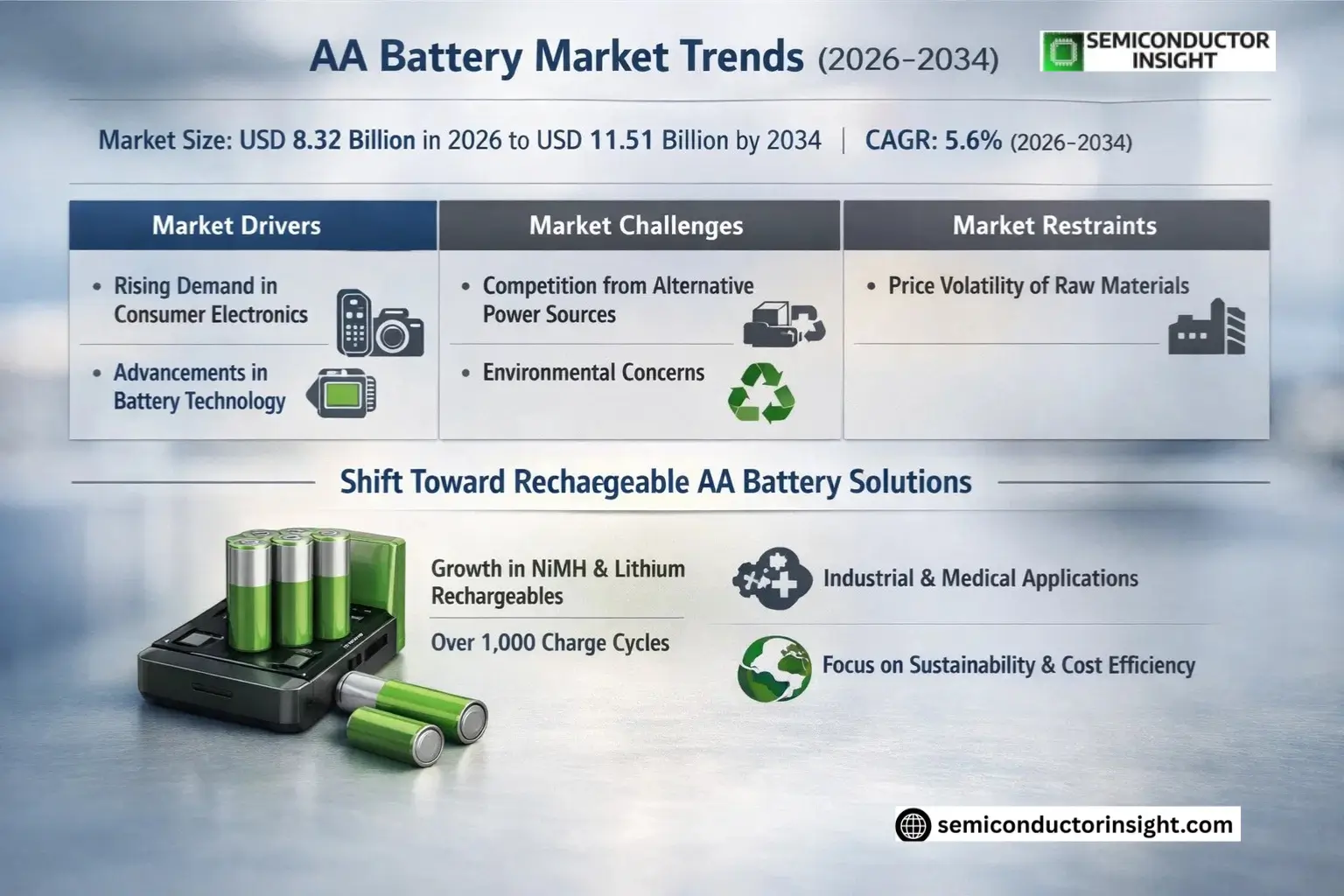
MARKET DRIVERS
Rising Demand in Consumer Electronics
AA Battery Market is experiencing steady growth due to increased demand from consumer electronics. Devices such as remote controls, digital cameras, and wireless keyboards rely heavily on AA batteries, with global shipments exceeding 15 billion units annually. The convenience and portability of AA batteries make them a preferred choice for low-power devices.
Advancements in Battery Technology
Recent innovations in AA battery technology, including lithium and rechargeable variants, have extended battery life and performance. These improvements are driving adoption in high-drain applications like gaming controllers and smart home devices. The shift toward eco-friendly options has further boosted the market, with rechargeable AA batteries growing at 8-10% annually.
Additionally, the expansion of retail distribution channels and e-commerce platforms has made AA batteries more accessible worldwide, supporting market growth.
MARKET CHALLENGES
Competition from Alternative Power Sources
AA Battery Market faces competition from lithium-ion packs and built-in rechargeable batteries in modern electronics. Many manufacturers are integrating permanent power solutions, reducing reliance on disposable AA batteries.
Other Challenges
Environmental Concerns
Growing awareness of battery waste and strict regulations on disposable batteries pose challenges for the AA battery industry. Recycling rates remain low at around 20%, necessitating sustainable solutions.
MARKET RESTRAINTS
Price Volatility of Raw Materials
Fluctuating prices of zinc, manganese dioxide, and other key materials impact AA battery production costs, affecting profit margins for manufacturers. Supply chain disruptions have exacerbated this challenge in recent years.
MARKET OPPORTUNITIES
Emerging Markets Expansion
Developing regions in Asia and Africa present significant growth opportunities for the AA Battery Market, driven by rising disposable incomes and increased adoption of battery-powered devices. These markets currently represent only 25% of global consumption but are growing at double-digit rates.
MAIN TITLE HERE () Trends
Shift Toward Rechargeable AA Battery Solutions
AA Battery Market is experiencing increased demand for rechargeable NiMH and lithium-based solutions, particularly in industrial and medical applications where cost-effectiveness and sustainability are priorities. Manufacturers are investing in improved cycle life technologies, with premium NiMH AA batteries now offering over 1,000 charge cycles, reducing long-term operational costs for commercial users.
Other Trends
Environmental Compliance Influencing Product Development
Stricter global regulations on battery disposal are accelerating the transition to mercury-free alkaline and zero-cadmium NiMH formulations. Major producers are aligning their R&D with EU Battery Directive and EPA guidelines, with over 85% of new AA battery products now meeting RoHS compliance standards as of 2023.
Consolidation in the AA Battery Supply Chain
The market is witnessing vertical integration as leading brands secure raw material supply chains for manganese dioxide and nickel alloys. Recent mergers between battery manufacturers and mining operations aim to stabilize input costs, particularly for alkaline and NiMH battery production where commodity prices significantly impact margins.
Regional Manufacturing Shifts in the AA Battery Market
Production capacity is gradually relocating from China to Southeast Asia and India, driven by trade policies and labor costs. New manufacturing facilities in Vietnam and Thailand now account for approximately 18% of global AA battery output, specializing in cost-competitive alkaline batteries for developing markets.
Smart Packaging Innovations
Brands are implementing QR code tracking and NFC-enabled packaging to combat counterfeit products in the AA Battery Market. These technological integrations provide authentication features while enabling consumers to access recycling information, addressing both brand protection and sustainability concerns in the industry.
COMPETITIVE LANDSCAPE
Key Industry Players
Global AA Battery Market Driven by Established Brands and Emerging Manufacturers
AA Battery Market is dominated by multinational corporations with strong brand recognition and extensive distribution networks. Energizer and Duracell collectively hold over 40% of the global market share, leveraging their alkaline battery technology and consumer trust. Panasonic and VARTA AG lead in industrial and specialty battery segments, while Asian manufacturers like Fujitsu’s FDK Corporation and GP Batteries compete through cost-efficient production and regional distribution advantages.
Niche players such as Saft and Maxell focus on high-performance rechargeable AA batteries for professional applications, whereas Chinese manufacturers like NANFU and PKCELL have gained traction in emerging markets through competitive pricing. The market sees increasing competition from lithium AA battery innovators, though alkaline remains the dominant chemistry due to its price-performance balance in mainstream applications.
List of Key AA Battery Companies Profiled
- Energizer
- Panasonic
- Duracell
- VARTA AG
- GP Batteries
- FDK Corporation (Fujitsu)
- Maxell
- SAMSUNG
- NANFU
- Ningbo GP&Sonluk Battery
- PKCELL
- Liwang
- Toshiba
- Camelion
- Saft
Segment Analysis:
| Segment Category | Sub-Segments | Key Insights |
| By Type |
|
Alkaline Battery
|
| By Application |
|
Household
|
| By End User |
|
Consumer Retail
|
| By Chemistry |
|
Alkaline Manganese
|
| By Distribution Channel |
|
Mass Merchandisers
|
Regional Analysis: AA Battery Market
Asia-Pacific sets global benchmarks in battery technology integration, with Japanese firms developing advanced nickel-metal hydride and lithium AA alternatives. Chinese manufacturers lead in cost-effective alkaline battery production at scale.
The region houses over 60% of global AA battery production facilities, concentrating in China’s Pearl River Delta and Japan’s Kansai region. Vertical integration strategies give local players significant cost advantages in raw material sourcing.
South Korean battery makers integrate AI for predictive maintenance in smart batteries. Machine learning algorithms optimize discharge rates for different devices, extending battery life in consumer electronics applications.
Japanese firms lead in developing mercury-free alkaline batteries, while Chinese manufacturers invest heavily in recycling infrastructure. Regional R&D focuses on biodegradable battery components to reduce environmental impact.
North America
The North American AA Battery Market thrives on premium product demand and advanced retail distribution networks. U.S. consumers show strong preference for high-performance batteries in smart home devices and medical equipment. Major retailers collaborate with manufacturers to develop exclusive battery brands. The region sees growing adoption of rechargeable AA batteries among tech-savvy consumers, with Canadian markets showing particular interest in eco-friendly options. Regulatory focus on battery safety standards influences product development strategies across the region.
Europe
European markets emphasize battery sustainability and energy efficiency, driven by strict environmental regulations. Germany and Nordic countries lead in adopting rechargeable AA batteries for consumer electronics. The EU’s circular economy policies push manufacturers toward improved recycling systems and reduced hazardous materials. Premium battery brands maintain strong market presence through partnerships with high-end electronics manufacturers. Eastern Europe shows growing demand from industrial applications, particularly in Poland and Czech Republic.
South America
Brazil dominates the South American AA Battery Market with increasing urban household penetration. Price sensitivity drives demand for affordable alkaline batteries, though premium segments grow in Argentina and Chile. Infrastructure challenges affect distribution in rural areas, but e-commerce platforms help expand market reach. Governments incentivize local battery production to reduce import dependence, fostering regional manufacturing capabilities.
Middle East & Africa
The MEA market experiences steady growth from rising consumer electronics adoption. GCC countries prefer premium international brands, while North Africa shows strong demand for economical options. South Africa serves as regional manufacturing hub with exports to neighboring countries. Off-grid applications in rural areas drive demand for long-lasting AA batteries, with solar-powered charging solutions gaining traction.
Report Scope
This market research report provides a comprehensive analysis of the AA Battery Market, covering the forecast period 2025–2034. It offers detailed insights into market dynamics, technological advancements, competitive landscape, and key trends shaping the industry.
Key focus areas of the report include:
- Market Overview: The report begins with an overview outlining its current market scenario, key growth indicators, and industry transformation drivers. It discusses macroeconomic factors, demand-supply balance, regulatory landscape, and the strategic role of AA batteries in powering devices across industries such as consumer electronics, industrial equipment, medical devices, and household appliances.
- Market Size & Forecast: Historical data and future projections for revenue, unit shipments, and market value across major regions and segments.
- Segmentation Analysis: Detailed breakdown by product type (Ordinary Battery, Alkaline Battery, Rechargeable Battery), application (Industrial, Electronic Product, Household), and sales channel (Online, Offline).
- Regional Insights: Insights into market performance across North America, Europe, Asia, South America, and Middle East & Africa, including country-level analysis.
- Competitive Landscape: Profiles of leading market participants, including their product offerings, market share, manufacturing capacity, pricing strategies, and recent developments.
- Technology Trends & Innovation: Assessment of emerging battery technologies, performance improvements, and environmental considerations.
- Market Drivers & Restraints: Evaluation of factors driving market growth along with challenges such as lithium-ion battery competition and recycling constraints.
- Stakeholder Insights: Insights for manufacturers, suppliers, distributors, investors, and policymakers regarding market opportunities.
Primary and secondary research methods are employed, including interviews with industry experts and data from verified sources to ensure accuracy.
FREQUENTLY ASKED QUESTIONS:
What is the current market size of AA Battery Market?
-> AA Battery Market size was valued at USD 7.88 billion in 2025. The market is projected to grow from USD 8.32 billion in 2026 to USD 11.51 billion by 2034, exhibiting a CAGR of 5.6% during the forecast period.
Which key companies operate in AA Battery Market?
-> Key players include Energizer, Panasonic, Duracell, VARTA AG, GP Batteries, FDK Corporation, Maxell, SAMSUNG, and Toshiba.
What are the key growth drivers?
-> Key growth drivers include demand from consumer electronics, household devices, industrial applications, and technological advancements in battery chemistry.
Which region dominates the market?
-> Asia holds the largest market share, driven by China, Japan, and South Korea, while North America and Europe are significant markets.
What are the emerging trends?
-> Emerging trends include high-performance alkaline batteries, mercury-free technology, and improved rechargeable AA battery solutions.

Get Sample Report PDF for Exclusive Insights
Report Sample Includes
- Table of Contents
- List of Tables & Figures
- Charts, Research Methodology, and more...
 Download Sample Report PDF