
Wearable FPC Market Insights
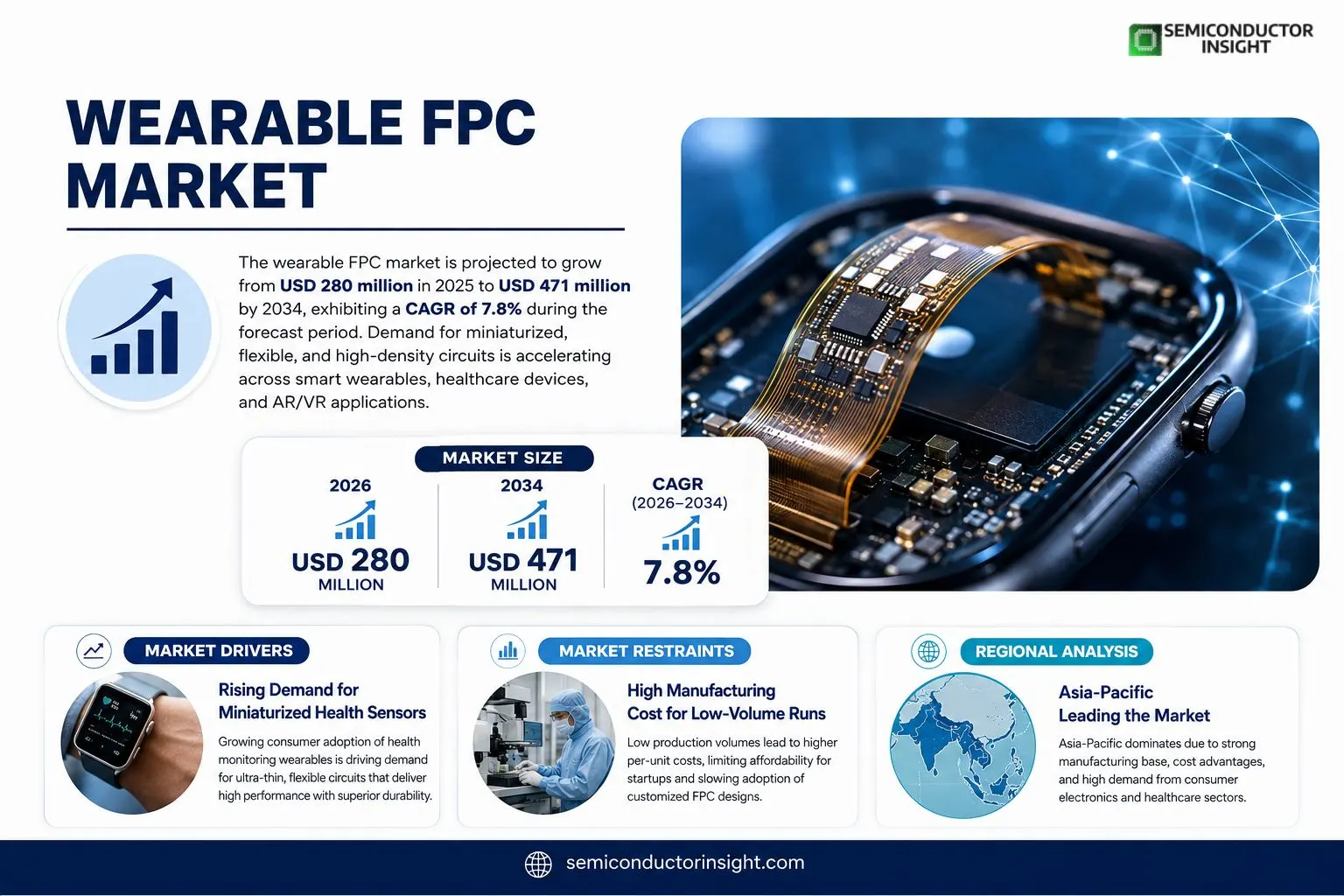
Wearable FPC market size was USD 280 million in 2025 and will rise to USD 471 million by 2034, reflecting a CAGR of 7.8% over the forecast period.
Wearable flexible printed circuits are ultra‑thin polymer‑based boards without reinforcing ribs; they can bend repeatedly while remaining lightweight and thin. By eliminating numerous interconnection points, these circuits lower packaging complexity and reduce failure probability, making them ideally suited for smart watches, health monitors and emerging AR/VR wearables.The expansion of wearable electronics fuels demand for finer line widthsoften under 20 µmand substrates such as polyimide or liquid‑crystal polymer that can be laminated below 0.1 mm thickness. Manufacturers enforce strict bubble‑rate limits (<0.5%) and verify durability through dynamic bending tests exceeding 100 000 cycles. Concentration remains high in Japan, where firms like Nippon Mektron and Sumitomo Electric dominate; Chinese players such as Shenzhen Longhai Circuit and Huizhou Yongmingsheng Technology serve regional markets. Recent trends emphasize higher density integration, improved signal integrity via sub‑10‑µm lines, and greener processes including halogen‑free substrates and cyanide‑free plating.
MARKET DRIVERS
Rising Demand for Miniaturized Health Sensors
The surge in consumer interest for continuous health monitoring has compelled device makers to seek circuits that combine thinness with durability. Wearable FPC Market participants are responding by embedding flexible printed circuits into wrist‑worn ECG and SpO₂ modules, thereby reducing bulk without sacrificing signal integrity. This shift reflects an industry‑wide recalibration toward data‑rich, unobtrusive devices.
Advancements in Flexible Substrate Technologies
Recent breakthroughs in polymer films and roll‑to‑roll lithography have lowered defect rates and improved yield on large‑area prints. Manufacturers now can produce multi‑layer FPCs that endure repeated bending cycles, a capability that directly fuels new product categories such as smart clothing and implantable monitors. The technical lift provides a solid platform for designers to experiment with unconventional form factors.
➤ Flexibility and low weight enable new form factors for wearables, opening revenue streams beyond traditional fitness bands.
Collectively, these forces are reshaping supplier negotiations, prompting original equipment manufacturers to prioritize partners that can deliver high‑frequency signal routes alongside mechanical compliance. The ripple effect is a more competitive pricing environment and accelerated time‑to‑market for next‑generation health gadgets.
MARKET CHALLENGES
Regulatory Hurdles for Medical‑grade Wearables
Certification pathways for devices that claim diagnostic accuracy remain stringent across key regions. Companies must align flexible circuit designs with electromagnetic compatibility standards and biocompatibility testing, a process that prolongs development cycles and inflates engineering budgets. The need for documented traceability further limits rapid iteration.
Other Challenges
Supply‑Chain Constraints
The limited number of suppliers capable of high‑volume roll‑to‑roll production creates bottlenecks, especially when demand spikes for newly launched smart‑watch lines. Lead times for specialty adhesives and conductive inks are extending, pressuring manufacturers to hold larger inventories or seek alternative material sources.
MARKET RESTRAINTS
High Manufacturing Cost for Low‑Volume Runs
When orders fall below the economies‑of‑scale threshold, the per‑unit cost of flexible printed circuits can eclipse that of rigid alternatives. Small start‑ups aiming to differentiate through niche wearables often confront pricing structures that erode margins, discouraging investment in bespoke FPC designs until volume justifies the expense.
MARKET OPPORTUNITIES
Integration with 5G‑enabled Edge Analytics
As 5G networks mature, edge‑compute platforms are becoming viable hosts for real‑time health analytics. Flexible circuits that embed antenna structures and low‑power processors can offload preprocessing tasks, reducing data transmission latency and battery consumption. Companies that engineer such integrated solutions stand to capture a growing slice of enterprise health‑monitoring contracts, where rapid insight delivery is a decisive advantage.
Wearable FPC Market Trends
Higher Integration Density and Signal Fidelity
The rise of smart‑watches, health‑monitoring bands, and mixed‑reality headsets has forced designers to push the limits of circuit mini‑aturization. Recent manufacturing data shows line widths are being reduced below 10 microns, while substrate thicknesses dip under 0.1 mm. These advances cut board footprints, allowing tighter component placement and preserving signal integrity at frequencies that were previously problematic for polyimide layers. For OEMs, the benefit is twofold: devices can accommodate larger sensor arrays without enlarging the chassis, and the reduction in interconnect points translates into higher yields and lower field failure rates. The net effect is a stronger value proposition for manufacturers seeking to differentiate premium wearables.
Other Trends
Environmental Compliance and Green Processing
Regulatory pressure in Europe and North America has accelerated the shift toward halogen‑free substrates and cyanide‑free plating baths. Suppliers such as Nippon Mektron and Shenzhen Longhai Circuit have begun qualifying their production lines with ISO 14001 standards, reporting up to a 15 % reduction in hazardous waste streams. This transition is more than a compliance exercise; it opens doors to contracts with medical device makers who require traceable, low‑toxicity components. By embedding eco‑friendly steps early in the lamination and etching phases, manufacturers also report marginal cost savings due to lower disposal fees and improved material utilization.
Emerging Applications in Medical and Implantable Devices
Beyond consumer gadgets, flexible circuit technology is gaining traction in minimally invasive diagnostics and electronic skin prototypes. The ability to sustain over 100,000 bending cycles without failure makes these boards suitable for catheter‑based sensors that must conform to dynamic anatomical surfaces. Companies are experimenting with liquid crystal polymer (LCP) films to enhance high‑frequency transmission, a prerequisite for real‑time telemetry in implantable monitors. As clinicians demand longer‑lasting, more reliable telemetry platforms, the market for ultra‑thin, biocompatible FPCs is likely to broaden, prompting supply‑chain adjustments that prioritize sterile processing and traceable material provenance.
COMPETITIVE LANDSCAPE
Key Industry Players
Competitive dynamics in the Wearable FPC sector
The wearable FPC arena remains tightly clustered around a handful of large‑scale manufacturers that dominate both volume and technology leadership. Nippon Mektron leverages its deep expertise in sub‑0.1 mm polyimide substrates to command a sizable share of high‑density smart‑watch modules, while Sumitomo Electric differentiates through advanced laser‑direct imaging that enables line widths under 20 µm. Fujikura and Oki Electric Cable round out the Japanese core, each supplying specialized multilayer stacks to premium AR/VR headsets. This concentration reflects the heavy capital investment required for ultra‑thin lamination lines and the stringent reliability testsexceeding 100,000 bending cyclesthat only incumbents can sustain at scale. Consequently, the competitive pressure centers on incremental process refinements, such as halogen‑free plating, rather than pure cost undercutting.Beyond the Japanese stronghold, an expanding cohort of Chinese and Taiwanese firms is reshaping the mid‑tier landscape. Shenzhen Longhai Circuit Technology, Huizhou Yongmingsheng Technology, and Zhen Ding Tech have accelerated capacity growth by adopting LCP substrates that favor high‑frequency signal integrity for health‑monitoring wearables. Companies like Interflex and Alliance Flex Tech focus on custom‑curved designs for emerging implantable sensors, carving out niche revenue streams despite lower absolute volumes. Meanwhile, European‑based Molekule (Molex) and U.S. player Foxlink are pivoting toward green‑process certifications to meet stricter environmental mandates, positioning themselves as attractive partners for OEMs seeking sustainable supply chains. This diversification injects competitive resilience, compelling the market leaders to pursue collaborative R&D rather than relying solely on scale advantages.
List of Key Wearable FPC Companies Profiled
- Nippon Mektron
- Sumitomo Electric
- Fujikura
- Oki Electric Cable
- Alliance Flex Tech
- Interflex
- Wearable Sensing
- Molex
- Ichia Technologies
- ExPlus Co
- MKS Corp
- Zhen Ding Tech
- Foxlink
- 3G Technology
- Shenzhen Longhai Circuit Technology
- Shenzhen Xinying Tongda Electronic Technology
- Huizhou Yongmingsheng Technology
- Shenzhen Minbo Hongtong Electronic Co., Ltd.
- Jiangxi Zhihao Electronic Technology
- Xiamen Bolion Tech
Segment Analysis:
| Segment Category | Sub-Segments | Key Insights |
| By Type |
|
Multilayer FPC
|
| By Application |
|
Health‑Monitoring Bands
|
| By End User |
|
Medical & Healthcare
|
| By Material |
|
Liquid Crystal Polymer (LCP)
|
| By Structure |
|
Curved Structure
|
Regional Analysis: Wearable FPC Market
The EU’s new Ecodesign Regulation compels manufacturers to certify recyclable components, nudging suppliers toward bio‑based polymers. Companies that embed compliance early gain market credibility and avoid costly redesigns, positioning themselves as preferred partners for premium device brands.
Proximity of silicon fabs in Germany to flexible‑circuit converters in the Netherlands shortens lead‑times. This logistical edge enables faster iteration cycles, which is critical when fashion‑driven wearables must hit seasonal shelves.
Fitness enthusiasts in the UK and health‑monitoring seniors in Italy prioritize durability and skin‑friendly materials, prompting local brands to tailor substrate flexibility and hypoallergenic coatings.
The Scandinavian cluster blends strong design schools with deep engineering talent, spawning startups that experiment with stretchable antennae and integrated energy‑harvesting layers.
North America
North America’s Wearable FPC Market dynamics revolve around rapid product cycles and a strong venture‑capital environment. Silicon Valley investors fund startups that trial ultra‑thin circuits for next‑generation smart watches, while large contract manufacturers in Texas scale those prototypes into volume runs. Consumer expectations for seamless integration with existing ecosystems push firms to prioritize multi‑layer flexibility, a capability that U.S. engineering teams have refined through cross‑industry collaborations with automotive and aerospace sectors. The result is a landscape where speed to market outweighs incremental cost savings, encouraging players to adopt modular design approaches that can be quickly reconfigured for new device form factors.
Asia‑Pacific
In the Asia‑Pacific arena, Wearable FPC Market benefits from a confluence of cost‑effective production and expansive consumer bases. Manufacturing powerhouses in China and Vietnam deliver competitive pricing for high‑volume roll‑to‑roll processes, attracting brands seeking aggressive margins. At the same time, rising middle‑class populations in India and Indonesia fuel demand for affordable health trackers, prompting local suppliers to balance price with sufficient performance. Regulatory environments are heterogeneous, yet many governments are easing import duties on flexible substrates to stimulate domestic innovation, creating fertile ground for joint ventures that blend cheap fabrication with higher‑end design expertise.
South America
South America’s participation in Wearable FPC Market reflects a gradual shift from import reliance toward localized assembly. Brazilian electronics clusters are establishing flexible‑circuit lines that focus on sports‑oriented wearables, capitalizing on the region’s strong outdoor lifestyle culture. While overall market size remains modest, the emphasis on low‑power, moisture‑resistant designs addresses the humid climates prevalent across the continent. Governments are beginning to offer tax incentives for low‑emission manufacturing processes, nudging producers to explore greener material choices that could serve as a differentiator in cost‑sensitive markets.
Middle East & Africa
The Middle East & Africa region presents a niche yet evolving segment of Wearable FPC Market, driven by increasing health‑awareness campaigns and smart‑city initiatives. UAE’s investment in digital health infrastructure encourages local OEMs to embed flexible circuits into biometric monitoring garments, aligning with government goals for remote patient tracking. African markets, particularly Kenya and South Africa, are experimenting with low‑cost wearables for agricultural labor monitoring, where durability against dust and temperature extremes is paramount. Although production capacity is limited, partnerships with European firms provide technology transfer pathways, allowing regional players to upscale capabilities without extensive capital outlays.
Report Scope
This market research report provides a comprehensive analysis of the Wearable FPC Market , covering the forecast period 2026–2034. It offers detailed insights into market dynamics, technological advancements, competitive landscape, and key trends shaping the industry.
Key focus areas of the report include:
- Market Overview: The report begins with an overview outlining its current market scenario, key growth indicators, and industry transformation drivers. It discusses macroeconomic factors, demand–supply balance, regulatory landscape, and the strategic role of semiconductors in powering advancements across industries such as automotive, telecommunications, consumer electronics, and industrial automation.
- Market Size & Forecast: Historical data and future projections for revenue, unit shipments, and market value across major regions and segments.
- Segmentation Analysis: Detailed breakdown by product type, technology, application, and end-user industry to identify high-growth segments and investment opportunities.
- Regional Insights: Insights into market performance across North America, Europe, Asia-Pacific, Latin America, and the Middle East & Africa, including country-level analysis where relevant.
- Competitive Landscape: Profiles of leading market participants, including their product offerings, R&D focus, manufacturing capacity, pricing strategies, and recent developments such as mergers, acquisitions, and partnerships.
- Technology Trends & Innovation: Assessment of emerging technologies, integration of AI/IoT, semiconductor design trends, fabrication techniques, and evolving industry standards.
- Market Drivers & Restraints: Evaluation of factors driving market growth along with challenges, supply chain constraints, regulatory issues, and market-entry barriers.
- Stakeholder Insights: Insights for component suppliers, OEMs, system integrators, investors, and policymakers regarding the evolving ecosystem and strategic opportunities.
Primary and secondary research methods are employed, including interviews with industry experts, data from verified sources, and real-time market intelligence to ensure the accuracy and reliability of the insights presented.
FREQUENTLY ASKED QUESTIONS:
What is the current market size of Wearable FPC Market?
-> Wearable FPC Market was valued at USD 280 million in 2025 and is expected to reach USD 471 million by 2034, growing at a CAGR of 7.8% during the forecast period.
Which key companies operate in Wearable FPC Market?
-> Key players include Nippon Mektron, Sumitomo Electric, Shenzhen Longhai Circuit, Huizhou Yongmingsheng Technology, among others.
What are the key growth drivers?
-> Key growth drivers include increasing adoption of smart watches, health‑monitoring devices, AR/VR applications, demand for ultra‑thin and high‑density integration, and the push for green, halogen‑free manufacturing processes.
Which region dominates the market?
-> Asia holds the dominant position, with Japan being a primary concentration hub for high‑technology manufacturers.
What are the emerging trends?
-> Emerging trends include reduction of line width to below 10 microns, use of liquid crystal polymer (LCP) substrates for high‑frequency performance, development of implantable and electronic‑skin devices, and broader implementation of environmentally friendly plating and substrate materials.
Get Sample Report PDF for Exclusive Insights
Report Sample Includes
- Table of Contents
- List of Tables & Figures
- Charts, Research Methodology, and more...


