Tech Dive Computer Market Insights
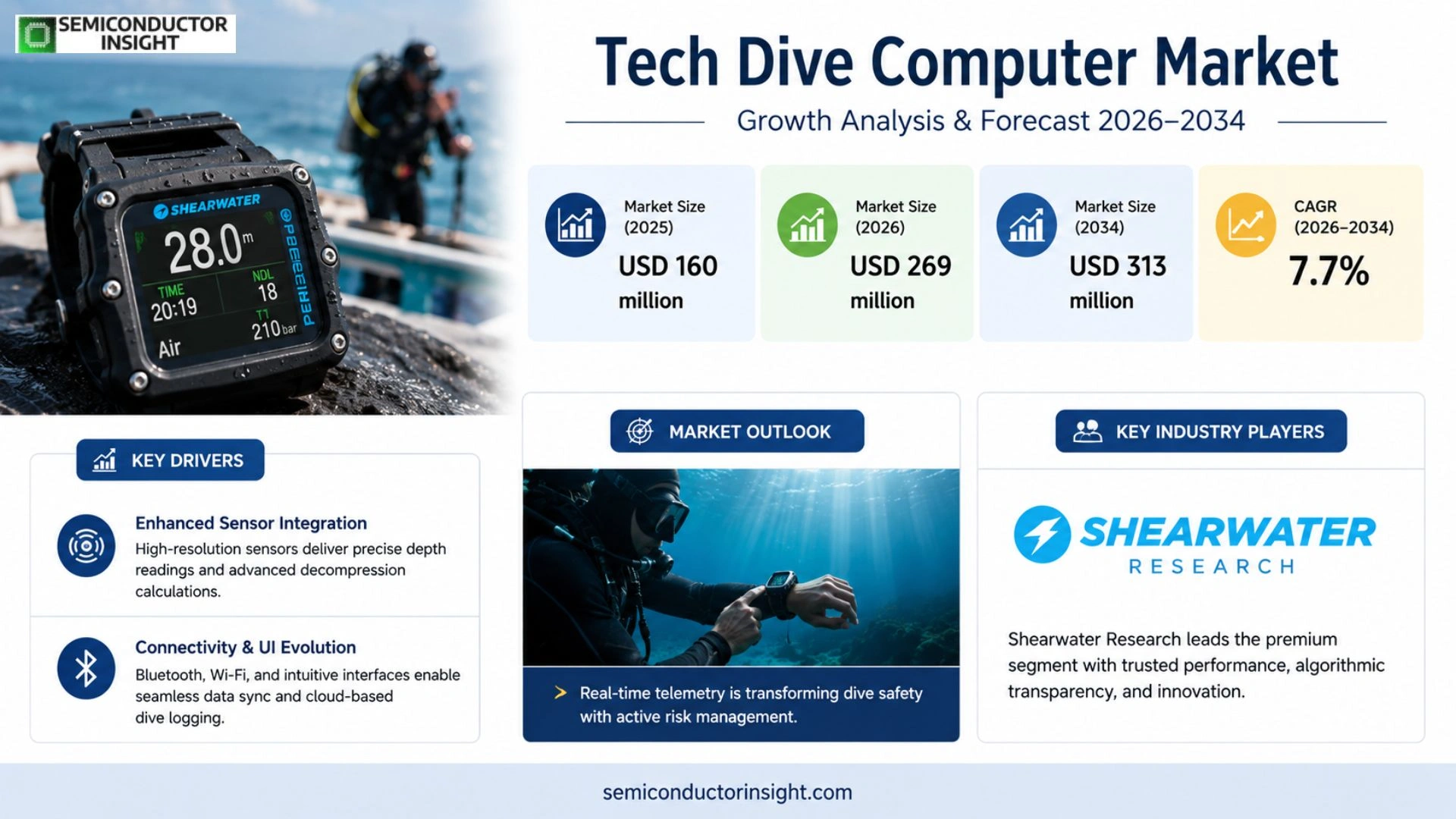
Tech Dive Computer market size was valued at USD 160 million in 2025. The market is projected to grow from USD 269 million in 2026 to approximately USD 313 million by 2034, exhibiting a CAGR of about 7.7% during the forecast period.
A Tech Dive Computer is a specialized underwater computing device designed for technical diving applications, supporting advanced functions such as multi‑gas management, decompression algorithms, trimix and rebreather compatibility, and real‑time dive planning under extreme depth and duration conditions.
The industry benefits from rising participation in technical diving, increased procurement by military and public‑safety units, and ongoing enhancements in sensor accuracy and algorithm transparency. Moreover, manufacturers are expanding ecosystem compatibility while maintaining rigorous certification standards, which sustains demand across professional and enthusiast segments.
MARKET DRIVERS
Enhanced Sensor Integration
Tech Dive Computer Market is benefitting from the rollout of high‑resolution pressure transducers that deliver depth readings within a ±0.1 m margin. Diversifiers that can translate those signals into real‑time decompression calculations are gaining preference among technical divers, because they reduce uncertainty during complex dive profiles. This precision also opens pathways for integrating multigas algorithms that were previously reserved for niche equipment.
Connectivity and User‑Interface Evolution
Bluetooth Low Energy and Wi‑Fi modules are now standard on mid‑range units, allowing seamless sync with mobile analytics platforms. The resulting data‑rich dashboards let instructors assess trainee performance across multiple sessions, which in turn fuels demand for devices that support cloud‑based log storage. Manufacturers that couple intuitive touchscreen menus with customizable alerts see higher repurchase rates.
➤ Real‑time telemetry from the dive computer to surface support teams is reshaping safety protocols, turning passive devices into active risk‑management tools.
Because the industry is moving toward integrated dive‑management ecosystems, firms that invest early in firmware that can accommodate third‑party plugins secure a competitive edge. The ripple effect is evident in a projected 6 % compound annual increase in unit shipments through 2027.
MARKET CHALLENGES
Regulatory Compliance Pressures
National diving authorities are tightening certification requirements for electronic dive aids, mandating rigorous electromagnetic compatibility testing and battery safety certifications. Companies that lack dedicated compliance teams face prolonged time‑to‑market, which diminishes their ability to capitalize on seasonal sales peaks.
Other Challenges
Battery Longevity Concerns
Even as lithium‑polymer cells become denser, the duty cycle of advanced algorithms drains power faster than legacy models. Diver confidence erodes when a computer cannot guarantee a minimum 24‑hour standby, prompting operators to stock replacement units,a cost burden that can deter price‑sensitive segments.
MARKET RESTRAINTS
High Production Costs
Precision‑machined housings, sapphire crystal displays, and waterproofing to 100 m add material expenses that push retail prices above $800 for premium models. Smaller operators, especially those in emerging tourism hubs, often opt for lower‑cost analog alternatives, constraining the overall addressable market for high‑end offerings.
MARKET OPPORTUNITIES
Emerging Recreational Markets
Adventure tourism destinations in Southeast Asia and Central America are witnessing a surge in novice technical divers eager to extend bottom time safely. This creates a niche for affordable, user‑friendly computers that embed beginner‑mode presets while retaining the scalability for advanced features. Brands that tailor firmware bundles to regional language preferences and local dive‑site databases stand to capture a sizable share of this untapped demand.
Tech Dive Computer Market Trends
Integration into Real‑Time Digital Platforms
The latest wave of product development pushes tech dive computers beyond simple dive‑time counters. Manufacturers now embed cloud‑connected firmware that streams depth, gas mix and decompression status to handheld tablets or smart‑watches. This shift enables divers to compare live telemetry with pre‑planned profiles, reducing the cognitive load during complex mixed‑gas dives. Because the underlying hardware still commands a premium price of roughly US$1,450 per unit, the added software value is a decisive differentiator for brand loyalty. Suppliers that can lock in post‑dive analytics while preserving data integrity are seeing stronger order books from professional instruction schools and military units, which value verified performance records for safety audits.
Other Trends
Supply Chain Resilience and Margin Pressure
The upstream ecosystem,pressure sensors, OLED displays and sealed housings,remains tightly regulated, with lead times averaging 10 weeks for Tier‑1 components. Recent geopolitical friction has forced several OEMs to qualify secondary sources in Southeast Asia, adding cost buffers of 4‑6 percent. Despite these pressures, gross margins stay within the 46‑62 percent band, thanks to proprietary algorithm patents and the willingness of technical divers to pay for reliability. Production volumes of 122 000 units in 2025 illustrate that manufacturers can absorb modest component cost spikes without sacrificing profitability, provided they maintain rigorous testing cycles that meet certification standards demanded by the dive‑community.
Algorithm Transparency and Community Validation
Transparency in decompression modeling has become a competitive lever. Brands that openly publish the mathematical basis of their algorithms,while still protecting core intellectual property,earn endorsements from influential diving forums and instructor associations. This community validation shortens the adoption curve for new multi‑gas capabilities such as trimix and rebreather integration. As a result, sales to specialized commercial users, including underwater research teams, have risen steadily, reflecting a preference for devices that can be audited before deployment. The ripple effect is evident in pricing trends: units with fully disclosed algorithms command a modest premium, reinforcing the link between trust and revenue growth in Tech Dive Computer Market.
COMPETITIVE LANDSCAPE
Key Industry Players
Tech Dive Computer Market Competitive Overview
Shearwater Research commands the premium segment of the tech‑dive computer market, leveraging a reputation for algorithmic transparency and rigorous testing that resonates with professional divers and rebreather operators. Its product portfolio, anchored by the Predator and Teric lines, demonstrates a blend of high‑resolution OLED displays and multi‑gas management that sets a benchmark for safety‑critical applications. The company’s vertically integrated supply chain,from sensor sourcing to firmware validation,creates a margin advantage that pressures midsized rivals to specialize or partner with OEMs. Suunto and Oceanic follow as the second and third largest manufacturers, respectively; Suunto differentiates through its strong brand heritage in sport diving and a growing suite of inductive‑touch controls, while Oceanic leverages a broad distribution network across hobbyist and commercial segments, allowing it to capture volume in markets where price sensitivity outweighs the need for elite algorithmic features.
Niche innovators such as Hollis, Ratio Computers, and Heinrichs Weikamp fill critical gaps in the ecosystem by targeting the rebreather and semi‑closed circuit niche. Hollis’s focus on modular hardware architectures enables rapid adaptation to emerging sensor technologies, a capability that appeals to military and public‑safety contracts. Ratio Computers has cultivated a loyal community of technical instructors through open‑source firmware initiatives, reducing development costs and fostering user‑driven enhancements. Heinrichs Weikamp, while smaller in sales, distinguishes itself with a proprietary pressure‑sensor platform that delivers superior accuracy under extreme depth, a factor that underpins its inclusion in several European research programs. Collectively, these specialized players inject competitive pressure that forces the market leaders to continuously refine ergonomics, user interface readability, and ecosystem compatibility.
List of Key Tech Dive Computer Companies Profiled
- Shearwater Research
- Suunto
- Oceanic
- Hollis
- Ratio Computers
- Heinrichs Weikamp
- Divesoft
- Aeris
- Cressi
- Mares
- Scubapro
- Sherwood
- Liquivision
Segment Analysis:
| Segment Category | Sub-Segments | Key Insights |
| By Type |
|
OLED Color Display
|
| By Application |
|
Commercial
|
| By End User |
|
Technical Divers
|
| By Control Type |
|
Hybrid Control
|
| By Diving Mode |
|
Closed Circuit Rebreather (CCR)
|
Regional Analysis: Tech Dive Computer Market
North America
Adoption curves accelerate as Bluetooth connectivity becomes a de‑facto standard, enabling seamless data export to mobile dive logs. Manufacturers that incorporate open‑source APIs gain a reputational advantage among tech‑savvy divers.
A handful of legacy brands dominate premium tiers, while agile startups focus on niche ergonomics and app integration, intensifying pressure on pricing and feature sets across the spectrum.
EPA guidelines on battery disposal and FCC certification for wireless modules shape design constraints, compelling firms to invest in compliance testing early in development cycles.
Divers increasingly prioritize intuitive user interfaces and customizable display layouts, prompting a shift from button‑heavy consoles to touchscreen hybrids that retain underwater reliability.
Europe
European markets exhibit a nuanced blend of safety‑first ethos and environmental stewardship. Certification bodies such as the EU Dive Safety Association impose stringent depth‑alarm thresholds, which manufacturers accommodate through redundant sensor arrays. Simultaneously, Northern European consumers favor eco‑friendly product lifecycles, encouraging firms to adopt recyclable housings and low‑toxicity batteries. The region’s fragmented retail landscape, ranging from boutique dive shops in the Mediterranean to large‑scale distributors in Germany, creates a diversified pricing environment. Companies that tailor multilingual firmware and integrate regional dive‑site databases see higher adoption rates, particularly among travel‑oriented divers who rely on localized depth‑profile analytics. These dynamics compel a balanced portfolio strategy that reconciles premium performance with sustainability messaging.
Asia-Pacific
The Asia‑Pacific corridor is experiencing accelerated market maturation, powered by expanding coastal tourism and a burgeoning middle class with disposable income earmarked for niche sports. Nations such as Indonesia and the Philippines host extensive reef systems, prompting local dive operators to seek affordable yet reliable computing solutions. Manufacturers responding with cost‑effective modules and multilingual support gain traction, especially when paired with after‑sales service networks that address the region’s logistical challenges. Yet, regulatory fragmentation,varying standards across countries,necessitates adaptable design architectures, encouraging a modular approach that can be calibrated to differing certification regimes without extensive redesign.
South America
South American growth hinges on the interplay between adventure tourism and governmental investment in marine conservation zones. Brazil’s extensive coastline fuels a steady stream of novice divers, while Argentina’s Patagonia attracts technical enthusiasts demanding high‑precision dive computers for cold‑water expeditions. Brands that align product narratives with local conservation initiatives, offering firmware that logs reef‑impact metrics, resonate strongly with environmentally conscious consumers. Distribution channels remain dominated by regional importers, making localized marketing essential for brand differentiation.
Middle East & Africa
In the Middle East & Africa, market dynamics are shaped by luxury tourism operators and emerging recreational diving hubs. High‑income expatriate communities in the Gulf states drive demand for top‑tier devices with integrated GPS and real‑time surface monitoring, while African destinations such as Zanzibar appeal to eco‑tourists who value rugged, low‑maintenance equipment. Infrastructure constraints often limit post‑sale service, prompting firms to emphasize durable hardware and remote firmware updates. Partnerships with regional dive academies provide a conduit for product education, enhancing market penetration despite limited retail footprints.
Report Scope
This market research report provides a comprehensive analysis of the Tech Dive Computer Market , covering the forecast period 2026–2034. It offers detailed insights into market dynamics, technological advancements, competitive landscape, and key trends shaping the industry.
Key focus areas of the report include:
- Market Overview: The report begins with an overview outlining its current market scenario, key growth indicators, and industry transformation drivers. It discusses macroeconomic factors, demand–supply balance, regulatory landscape, and the strategic role of semiconductors in powering advancements across industries such as automotive, telecommunications, consumer electronics, and industrial automation.
- Market Size & Forecast: Historical data and future projections for revenue, unit shipments, and market value across major regions and segments.
- Segmentation Analysis: Detailed breakdown by product type, technology, application, and end-user industry to identify high-growth segments and investment opportunities.
- Regional Insights: Insights into market performance across North America, Europe, Asia-Pacific, Latin America, and the Middle East & Africa, including country-level analysis where relevant.
- Competitive Landscape: Profiles of leading market participants, including their product offerings, R&D focus, manufacturing capacity, pricing strategies, and recent developments such as mergers, acquisitions, and partnerships.
- Technology Trends & Innovation: Assessment of emerging technologies, integration of AI/IoT, semiconductor design trends, fabrication techniques, and evolving industry standards.
- Market Drivers & Restraints: Evaluation of factors driving market growth along with challenges, supply chain constraints, regulatory issues, and market-entry barriers.
- Stakeholder Insights: Insights for component suppliers, OEMs, system integrators, investors, and policymakers regarding the evolving ecosystem and strategic opportunities.
Primary and secondary research methods are employed, including interviews with industry experts, data from verified sources, and real-time market intelligence to ensure the accuracy and reliability of the insights presented.
FREQUENTLY ASKED QUESTIONS:
What is the current market size of Tech Dive Computer Market?
-> Tech Dive Computer market is projected to grow from USD 269 million in 2026 to approximately USD 313 million by 2034, exhibiting a CAGR of about 7.7%
Which key companies operate in Tech Dive Computer Market?
-> Key players include Divesoft, Aeris, Oceanic, Cressi, Mares, Scubapro, Sherwood, Suunto, Hollis, Liquivision, Shearwater Research, Ratio Computers, Heinrichs Weikamp, among others.
What are the key growth drivers?
-> Key growth drivers include advancements in algorithm transparency, multi‑gas flexibility, enhanced display readability, ecosystem compatibility, and strong safety credibility backed by community endorsement.
Which region dominates the market?
-> North America holds the largest market share, driven by a high concentration of technical diving activities and professional training institutions, while Europe shows rapid growth due to increasing recreational and military diving programs.
What are the emerging trends?
-> Emerging trends include integration of dive computers into comprehensive digital platforms for real‑time decision‑making, post‑dive analytics, and cloud‑based data sharing, as well as continued focus on ruggedized hardware and sensor accuracy improvements.
Get Sample Report PDF for Exclusive Insights
Report Sample Includes
- Table of Contents
- List of Tables & Figures
- Charts, Research Methodology, and more...
 Download Sample Report PDF