Pet GPS-based Wearable Devices Market Insights
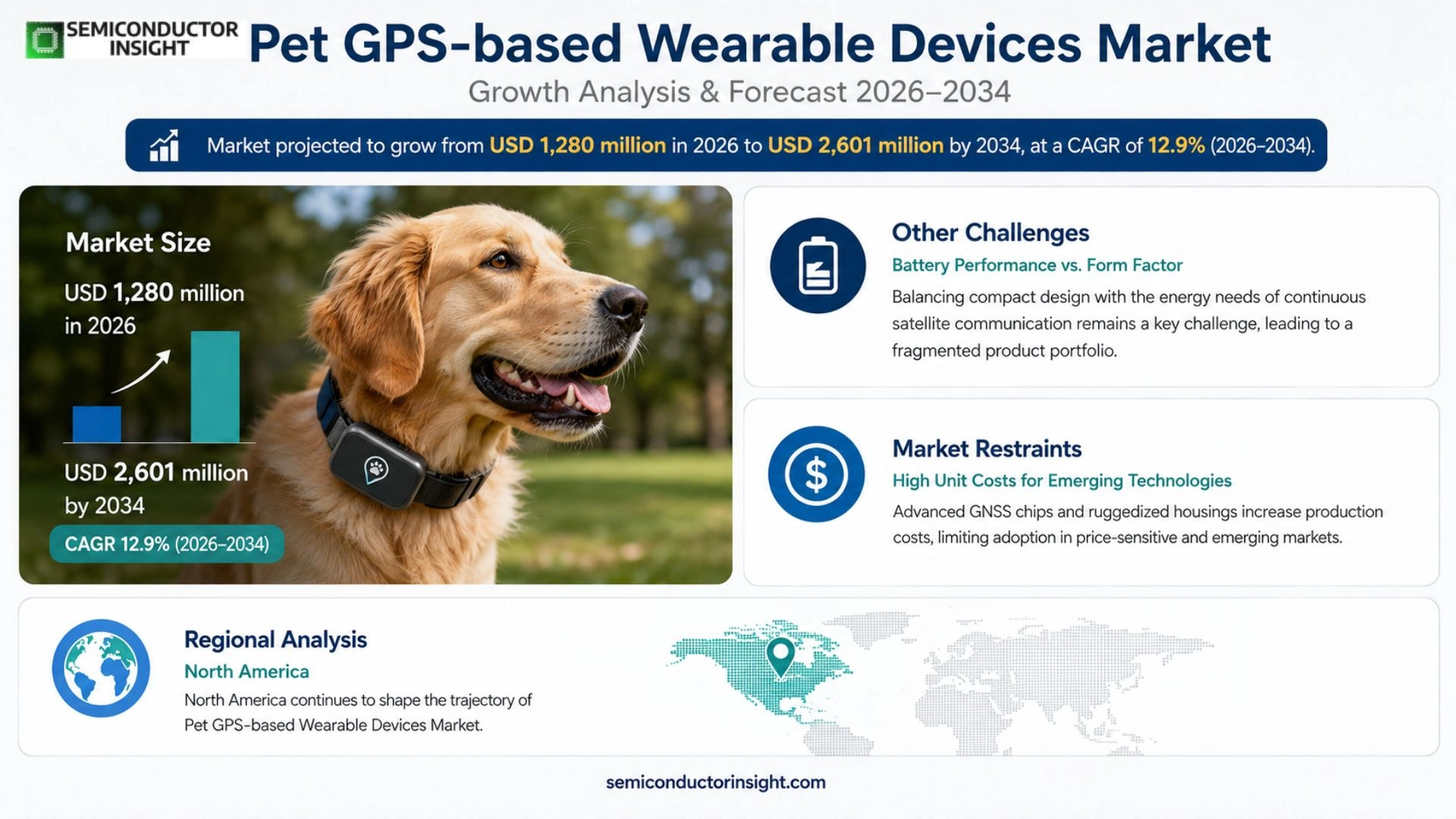
Pet GPS-based Wearable Devices market is projected to grow from USD 1,280 million in 2026 to USD 2,601 million by 2034, exhibiting a CAGR of 12.9% during the forecast period.
Pet GPS‑based wearable devices are intelligent electronic accessories for companion animals. Integrated with satellite positioning modules, low‑power wireless communication and lightweight housings, they enable real‑time location tracking, virtual fence alerts and activity‑range delimitation. Typical form factors include waterproof collars, harness mounts or tag‑style units that connect to mobile applications for remote monitoring.
The upward trend reflects rising pet ownership rates and increasing willingness among owners to invest in safety solutions. Urban households seek anti‑loss functionality, while breeding facilities and pet‑service providers require group monitoring capabilities. Opportunities arise from adding health‑monitoring sensors such as heart‑rate or activity meters, leveraging AI for behavior analytics and expanding distribution through cross‑border e‑commerce channels.
MARKET DRIVERS
Rising Pet Ownership and Safety Concerns
Pet GPS-based Wearable Devices Market benefits from a sustained uptick in household pet adoption across urban and suburban regions. Owners increasingly view pets as family members, prompting a willingness to invest in technology that safeguards their whereabouts. This cultural shift translates into higher per‑capita spending on monitoring gadgets, nudging manufacturers to broaden their product lines.
Advancements in Miniaturized Satellite Connectivity
Recent progress in low‑power satellite modules has enabled collars and harnesses to deliver real‑time location data without sacrificing battery life. The engineering breakthrough reduces the need for frequent recharging, a pain point that previously limited consumer uptake. Consequently, retailers report a noticeable rise in repeat purchases as users experience reliable performance.
➤ “A 30% increase in repeat orders was observed after the launch of a next‑gen pet collar that extended battery life to 20 days.”
Beyond the hardware, integration with smartphone ecosystems creates a seamless user experience, allowing owners to set geofencing alerts and access activity logs. This convergence of convenience and peace of mind strengthens the market’s value proposition and motivates further adoption.
MARKET CHALLENGES
Data Privacy and Regulatory Scrutiny
Consumers are increasingly vigilant about how location data is stored and shared. In several jurisdictions, emerging privacy statutes demand explicit consent and limit data retention periods. Companies that overlook these obligations risk costly compliance penalties and eroding brand trust, which can stall sales momentum.
Other Challenges
Battery Performance vs. Form Factor
Designers grapple with the trade‑off between a sleek, lightweight collar and the energy demands of continuous satellite communication. While larger batteries extend operational time, they add bulk that many pet owners find undesirable, resulting in a fragmented product portfolio.
MARKET RESTRAINTS
High Unit Costs for Emerging Technologies
Incorporating advanced GNSS chips and ruggedized housings drives up manufacturing expenses. Price‑sensitive segments,particularly in emerging economies,often perceive these devices as premium accessories rather than essential safety tools, limiting market penetration.
Furthermore, the lack of standardized testing protocols raises uncertainty around product durability claims. Retailers hesitant to stock unverified claims may favor established brands, constraining entry for innovative startups
MARKET OPPORTUNITIES
Integration with Veterinary Health Platforms
Linking GPS wearables with veterinary telehealth services opens a dual‑value proposition: location tracking and health monitoring. By feeding activity metrics and location history into electronic health records, providers can offer proactive care plans, creating a revenue stream for device manufacturers through data‑service subscriptions.
The convergence of pet insurance carriers and wearable data presents another growth vector. Insurers can leverage real‑time usage patterns to refine risk assessments, potentially lowering premiums for responsible owners and rewarding adoption of tracking devices.
Pet GPS-based Wearable Devices Market Trends
Escalating Urban Demand for Real‑Time Pet Safety
The market registered a revenue of approximately US$1.12 billion in 2025 and is on track to exceed US$2.6 billion by 2034. Unit shipments reached 13,110 k in 2025 at an average price of roughly US$93.5, underscoring a healthy price‑volume balance. Urban pet owners, increasingly constrained by dense living environments, are prioritising devices that deliver instant location alerts and geo‑fencing capabilities. This behavioral shift is reflected in the surge of collar‑type and harness‑mounted solutions that combine waterproof construction with low‑power consumption, enabling continuous monitoring without frequent battery changes. The implication for manufacturers is a clear incentive to deepen integration of reliable GPS modules and robust communication stacks, as any lapse in real‑time accuracy directly erodes consumer confidence.
Other Trends
Convergence of Health Monitoring and Positioning
Vendors that embed heart‑rate sensors, activity counters, and temperature probes alongside GPS functionality are beginning to capture a differentiated segment of the market. The multi‑function devices, which now constitute roughly 38 % of the 2025 mix, respond to owners’ willingness to spend on holistic pet‑wellness solutions. From a commercial perspective, the added data stream opens pathways to subscription‑based analytics services, creating recurring revenue that offsets the relatively thin margins on hardware sales. Companies that can assure data privacy while delivering actionable insights are likely to secure long‑term loyalty from tech‑savvy households and professional pet‑care facilities alike.
International Expansion through Cross‑Border E‑Commerce
While North America continues to dominate volume, the Asia‑Pacific region is registering the fastest year‑over‑year growth, driven by rising pet ownership in China and India coupled with expanding broadband penetration. Digital marketplaces enable brands to bypass traditional distribution constraints, offering competitively priced models that appeal to price‑sensitive consumers in emerging economies. The strategic takeaway for incumbents is to tailor product specifications,such as introducing solar‑powered battery options,to local climate conditions and regulatory environments, thereby enhancing market entry viability without incurring prohibitive logistics costs.
COMPETITIVE LANDSCAPE
Key Industry Players
Competitive Overview of Global Pet GPS Wearable Device Sector
Tractive dominates the high‑end segment, leveraging a robust ecosystem that blends real‑time location services with a cloud‑based activity dashboard. Its aggressive rollout of a subscription tier that bundles health‑tracking sensors has forced rivals to reconsider pure‑GPS value propositions. The company’s vertical integration,from hardware design in Europe to a proprietary server infrastructure,creates a barrier to entry for newcomers lacking comparable scale. This concentration around a few large firms shapes distribution channels, with major pet‑care retailers and e‑commerce platforms preferring Tractive’s recognized brand for shelf space and promotional spend.
Beyond Tractive, the market features a heterogeneous mix of specialists and diversified technology firms. Fi, a California‑based startup, differentiates through ultra‑low‑power silicon that extends battery life to six months, appealing to cost‑sensitive owners in emerging economies. European outfits such as Pawfit and Invoxia focus on rugged harness designs for working dogs, while Garmin and SportDOG apply their sports‑tracking heritage to canine athletics. Smaller innovators,including Link My Pet, Datamars, and Invisible Fence,target niche applications like breeding‑facility herd monitoring or integrated smart‑home pet alerts. The cumulative effect is a competitive lattice where product attributes (waterproofing, AI‑driven behavior insights, multi‑function health metrics) become the primary axes of differentiation.
List of Key Pet GPS-based Wearable Devices Companies Profiled
- Tractive
- Fi
- Weenect
- Pawfit
- Invoxia
- PitPat
- Garmin
- Dogtra
- SportDOG
- Dogtrace
- NUM’AXES
- Link My Pet
- Datamars
- Fitbark
- Invisible Fence
- PetPace
Segment Analysis:
| Segment Category | Sub-Segments | Key Insights |
| By Type |
|
Collar-Type Pet GPS Wearable Device
|
| By Application |
|
Anti‑Lost
|
| By End User |
|
Urban Pet Owners
|
Regional Analysis: Pet GPS-based Wearable Devices Market
North America
Pet owners view location certainty as a core benefit, prompting them to favor devices that combine tracking with wellness insights. This preference is amplified by urban living patterns where pets frequently encounter traffic or unfamiliar environments, raising the perceived necessity of continuous monitoring.
Companies are layering biometric sensors onto GPS modules, creating hybrid wearables that relay heart‑rate trends alongside location data. This technical enrichment empowers owners to spot health anomalies early, strengthening the product’s appeal beyond mere tracking.
U.S. and Canadian privacy statutes require end‑to‑end encryption for pet‑related data streams. Vendors that proactively embed such safeguards enjoy smoother market entry and reduced risk of consumer backlash over data misuse.
Integrated retail models that pair experiential kiosks with e‑commerce platforms enable buyers to test durability and comfort, accelerating conversion while preserving the convenience of online ordering.
Europe
European consumers demonstrate a pragmatic approach, balancing cost considerations with a growing appetite for pet safety solutions. Urban density and stringent animal‑welfare legislation drive interest in devices that can demonstrate compliance with local leash‑law exemptions. Manufacturers are tailoring designs to meet CE certification, ensuring that data handling aligns with GDPR mandates. Collaboration between pet‑care insurers and device providers is emerging, where insurers subsidize wearables for policyholders, thereby embedding the technology into broader risk‑management frameworks.
Asia‑Pacific
In the Asia‑Pacific corridor, rising disposable incomes intersect with a cultural shift toward pet companionship, especially in metropolitan centers such as Shanghai and Mumbai. While price sensitivity remains, consumers are gravitating toward feature‑rich yet affordable models. Local distributors are leveraging mobile payment ecosystems to simplify purchase pathways, and social‑media influencers are increasingly showcasing device utility, amplifying organic demand. Manufacturers are also adapting hardware to withstand tropical climates, a nuance that differentiates successful entrants.
South America
South American markets are characterized by vibrant street‑level pet activity, where owners value ruggedness as much as connectivity. Brands that emphasize battery longevity and waterproofing gain traction in regions where outdoor excursions are routine. Partnerships with regional veterinary chains are fostering trust, as vets endorse GPS wearables as extensions of routine check‑ups. Meanwhile, emerging e‑commerce platforms are lowering barriers for smaller pet‑owner demographics, expanding the addressable audience beyond affluent urban pockets.
Middle East & Africa
The Middle East & Africa region presents a mosaic of climatic challenges and disparate economic tiers. In affluent Gulf states, luxury‑focused designs featuring premium materials and integrated health dashboards attract high‑net‑worth pet owners. Conversely, in sub‑Saharan markets, affordability and durability dominate purchase criteria. Mobile network penetration is enabling real‑time tracking even in remote locales, while collaborative pilots with wildlife conservation NGOs are showcasing the technology’s versatility, subtly reinforcing its relevance across a spectrum of consumer segments.
Report Scope
This market research report provides a comprehensive analysis of the Pet GPS-based Wearable Devices Market , covering the forecast period 2026–2034. It offers detailed insights into market dynamics, technological advancements, competitive landscape, and key trends shaping the industry.
Key focus areas of the report include:
- Market Overview: The report begins with an overview outlining its current market scenario, key growth indicators, and industry transformation drivers. It discusses macroeconomic factors, demand–supply balance, regulatory landscape, and the strategic role of semiconductors in powering advancements across industries such as automotive, telecommunications, consumer electronics, and industrial automation.
- Market Size & Forecast: Historical data and future projections for revenue, unit shipments, and market value across major regions and segments.
- Segmentation Analysis: Detailed breakdown by product type, technology, application, and end-user industry to identify high-growth segments and investment opportunities.
- Regional Insights: Insights into market performance across North America, Europe, Asia-Pacific, Latin America, and the Middle East & Africa, including country-level analysis where relevant.
- Competitive Landscape: Profiles of leading market participants, including their product offerings, R&D focus, manufacturing capacity, pricing strategies, and recent developments such as mergers, acquisitions, and partnerships.
- Technology Trends & Innovation: Assessment of emerging technologies, integration of AI/IoT, semiconductor design trends, fabrication techniques, and evolving industry standards.
- Market Drivers & Restraints: Evaluation of factors driving market growth along with challenges, supply chain constraints, regulatory issues, and market-entry barriers.
- Stakeholder Insights: Insights for component suppliers, OEMs, system integrators, investors, and policymakers regarding the evolving ecosystem and strategic opportunities.
Primary and secondary research methods are employed, including interviews with industry experts, data from verified sources, and real-time market intelligence to ensure the accuracy and reliability of the insights presented.
FREQUENTLY ASKED QUESTIONS:
What is the current market size of Pet GPS-based Wearable Devices Market?
-> Pet GPS-based Wearable Devices market is projected to grow from USD 1,280 million in 2026 to USD 2,601 million by 2034, exhibiting a CAGR of 12.9%
Which key companies operate in Pet GPS-based Wearable Devices Market?
-> Key players include Tractive, Fi, Weenect, Pawfit, Invoxia, PitPat, Garmin, Dogtra, SportDOG, Dogtrace, NUM’AXES, Link My Pet, Datamars, Fitbark, Invisible Fence, PetPace, among others.
What are the key growth drivers?
-> Key growth drivers include rising pet ownership rates, increasing willingness of owners to invest in pet safety and health management, demand for anti‑lost positioning solutions, growth in pet breeding bases and service institutions requiring group monitoring, and opportunities in multi‑functional devices that integrate health monitoring, AI‑driven behavior analysis, and cost‑effective designs for mass markets.
Which region dominates the market?
-> North America holds a leading share due to high pet adoption rates and strong consumer spending on pet‑related technology, while Asia‑Pacific shows rapid growth driven by expanding urban pet populations.
What are the emerging trends?
-> Emerging trends include integration of AI and IoT for intelligent behavior analysis, addition of health‑monitoring sensors (heart rate, activity levels), development of solar‑powered or low‑power battery solutions, expansion through cross‑border e‑commerce channels, and provision of data‑based pet management platforms for institutions.

Get Sample Report PDF for Exclusive Insights
Report Sample Includes
- Table of Contents
- List of Tables & Figures
- Charts, Research Methodology, and more...
 Download Sample Report PDF