
Mono LCD Displays Market Insights
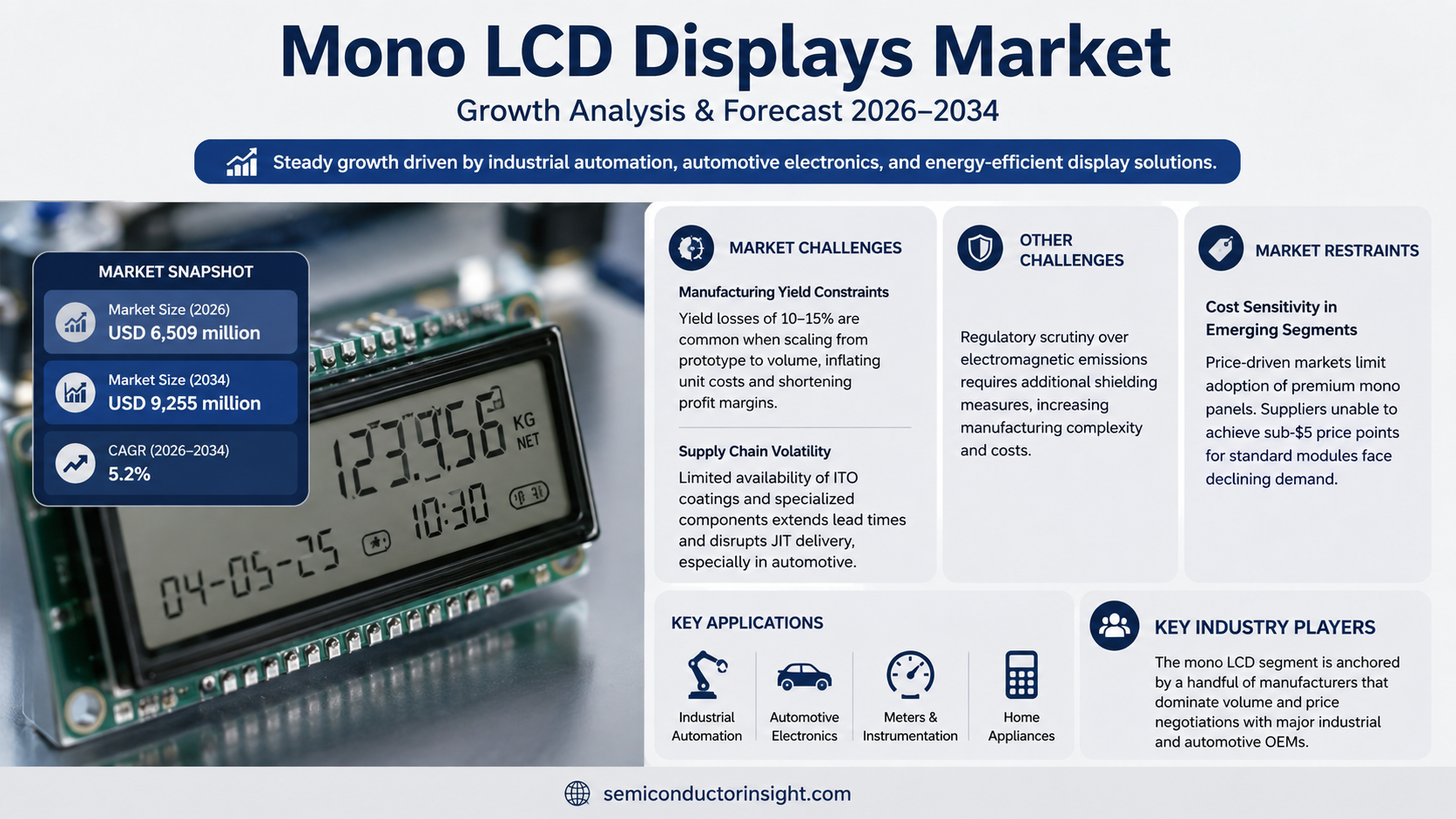
Global Mono LCD Displays market is projected to grow from USD 6,509 million in 2026 to USD 9,255 million by 2034, exhibiting a CAGR of 5.2% during the forecast period.
Mono LCD displays are monochrome liquid‑crystal panels noted for low power consumption, high stability and cost‑effectiveness. They serve industrial control panels, medical instrumentation, smart meters and automotive human‑machine interfaces where high contrast and sunlight readability are essential.
The market is experiencing growth because emerging IoT terminals, wearable health devices and portable testing instruments demand long battery life and tight cost control. Recent initiatives by manufacturers such as Powertip Technology, Raystar Optronics, Riverdi, BOE Varitronix and WINSTAR Display include new product launches and capacity expansions that reinforce the segment’s competitiveness.
MARKET DRIVERS
Rising Demand for Compact Visual Interfaces
Automakers are replacing traditional gauges with single‑line LCD panels to free cockpit space and cut wiring complexity. Industrial control cabinets benefit from the thin form factor, allowing retrofits without major enclosure redesign. The resulting surge in component orders lifts the overall Mono LCD Displays Market, especially as manufacturers seek slimmer, energy‑conserving solutions for handheld diagnostic tools.
Advances in Backlight Efficiency
Recent breakthroughs in edge‑lit LED technology have slashed power draw by roughly 30 % while preserving luminance levels required for outdoor signage. These efficiency gains reduce total cost of ownership for end‑users and make mono‑line panels viable in battery‑powered devices such as portable scanners. Consequently, OEMs are allocating larger bill‑of‑materials percentages to these displays.
➤ “Efficiency upgrades are turning what was once a niche component into a mainstream choice for low‑profile equipment.”
Combined, higher adoption rates and lower operating expenses create a feedback loop that encourages further R&D investments, reinforcing the growth trajectory of Mono LCD Displays market.
MARKET CHALLENGES
Manufacturing Yield Constraints
Fabricating ultra‑thin glass substrates while maintaining uniform pixel alignment stretches current production lines. Yield losses of 10–15 % are common when scaling from prototype to volume, inflating unit costs and shortening profit margins for small‑batch producers.
Other Challenges
Supply Chain Volatility
Limited availability of high‑purity indium tin oxide (ITO) coatings and specialized backlight components amplifies lead times. Customers in the automotive sector, which operates on a just‑in‑time model, often face schedule disruptions that erode confidence in mono‑line solutions.
Regulatory scrutiny over electromagnetic emissions adds another layer of complexity, forcing manufacturers to implement additional shielding measures that further drive up manufacturing expenses.
MARKET RESTRAINTS
Cost Sensitivity in Emerging Segments
Emerging markets prioritize price over performance, and the premium associated with high‑resolution mono panels limits penetration in low‑margin applications such as basic vending machines. Suppliers that cannot achieve sub‑$5 price points for standard‑size modules see dwindling orders.
Competing display technologies, notably organic light‑emitting diode (OLED) units, are experiencing price reductions that challenge the economic case for mono LCDs in consumer‑facing products.
Environmental legislation requiring recyclable materials forces redesign of glass substrates, adding to upfront engineering costs and slowing product roll‑out cycles.
MARKET OPPORTUNITIES
Integration with IoT Edge Devices
Edge gateways and smart meters increasingly need a single line of clear read‑outs for status and alerts. Mono LCD panels, with their low power draw and straightforward driver architecture, fit naturally into these constrained environments, opening a sizable niche for vendors willing to customize firmware interfaces.
Wearable health monitors are beginning to incorporate small mono displays for vital‑sign readouts, creating a cross‑sector opportunity that merges medical compliance with consumer convenience.
Rapid urbanization in Southeast Asia is prompting municipal projects to adopt digital signage for wayfinding and public announcements. The demand for durable, low‑maintenance single‑line displays in such deployments offers a geographic expansion path for manufacturers.
Mono LCD Displays Market Trends
Rising Demand in Industrial Automation
The adoption of robust, low‑power screens continues to reshape control panels across factories, water‑treatment facilities and energy substations. Mono LCD technology offers a blend of high contrast and resistance to harsh temperatures, which makes it attractive for equipment that must run uninterrupted for years. As manufacturers replace legacy electromechanical gauges with digital interfaces, the requirement for screens that can survive dust, vibration and prolonged on‑time pushes suppliers toward monochrome modules. This shift not only reduces overall device cost but also simplifies maintenance, because the simpler backlight structure lowers failure rates compared to full‑color alternatives.
Other Trends
Utility Smart Meter Upgrades
Smart grid initiatives across North America and Europe have triggered a wave of retrofit projects for electricity and water meters. Operators prioritize displays that remain legible under direct sunlight and consume minimal power, because meters are often powered by the line itself. Mono LCD panels meet those criteria, enabling meters to transmit consumption data while still providing an on‑site readout for field technicians. The cumulative effect is a steady inflow of orders for dot‑matrix and graphic monochrome displays, especially in regions where regulatory bodies mandate real‑time monitoring of resource usage.
IoT and Wearable Health Devices Expansion
Emerging handheld diagnostics, fitness bands and portable health monitors rely on battery longevity as a core selling point. Designers select monochrome LCDs to shave milliwatts from the power budget, while still delivering sharp text and basic iconography. The market for such devices is gaining momentum in Asia‑Pacific, where government health programs subsidize low‑cost monitoring tools. As a result, several OEMs have announced new product lines that integrate 4‑bit grayscale panels, a compromise that preserves readability while extending standby time. This trend generates a parallel demand stream for compact, cost‑effective modules, prompting traditional display makers to expand their thin‑film production capacity.
COMPETITIVE LANDSCAPE
Key Industry Players
Mono LCD Displays: Competitive Landscape Overview
The mono LCD segment is anchored by a handful of manufacturers that dominate volume and price negotiations with major industrial and automotive OEMs. Raystar Optronics, for instance, leverages a global supply chain and a broad portfolio that spans character, graphic and segmented glass panels, allowing it to capture the majority of high‑volume contracts for smart‑metering and factory‑floor HMIs. Its ability to deliver consistent yield at a low unit cost has forced smaller outfits to adopt niche strategies or align with system integrators. The market therefore exhibits a tiered structure: a core of multinationals controlling 60‑70 % of shipments, a second tier of regionally strong firms such as Tianma and BOE Varitronix filling specialized demand, and a long tail of boutique suppliers that survive on custom engineering and rapid‑response service.
Beyond the dominant tier, a diverse set of players addresses sector‑specific requirements. Sharp’s high‑contrast TN panels are favoured in automotive dashboards where sunlight readability is non‑negotiable, while Crystalfontz and Densitron focus on medical instrumentation that demands stringent regulatory compliance. Companies like CreateXplay and Double Black Imaging have carved out positions in emerging IoT wearables by emphasizing ultra‑low power consumption and miniature form factors. This fragmentation creates ample opportunity for strategic partnerships, as larger manufacturers often outsource bespoke module development to these specialists to accelerate time‑to‑market for niche applications.
List of Key Mono LCD Displays Companies Profiled
- Powertip Technology
- Raystar Optronics
- Riverdi
- BOE Varitronix
- WINSTAR Display
- Kyocera Display
- Tianma
- Sharp
- Sinocrystal Technology
- Vatronix
- ICAPE Group
- CreateXplay
- TOPWAY
- Crystalfontz
- Shenzhen SLS Industrial
- TRICOMTEK
- Double Black Imaging
- Densitron
- Optrex Corporation
- Solomon Systech Limited
- Newhaven Display International, Inc.
Segment Analysis:
| Segment Category | Sub-Segments | Key Insights |
| By Type |
|
Character LCD
Graphic LCD
Segmented Glass LCD
|
| By Application |
|
Industrial
Consumer Electronics
Automotive
Others
|
| By End User |
|
Industrial Automation
Medical Instruments
Automotive Instruments
|
| By Light Source |
|
Reflective
Transmissive
Others
|
| By Display Mode |
|
TN
HTN
STN
Others
|
Regional Analysis: Mono LCD Displays Market
North America
Manufacturers integrate advanced thin‑film transistor (TFT) architectures with monochrome backlights, delivering sharper contrast while preserving low power draw. This evolution satisfies both consumer gadget makers and industrial equipment builders, who value long‑life cycles and minimal heat generation in compact assemblies.
Companies diversify component sourcing across the United States and Canada, reducing exposure to single‑source bottlene‑backs. Strategic warehousing near major logistics hubs shortens lead times, ensuring that production schedules remain insulated from global disruptions.
Stringent RoHS and energy‑efficiency directives push vendors toward mercury‑free phosphor coatings and low‑voltage drive schemes. Compliance becomes a market differentiator, prompting early adopters to embed certification processes into product development cycles.
End‑users prioritize readability in extreme lighting, prompting a shift toward high‑gain, anti‑glare finishes. Feedback loops from field installations inform iterative design tweaks that enhance durability without inflating unit costs.
Europe
European manufacturers leverage a dense network of research institutes to refine display phosphor chemistry, achieving higher luminance at reduced power thresholds. Market participants respond to EU directives that emphasize circular‑economy principles, recycling panel components and extending product lifespans. OEMs in automotive and medical device sectors favor mono‑color displays for their reliability under temperature swings, prompting vendors to certify compliance with IEC standards. Collaborative pilots between local integrators and component suppliers accelerate the rollout of customized form factors, aligning with niche applications such as point‑of‑sale terminals and industrial kiosks.
Asia‑Pacific
In Asia‑Pacific, Mono LCD Displays market benefits from a confluence of high‑volume consumer production and burgeoning smart‑factory initiatives. Manufacturers capitalize on cost‑effective fabrication facilities in Southeast Asia, where skilled labor and favorable export incentives lower overall unit economics. Simultaneously, regional governments promulgate digital‑transition policies that embed monochrome panels into public‑information systems, reinforcing demand for ruggedized solutions. The competitive pressure encourages rapid iteration on panel thickness, enabling integration into ultra‑slim wearable devices while preserving long‑term stability.
South America
South American adoption is shaped by expanding telecommunications infrastructure and growing investments in renewable‑energy monitoring stations. Vendors tailor displays to withstand humidity and dust, delivering sealed enclosures that meet local reliability standards. Public‑sector procurement programs, particularly in Brazil and Chile, prioritize low‑maintenance displays for remote sensing applications, creating a steady pipeline of orders that incentivizes local assembly lines. The emphasis on cost containment drives a preference for standardized sizes, simplifying inventory management for regional distributors.
Middle East & Africa
The Middle East & Africa region sees mono‑LCD panels applied in harsh desert climates and oil‑field monitoring equipment, where readability under intense sunlight is paramount. Suppliers respond by engineering high‑contrast backlights and reinforced glass substrates. In Africa, emerging mobile health initiatives adopt monochrome displays for low‑cost diagnostic tools, aligning with NGOs’ focus on durability and ease of sterilization. Partnerships between multinational vendors and regional system integrators foster knowledge transfer, gradually elevating the technical sophistication of local manufacturing capabilities.
Report Scope
This market research report provides a comprehensive analysis of the Mono LCD Displays Market , covering the forecast period 2026–2034. It offers detailed insights into market dynamics, technological advancements, competitive landscape, and key trends shaping the industry.
Key focus areas of the report include:
- Market Overview: The report begins with an overview outlining its current market scenario, key growth indicators, and industry transformation drivers. It discusses macroeconomic factors, demand–supply balance, regulatory landscape, and the strategic role of semiconductors in powering advancements across industries such as automotive, telecommunications, consumer electronics, and industrial automation.
- Market Size & Forecast: Historical data and future projections for revenue, unit shipments, and market value across major regions and segments.
- Segmentation Analysis: Detailed breakdown by product type, technology, application, and end-user industry to identify high-growth segments and investment opportunities.
- Regional Insights: Insights into market performance across North America, Europe, Asia-Pacific, Latin America, and the Middle East & Africa, including country-level analysis where relevant.
- Competitive Landscape: Profiles of leading market participants, including their product offerings, R&D focus, manufacturing capacity, pricing strategies, and recent developments such as mergers, acquisitions, and partnerships.
- Technology Trends & Innovation: Assessment of emerging technologies, integration of AI/IoT, semiconductor design trends, fabrication techniques, and evolving industry standards.
- Market Drivers & Restraints: Evaluation of factors driving market growth along with challenges, supply chain constraints, regulatory issues, and market-entry barriers.
- Stakeholder Insights: Insights for component suppliers, OEMs, system integrators, investors, and policymakers regarding the evolving ecosystem and strategic opportunities.
Primary and secondary research methods are employed, including interviews with industry experts, data from verified sources, and real-time market intelligence to ensure the accuracy and reliability of the insights presented.
FREQUENTLY ASKED QUESTIONS:
What is the current market size of Mono LCD Displays Market?
-> Mono LCD Displays market is projected to grow from USD 6,509 million in 2026 to USD 9,255 million by 2034, exhibiting a CAGR of 5.2%
Which key companies operate in Mono LCD Displays Market?
-> Key players include Powertip Technology, Raystar Optronics, Riverdi, BOE Varitronix, WINSTAR Display, Kyocera Display, Tianma, Sharp, Sinocrystal Technology, Vatronix, ICAPE Group, CreateXplay, TOPWAY, Crystalfontz, Shenzhen SLS Industrial, TRICOMTEK, Double Black Imaging, Densitron, Optrex Corporation, Solomon Systech Limited, Newhaven Display International, Inc..
What are the key growth drivers?
-> Key growth drivers include low power consumption, high stability, cost effectiveness, expanding use in industrial control HMIs, medical instruments, smart meters, automotive dashboards, utility upgrades such as smart grids and water meters, and the rise of IoT terminals, wearable health devices, and portable testing instruments.
Which region dominates the market?
-> Asia-Pacific holds the largest market share, driven by strong industrial automation, automotive manufacturing, and consumer electronics activities, while North America and Europe also contribute significant volumes.
What are the emerging trends?
-> Emerging trends include integration of Mono LCDs in IoT edge devices, wearable health monitoring equipment, portable diagnostic tools, and continued adoption in smart grid and smart meter applications to meet stringent power‑efficiency and cost targets.

Get Sample Report PDF for Exclusive Insights
Report Sample Includes
- Table of Contents
- List of Tables & Figures
- Charts, Research Methodology, and more...
 Download Sample Report PDF