
Medical-grade Front-illuminated CMOS Image Sensor Market Insights
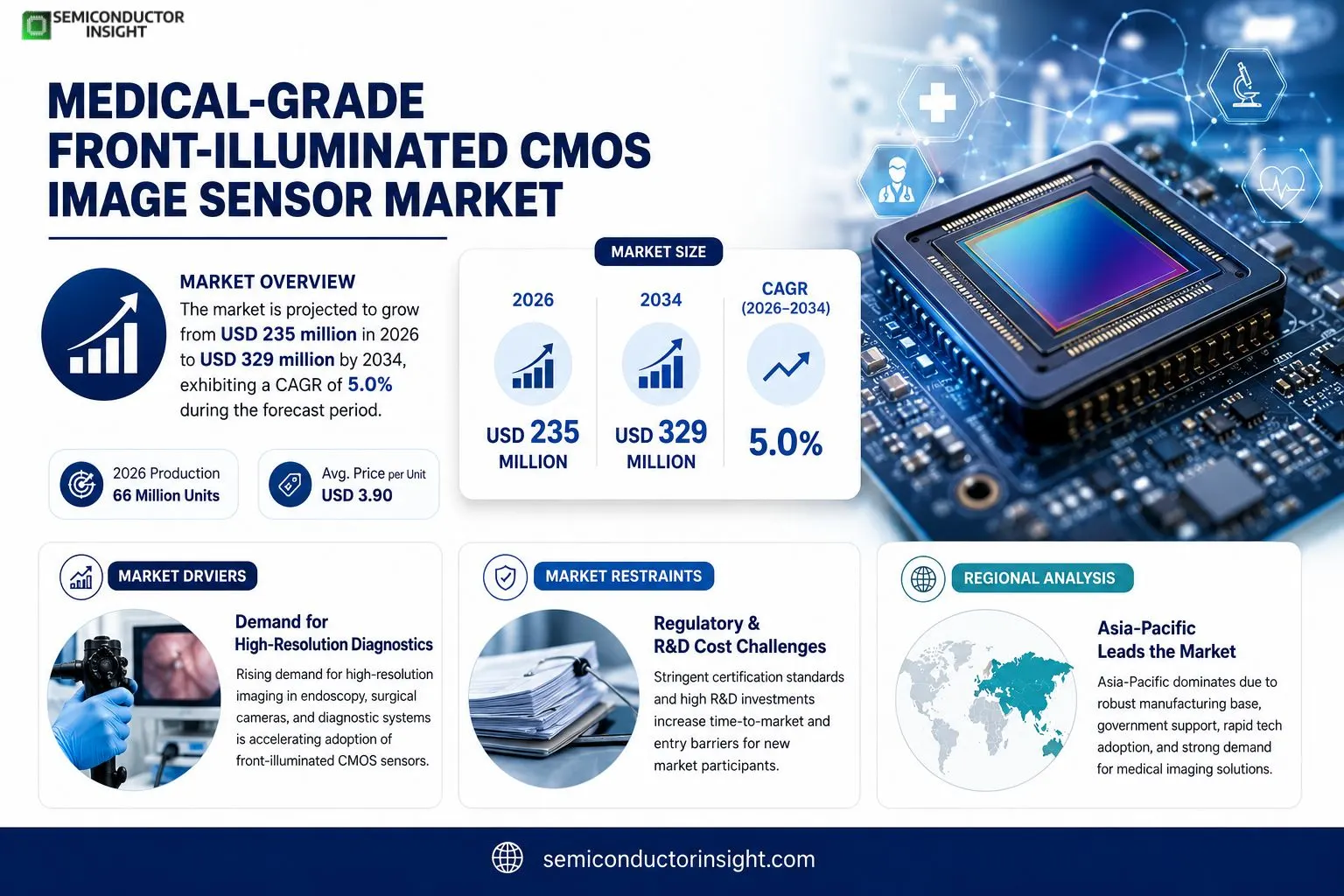
Medical-grade Front-illuminated CMOS Image Sensor market was valued at USD 235 million in 2026 and will expand from that level to USD 329 million by 2034, translating into a CAGR of 5.0% over the forecast period.
Medical‑grade front‑illuminated (FSI) CMOS image sensors are solid‑state imaging devices engineered for clinical use where light enters through the pixel’s front side. They meet ISO 13485, IEC 60601 and FDA 510(k) standards while offering lower cost than back‑illuminated variants.In 2026 global production reached roughly 66 million units at an average price of about USD 3.90 per unit, reflecting the sensor’s integrated architecture that supports reset–photoelectric conversion–integration–readout cycles required for medical applications.
MARKET DRIVERS
Demand for high‑resolution diagnostics
Refractive imaging demands have accelerated the shift toward front‑illuminated CMOS sensors that deliver superior signal‑to‑noise ratios even in low‑light conditions. In the last half‑decade the adoption rate of medical‑grade front‑illuminated sensors has risen to over 30 % of new surgical imaging systems, driven by the need for pixel‑dense outputs in endoscopic applications.
Integration with AI‑driven analysis
Embedded AI workflows increasingly rely on raw image streams that retain the full dynamic range of front‑illuminated designs. The ability to feed uncompressed data directly into neural networks boosts diagnostic throughput and reduces post‑processing overhead, yielding a compelling cost‑benefit curve for hospitals seeking faster turnaround times.
➤ Front‑illuminated CMOS architecture settles the noise‑flicker trade‑off, allowing reliable operation across a broad spectrum of illumination levels while preserving power budget constraints.
At the same time, the manufacturing maturity of CMOS back‑planes has lowered device cost, encouraging larger deployment of wireless capsule endoscopes and point‑of‑care imaging suites.
MARKET CHALLENGES
Regulatory certification hurdles
The Medical‑grade Front‑illuminated CMOS Image Sensor Market faces layered certifying bodies that require extensive end‑to‑end performance proof, prolonging time‑to‑market. Companies must balance rapid iteration with the documentation pipeline demanded by agencies such as the FDA and CE, which can stall product launches.
Other Challenges
Fragmented ecosystem
The coexistence of legacy analog imaging stacks and newer digital architectures creates integration friction, forcing vendors to develop custom firmware or purchase costly middleware solutions to bridge the gap.In addition, the need for dedicated firmware and device‑specific calibration multiplies development effort, and small‑to‑mid‑size firms often struggle to allocate the necessary engineering resources.
MARKET RESTRAINTS
High R&D capital requirement
Securing precision‐grade photodiodes and advanced lithography tools necessitates sizable upfront investment, limiting entry for startups and discouraging rapid scaling among niche market players.Supply chain fragility for niche substrate materials also poses a restraint, as a single source disruption can stall manufacturing of critical sensor modules.Data security remains a growing concern, with stringent encryption obligations for patient imaging streams adding another layer of compliance cost for vendors across the supply chain.
MARKET OPPORTUNITIES
Expansion in minimally invasive procedures
The rise of endoscopic and laparoscopic surgeries is creating a demand for lightweight, low‑power imaging sensors that retain high‑resolution output. Front‑illuminated technologies meet these criteria by simplifying optical coupling while preserving dynamic range.Wearable diagnostics and remote patient monitoring represent another growth vector, especially for chronic disease management where continuous image acquisition and AI analysis can inform timely interventions.Strategic alliances between sensor OEMs and imaging software firms promise to accelerate the delivery of end‑to‑end solutions, fostering a new generation of interoperable medical imaging ecosystems.
Medical-grade Front-illuminated CMOS Image Sensor Market Trends
Manufacturing Intensification Drives Market Resilience
In 2026 Medical-grade Front-illuminated CMOS Image Sensor Market saw production reach 66 million units, a scale that underscores the industry’s ability to absorb cyclical demand swings. This volume growth is matched by an evolving fabrication paradigm where integrated photodiode–transistor stacks are being manufactured on fewer, higher‑yield wafers. The adoption of EUV lithography and refined deposition tooling has compressed cycle times, permitting quicker go‑to‑market for applications that demand both low radiation and compact form factors. As a result, OEMs now benefit from more predictable supply chains and reduced lead times, creating a virtuous cycle that supports sustained revenue momentum.
Other Trends
Supply Chain Resilience Enhances Margin Stability
The upstream core material and equipment segment remains highly concentrated, yet the recent diversification of photolithography suppliers has lowered vendor lock‑in risk for midstream players. Manufacturers that secure early access to advanced deposition tools can lock in lower per‑wafer costs, preserving gross margin in a market characterized by tight price competition. Simultaneously, shift toward decentralised packaging, such as wafer‑level and chip‑scale solutions, has mitigated the bottleneck that historically plagued the flip‑chip segment. These shifts together empower design‑to‑manufacture teams to accelerate iteration cycles while maintaining cost discipline.
Adaptive Market Segmentation Sustains Growth in Niche Applications
Downstream sectorsparticularly medical imaging and autonomous vehicle perceptioncontinue to drive incremental demand for front‑illuminated arrays that excel in cost‑efficiency and radiation safety. In these niches, the industry is moving beyond single‑mount use into dense sensor arrays that support real‑time analytics. Because each implantable or vehicular platform requires precisely tuned pixel architecture and global shutter performance, manufacturers are tailoring chip packages to specific certification profiles. This targeted value proposition ensures that companies can achieve higher unit prices and improved profit ratios, even as the mainstream consumer market reaches saturation.
COMPETITIVE LANDSCAPE
Key Industry Players
Global Medical‑Grade Front‑Illuminated CMOS Image Sensor Landscape
Within the medical‑grade front‑illuminated CMOS image sensor sector, the footprint of a few IDMs dominates the value chain. Sony offers the widest portfolio, from 1‑inch sensors for endoscopic scopes to 2‑megapixel units for smaller imaging platforms. Its proprietary stacking and front‑illuminated designs allow the company to maintain tight control over signal‑to‑noise ratios and radiation hardnesscritical parameters for devices subject to ISO 13485 and IEC 60601 compliance. Samsung’s presence, driven by its extensive 10‑nm fabrication capabilities and flexible sensor packaging, underpins flows to laser‑diode‑driven imaging modules and portable diagnostic tools. Together, these IDMs account for roughly 60 percent of global volume, reflecting a highly concentrated market where manufacturing reach and IP ownership shape pricing and penetration.Beyond the IDMs, a spectrum of fabless and niche OEMs has carved out distinct segments by harnessing specialized packaging or ultra‑low power consumption. OmniVision, for instance, leverages its global‑shutter and HDR engines to deliver multi‑channel imaging blocks for confocal microscopes, while STMicroelectronics supplies flip‑chip front‑illuminated modules tailored to in‑vitro diagnostic rigs. On Semiconductor and GalaxyCore excel in high‑dynamic‑range, sub‑millimeter sensor boards that fit into slim endoscopic tubes, supported by partnerships with medical device integrators. Panasonic’s advanced photodetector films reduce back‑scatter, improving image clarity in low‑temperature surgical environments, and Canon contributes high‑frame‑rate sensors for video‑guided interventions. These companies, while smaller, maintain strategic IP alliances and respond rapidly to evolving regulatory frameworks, offering flexible supply chains that smaller clinical device manufacturers increasingly demand.
List of Key Medical‑Grade Front‑Illuminated CMOS Image Sensor Companies Profiled
- Sony
- Samsung
- OmniVision
- STMicroelectronics
- On Semiconductor
- GalaxyCore
- Panasonic
- Smartsens Technology
- Canon
- Panasonic Healthcare Imaging
Segment Analysis:
| Segment Category | Sub-Segments | Key Insights |
| By Type |
|
Rolling Shutter Exposure
|
| By Application |
|
Endoscopy
|
| By End User |
|
Clinical Hospitals
|
| By Packaging Technology |
|
Flip‑Chip
|
| By Integration Level |
|
Wearable Diagnostic
|
Regional Analysis: Medical-grade Front-illuminated CMOS Image Sensor Market
United States
In the U.S., front‑illuminated CMOS sensors are expanding into robotic assembly lines for precision instrument fabrication. The advantage of high frame rates combined with low power consumption enables real‑time defect detection, shortening development cycles and enhancing product consistency in medical hardware manufacturing.
Robotic platforms now integrate these sensors to offer surgeons intra‑op imaging without disturbing the sterile field. The capability to capture depth‑encoded data at 30 Hz allows rapid navigation around critical tissues, improving procedural safety and outcome reliability.
Dental practices adopt high‑resolution CMOS systems to capture detailed intra‑oral scans. The sensor’s front‑illumination architecture delivers clean imaging under limited light, reducing patient discomfort during restorative procedures and expediting diagnosis.
Compact front‑illuminated sensors are seamlessly incorporated into ophthalmic slit‑lamp devices, delivering high‑contrast images of the retina and cornea. Improved signal‑to‑noise ratios enable early detection of retinal diseases, positioning these sensors at the forefront of eye‑care innovation.
Europe
European adopters prioritize stringent compliance with the Medical Device Regulation (MDR), ensuring that front‑illuminated sensors meet EU safety and performance criteria. Manufacturers focus on modular sensor assemblies that support plug‑and‑play integration into diagnostic suites, streamlining procurement for hospitals. Collaborative projects between academia and industry accelerate the transition from prototype imaging capabilities to fully licensed medical devices, reinforcing a stable demand cycle despite currency fluctuations. Europe’s emphasis on electronic patient‑record interoperability drives the adoption of sensors that can encode imaging metadata efficiently, thereby enhancing diagnostic workflow continuity across regional healthcare systems.
Asia‑Pacific
The Asia‑Pacific region is distinguished by a rapidly expanding network of mid‑tier hospitals and emerging tele‑medicine platforms. Affordable production of front‑illuminated CMOS sensors, coupled with local manufacturing clusters in South Korea and Taiwan, has lowered barrier to entry for new entries. The government‑backed Digital Health initiatives across Japan, China, and India amplify sensor adoption across rural clinics, where low‑power, high‑resolution imaging can bridge specialist access gaps. Market momentum is also fueled by the region’s robust consumer electronics culture, which drives early technological uptake and spill‑over into medical imaging pipelines. Supply‑chain resilience and proximity to advanced fabrication facilities give Asia‑Pacific vendors a decisive cost advantage over competitors.
South America
In South America, healthcare infrastructure upgrades are frequently bundled with public‑private partnerships that include medical device procurement. Front‑illuminated CMOS imaging finds application in diagnostics for diseases prevalent in the region, such as tuberculosis and dengue fever. The market is sensitive to changes in import tariffs and local currency volatility, prompting manufacturers to localize production to reduce exposure. Regional academic institutions collaborate with multinational OEMs to adapt sensor technologies for remote monitoring of chronic conditions, creating a niche for low‑cost imaging solutions that maintain stringent clinical standards.
Middle East & Africa
Middle East and Africa face a dichotomy of high‑investment willingness for cutting‑edge medical solutions and logistical challenges related to region‑specific regulatory approvals. As tele‑medicine expansion accelerates, mobile imaging units equipped with front‑illuminated CMOS sensors are filling gaps in remote health delivery. Local government incentives for medical device manufacturing create a pipeline of domestic suppliers that can better match regional power and connectivity constraints. However, the market remains fragmented, with a handful of key players dominating the high‑end surgical imaging space. Market resilience is contingent on the ability of sensor vendors to demonstrate long‑term reliability under variable environmental conditions.
Report Scope
This market research report provides a comprehensive analysis of the Medical-grade Front-illuminated CMOS Image Sensor Market , covering the forecast period 2026–2034. It offers detailed insights into market dynamics, technological advancements, competitive landscape, and key trends shaping the industry.
Key focus areas of the report include:
- Market Overview: The report begins with an overview outlining its current market scenario, key growth indicators, and industry transformation drivers. It discusses macroeconomic factors, demand–supply balance, regulatory landscape, and the strategic role of semiconductors in powering advancements across industries such as automotive, telecommunications, consumer electronics, and industrial automation.
- Market Size & Forecast: Historical data and future projections for revenue, unit shipments, and market value across major regions and segments.
- Segmentation Analysis: Detailed breakdown by product type, technology, application, and end-user industry to identify high-growth segments and investment opportunities.
- Regional Insights: Insights into market performance across North America, Europe, Asia-Pacific, Latin America, and the Middle East & Africa, including country-level analysis where relevant.
- Competitive Landscape: Profiles of leading market participants, including their product offerings, R&D focus, manufacturing capacity, pricing strategies, and recent developments such as mergers, acquisitions, and partnerships.
- Technology Trends & Innovation: Assessment of emerging technologies, integration of AI/IoT, semiconductor design trends, fabrication techniques, and evolving industry standards.
- Market Drivers & Restraints: Evaluation of factors driving market growth along with challenges, supply chain constraints, regulatory issues, and market-entry barriers.
- Stakeholder Insights: Insights for component suppliers, OEMs, system integrators, investors, and policymakers regarding the evolving ecosystem and strategic opportunities.
Primary and secondary research methods are employed, including interviews with industry experts, data from verified sources, and real-time market intelligence to ensure the accuracy and reliability of the insights presented.
FREQUENTLY ASKED QUESTIONS:
What is the current market size of Medical-grade Front-illuminated CMOS Image Sensor Market?
-> Medical-grade Front-illuminated CMOS Image Sensor Market was valued at USD 235 million in 2026 and is projected to reach USD 329 million by 2034 at a CAGR of 5.0% during the forecast period.
Which key companies operate in Medical-grade Front-illuminated CMOS Image Sensor Market?
-> Key players include Sony Semiconductor Solutions, Samsung Electronics, OmniVision, STMicroelectronics, On Semiconductor, GalaxyCore, and Panasonic, among others.
What are the key growth drivers?
-> Key growth drivers include expanding medical imaging device market, increasing adoption of minimally invasive procedures, demand for high-resolution and cost-effective front-illuminated sensors, and stringent regulatory compliance standards such as ISO 13485 and FDA 510(k).
Which region dominates the market?
-> The Asia‑Pacific region leads the market, driven by large manufacturing base and rapid adoption of medical technologies.
What are the emerging trends?
-> Emerging trends include integration of AI for image enhancement, advanced packaging techniques such as flip‑chip and wafer‑level packaging, higher frame rates, and enhanced light sensitivity for challenging clinical environments.
Get Sample Report PDF for Exclusive Insights
Report Sample Includes
- Table of Contents
- List of Tables & Figures
- Charts, Research Methodology, and more...




