
Electric Sewing Machine Market Insights
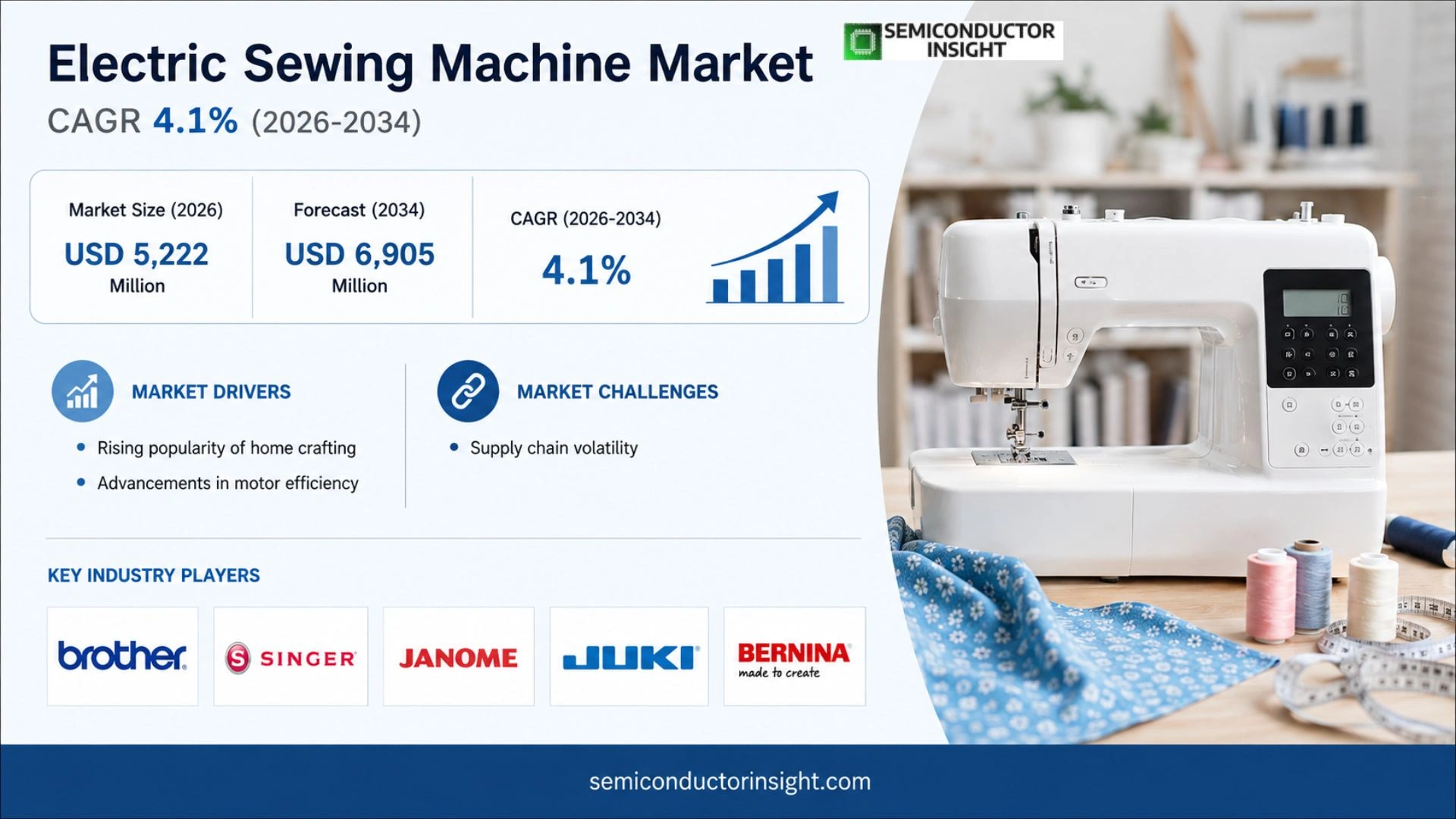
Global Electric Sewing Machine market is projected to grow from USD 5,222 million in 2026 to USD 6,905 million by 2034, exhibiting a CAGR of 4.1% during the forecast period.
Electric sewing machines are devices powered by electric motors and controlled electronically or mechanically to perform sewing operations. They serve home users, light‑commercial workshops and industrial production lines, ranging from compact household models to high‑speed multi‑needle industrial equipment that can integrate computer control, servo drives and pattern‑sewing functions.
The market is experiencing growth because DIY crafting culture has revived, online tutorials stimulate hobbyist purchases and small‑scale textile businesses expand in emerging economies. In developed regions, demand for computer‑controlled high‑end machines rises due to programmable stitching modes and LCD interfaces. Meanwhile, e‑commerce platforms dominate distribution channels, prompting brands to invest in digital marketing and after‑sales service. Challenges arise from price competition in low‑end segments, rising repair costs and entry barriers for new manufacturers lacking extensive channel networks.
MARKET DRIVERS
Consumer Shift Toward Home Crafting
Electric Sewing Machine Market benefits from a noticeable rise in hobbyist activity, as more households allocate discretionary income to DIY garment and textile projects. This cultural pivot is reinforced by social‑media platforms that showcase personalized fashion, prompting retailers to stock more compact, user‑friendly models that cater to beginners and seasoned crafters alike.
Advancements in Motor Efficiency
Recent innovations in brushless motor design have trimmed energy consumption by roughly 15 % while delivering smoother stitch quality. Manufacturers that integrate these motors can charge a premium, yet the incremental cost is offset by lower operating expenses, making Electric Sewing Machine Market attractive to both commercial workshops and home users seeking long‑term savings.
➤ Manufacturers that combine IoT connectivity with energy‑efficient motors are positioning themselves at the forefront of the market’s evolution.
Together, lifestyle changes and technology upgrades create a virtuous cycle: heightened demand fuels further R&D, which in turn delivers products that deepen consumer engagement across Electric Sewing Machine Market.
MARKET CHALLENGES
Supply Chain Volatility
Global component shortages, particularly for electronic control boards, have introduced lead‑time extensions of up to eight weeks. This bottleneck forces brand owners to balance inventory levels against cash flow constraints, limiting the speed at which new models can reach shelves.
Other Challenges
Pricing Pressure
As low‑cost imports flood entry‑level segments, premium manufacturers experience margin compression. Competing on features alone is insufficient; firms must differentiate through service ecosystems, such as extended warranties or virtual training modules, to preserve profitability in Electric Sewing Machine Market.
Regulatory scrutiny over electronic waste disposal adds another layer of complexity, compelling firms to redesign end‑of‑life programs while maintaining cost competitiveness.
MARKET RESTRAINTS
Limited Access to Skilled Service Networks
Even as product sophistication rises, many regions lack qualified technicians capable of diagnosing motor or software faults. This service gap discourages potential buyers who fear prolonged downtime, thereby tempering adoption rates.
The scarcity of localized parts distributors forces end‑users to rely on centralized hubs, increasing shipping costs and diminishing the perceived value proposition of higher‑priced units within Electric Sewing Machine Market.
Additionally, strict safety certification requirements in key markets can delay product launches, especially for manufacturers seeking to introduce cutting‑edge electronic features.
MARKET OPPORTUNITIES
Integration of Smart Fabric Management
Embedding sensors that monitor thread tension, fabric type, and stitch consistency opens a pathway to subscription‑based analytics services. Companies that pioneer such ecosystems can capture recurring revenue while providing users actionable insights, thereby expanding the overall addressable size of Electric Sewing Machine Market.
Emerging economies, where urbanization fuels a growing middle class, present untapped demand for affordable yet feature‑rich machines. Tailoring product portfolios to local price points and offering multilingual digital guides could accelerate market penetration in these regions.
Electric Sewing Machine Market Trends
Automation and Smart Controls
Electric Sewing Machine Market is undergoing a shift toward integrated electronic control systems. Manufacturers are embedding servo drives and programmable logic that enable precise stitch regulation and reduced vibration. This transition improves throughput in small workshops and enhances user confidence in home environments. The rise of DIY crafting platforms has created demand for machines that can store pattern libraries and adapt to variable fabric thickness without manual recalibration. Consequently, suppliers that invest in firmware upgrades and cloud‑based design downloads are capturing a growing share of the segment, as customers value the convenience of updating functionality without purchasing new hardware. These capabilities also open opportunities for subscription‑based services, allowing brands to monetize software enhancements over the product lifecycle. Additionally, the ability to synchronize multiple needles via a single controller simplifies complex stitching tasks, making high‑precision applications accessible to small‑scale producers.
Other Trends
E‑Commerce Distribution Channels
Online retail has supplanted traditional dealer networks for Electric Sewing Machine Market. Brands are leveraging targeted digital campaigns and influencer collaborations to reach hobbyists and micro‑manufacturers alike. Fast‑shipping logistics combined with virtual product demos reduce purchase friction, especially in regions where brick‑and‑mortar presence is limited. As a result, companies that streamline after‑sales support through remote diagnostics and spare‑part kiosks are experiencing higher repeat‑purchase rates. The data collected from e‑commerce platforms also informs product development, allowing rapid iteration based on real‑time consumer feedback. Furthermore, the emergence of augmented‑reality fitting tools enables users to visualize finished garments before stitching, reinforcing confidence in online purchases.
Sustainability and Material Innovation
Environmental considerations are reshaping product design within Electric Sewing Machine Market. Engineers are substituting conventional motor housings with recyclable polymers and optimizing energy consumption through low‑power standby modes. Such measures address regulatory pressure in Europe and growing consumer awareness in North America. Simultaneously, the integration of lightweight aluminum frames reduces shipping weight, lowering carbon emissions per unit. Manufacturers that communicate these green attributes through transparent labeling gain credibility, which translates into premium pricing power in affluent segments. The convergence of sustainability and advanced functionality suggests that future growth will be anchored in both ecological responsibility and technological differentiation. The shift toward modular designs also facilitates refurbishment, extending product lifespan and aligning with circular‑economy principles embraced by many retailers.
COMPETITIVE LANDSCAPE
Key Industry Players
Electric Sewing Machine Market – Competitive Overview
The upper tier of Electric Sewing Machine market is anchored by a handful of globally recognized manufacturers that have leveraged extensive distribution networks and advanced servo‑drive technology to secure premium positioning. Brother and Juki dominate the industrial‑grade segment, each offering multi‑needle, computer‑controlled platforms that cater to high‑volume garment factories in East Asia and Europe. Their ability to integrate real‑time diagnostics with cloud‑based service portals has raised entry barriers for newcomers. SVP Worldwide, operating under the Singer, Husqvarna Viking and Pfaff banners, enjoys a commanding share of the home‑craft space, where programmable stitch libraries and LCD interfaces drive consumer preference. The concentration of revenue among these three groups creates a stable oligopoly, yet they remain vigilant, continuously refreshing product roadmaps to address rising expectations for silent operation and energy efficiency.
Beyond the dominant trio, a diverse set of niche players sustains the market’s breadth by addressing regional tastes and specialized applications. Bernina and Janome retain loyal followings in Europe and Japan through precision engineering and a strong emphasis on quilting and embroidery functionalities. Pegasus and Baby Lock concentrate on mid‑range home users, differentiating themselves with ergonomic designs and bundled accessories. Barudan and ZSK are entrenched in heavy‑duty industrial segments, supplying multi‑head machines to automotive and upholstery manufacturers. Companies such as HappyJapan, Feiyue, and Shang Gong Group focus on cost‑competitive models for emerging markets, leveraging local supply chains to keep price points attractive. This layered competitive fabric ensures that while the top tier chases high‑value innovation, smaller firms capture growth pockets in developing economies and specialty niches.
List of Key Electric Sewing Machine Companies Profiled
- Brother Industries
- Juki Corporation
- SVP Worldwide (Singer, Husqvarna Viking, Pfaff)
- Janome
- Bernina International
- Pegasus
- Baby Lock
- Barudan
- ZSK
- HappyJapan
- Feiyue
- Shang Gong Group
- Yuelong Sewing Equipment
Segment Analysis:
| Segment Category | Sub-Segments | Key Insights |
| By Type |
|
Single Needle
|
| By Application |
|
Household
|
| By End User |
|
Home Hobbyists
|
| By Technology |
|
Smart IoT‑Enabled
|
| By Distribution Channel |
|
Online E‑commerce
|
Regional Analysis: Electric Sewing Machine Market
Asia-Pacific
Heavy‑investment corridors in Guangdong and Tamil Nadu have integrated robotic assembly cells, reducing cycle time and enabling rapid SKU turnover. The proximity of component suppliers shortens lead‑times, allowing brands to respond to fleeting fashion trends with customized motor speeds and stitch settings.
Young families are gravitating toward compact, noise‑reduced machines that can be stored in apartments. This has spurred a niche segment of ultra‑lightweight units equipped with Bluetooth connectivity, catering to a tech‑savvy demographic that values convenience over raw power.
Recent disruptions highlighted the importance of diversified logistics hubs. Companies are now routing critical motor components through Singapore and Busan, mitigating the impact of port congestions and ensuring steady inventory for OEM partners across the region.
Energy‑efficiency standards introduced by the Asian Energy Agency have forced manufacturers to adopt high‑efficiency brushless motors, reducing electricity consumption per stitch and aligning product portfolios with emerging sustainability expectations.
North America
In North America, Electric Sewing Machine market is anchored by a mature consumer segment that values durability and advanced feature sets. Professional tailors and boutique designers demand high‑torque machines capable of handling heavy fabrics, prompting brands to offer modular upgrades such as interchangeable feed dogs and precision needle controls. At the same time, the DIY community, fueled by streaming tutorials and maker‑space cultures, seeks user‑friendly interfaces with intuitive touchscreens. This dichotomy forces manufacturers to maintain parallel product lines, balancing robust industrial specs with sleek home‑use aesthetics. Retail channels are increasingly digital, with e‑commerce platforms providing detailed video demos that influence purchase decisions more than in‑store displays.
Europe
European buyers exhibit a pronounced preference for machines that combine heritage craftsmanship with modern automation. Countries like Germany and Italy, renowned for textile heritage, prioritize precision stitching and ergonomic design, often integrating programmable stitch libraries that sync with CAD patterns. Sustainability directives across the EU have accelerated the shift toward recyclable polymer housings and low‑noise motors, compelling manufacturers to certify products under the EU Eco‑Design framework. Additionally, collaborative partnerships between machine makers and fashion institutes are spawning limited‑edition models that serve as both educational tools and status symbols within the creative community.
South America
The South American landscape is shaped by a growing informal sector that leverages electric sewing machines to add value to raw textiles. Entrepreneurs in Brazil and Colombia are converting traditional tailoring shops into semi‑automated micro‑factories, emphasizing machines that offer quick thread changes and multi‑needle capability. Price sensitivity remains a core driver, so manufacturers who can bundle accessories,such as foot pedals and interchangeable presser feet,at competitive rates gain an edge. Emerging fintech solutions are also influencing purchasing patterns, enabling small businesses to finance equipment through micro‑loan platforms.
Middle East & Africa
In the Middle East and Africa, the market is transitioning from a reliance on imported manual units to locally assembled electric models. Government initiatives that promote vocational training in textile manufacturing have sparked demand for machines that can accommodate both novice students and experienced artisans. Brands that establish regional service hubs benefit from reduced downtime, a critical factor in markets where spare‑part lead times can be lengthy. Moreover, the rise of modest fashion lines is prompting a niche demand for machines capable of intricate embroidery and delicate stitch tension, aligning product development with culturally specific design trends.
Report Scope
This market research report provides a comprehensive analysis of the Electric Sewing Machine Market , covering the forecast period 2026–2034. It offers detailed insights into market dynamics, technological advancements, competitive landscape, and key trends shaping the industry.
Key focus areas of the report include:
- Market Overview: The report begins with an overview outlining its current market scenario, key growth indicators, and industry transformation drivers. It discusses macroeconomic factors, demand–supply balance, regulatory landscape, and the strategic role of semiconductors in powering advancements across industries such as automotive, telecommunications, consumer electronics, and industrial automation.
- Market Size & Forecast: Historical data and future projections for revenue, unit shipments, and market value across major regions and segments.
- Segmentation Analysis: Detailed breakdown by product type, technology, application, and end-user industry to identify high-growth segments and investment opportunities.
- Regional Insights: Insights into market performance across North America, Europe, Asia-Pacific, Latin America, and the Middle East & Africa, including country-level analysis where relevant.
- Competitive Landscape: Profiles of leading market participants, including their product offerings, R&D focus, manufacturing capacity, pricing strategies, and recent developments such as mergers, acquisitions, and partnerships.
- Technology Trends & Innovation: Assessment of emerging technologies, integration of AI/IoT, semiconductor design trends, fabrication techniques, and evolving industry standards.
- Market Drivers & Restraints: Evaluation of factors driving market growth along with challenges, supply chain constraints, regulatory issues, and market-entry barriers.
- Stakeholder Insights: Insights for component suppliers, OEMs, system integrators, investors, and policymakers regarding the evolving ecosystem and strategic opportunities.
Primary and secondary research methods are employed, including interviews with industry experts, data from verified sources, and real-time market intelligence to ensure the accuracy and reliability of the insights presented.
FREQUENTLY ASKED QUESTIONS:
What is the current market size of Electric Sewing Machine Market?
-> Electric Sewing Machine market is projected to grow from USD 5,222 million in 2026 to USD 6,905 million by 2034, exhibiting a CAGR of 4.1%
Which key companies operate in Electric Sewing Machine Market?
-> Key players include Tajima, Brother, Juki Corporation, Toyota, Gemsy, SVP Worldwide (Jaguar, Singer, Husqvarna Viking, PFAFF), SunStar, Janome, Bernina, Pegasus, Baby Lock, Barudan, ZSK, HappyJapan, Feiyue, Jack, ZOJE, Shang Gong Group, Typical, Maqi, MAX, Feiya, Jingwei Electronic, Yuelong Sewing Equipment, Xinsheng Sewing Equipment, Feiying Electric Machinery, Shenshilei Group, Maya.
What are the key growth drivers?
-> Key growth drivers include the resurgence of DIY home crafting culture, the popularity of online sewing tutorials, rising demand from light commercial and small‑scale workshop production, improved household incomes in developing countries, and the expansion of e‑commerce channels that strengthen brand‑consumer engagement.
Which region dominates the market?
-> Asia, led by China, dominates Electric Sewing Machine market, accounting for the largest share of global sales and revenue.
What are the emerging trends?
-> Emerging trends include the shift from mechanical to electronic control and servo‑drive technology, integration of multi‑needle and multi‑head configurations, incorporation of smart/AI‑enabled functions, and growing connectivity with IoT platforms for enhanced user experience.

Get Sample Report PDF for Exclusive Insights
Report Sample Includes
- Table of Contents
- List of Tables & Figures
- Charts, Research Methodology, and more...
 Download Sample Report PDF