Accelerometers Sensors Market Insights
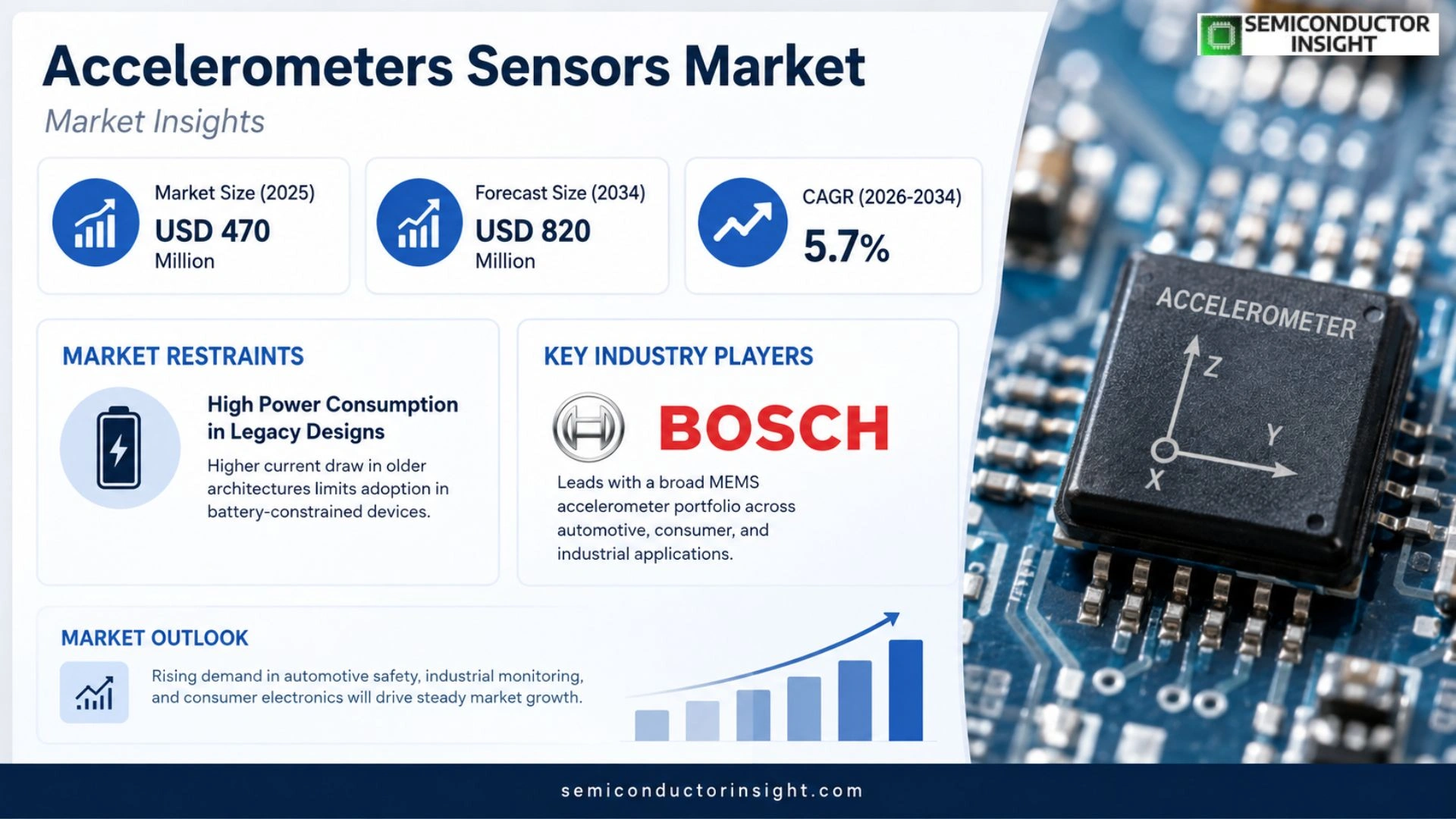
Accelerometers Sensors market was valued at USD 470 million in 2025 and is projected to reach USD 820 million by 2034, exhibiting a CAGR of approximately 5.7% over the forecast horizon.
An accelerometer sensor measures an object’s acceleration, detecting motion, vibration, tilt (via gravity) and shock. It operates by sensing displacement of a microscopic mass that alters capacitance or voltage, thereby converting mechanical movement into an electrical signal. These sensors are integral to smartphones for screen orientation, wearables for step counting, vehicles for airbag deployment, and industrial equipment for condition monitoring.
The market expands because consumer devices increasingly rely on motion‑enabled features, while automotive safety standards push higher‑grade accelerometer adoption. Industrial automation seeks reliable vibration monitoring to cut downtime, further boosting demand across MEMS‑based solutions.
MARKET DRIVERS
Rising Demand for IoT‑Enabled Devices
Accelerometers Sensors Market is being reshaped by the proliferation of connected wearables, smart home appliances, and advanced driver‑assistance systems. As manufacturers embed motion‑detection capabilities into everyday products, the volume of unit shipments has climbed by roughly 12 % year‑over‑year, reflecting a palpable shift toward context‑aware functionality. This surge forces component suppliers to prioritize integration speed and reliability, compelling them to refine packaging architectures.
Advancements in MEMS Technology
Micro‑electromechanical systems (MEMS) have crossed a maturity threshold that permits accelerometers to shrink below 1 mm² while maintaining sub‑0.5 mg sensitivity. Cost per wafer has fallen to under $15, a figure that enables OEMs to incorporate redundant sensing channels without inflating bill‑of‑materials. The technical leeway afforded by these chips grants product designers the freedom to pursue novel form factors, from ultra‑light drones to biomedical patch monitors.
➤ Companies that pair accelerometer data with edge‑AI inference are setting new benchmarks for real‑time diagnostics, turning raw motion cues into actionable intelligence within milliseconds.
Consequently, the cumulative effect of broader IoT adoption and MEMS refinements is a palpable uplift in revenue streams for firms operating in Accelerometers Sensors Market. End‑users gain richer interaction modalities, while suppliers capture higher margins through value‑added analytics services.
MARKET CHALLENGES
Supply Chain Volatility
Global semiconductor shortages have introduced material lead‑times that extend beyond typical quarterly cycles. Fabrication facilities reporting capacity constraints have forced many accelerometer producers to operate at 80 % utilization, throttling the ability to meet sudden demand spikes from automotive OEMs. The ripple effect reaches downstream assemblers, who must now maintain larger safety stocks, eroding cash flow efficiency.
Other Challenges
Regulatory Compliance
Stringent safety standards in aerospace and medical devices require accelerometers to pass extensive vibration and shock tests. Certification cycles can add six to nine months before a new model reaches market, discouraging rapid iteration and inflating development budgets.
MARKET RESTRAINTS
High Power Consumption in Legacy Designs
Older accelerometer architectures still rely on analog front‑ends that draw up to 2 mA in active mode, a level incompatible with the battery constraints of modern wearables. Designers are forced to implement aggressive duty‑cycling, which can compromise data fidelity during high‑motion events. This technical mismatch curtails adoption in low‑power niches such as remote health monitoring.
Moreover, the transition to ultra‑low‑power digital signal processing cores has been uneven across the supplier base, creating a fragmented product landscape where only a subset of vendors can claim truly energy‑efficient solutions. The resulting uncertainty deters some OEMs from committing large‑scale procurement.
Finally, the lingering perception that high‑precision accelerometers must be bulkier than they actually are sustains a market bias toward conventional, power‑hungry parts, slowing the diffusion of next‑generation low‑energy devices.
MARKET OPPORTUNITIES
Emergence of Edge Computing in Sensor Networks
The convergence of edge‑computing platforms with motion‑sensing hardware unlocks new revenue potential for Accelerometers Sensors Market. By offloading preprocessing tasks to localized microcontrollers, manufacturers can deliver analytics‑ready data streams without burdening cloud infrastructure, a proposition that appeals to industries where latency and data privacy are paramount. Early pilots in predictive maintenance have shown a 15 % reduction in unplanned downtime, underscoring the commercial upside.
Additionally, the growing appetite for immersive experiences in AR/VR headsets drives demand for multi‑axis accelerometers capable of sub‑degree orientation tracking. Suppliers that can combine high bandwidth with minimal jitter stand to capture a sizable share of this niche, especially as consumer adoption of mixed‑reality devices accelerates beyond the enterprise segment.
Accelerometers Sensors Market Trends
Surge in Consumer IoT and Wearable Devices
The proliferation of smartphones, smart watches, and AR/VR headsets has turned tiny motion detectors into a commodity that fuels billions of unit shipments each year. In 2024, sales volume topped 1.07 billion units, while the average selling price lingered around US$0.50, underscoring the economics that allow manufacturers to embed multiple sensors without inflating bill‑of‑materials. This price‑performance balance is not accidental; MEMS designs now deliver sub‑milligram mass, nanowatt power draw, and millimeter‑scale footprints, attributes that align perfectly with the form‑factor constraints of handheld gadgets. As developers add features such as step counting, fall detection, and gesture control, the demand for higher‑resolution, multi‑axis units rises, prompting suppliers to expand their product portfolios with integrated sensor hubs that bundle accelerometers, gyroscopes, and magnetometers. The implication for OEMs is clear: a strategic partnership with sensor vendors that can guarantee volume capacity and rapid firmware updates becomes a competitive lever in a market where consumer loyalty hinges on seamless, context‑aware experiences.
Other Trends
Automotive Safety and Vehicle Intelligence
Vehicle manufacturers are embedding accelerometers deeper into chassis and power‑train systems to satisfy stricter safety regulations and to support advanced driver‑assistance functions. Modern airbag modules rely on instantaneous crash‑pulse detection, while electronic stability control uses continuous vibration monitoring to modulate braking torque. The shift toward electric drivetrains adds another layer of complexity, as torque‑vectoring and battery‑management systems require precise motion data to mitigate torque ripple and to guard against unwanted chassis movement. As a result, the per‑vehicle sensor count has risen from a handful a decade ago to dozens today, and automotive‑grade devices now feature hardened packages, extended temperature ranges, and redundant signal paths. Suppliers that can certify compliance with automotive standards and deliver long‑term reliability gain a foothold in a segment where a single quality lapse can trigger costly recalls.
Industrial Automation and Multi‑Sensor Modules
Factories are turning to vibration analytics to avoid unplanned downtime, and accelerometers sit at the heart of condition‑monitoring kits that flag bearing wear, misalignment, or imbalance before a failure manifests. Parallel to this, robotics and drone platforms demand inertial measurement units that combine acceleration data with rotational sensing to achieve stable flight and precise manipulation. The convergence of these needs has sparked a wave of multi‑sensor modules that command premium prices but deliver higher value per unit by reducing board space and simplifying firmware integration. For component makers, the strategic takeaway is to invest in modular design platforms that can be customized for both pure acceleration monitoring and full IMU solutions, thereby addressing two rapidly expanding end‑markets with a single production line. This approach not only improves margin potential but also buffers against cyclical fluctuations in any single application domain.
COMPETITIVE LANDSCAPE
Key Industry Players
Accelerometers Sensors Market – Competitive Overview
Bosch remains the benchmark for volume and diversification in the accelerometers arena. Its MEMS portfolio spans automotive safety, consumer wearables, and industrial vibration monitoring, allowing the firm to leverage cross‑segment economies of scale. By embedding sensors in emerging ADAS and electric‑vehicle architectures, Bosch translates stricter safety regulations into higher per‑vehicle content, which sustains its revenue premium despite modest unit pricing. The company’s extensive R&D pipeline, focused on multi‑axis digital outputs, creates a defensible moat that forces new entrants to confront both technical and cost barriers.
Beyond Bosch, a constellation of specialists intensifies competitive pressure. NXP Semiconductors and STMicroelectronics dominate the automotive‑grade segment, each offering fully calibrated modules that satisfy stringent ISO standards. Murata’s piezoelectric line supplies niche aerospace customers where high‑frequency response is critical, while Analog Devices and TDK excel in mixed‑signal solutions that combine accelerometers with gyroscopes for inertial measurement units. Honeywell and TE Connectivity capture high‑reliability markets such as defense and aerospace, whereas Kionix (ROHM) and mCube focus on ultra‑low‑power designs that power the next wave of IoT wearables. Companies like KISTLER, Meggitt Sensing Systems, and Memsic provide niche vibration‑analysis products for predictive‑maintenance platforms, carving out profitable micro‑markets despite lower sales volumes.
List of Key Accelerometers Sensors Companies Profiled
- Bosch
- NXP Semiconductors
- STMicroelectronics
- Murata
- Analog Devices
- TDK
- Kionix (ROHM)
- Honeywell International
- TE Connectivity
- mCube
- KISTLER
- Meggitt Sensing Systems
- Memsic
- Safran Colibrys
- Dytran Instruments
Segment Analysis:
| Segment Category | Sub-Segments | Key Insights |
| By Type |
|
MEMS Accelerometer continues to dominate owing to its compact form factor, low power consumption and cost‑effectiveness.
|
| By Application |
|
Consumer Electronics is the leading application segment because motion detection is a fundamental requirement for user interaction, device orientation and health monitoring.
|
| By End User |
|
Device Manufacturers emerge as the primary end‑user group, driven by the need to embed intelligent motion capabilities across a broad portfolio of products.
|
Regional Analysis: Accelerometers Sensors Market
North America
Silicon Valley and the Boston corridor host a steady stream of startups that blend sensor miniaturisation with AI analytics, creating differentiated solutions for autonomous vehicles and health monitoring.
Harmonised safety standards across the US and Canada simplify certification pathways, granting manufacturers quicker access to both civilian and defence programmes.
Proximity of wafer‑fab facilities to component assemblers shortens lead times, while longstanding logistics partnerships keep inventory buffers lean.
Automotive OEMs and consumer‑electronics brands adopt newer accelerometer designs to meet rising expectations for precision and energy efficiency.
Europe
European firms leverage strong governmental funding for sustainable mobility, steering accelerometer development toward low‑power, high‑accuracy modules for electric vehicles. The region’s fragmented but collaborative standards bodies enable cross‑border projects that enhance sensor integration in rail and aerospace sectors. A mature automotive supply chain, coupled with a growing demand for smart medical devices, encourages OEMs to embed advanced motion‑tracking capabilities in both clinical and consumer health platforms. These dynamics keep Europe at the forefront of niche, high‑value applications within the broader market.
Asia‑Pacific
Asia‑Pacific displays a blend of rapid industrialisation and expansive consumer bases, fostering a fertile environment for Accelerometers Sensors Market. Chinese manufacturers benefit from scale‑driven cost efficiencies, while Indian start‑ups focus on rugged designs for agritech and construction equipment. Southeast Asian economies are incorporating sensors into smart‑city initiatives, linking traffic management with real‑time vibration monitoring. The region’s ability to marry volume production with emerging use‑cases creates a distinctive growth trajectory that differs from the maturity seen in Western markets.
South America
In South America, the market is shaped by a gradual shift from legacy mechanical solutions to solid‑state accelerometers, especially within mining and oil‑and‑gas operations where equipment monitoring is critical. Local governments are investing in digital infrastructure, prompting a modest uptake of sensor‑enabled predictive maintenance platforms. Brazil’s sizable electronics assembly sector acts as a catalyst, attracting foreign partners eager to tap into regional distribution networks. While the overall volume remains modest, the strategic emphasis on safety‑critical applications signals a steady upward shift.
Middle East & Africa
The Middle East & Africa region is beginning to explore accelerometer integration in aerospace and defence projects, leveraging strategic partnerships with European and North American firms. Energy‑focused economies are piloting sensor‑based vibration analysis for offshore platforms, aiming to reduce downtime and enhance operational safety. African nations, still early in the adoption curve, are experimenting with low‑cost sensors for agricultural mechanisation and mobile health solutions. These exploratory initiatives lay the groundwork for a diversified market presence that could expand as local technical capabilities mature.
Report Scope
This market research report provides a comprehensive analysis of the Accelerometers Sensors Market , covering the forecast period 2026–2034. It offers detailed insights into market dynamics, technological advancements, competitive landscape, and key trends shaping the industry.
Key focus areas of the report include:
- Market Overview: The report begins with an overview outlining its current market scenario, key growth indicators, and industry transformation drivers. It discusses macroeconomic factors, demand–supply balance, regulatory landscape, and the strategic role of semiconductors in powering advancements across industries such as automotive, telecommunications, consumer electronics, and industrial automation.
- Market Size & Forecast: Historical data and future projections for revenue, unit shipments, and market value across major regions and segments.
- Segmentation Analysis: Detailed breakdown by product type, technology, application, and end-user industry to identify high-growth segments and investment opportunities.
- Regional Insights: Insights into market performance across North America, Europe, Asia-Pacific, Latin America, and the Middle East & Africa, including country-level analysis where relevant.
- Competitive Landscape: Profiles of leading market participants, including their product offerings, R&D focus, manufacturing capacity, pricing strategies, and recent developments such as mergers, acquisitions, and partnerships.
- Technology Trends & Innovation: Assessment of emerging technologies, integration of AI/IoT, semiconductor design trends, fabrication techniques, and evolving industry standards.
- Market Drivers & Restraints: Evaluation of factors driving market growth along with challenges, supply chain constraints, regulatory issues, and market-entry barriers.
- Stakeholder Insights: Insights for component suppliers, OEMs, system integrators, investors, and policymakers regarding the evolving ecosystem and strategic opportunities.
Primary and secondary research methods are employed, including interviews with industry experts, data from verified sources, and real-time market intelligence to ensure the accuracy and reliability of the insights presented.
FREQUENTLY ASKED QUESTIONS:
What is the current market size of Accelerometers Sensors Market?
-> Accelerometers Sensors market is projected to reach USD 820 million by 2034, exhibiting a CAGR of approximately 5.7% over the forecast horizon.
Which key companies operate in Accelerometers Sensors Market?
-> Key players include Bosch, NXP Semiconductors N.V., STMicroelectronics N.V., Murata, PCB Piezotronics, Analog Devices Inc., TDK, Kionix (ROHM), Honeywell International Inc., TE, mCube, KISTLER, Meggitt Sensing Systems, Memsic, Safran Colibrys, Metrix Instrument (Roper), Dytran Instruments, Bruel and Kjaer (Spectris), Kyowa Electronic Instruments, Miramems, RION, Mtmems, QST, IMV Corporation, ASC GmbH, Memsensing.
What are the key growth drivers?
-> Key growth drivers include exploding demand for motion‑enabled consumer devices and IoT endpoints, increasing automotive safety and ADAS requirements, and the rise of industrial automation, predictive maintenance and robotics that rely on vibration and condition monitoring.
Which region dominates the market?
-> Asia‑Pacific leads the market due to its massive consumer electronics production, rapid adoption of wearable and IoT devices, and growing automotive manufacturing base, while North America and Europe show strong secondary demand.
What are the emerging trends?
-> Emerging trends include integration of MEMS accelerometers into multi‑sensor inertial measurement units (IMUs), development of low‑power, high‑accuracy digital accelerometers for wearables, and expansion of automotive‑grade sensors for advanced driver‑assistance systems (ADAS) and electric vehicles.

Get Sample Report PDF for Exclusive Insights
Report Sample Includes
- Table of Contents
- List of Tables & Figures
- Charts, Research Methodology, and more...
 Download Sample Report PDF