MARKET INSIGHTS
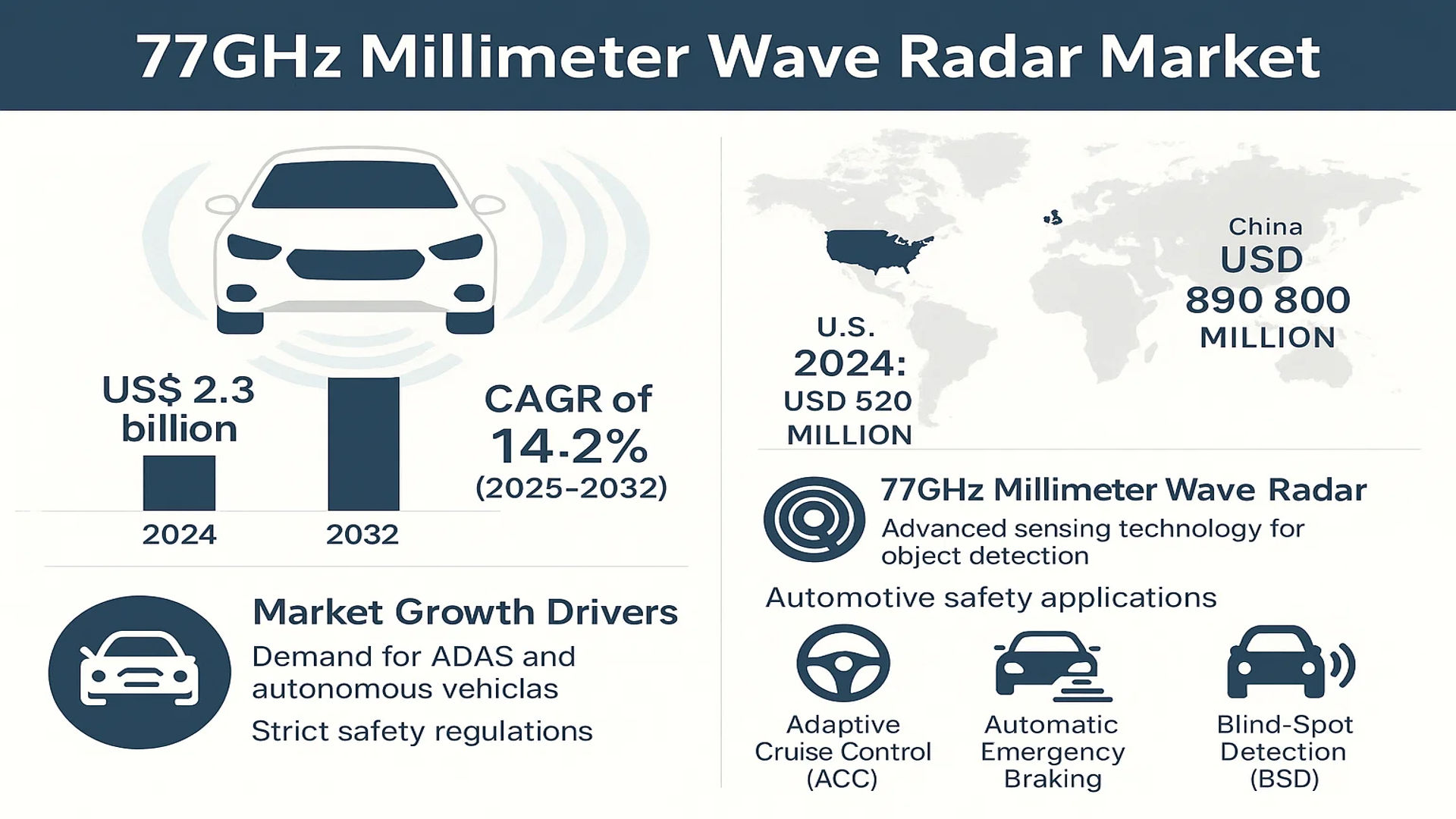
The global 77GHz Millimeter Wave Radar Market size was valued at US$ 2.3 billion in 2024 and is projected to reach US$ 6.7 billion by 2032, at a CAGR of 14.2% during the forecast period 2025-2032. The U.S. market is estimated at USD 520 million in 2024, while China is expected to account for USD 890 million by 2032, driven by rapid automotive industry growth.
77GHz millimeter wave radar is an advanced sensing technology that operates in the high-frequency spectrum, offering superior resolution and accuracy for object detection. These radar systems are widely used in automotive safety applications such as adaptive cruise control (ACC), automatic emergency braking (AEB), and blind-spot detection (BSD). The technology is gaining traction due to its ability to perform reliably in adverse weather conditions and provide precise measurements of distance, speed, and angle.
The market growth is propelled by increasing demand for advanced driver-assistance systems (ADAS) and autonomous vehicles, along with stringent government safety regulations. However, high development costs and complex integration challenges pose barriers to adoption. Leading manufacturers like Bosch, Continental, and Denso are investing heavily in R&D to improve performance and reduce costs. Recent collaborations between automakers and radar suppliers are accelerating commercialization, particularly in the passenger vehicle segment which accounted for over 65% of market share in 2024.
MARKET DYNAMICS
MARKET DRIVERS
Rise in Autonomous Vehicle Adoption to Fuel Demand for 77GHz Millimeter Wave Radar
The automotive industry’s rapid shift toward autonomous and semi-autonomous vehicles is a key driver for the 77GHz millimeter wave radar market. With regulatory bodies pushing for advanced driver assistance systems (ADAS) to enhance road safety, automakers are increasingly integrating high-resolution radar sensors. The 77GHz frequency band offers superior resolution and accuracy compared to legacy 24GHz systems, making it ideal for object detection, blind-spot monitoring, and emergency braking. Over 70% of new premium vehicles now incorporate at least one 77GHz radar unit, with mid-range models following suit as costs decline.
Stringent Safety Regulations Accelerate Market Penetration
Global safety mandates are compelling automakers to adopt collision avoidance technologies. The European New Car Assessment Programme (Euro NCAP) now awards higher safety ratings to vehicles equipped with autonomous emergency braking (AEB) systems using 77GHz radar. Similar regulations in North America and Asia-Pacific are creating a $2.8 billion annual addressable market for radar suppliers. This regulatory push is further amplified by insurers offering premium discounts for vehicles with certified ADAS features, driving consumer demand.
Furthermore, technological advancements in radar miniaturization and signal processing are enabling new applications beyond automotive. Industrial automation, drone navigation, and smart city infrastructure are emerging verticals where 77GHz radar’s all-weather performance provides distinct advantages over optical sensors.
MARKET RESTRAINTS
High Development Costs and Complexities Limit Market Expansion
While 77GHz radar technology offers superior performance, its development presents significant challenges. Designing compact antennas and high-frequency integrated circuits requires specialized semiconductor processes that can increase production costs by 30-40% compared to lower frequency alternatives. The need for stringent electromagnetic interference (EMI) shielding and precise calibration further drives up manufacturing expenses, particularly for long-range applications.
Other Constraints
Supply Chain Vulnerabilities
The global semiconductor shortage has disproportionately affected high-frequency components, with lead times for 77GHz radar chipsets extending beyond 50 weeks in some cases. This supply-demand imbalance creates production bottlenecks for automakers and Tier 1 suppliers.
Regulatory Fragmentation
Differing spectrum allocations across regions complicate global product strategies. While 76-77GHz is standardized in most markets, some countries impose power restrictions or require additional certification steps, increasing time-to-market for manufacturers.
MARKET OPPORTUNITIES
Emerging Industrial Applications Open New Growth Avenues
Beyond automotive uses, 77GHz radar is gaining traction in industrial automation for precise level monitoring, gesture recognition, and collision avoidance in robotics. The technology’s ability to operate reliably in dust, fog, or low-light conditions makes it preferable to optical sensors in harsh environments. Market leaders are developing compact radar modules priced below $50 to penetrate these high-volume applications.
Integration with 5G and Edge Computing Creates Synergies
The rollout of 5G networks enables real-time processing of radar data through edge computing nodes. This convergence allows distributed sensor networks for smart traffic management and perimeter security applications. Automotive radar chipsets are being redesigned with embedded AI processors to enable on-device object classification, reducing latency and bandwidth requirements.
MARKET CHALLENGES
Sensor Fusion Complexity Poses Integration Hurdles
Modern ADAS systems require seamless integration of radar with cameras and LiDAR, creating significant engineering challenges. Synchronizing multiple sensor modalities with sub-millisecond precision demands advanced time synchronization protocols and calibration algorithms. These complexities contribute to extended validation cycles and higher R&D expenditures for OEMs.
Other Challenges
Performance Limitations in Adverse Conditions
While superior to optical sensors in poor visibility, heavy rain can attenuate 77GHz signals by 8-12 dB/km, reducing effective range. Developing robust signal processing algorithms for such conditions remains an active research area.
Data Security Concerns
As radar systems incorporate more connectivity features, vulnerabilities to spoofing and jamming attacks have emerged. Implementing cybersecurity measures without compromising real-time performance presents ongoing design challenges.
77GHZ MILLIMETER WAVE RADAR MARKET TRENDS
Autonomous Vehicle Adoption Accelerates Market Expansion
The rapid development of autonomous vehicles has become a major driver for the 77GHz millimeter wave radar market, as this frequency band offers superior resolution and accuracy for Advanced Driver-Assistance Systems (ADAS). With sensing ranges extending up to 250 meters and angular accuracy within 0.1 degrees, 77GHz radar enables critical functions like adaptive cruise control and collision avoidance. Over 60% of new passenger vehicles in developed markets now incorporate some level of ADAS functionality, creating sustained demand for high-performance radar systems. While Level 4 autonomy remains in development, the incremental progression from driver assistance features to conditional automation continues to push technological boundaries in radar sensing.
Other Trends
Integration With Complementary Sensor Technologies
The automotive industry is increasingly adopting sensor fusion approaches that combine 77GHz radar with LiDAR and cameras for comprehensive environmental perception. This multi-modal approach addresses the limitations of individual sensing methods while leveraging radar’s all-weather reliability and long-range detection capabilities. The ability to detect objects through fog, dust, and rain—conditions where optical sensors struggle—makes 77GHz radar indispensable for safety-critical applications. Recent innovations in antenna design and signal processing have reduced the physical footprint of radar modules by nearly 40% since 2020, enabling more flexible vehicle integration alongside other sensing technologies.
Industrial Automation Applications Driving New Growth Areas
Beyond automotive applications, 77GHz millimeter wave radar is finding expanding use cases in industrial automation, particularly for precise object detection and collision avoidance in manufacturing environments. The technology’s ability to accurately measure distance and velocity at ranges up to 200 meters, along with immunity to environmental interference, makes it ideal for robotic guidance systems and automated material handling. Warehouse automation projects now account for approximately 15% of all new 77GHz radar deployments as e-commerce fulfillment centers seek reliable solutions for autonomous mobile robots. The superior penetration capabilities compared to infrared sensors allow these systems to maintain consistent performance in challenging industrial conditions with dust, steam, or variable lighting.
COMPETITIVE LANDSCAPE
Key Industry Players
Automotive and Technology Giants Lead the Charge in 77GHz Radar Innovation
The global 77GHz millimeter wave radar market features a highly competitive landscape dominated by established automotive suppliers and emerging technology specialists. Bosch currently leads the market with an estimated 22% revenue share in 2024, benefiting from its vertically integrated manufacturing capabilities and strategic partnerships with major automakers. Their radar systems are deployed in over 50 vehicle models globally, demonstrating strong market penetration across passenger and commercial vehicle segments.
Continental AG and Denso Corporation follow closely, collectively accounting for approximately 35% of the market. These companies have significantly invested in R&D for advanced driver assistance systems (ADAS), with Continental launching 12 new radar variants in 2023 alone. Their technological edge comes from proprietary signal processing algorithms that enable superior object detection in challenging weather conditions.
The competitive intensity is further heightened by Aptiv and ZF Friedrichshafen, who are aggressively expanding their product portfolios through both organic developments and strategic acquisitions. ZF’s 2023 acquisition of a Chinese radar specialist has notably strengthened its position in Asia-Pacific markets, where demand for 77GHz systems is growing at 18% annually.
Meanwhile, Japanese suppliers including Hitachi and Nidec Elesys are differentiating themselves through compact, low-power radar solutions optimized for electric vehicles. Their focus on energy efficiency addresses a critical need as automakers balance ADAS functionality with EV range requirements.
List of Key 77GHz Millimeter Wave Radar Companies Profiled
- Bosch GmbH (Germany)
- Continental AG (Germany)
- Hella GmbH (Germany)
- Denso Corporation (Japan)
- Veoneer (Sweden)
- Valeo SA (France)
- Aptiv PLC (Ireland)
- ZF Friedrichshafen AG (Germany)
- Hitachi Ltd. (Japan)
- Nidec Elesys Corporation (Japan)
- Cubtek Inc. (China)
- United Optoelectronics (China)
Segment Analysis:
By Type
Short Range Segment Dominates Due to Its Widespread Application in ADAS Systems
The market is segmented based on type into:
- Short Range
- Subtypes: Blind Spot Detection, Parking Assistance, and others
- Medium Range
- Long Range
- Subtypes: Adaptive Cruise Control, Collision Avoidance, and others
By Application
Passenger Vehicle Segment Leads Owing to Increasing Adoption of Safety Features
The market is segmented based on application into:
- Passenger Vehicle
- Subtypes: Sedans, SUVs, Hatchbacks, and others
- Commercial Vehicle
- Subtypes: Heavy Trucks, Buses, and others
By Technology
Multiple-Input Multiple-Output (MIMO) Technology Gains Traction for Improved Resolution
The market is segmented based on technology into:
- Multiple-Input Multiple-Output (MIMO)
- Single-Input Single-Output (SISO)
- Others
By Frequency Bandwidth
High Bandwidth Segment Expands with Growing Demand for Precise Detection
The market is segmented based on frequency bandwidth into:
- High Bandwidth
- Medium Bandwidth
- Low Bandwidth
Regional Analysis: 77GHz Millimeter Wave Radar Market
Asia-Pacific
The Asia-Pacific region dominates the global 77GHz millimeter wave radar market, driven by rapid advancements in autonomous driving technologies, government mandates for vehicle safety, and significant automotive production in China, Japan, and South Korea. China leads the region, accounting for over 40% of the global market share, owing to aggressive investments in intelligent transportation systems and strong local players like Huawei and Baidu entering the radar sensor space. Japan follows closely, with automotive giants such as Denso and Hitachi driving innovation in short-range radar applications for collision avoidance. However, price sensitivity in emerging economies like India creates challenges for high-end radar adoption, though increasing road safety regulations are gradually shifting demand.
North America
North America represents the second-largest market, with stringent NHTSA safety regulations and widespread ADAS adoption fueling demand. The U.S. accounts for nearly 80% of regional revenue, supported by technological leadership from companies like Aptiv and Texas Instruments. Short-range radar systems dominate passenger vehicle applications, while long-range variants gain traction in commercial trucks. Recent collaborations between radar manufacturers and Silicon Valley tech firms are accelerating the development of 4D imaging radar solutions, though high R&D costs pose barriers for smaller market entrants.
Europe
Europe maintains steady growth through rigorous Euro NCAP safety protocols and the presence of automotive Tier 1 suppliers like Bosch and Continental. Germany remains the technology hub, contributing approximately 35% of regional sales. The EU’s Vision Zero initiative promotes radar integration across all vehicle classes, creating uniform demand. While Western European markets showcase high penetration rates, Eastern Europe presents untapped potential, hindered currently by slower regulatory adoption. Environmental concerns about sensor interference are prompting manufacturers to develop more efficient signal processing algorithms.
Middle East & Africa
This emerging market shows gradual growth, primarily in premium vehicle segments and smart city infrastructure projects across the UAE and Saudi Arabia. Harsh climatic conditions pose technical challenges for radar reliability, encouraging localized product adaptations. Though currently representing less than 5% of global market share, strategic investments in autonomous shuttle programs and port automation indicate long-term growth potential. South Africa serves as a manufacturing outpost for global players, leveraging trade agreements to supply other African markets.
South America
Market development remains constrained by economic volatility and fragmented automotive safety regulations, with Brazil accounting for over 60% of regional demand. Localized production by global manufacturers aims to circumvent import barriers, while aftermarket installations gain popularity due to lower upfront costs compared to OEM solutions. Recent stability in Chile and Colombia has attracted radar suppliers for mining and industrial applications, diversifying beyond the automotive sector.
The 77GHz millimeter wave radar market demonstrates clear regional differentiation in adoption patterns and growth drivers. While Asia-Pacific leads in volume and innovation, mature markets emphasize regulatory compliance, and emerging regions focus on cost-optimized solutions. Global supply chain realignments post-pandemic are prompting manufacturers to establish regional production hubs, particularly in Southeast Asia and Eastern Europe, to balance technological sophistication with market accessibility.
Report Scope
This market research report provides a comprehensive analysis of the global and regional 77GHz Millimeter Wave Radar markets, covering the forecast period 2025–2032. It offers detailed insights into market dynamics, technological advancements, competitive landscape, and key trends shaping the industry.
Key focus areas of the report include:
- Market Size & Forecast: Historical data and future projections for revenue, unit shipments, and market value across major regions and segments. The global 77GHz Millimeter Wave Radar market was valued at US$ 2.3 billion in 2024 and is projected to reach US$ 6.7 billion by 2032, growing at a CAGR of 14.2%.
- Segmentation Analysis: Detailed breakdown by product type (Short Range, Medium Range, Long Range), application (Passenger Vehicle, Commercial Vehicle), and end-user industry to identify high-growth segments and investment opportunities. The Short Range segment is expected to dominate with 45% market share by 2032.
- Regional Outlook: Insights into market performance across North America (USD 380 million in 2024), Europe, Asia-Pacific (fastest growing at 13.1% CAGR), Latin America, and the Middle East & Africa, including country-level analysis where relevant. China accounts for 32% of the Asia-Pacific market.
- Competitive Landscape: Profiles of leading market participants including Bosch, Continental, Denso, and ZF, covering their product offerings (e.g., ARS540 radar system), R&D focus (autonomous driving applications), manufacturing capacity, pricing strategies, and recent developments such as mergers and acquisitions.
- Technology Trends & Innovation: Assessment of emerging technologies like 4D imaging radar, integration with ADAS systems, semiconductor design trends (SiGe vs. CMOS), and evolving industry standards (ISO 26262 functional safety).
- Market Drivers & Restraints: Evaluation of factors driving market growth (ADAS mandate expansions, autonomous vehicle development) along with challenges (high development costs, regulatory hurdles).
- Stakeholder Analysis: Insights for component suppliers, automotive OEMs, system integrators, investors, and policymakers regarding the evolving ecosystem and strategic opportunities in radar sensor networks.
Primary and secondary research methods are employed, including interviews with industry experts from Tier 1 automotive suppliers, data from verified market reports, and real-time market intelligence to ensure the accuracy and reliability of the insights presented.
FREQUENTLY ASKED QUESTIONS:
What is the current market size of Global 77GHz Millimeter Wave Radar Market?
-> 77GHz Millimeter Wave Radar Market size was valued at US$ 2.3 billion in 2024 and is projected to reach US$ 6.7 billion by 2032, at a CAGR of 14.2% during the forecast period 2025-2032.
Which key companies operate in Global 77GHz Millimeter Wave Radar Market?
-> Key players include Bosch, Continental, Denso, ZF, Valeo, Aptiv, and Hitachi, with the top 5 companies holding 68% market share in 2024.
What are the key growth drivers?
-> Key growth drivers include increasing ADAS adoption (present in 65% of new vehicles), autonomous vehicle development, and government safety regulations.
Which region dominates the market?
-> Asia-Pacific is the largest market (42% share), while North America shows the fastest growth due to autonomous vehicle testing.
What are the emerging trends?
-> Emerging trends include 4D imaging radar, radar-vision sensor fusion, and software-defined radar systems for advanced autonomous functions.

Get Sample Report PDF for Exclusive Insights
Report Sample Includes
- Table of Contents
- List of Tables & Figures
- Charts, Research Methodology, and more...
 Download Sample Report PDF