
60GHz Radar Sensor Chip Market Insights
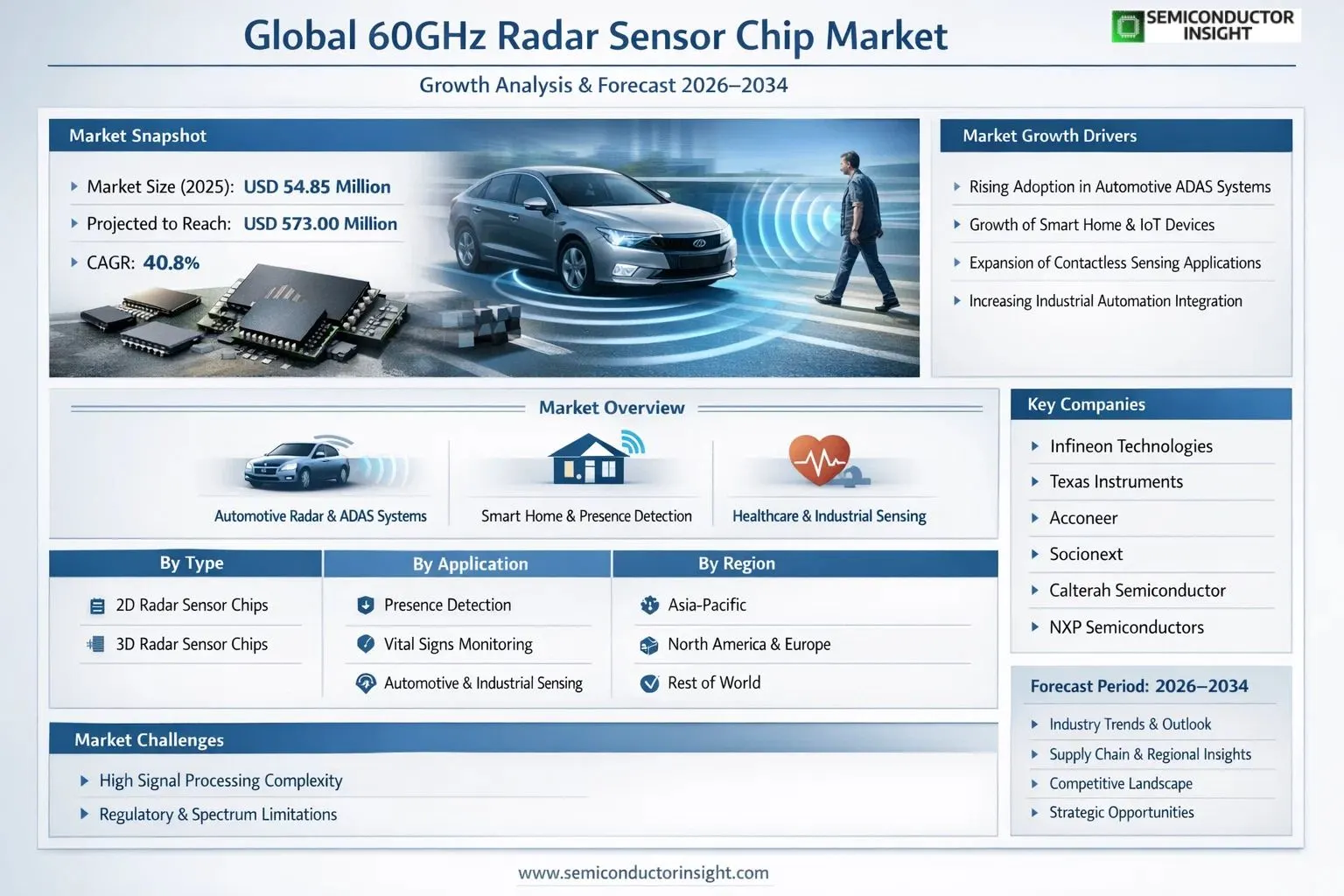
Global 60GHz Radar Sensor Chip market size was valued at USD 54.85 million in 2025. The market is projected to grow from USD 76.23 million in 2026 to USD 573.00 million by 2034, exhibiting a CAGR of 40.8% during the forecast period.
A 60GHz radar sensor chip is a compact electronic device that operates at a frequency of 60 gigahertz (GHz) and is engineered to detect objects, movements, distances, and a broad range of physical parameters using advanced radar technology. These chips integrate transmitter, receiver, and signal processing functions within a single semiconductor package, enabling high-resolution sensing in an exceptionally small form factor. They are widely adopted across diverse end-use sectors, including automotive safety systems, industrial automation, smart home devices, and healthcare monitoring applications such as contactless vital signs detection and presence sensing.
The market is witnessing remarkable momentum driven by the rapid proliferation of IoT-connected devices, growing emphasis on non-contact sensing technologies, and accelerating demand for advanced driver-assistance systems (ADAS). Furthermore, the expanding use of 60GHz radar sensor chips in smart building infrastructure and industrial robotics is broadening the addressable market considerably. Key manufacturers actively shaping the competitive landscape include Infineon Technologies, Texas Instruments, Acconeer, Socionext, Calterah, and Kaikutek, each offering differentiated product portfolios tailored to evolving application requirements across global markets.
MARKET DRIVERS
Rising Adoption of 60GHz Radar Sensor Chips in Automotive Safety Systems
The automotive industry remains one of the most significant growth catalysts for 60GHz radar sensor chip market. As global regulatory frameworks increasingly mandate advanced driver-assistance systems (ADAS), automakers are integrating 60GHz millimeter-wave radar sensor chips into collision avoidance, blind-spot detection, and adaptive cruise control systems. The ability of 60GHz radar technology to deliver high-resolution, short-range sensing with exceptional accuracy makes it well suited for in-cabin occupant monitoring and gesture recognition applications. The transition toward semi-autonomous and fully autonomous vehicles continues to amplify demand for these chips across passenger and commercial vehicle segments worldwide.
Expansion of Smart Home and Consumer Electronics Applications
Beyond automotive, the proliferation of smart home ecosystems is emerging as a powerful driver within 60GHz radar sensor chip market. Consumer electronics manufacturers are embedding 60GHz radar sensor chips into smart speakers, televisions, and home security devices to enable touchless gesture control, presence detection, and fall detection for elderly care. The growing penetration of the Internet of Things (IoT) across residential environments is accelerating the demand for compact, low-power, and highly integrated radar sensor chip solutions. As chipmakers develop increasingly miniaturized 60GHz radar modules, the cost-per-unit continues to decline, broadening accessibility across mid-range consumer product categories.
➤ The convergence of 60GHz radar sensor chip technology with artificial intelligence-based signal processing is enabling real-time, highly accurate human activity recognition, positioning the market for sustained long-term growth across diverse end-use verticals.
Industrial automation and smart manufacturing environments are further amplifying demand for 60GHz radar sensor chips. In factory settings, these chips support contactless level sensing, people counting, and proximity detection in environments where optical or ultrasonic sensors are limited by dust, moisture, or lighting conditions. The robustness of 60GHz millimeter-wave radar technology under adverse environmental conditions positions it as a preferred sensing modality for Industry 4.0 deployments. Government investments in smart infrastructure and industrial digitization programs across major economies are expected to provide sustained momentum for 60GHz radar sensor chip market through the coming years.
MARKET CHALLENGES
Technical Complexity in Signal Processing and Chip Integration for 60GHz Radar Systems
Despite strong growth potential, 60GHz radar sensor chip market faces notable technical challenges related to signal processing complexity and system integration. Operating at millimeter-wave frequencies requires sophisticated beamforming algorithms, high-speed analog-to-digital converters, and advanced signal processing architectures that demand significant engineering expertise. The tight integration of RF front-end components, baseband processing units, and antenna arrays within a single chip or compact module presents substantial design and manufacturing challenges. Achieving consistent performance across temperature variations and electromagnetic interference-prone environments remains a persistent engineering hurdle for chip designers targeting automotive-grade and industrial-grade qualification standards.
Other Challenges
Spectrum Regulatory Fragmentation
The 60GHz frequency band is subject to varying regulatory frameworks across different geographies, creating complexity for manufacturers seeking to develop globally deployable 60GHz radar sensor chip solutions. Differences in permissible transmission power levels, bandwidth allocations, and certification requirements between regulatory bodies such as the FCC, ETSI, and regional Asian authorities increase time-to-market and compliance costs for chip developers. This regulatory fragmentation particularly affects smaller market participants with limited resources for multi-regional certification processes.
High Development and Validation Costs
The development lifecycle for 60GHz radar sensor chips targeting safety-critical applications such as automotive ADAS involves extensive validation, testing, and compliance with functional safety standards including ISO 26262. These requirements drive substantial upfront investment in engineering resources, specialized test equipment, and long qualification cycles. For emerging players in 60GHz radar sensor chip market, competing against established semiconductor companies with deep R&D budgets and existing customer relationships presents a considerable barrier to commercial traction.
MARKET RESTRAINTS
Cost Sensitivity and Competition from Alternative Sensing Technologies
One of the primary restraints facing 60GHz radar sensor chip market is the cost sensitivity of high-volume consumer and industrial applications, where manufacturers evaluate radar solutions against lower-cost alternatives such as passive infrared (PIR) sensors, ultrasonic sensors, and camera-based vision systems. While 60GHz radar sensor chips offer superior all-weather performance and privacy-preserving sensing without capturing visual imagery, the higher bill-of-materials cost associated with millimeter-wave components can deter adoption in price-competitive market segments. This is particularly evident in entry-level smart home devices and low-cost industrial automation applications where procurement decisions are driven heavily by component cost rather than technical capability differentiation.
Supply Chain Constraints and Semiconductor Manufacturing Capacity Limitations
60GHz radar sensor chip market is also constrained by the specialized semiconductor manufacturing processes required for millimeter-wave chip production, including advanced CMOS and SiGe BiCMOS process nodes that are supported by a limited number of foundry partners globally. Geopolitical tensions affecting semiconductor supply chains, combined with ongoing capacity allocation competition across multiple chip categories, create procurement uncertainty for radar sensor chip manufacturers. These supply chain vulnerabilities can lead to extended lead times and component shortages that disrupt production schedules for OEMs integrating 60GHz radar sensor chips into automotive and industrial systems, thereby constraining near-term market expansion.
MARKET OPPORTUNITIES
Growing Demand for Contactless Vital Sign Monitoring and Healthcare Sensing Applications
The healthcare sector presents a compelling and largely underpenetrated opportunity for 60GHz radar sensor chip market. The capability of 60GHz millimeter-wave radar to detect subtle micro-movements associated with respiratory rate, heart rate, and sleep pattern monitoring without physical contact or wearable devices is attracting significant interest from medical device developers and digital health platform providers. As aging populations in developed economies drive demand for remote patient monitoring and in-home health management solutions, 60GHz radar sensor chips are being evaluated for integration into smart beds, hospital room monitoring systems, and telehealth infrastructure. This application segment offers a high-value growth pathway that is distinctly different from the more competitive consumer electronics and automotive end-markets.
Integration with 5G Infrastructure and Smart City Deployments
The accelerating global rollout of 5G networks and smart city infrastructure initiatives is creating new deployment opportunities for 60GHz radar sensor chips in traffic management, crowd analytics, perimeter security, and urban mobility sensing systems. Municipal governments and telecommunications operators are exploring the co-deployment of millimeter-wave radar sensing nodes alongside 5G small cell infrastructure to enable real-time environmental awareness without the privacy concerns associated with video-based surveillance. The alignment of the 60GHz frequency band with the broader millimeter-wave ecosystem being developed for next-generation wireless communications further strengthens the long-term strategic relevance of 60GHz radar sensor chip technology within smart infrastructure frameworks. Vendors capable of delivering scalable, standards-compliant radar sensor chip platforms are well positioned to capture a meaningful share of this emerging opportunity.
Trends
Rising Adoption Across Automotive and Industrial Applications Drives 60GHz radar sensor chip market
60GHz radar sensor chip market is witnessing accelerated momentum as industries increasingly rely on high-frequency radar technology for precision sensing applications. Operating at 60 gigahertz, these compact chips offer superior resolution and accuracy in detecting objects, movements, and distances , making them indispensable across automotive safety systems, industrial automation, smart home ecosystems, and healthcare monitoring. As demand for contactless, reliable sensing solutions intensifies globally, the 60GHz radar sensor chip has emerged as a foundational component across multiple verticals. Key manufacturers such as Infineon, Texas Instruments, Acconeer, Socionext, Calterah, and Kaikutek are actively expanding their product portfolios and investing in next-generation chip architectures to address this rising demand.
Other Trends
Expansion of Contactless Vital Signs Monitoring and Healthcare Applications
One of the most significant trends shaping 60GHz radar sensor chip market is the growing deployment of radar-based contactless vital signs monitoring in healthcare environments. Hospitals, eldercare facilities, and home health setups are increasingly integrating 60GHz radar chips to monitor respiration rates, heart rhythms, and patient movement without physical contact. This shift is particularly relevant in post-pandemic healthcare infrastructure, where minimizing physical contact has become a clinical priority. The technology’s ability to operate through clothing and non-metallic barriers further enhances its applicability in clinical and remote patient monitoring scenarios.
Presence Detection and Smart Building Integration
The smart building sector is emerging as a high-growth application area for 60GHz radar sensor chip market. Presence detection systems powered by 60GHz radar chips are being embedded into HVAC controls, occupancy-based lighting, and security access systems. Unlike passive infrared (PIR) sensors, 60GHz radar chips can detect stationary human presence with high precision, making them preferred for intelligent building management systems. This trend is gaining traction across commercial real estate and retail environments seeking energy efficiency and occupancy analytics.
Automotive Radar Integration for Advanced Driver Assistance Systems (ADAS)
Automotive safety requirements are a pivotal growth driver within 60GHz radar sensor chip market. The deployment of radar chips in ADAS for car detection, object classification, and distance measurement is accelerating as vehicle safety standards tighten across North America, Europe, and Asia. Automakers are integrating 60GHz radar sensor chips as complementary units alongside LiDAR and camera systems to enhance redundancy and reliability in autonomous driving architectures.
Regional Dynamics: Asia Leads While North America Maintains Strong Innovation Pipeline
Geographically, Asia , particularly China, Japan, South Korea, and India , is demonstrating robust growth in 60GHz radar sensor chip market, driven by strong electronics manufacturing ecosystems and government-backed smart infrastructure initiatives. Meanwhile, North America continues to anchor significant research and commercialization activity, with the U.S. market benefiting from advanced automotive and industrial automation sectors. Europe, led by Germany and France, is focusing on industrial radar applications and regulatory alignment with automotive safety mandates, further reinforcing demand across Global 60GHz radar sensor chip landscape.
COMPETITIVE LANDSCAPE
Key Industry Players
60GHz Radar Sensor Chip Market – Competitive Dynamics, Strategic Positioning & Leading Manufacturer Profiles
Global 60GHz Radar Sensor Chip market is characterized by a moderately consolidated competitive landscape, with a handful of established semiconductor giants commanding significant revenue share alongside a growing cohort of specialized fabless design firms. Infineon Technologies holds a prominent position in this space, leveraging its deep expertise in mmWave radar IC design and a broad product portfolio that spans automotive, industrial, and smart building applications. Texas Instruments similarly commands strong market presence through its IWR and AWR series of 60GHz radar sensor chips, backed by extensive developer ecosystems, reference designs, and global distribution networks. These two incumbents collectively anchor the market’s upper tier, benefiting from economies of scale, robust R&D investment, and long-standing relationships with Tier-1 automotive and industrial OEM customers. The market’s rapid expansion , projected to grow from USD 54.85 million in 2025 to USD 573 million by 2034 at a CAGR of 40.8% , continues to attract new entrants and intensify competition across all application segments including presence detection, contactless vital signs monitoring, distance measurement, and material classification.
Beyond the market leaders, a number of highly specialized players are carving out differentiated niches within the 60GHz radar sensor chip ecosystem. Acconeer, a Swedish fabless semiconductor company, has gained recognition for its pulsed coherent radar (PCR) technology optimized for ultra-low power consumption, making it particularly well-suited for IoT and healthcare wearable applications. Socionext, a Japan-based SoC design company, brings strong signal processing capabilities to the segment, targeting industrial automation and smart infrastructure deployments. Calterah Semiconductor, headquartered in China, has rapidly scaled its presence in the Asia-Pacific region with cost-competitive mmWave radar chipsets designed for consumer electronics and smart home applications. Kaikutek, another emerging Asian fabless firm, focuses on gesture recognition and proximity sensing use cases. Additional competitors such as NXP Semiconductors, Qualcomm, HUAWEI HiSilicon, Renesas Electronics, Silicon Radar, and Novelda (now part of the broader Nordic Semiconductor ecosystem) further diversify the competitive field, each contributing unique technological approaches , from FMCW radar architectures to UWB-integrated sensing platforms , that collectively drive innovation and price competition across Global 60GHz radar sensor chip value chain.
List of Key 60GHz Radar Sensor Chip Companies Profiled
- Infineon Technologies
- Texas Instruments
- Acconeer
- Socionext
- Calterah Semiconductor
- Kaikutek
- NXP Semiconductors
- Qualcomm Technologies
- HUAWEI HiSilicon
- Renesas Electronics
- Silicon Radar
- Novelda
- Smartmicro
- Vayyar Imaging
- Peraso Technologies
Segment Analysis:
| Segment Category | Sub-Segments | Key Insights |
| By Type |
|
3D Radar Sensor Chips are rapidly emerging as the leading and most strategically significant segment within 60GHz radar sensor chip market, driven by their superior spatial awareness and depth perception capabilities.
|
| By Application |
|
Contactless Vital Signs Monitoring stands out as the most transformative and high-growth application segment, fundamentally reshaping how healthcare and wellness industries approach patient monitoring and occupancy management.
|
| By End User |
|
Automotive Industry remains the most established and strategically dominant end-user segment for 60GHz radar sensor chips, anchored by Global push toward advanced driver assistance systems and fully autonomous vehicle architectures.
|
| By Integration Level |
|
System-on-Chip (SoC) Integrated Solutions are rapidly becoming the preferred architecture across 60GHz radar sensor chip market, as design engineers and product developers seek to consolidate radar transceiver functionality, signal processing, and microcontroller capabilities into a single compact package.
|
| By Deployment Environment |
|
Indoor Deployment represents the most expansive and diversified segment by environment, encompassing a broad range of use cases spanning smart office spaces, hospital wards, retail environments, and residential smart home installations.
|
Regional Analysis: 60GHz Radar Sensor Chip Market
North America
North America’s automotive sector is a primary consumption driver for 60GHz radar sensor chip solutions. Leading OEMs and Tier-1 suppliers based in the United States are integrating millimeter-wave radar technology into advanced driver assistance systems, in-cabin occupant monitoring, and parking assistance platforms. The region’s extensive autonomous vehicle testing programs and supportive regulatory frameworks are accelerating commercial deployment timelines across passenger and commercial vehicle segments.
The consumer electronics industry in North America is embracing 60GHz radar sensor chip technology for gesture recognition, presence detection, and smart home automation. Major technology companies headquartered in the United States are embedding millimeter-wave radar into smart speakers, televisions, and IoT hubs, driving a new wave of contactless interaction experiences that are reshaping consumer expectations and expanding addressable market opportunities.
Industrial automation and healthcare monitoring represent two rapidly maturing verticals for 60GHz radar sensor chips across North America. In manufacturing environments, radar-based proximity sensing and personnel safety systems are gaining traction. In healthcare, non-contact vital sign monitoring and fall detection solutions leveraging 60GHz technology are being piloted in hospitals, assisted living facilities, and home care settings, supported by growing regulatory interest in remote patient monitoring.
North America’s semiconductor ecosystem, anchored by leading fabless design houses, foundry partnerships, and world-class research universities, continues to drive foundational innovation in 60GHz radar sensor chip architecture. Government-backed initiatives to strengthen domestic chip design and manufacturing capabilities are reinforcing long-term competitiveness, ensuring the region retains its technological leadership as millimeter-wave applications proliferate across industries through the forecast period.
Europe
Europe represents a strategically significant region within Global 60GHz radar sensor chip market, characterized by strong automotive heritage, stringent safety regulations, and a forward-looking industrial digitization agenda. Germany, as Europe’s automotive powerhouse, is at the forefront of integrating millimeter-wave radar solutions into next-generation vehicles, with Tier-1 suppliers and OEMs actively collaborating with chip designers to develop bespoke sensing modules. The European Union’s broader push toward smart mobility, Industry 4.0, and energy-efficient buildings is generating diversified demand for 60GHz radar sensor technologies. Regulatory harmonization across EU member states regarding spectrum usage in the 60GHz band has created a conducive environment for product standardization and cross-border deployment. Additionally, European research consortia and Horizon-funded programs are channeling significant resources into millimeter-wave sensing research, ensuring that the region remains at the innovation frontier. The United Kingdom, France, and the Nordic countries are also contributing to market expansion through investments in smart city infrastructure and industrial IoT deployments that leverage high-resolution radar sensing capabilities.
Asia-Pacific
Asia-Pacific is emerging as the fastest-growing regional market for 60GHz radar sensor chips, propelled by the region’s unparalleled electronics manufacturing scale, rapid urbanization, and aggressive government investment in smart infrastructure and autonomous mobility. China dominates the regional landscape, supported by a vast domestic semiconductor industry, substantial state-backed R&D funding, and a rapidly expanding automotive sector that is increasingly prioritizing advanced sensing technologies. Japan and South Korea contribute significantly through their world-leading consumer electronics and automotive supplier ecosystems, with both countries investing heavily in radar-based human-machine interface and driver monitoring applications. India is emerging as a notable growth frontier, driven by expanding vehicle production, smart city programs, and a burgeoning electronics manufacturing sector. The region’s competitive manufacturing cost structure, combined with strong government support for homegrown semiconductor development, positions Asia-Pacific to progressively capture a larger share of Global 60GHz radar sensor chip market value chain through 2034.
South America
South America represents a nascent but gradually maturing market for 60GHz radar sensor chip technology, with growth primarily anchored in Brazil and, to a lesser extent, Argentina and Colombia. The region’s automotive industry, particularly in Brazil where vehicle production volumes are significant, is beginning to incorporate advanced driver assistance features that rely on millimeter-wave radar sensing, driven partly by evolving vehicle safety regulations and consumer demand for modern safety technologies. Industrial automation investments in the mining, agriculture, and energy sectors are also creating early-stage demand for proximity and motion sensing solutions. However, challenges including economic volatility, limited domestic semiconductor design capability, and infrastructure constraints have historically tempered the pace of adoption. As import tariff structures evolve and regional manufacturing investments increase, the South American market is expected to become a more meaningful participant in Global 60GHz radar sensor chip market ecosystem over the forecast horizon.
Middle East & Africa
The Middle East and Africa region occupies an emerging position in Global 60GHz radar sensor chip market, with growth momentum primarily concentrated in the Gulf Cooperation Council countries, particularly the United Arab Emirates and Saudi Arabia. These nations are channeling substantial capital into smart city development, intelligent transportation systems, and building automation as part of broader national economic diversification strategies, all of which represent viable application domains for 60GHz radar sensor technology. South Africa contributes modestly through its relatively developed industrial and telecommunications infrastructure. Across the wider African continent, infrastructure development constraints and limited electronics manufacturing capacity present near-term adoption barriers, though long-term urbanization trends and technology leapfrogging dynamics offer promising growth prospects. The region’s increasing openness to foreign technology partnerships and pilot programs involving contactless sensing and security monitoring applications is gradually establishing a foundation for broader 60GHz radar sensor chip market penetration through the latter part of the forecast period.
Report Scope
This market research report provides a comprehensive analysis of 60GHz radar sensor chip market, covering the forecast period 2026–2034. It offers detailed insights into market dynamics, technological advancements, competitive landscape, and key trends shaping the industry.
Key focus areas of the report include:
- Market Overview: The report begins with an overview outlining its current market scenario, key growth indicators, and industry transformation drivers. It discusses macroeconomic factors, demand–supply balance, regulatory landscape, and the strategic role of semiconductors in powering advancements across industries such as automotive, telecommunications, consumer electronics, and industrial automation.
- Market Size & Forecast: Historical data and future projections for revenue, unit shipments, and market value across major regions and segments.
- Segmentation Analysis: Detailed breakdown by product type, technology, application, and end-user industry to identify high-growth segments and investment opportunities.
- Regional Insights: Insights into market performance across North America, Europe, Asia-Pacific, Latin America, and the Middle East & Africa, including country-level analysis where relevant.
- Competitive Landscape: Profiles of leading market participants, including their product offerings, R&D focus, manufacturing capacity, pricing strategies, and recent developments such as mergers, acquisitions, and partnerships.
- Technology Trends & Innovation: Assessment of emerging technologies, integration of AI/IoT, semiconductor design trends, fabrication techniques, and evolving industry standards.
- Market Drivers & Restraints: Evaluation of factors driving market growth along with challenges, supply chain constraints, regulatory issues, and market-entry barriers.
- Stakeholder Insights: Insights for component suppliers, OEMs, system integrators, investors, and policymakers regarding the evolving ecosystem and strategic opportunities.
Primary and secondary research methods are employed, including interviews with industry experts, data from verified sources, and real-time market intelligence to ensure the accuracy and reliability of the insights presented.
FREQUENTLY ASKED QUESTIONS:
What is the current market size of 60GHz radar sensor chip market?
-> Global 60GHz Radar Sensor Chip Market was valued at USD 54.85 million in 2025 and is expected to reach USD 573 million by 2034, growing at a CAGR of 40.8% during the forecast period.
Which key companies operate in 60GHz radar sensor chip market?
-> Key players include Infineon, Texas Instruments, Acconeer, Socionext, Calterah, and Kaikutek, among others. In 2025, Global top five players held a significant share of the market in terms of revenue.
What are the key growth drivers?
-> Key growth drivers include rising demand for automotive safety systems, expansion of industrial automation, growing adoption in smart home devices, and increasing use in healthcare monitoring applications such as contactless vital signs monitoring and presence detection.
Which region dominates the market?
-> Asia is among the fastest-growing regions driven by demand from China, Japan, South Korea, and Southeast Asia, while North America remains a significant market with strong adoption across automotive and industrial sectors.
What are the emerging trends?
-> Emerging trends include integration of 60GHz radar chips in contactless vital signs monitoring, vibration detection, material classification, and advanced presence detection systems, as well as growing convergence with AI and IoT platforms across smart infrastructure and connected vehicle ecosystems.

Get Sample Report PDF for Exclusive Insights
Report Sample Includes
- Table of Contents
- List of Tables & Figures
- Charts, Research Methodology, and more...
 Download Sample Report PDF


