6 Axis FT Sensors Market Insights
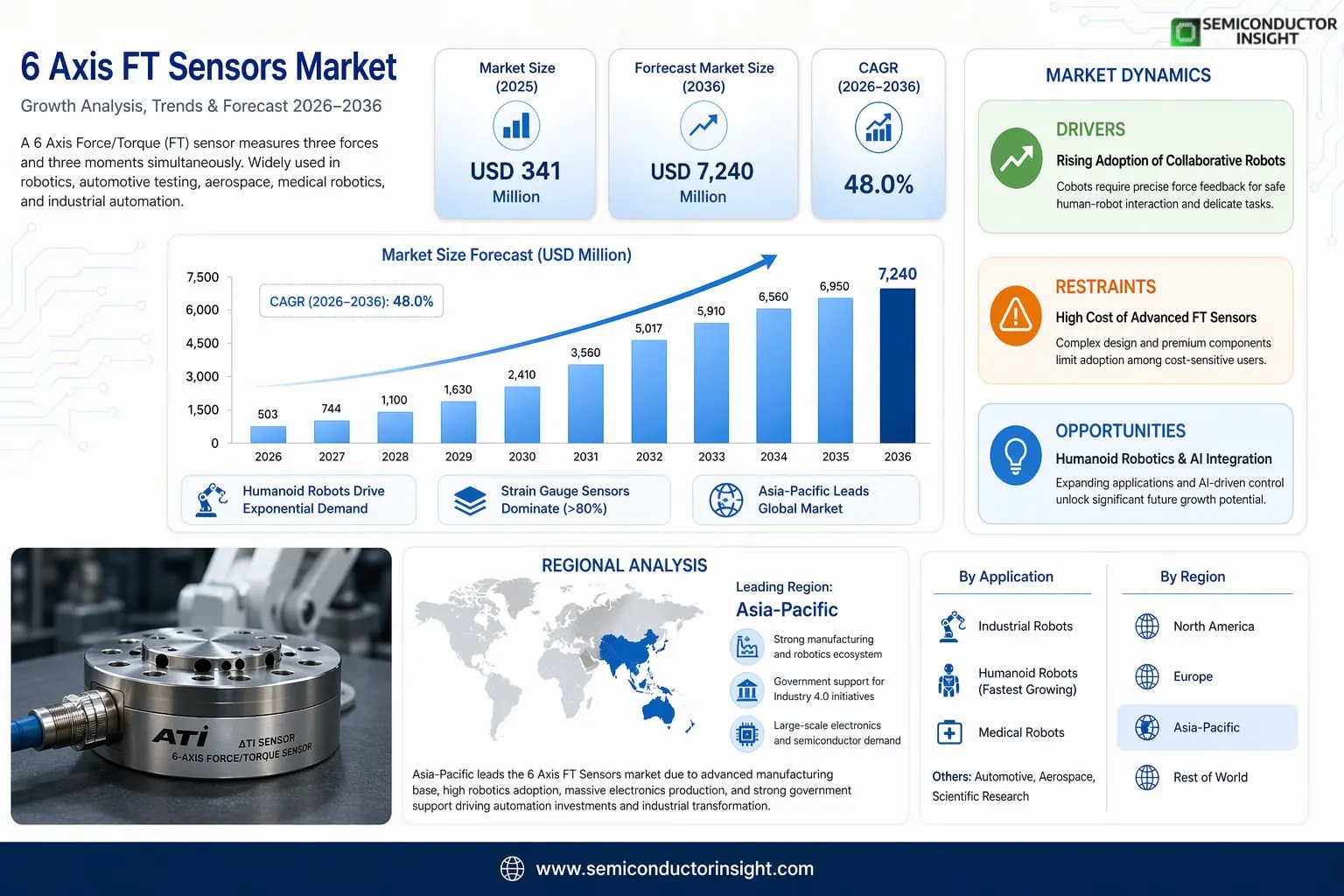
Global 6 Axis FT Sensors market size was valued at USD 341 million in 2025. The market is projected to grow from USD 503 million in 2026 to USD 7,240 million by 2036, exhibiting a CAGR of 48.0% during the forecast period.
A 6 Axis Force/Torque (FT) Sensor is a specialized sensing device capable of simultaneously measuring three orthogonal forces (FX, FY, FZ) and three orthogonal moments (MX, MY, MZ) within a single coordinate system. Originally developed for the aerospace industry to characterize aerodynamic forces including lift, drag, lateral force, pitch moment, yaw moment, and roll moment, the technology has since expanded into a broad spectrum of applications. Today, 6 Axis FT Sensors are widely deployed across robot control systems, mechanical testing, scientific research, automotive testing, biomechanics, and industrial automation, making them one of the most versatile and critical sensing components in advanced engineering environments.
The market is experiencing exceptional growth momentum driven by the rapid proliferation of industrial and humanoid robotics, growing automation investments, and the expanding role of precision force measurement in manufacturing quality control. Strain gauge-based sensors currently dominate the technology landscape, accounting for more than 80% of total force sensor usage globally, with key adopters including ATI Industrial Automation, Schunk, ME-Meßsysteme, and Sintokogio. Furthermore, the accelerating development of humanoid robots , projected to grow at a compound annual rate exceeding 104% globally between 2025 and 2030 , is emerging as a transformative demand driver, with 6 Axis FT Sensors increasingly adopted as standard components in wrist and ankle assemblies. ATI Industrial Automation, Schunk, and Advanced Mechanical Technology are among the leading global players, while Chinese manufacturers such as Kunwei Technology and Xinjingcheng are recording rapid market share gains.
MARKET DRIVERS
Rising Adoption of Collaborative Robots Fueling Demand in 6 Axis FT Sensors Market
6 Axis FT Sensors Market is experiencing robust growth, primarily driven by the accelerating deployment of collaborative robots (cobots) across manufacturing sectors. Six-axis force/torque sensors are critical components in cobot applications, enabling precise force feedback that allows robots to interact safely alongside human workers. As industries such as automotive, electronics, and consumer goods continue to automate assembly and quality inspection processes, the demand for reliable, high-resolution 6 axis force torque sensors is intensifying. The ability of these sensors to simultaneously measure forces and torques along all six degrees of freedom makes them indispensable in applications requiring delicate handling, insertion, and grinding tasks.
Expansion of Industrial Automation and Smart Manufacturing Initiatives
Global investments in smart manufacturing and Industry 4.0 frameworks are acting as a significant catalyst for 6 Axis FT Sensors Market. Manufacturers are increasingly integrating advanced sensor technologies into production lines to enhance process efficiency, reduce downtime, and improve product quality. Six-axis force torque sensors play a pivotal role in closed-loop control systems, enabling real-time adaptive manufacturing. Governments across North America, Europe, and Asia-Pacific have introduced substantial incentives for factory automation, further accelerating sensor adoption. Germany, Japan, South Korea, and China remain among the most active markets, driven by strong manufacturing bases and strategic digital transformation programs.
➤ The integration of 6 axis FT sensors into robotic end-effectors for precision assembly tasks has become a standard requirement in high-mix, low-volume manufacturing environments, underscoring the sensor’s role as a core enabler of flexible automation strategies.
Additionally, the growing application of 6 axis force torque sensors in medical robotics , particularly in surgical robots and rehabilitation devices , is opening new revenue streams. The need for precise tactile feedback in minimally invasive surgical systems demands sensors that offer high sensitivity, low noise, and compact form factors. As healthcare robotics investment continues to grow globally, this segment is expected to contribute meaningfully to overall 6 Axis FT Sensors Market expansion in the coming years.
MARKET CHALLENGES
High Cost of Advanced 6 Axis Force Torque Sensors Limiting Widespread Adoption
One of the primary challenges facing 6 Axis FT Sensors Market is the relatively high cost associated with precision six-axis force torque sensors. The sophisticated mechanical design, specialized strain gauge configurations, and advanced signal processing electronics required to deliver accurate multi-axis measurements contribute to elevated per-unit pricing. For small and medium-sized enterprises (SMEs) operating on constrained automation budgets, the cost-benefit justification for deploying 6 axis force torque sensors remains a significant barrier. While prices have trended downward with increased competition and volume production, the premium segment continues to pose adoption challenges in cost-sensitive markets across Southeast Asia and Latin America.
Other Challenges
Technical Complexity and Integration Difficulties
Integrating 6 axis force torque sensors into existing robotic systems and production environments requires considerable technical expertise. Compatibility with diverse robot brands, communication protocols, and control software platforms introduces engineering complexity that can extend deployment timelines and increase total cost of ownership. The absence of fully standardized interfaces across 6 Axis FT Sensors Market means that end-users often rely on custom integration work, which demands skilled personnel and increases implementation risk, particularly for first-time adopters in emerging industrial markets.
Calibration, Drift, and Long-Term Reliability Concerns
Maintaining measurement accuracy over extended operational periods is a persistent technical challenge in 6 Axis FT Sensors Market. Six-axis force torque sensors are susceptible to thermal drift, mechanical fatigue, and signal degradation in harsh industrial environments involving vibration, extreme temperatures, and exposure to coolants or chemicals. Regular recalibration requirements add to operational costs and can introduce production interruptions. Manufacturers are investing in improved compensation algorithms and robust mechanical designs to address these concerns, but long-term reliability in demanding conditions remains an area requiring continued development.
MARKET RESTRAINTS
Limited Awareness and Technical Expertise Among End-Users Restraining Market Growth
Despite the clear functional advantages of six-axis force torque measurement, limited awareness of sensor capabilities among potential end-users continues to restrain the pace of adoption in 6 Axis FT Sensors Market. Many manufacturers, particularly in developing economies, continue to rely on simpler single-axis load cells or purely vision-based systems, unaware of the productivity and quality improvements that 6 axis FT sensors can deliver. The absence of specialized technical training programs and application engineering support in several regions further compounds this challenge, limiting market penetration beyond established automation-intensive industries.
Supply Chain Constraints and Dependence on Specialized Raw Materials
6 Axis FT Sensors Market faces supply chain vulnerabilities stemming from dependence on specialized materials and electronic components essential for sensor fabrication, including precision-machined metallic flexures, high-performance strain gauges, and advanced ASIC-based signal conditioners. Disruptions in global semiconductor supply chains, as observed in recent years, have demonstrated the sensitivity of high-precision sensor manufacturing to component shortages. Furthermore, geopolitical tensions affecting critical material sourcing present ongoing risks to production continuity and cost stability for manufacturers operating in the 6 axis force torque sensor space, potentially limiting their ability to meet growing demand in a timely and cost-effective manner.
MARKET OPPORTUNITIES
Emerging Applications in Humanoid Robotics and Advanced Research Platforms Creating New Growth Avenues
The emergence of humanoid robots and next-generation research platforms represents a significant untapped opportunity for 6 Axis FT Sensors Market. Humanoid robots require highly sensitive, multi-axis force torque sensing across joints and end-effectors to replicate human-like dexterous manipulation and stable bipedal locomotion. Leading robotics developers and research institutions are actively sourcing compact, lightweight 6 axis force torque sensors capable of operating within tight spatial and weight constraints. As humanoid robotics transitions from research environments toward early commercial applications in logistics, healthcare, and service industries, this segment is expected to become an increasingly important growth driver for sensor manufacturers.
Integration with AI and Machine Learning Platforms Unlocking Intelligent Force Control Capabilities
The convergence of 6 axis FT sensor technology with artificial intelligence and machine learning presents compelling opportunities for intelligent force control applications. By feeding rich, real-time six-dimensional force and torque data into AI-driven control algorithms, robotic systems can learn and adapt to complex assembly tasks, variable workpiece geometries, and unpredictable contact dynamics without explicit programming. This capability is particularly valuable in flexible manufacturing environments where product variants change frequently. Market participants that develop sensor solutions with native software integration, edge processing capabilities, and compatibility with leading robot operating systems are well-positioned to capture premium value in the evolving 6 Axis FT Sensors Market landscape.
6 Axis FT Sensors Market Trends
Humanoid Robotics Driving Unprecedented Demand for 6 Axis FT Sensors
6 Axis FT Sensors Market is undergoing a significant transformation, largely propelled by the rapid rise of humanoid robotics. Since the concept of humanoid robots gained mainstream momentum in 2021, demand for multi-axis force and torque sensing solutions has accelerated sharply. Global sales of 6 Axis FT Sensors reached nearly 60,000 units in 2024, with China alone accounting for approximately 17,000 units , a year-on-year increase of over 40%. Projections indicate that global market sales could reach 820,000 units by 2030, with China contributing around 300,000 units, reflecting a compound annual sales growth rate of approximately 60% between 2025 and 2030. These sensors, capable of simultaneously measuring three forces (FX, FY, FZ) and three moments (MX, MY, MZ), have become standard components in high-performance humanoid robots, particularly at wrist and ankle joints where precision force control is critical for stable locomotion and dexterous manipulation.
Other Trends
Strain Gauge Technology Maintaining Dominant Market Position
Among the various sensing technologies available in 6 Axis FT Sensors Market , including photoelectric, capacitive, and piezoelectric types , strain gauge-based sensors continue to dominate, accounting for more than 80% of total force sensor usage globally. Leading manufacturers such as ATI Industrial Automation, Schunk, and ME-Meßsysteme, along with the majority of Chinese producers, rely on strain gauge technology due to its proven reliability, cost-effectiveness, and broad application compatibility. This technological preference is expected to persist as manufacturers scale production to meet growing demand across industrial automation, medical robotics, and humanoid robot segments.
Chinese Manufacturers Emerging as Competitive Market Forces
A notable structural shift in 6 Axis FT Sensors Market is the rapid ascent of Chinese manufacturers. Companies such as Kunwei Beijing Technology and Shenzhen Xinjingcheng Sensing Technology have recorded explosive growth, challenging the historical dominance of established Western players. Despite this, Global top five manufacturers still commanded more than 60% of market share in 2024, indicating that consolidation remains a defining characteristic of the competitive landscape. The entry of well-funded Chinese firms is intensifying price competition while simultaneously expanding overall market accessibility across emerging industrial automation ecosystems.
Expanding Application Scope Beyond Industrial Robotics
While industrial automation , including traditional robotic applications such as force control, force feedback, quality inspection, and dynamic control , continues to represent the largest application segment for 6 Axis FT Sensors, the scope of deployment is broadening considerably. Key growth areas include automotive testing (collision tests, wheel hub and seat component evaluations), aerospace vehicle development, biomechanics research, and medical robotics. The humanoid robot segment, however, is emerging as the fastest-growing application category, with Global compound annual growth rate for humanoid robots projected at approximately 104% between 2025 and 2030. This trajectory positions humanoid robot integration as a primary long-term growth driver for the broader 6 Axis FT Sensors market, reinforcing the sensor’s role as an essential component in next-generation intelligent systems.
COMPETITIVE LANDSCAPE
Key Industry Players
Global 6 Axis FT Sensors Market: Competitive Dynamics, Leading Manufacturers, and Strategic Positioning
Global 6 Axis Force/Torque (FT) Sensors market is characterized by a moderately consolidated competitive structure, with the top five manufacturers collectively accounting for more than 60% of global market share as of 2025. ATI Industrial Automation remains the dominant force in the industry, widely recognized for its high-precision strain gauge-based sensors deployed extensively across industrial robotics, aerospace, and automotive testing applications. Schunk and Advanced Mechanical Technology (AMI) follow closely, offering diversified product portfolios that cater to both research-grade and industrial-grade end users. The competitive advantage of these established Western players lies in their long-standing technological expertise, robust intellectual property portfolios, and deep integration within global OEM supply chains. Kistler and FUTEK also hold significant positions, particularly in high-end measurement and medical robotics segments. The rapid ascent of humanoid robotics , projected to grow at a compound annual rate exceeding 104% from 2025 to 2030 , is reshaping competitive priorities, compelling all major players to accelerate miniaturization, multi-axis integration, and real-time force feedback capabilities.
Chinese manufacturers have emerged as a formidable and fast-growing competitive bloc within the 6 Axis FT Sensors landscape. Companies such as Kunwei Beijing Technology, Shenzhen Xinjingcheng Sensing Technology, and Yuli Instruments have recorded year-on-year sales growth exceeding 40% in 2024, driven by surging domestic demand from China’s expanding industrial robotics and humanoid robot sectors. China’s national sales of 6 Axis FT Sensors reached approximately 17,000 units in 2024, and are forecast to grow to 300,000 units by 2030. Hypersen Technologies, Bota Systems, Nanjing Bio-inspired Intelligent Technology, and OnRobot are also gaining traction in niche segments, including collaborative robots (cobots) and medical robotics. The competitive landscape continues to evolve as players differentiate across sensor type , strain gauge sensors dominate with over 80% usage share , application vertical, and geographic footprint, intensifying both innovation-driven and cost-driven competition across the value chain.
List of Key 6 Axis FT Sensors Companies Profiled
- ATI Industrial Automation
- Schunk
- Advanced Mechanical Technology (AMTI)
- FUTEK Advanced Sensor Technology
- Kistler Group
- Sunrise Instruments (SRI)
- Robotiq
- ME-Meßsysteme GmbH
- Wacoh-Tech
- Bota Systems
- OnRobot
- Hypersen Technologies
- Kunwei Beijing Technology
- Shenzhen Xinjingcheng Sensing Technology
- Nanjing Bio-inspired Intelligent Technology
- Sintokogio
- FANUC Corporation
- Nordbo Robotics
- Robotous
- Aidin Robotics
Segment Analysis:
| Segment Category | Sub-Segments | Key Insights |
| By Type |
|
Strain Gauge Type is the dominant sensing technology in 6 Axis FT Sensors Market, widely adopted across the vast majority of industrial and robotic applications globally.
|
| By Application |
|
Industrial Robots currently represent the largest application segment by volume, while Humanoid Robots are the fastest-growing application driving transformative demand in the market.
|
| By End User |
|
Industrial Automation & Manufacturing is the leading end-user segment, anchored by the rapid proliferation of robotic systems across global factory floors.
|
| By Measurement Principle |
|
Contact-Based Sensing remains the prevailing measurement principle across the majority of commercial 6 Axis FT Sensor deployments owing to its maturity and broad application compatibility.
|
| By Installation Position |
|
Wrist-Mounted (End-Effector) installation is the leading position segment, serving as the standard configuration for both traditional industrial robots and emerging humanoid robotic platforms.
|
Regional Analysis: 6 Axis FT Sensors Market
Asia-Pacific
Asia-Pacific’s 6 Axis FT Sensors Market is propelled by the region’s exceptional pace of industrial robot installations. Manufacturing hubs across China, Japan, and South Korea are deploying collaborative robots at scale, each requiring precise force-torque feedback systems to enable safe human-machine interaction, delicate assembly, and quality-assured production workflows across automotive, electronics, and consumer goods sectors.
Strategic national initiatives such as China’s “Made in China 2025,” Japan’s Society 5.0 framework, and South Korea’s Smart Manufacturing Innovation policies are generating structured demand within 6 Axis FT Sensors Market. These programs incentivize manufacturers to modernize production facilities, directly stimulating procurement of advanced sensing and precision measurement technologies at an accelerated rate.
The region’s dominant semiconductor and consumer electronics industries represent a critical end-use vertical for 6 Axis FT Sensors Market. Ultra-precise force-torque sensing is indispensable in wafer handling, circuit board assembly, and microelectronics packaging, where even minimal deviations in applied force can compromise product integrity, yield rates, and overall manufacturing quality benchmarks.
Beyond consumption, Asia-Pacific is increasingly becoming a production center within Global 6 Axis FT Sensors Market. Chinese and South Korean sensor developers are advancing their technological capabilities, offering competitively priced alternatives to established Western brands. This dual role as both producer and consumer is reinforcing the region’s strategic importance and long-term influence over global market dynamics.
North America
North America represents one of the most technologically mature and innovation-driven regions within Global 6 Axis FT Sensors Market. The United States anchors regional demand through its advanced robotics research ecosystem, prominent aerospace and defense manufacturing base, and rapidly expanding medical robotics sector. Leading technology companies and research universities across the region actively drive development of next-generation force-torque sensing applications, particularly in surgical robotics, autonomous systems, and human-robot collaboration environments. Canada contributes through its growing advanced manufacturing and agricultural automation segments, where force-torque feedback enables precision-guided machinery operations. 6 Axis FT Sensors Market in North America also benefits from strong partnerships between academic institutions and industrial players, fostering application-specific sensor innovation. Regulatory emphasis on workplace safety and collaborative robot certification further reinforces the structural demand for reliable six-axis sensing solutions across diverse industrial verticals throughout the forecast period.
Europe
Europe occupies a prominent position in 6 Axis FT Sensors Market, supported by its world-renowned engineering heritage, stringent manufacturing quality standards, and progressive industrial automation culture. Germany leads regional demand as the home of globally recognized automotive manufacturers and mechanical engineering firms that integrate six-axis force-torque sensors extensively across vehicle assembly and precision machining operations. The broader European 6 Axis FT Sensors Market is also shaped by strong activity in aerospace manufacturing in France and the United Kingdom, where high-precision assembly processes demand reliable force-torque feedback. The region’s emphasis on collaborative robotics safety standards, governed by harmonized CE certification frameworks, creates a compliance-driven adoption environment. Scandinavia’s leadership in clean technology and advanced manufacturing automation further contributes to European market momentum, with force-torque sensing playing a critical role in sustainable and precision-focused production systems across the continent.
South America
South America represents an emerging growth frontier within Global 6 Axis FT Sensors Market, characterized by gradual but steady industrial modernization across key economies. Brazil, as the region’s largest industrial base, is at the forefront of automation adoption particularly within the automotive assembly, agribusiness mechanization, and mining equipment sectors, each generating incremental demand for six-axis force-torque sensing solutions. Argentina and Chile are similarly witnessing expanding interest in precision automation technologies as manufacturers seek competitive efficiency improvements. While infrastructure constraints and economic volatility have historically moderated investment pace, growing foreign direct investment in smart manufacturing facilities and rising awareness of advanced robotics capabilities are creating a more favorable operating environment. 6 Axis FT Sensors Market in South America is expected to gain stronger traction as industrial automation penetration deepens and regional technology adoption frameworks continue to mature through the forecast period.
Middle East & Africa
The Middle East and Africa region currently holds a nascent but progressively developing position within Global 6 Axis FT Sensors Market. The Middle East, particularly the Gulf Cooperation Council countries, is channeling significant investment into industrial diversification initiatives aimed at reducing hydrocarbon dependency, with smart manufacturing and advanced automation emerging as priority sectors. The United Arab Emirates and Saudi Arabia are actively integrating robotic systems within logistics, construction, and energy infrastructure projects, creating foundational demand for precision force-torque sensing technologies. Africa’s contribution to 6 Axis FT Sensors Market remains in early stages, primarily concentrated around South Africa’s comparatively developed manufacturing and mining automation sectors. While adoption rates across the broader region remain measured, long-term infrastructure development programs and rising industrial investment flows are gradually establishing conditions conducive to expanded six-axis force-torque sensor deployment across targeted industrial applications.
Report Scope
This market research report provides a comprehensive analysis of 6 Axis FT Sensors Market, covering the forecast period 2026–2036. It offers detailed insights into market dynamics, technological advancements, competitive landscape, and key trends shaping the industry.
Key focus areas of the report include:
- Market Overview: The report begins with an overview outlining its current market scenario, key growth indicators, and industry transformation drivers. It discusses macroeconomic factors, demand–supply balance, regulatory landscape, and the strategic role of 6 Axis FT Sensors in powering advancements across industries such as robotics, automotive, aerospace, and industrial automation.
- Market Size & Forecast: Historical data and future projections for revenue, unit shipments, and market value across major regions and segments.
- Segmentation Analysis: Detailed breakdown by product type, technology, application, and end-user industry to identify high-growth segments and investment opportunities.
- Regional Insights: Insights into market performance across North America, Europe, Asia-Pacific, Latin America, and the Middle East & Africa, including country-level analysis where relevant.
- Competitive Landscape: Profiles of leading market participants, including their product offerings, R&D focus, manufacturing capacity, pricing strategies, and recent developments such as mergers, acquisitions, and partnerships.
- Technology Trends & Innovation: Assessment of emerging technologies, integration of AI/IoT, sensor design trends, fabrication techniques, and evolving industry standards.
- Market Drivers & Restraints: Evaluation of factors driving market growth along with challenges, supply chain constraints, regulatory issues, and market-entry barriers.
- Stakeholder Insights: Insights for component suppliers, OEMs, system integrators, investors, and policymakers regarding the evolving ecosystem and strategic opportunities.
Primary and secondary research methods are employed, including interviews with industry experts, data from verified sources, and real-time market intelligence to ensure the accuracy and reliability of the insights presented.
FREQUENTLY ASKED QUESTIONS:
What is the current market size of 6 Axis FT Sensors Market?
-> Global 6 Axis FT Sensors Market was valued at USD 341 million in 2025 and is projected to reach USD 5,017 million by 2032, growing at a CAGR of 48.0% during the forecast period.
Which key companies operate in 6 Axis FT Sensors Market?
-> Key players include ATI Industrial Automation, Schunk, Advanced Mechanical Technology, Sunrise Instruments (SRI), Kistler, Robotiq, FUTEK, Bota Systems, FANUC, and OnRobot, among others. Chinese manufacturers such as Kunwei Beijing Technology, Shenzhen Xinjingcheng Sensing Technology, and Hypersen Technologies have also witnessed explosive growth. In 2024, the world’s top five manufacturers accounted for more than 60% of the market.
What are the key growth drivers of 6 Axis FT Sensors Market?
-> Key growth drivers include rapid adoption of humanoid robots, expansion of industrial automation, rising demand in collaborative robotics, and growing applications in automotive testing, aerospace, and medical fields. Since Elon Musk proposed the concept of humanoid robots in 2021, the market has experienced accelerated growth. Global compound annual growth rate of humanoid robots from 2025 to 2030 is expected to reach 104%, making it a major long-term growth driver for 6 Axis FT Sensors Market.
Which region dominates 6 Axis FT Sensors Market?
-> Asia-Pacific, led by China, is the fastest-growing region. China’s sales of 6 Axis FT Sensors reached approximately 17,000 sets in 2024, a year-on-year increase of more than 40%, and are projected to reach 300,000 sets by 2030. Meanwhile, North America and Europe remain dominant markets, led by established players such as ATI Industrial Automation and Schunk.
What are the emerging trends in 6 Axis FT Sensors Market?
-> Emerging trends include mass adoption in humanoid robots, miniaturization of sensor technology, integration of strain gauge-type sensors (accounting for over 80% of total usage), expansion into medical robotics, and increasing deployment at wrist and ankle joints of humanoid robots for force control, swing stability control, and safety control applications. By 2030, global market sales are estimated to reach 820,000 sets, with a compound annual sales growth rate of 60% from 2025 to 2030.

Get Sample Report PDF for Exclusive Insights
Report Sample Includes
- Table of Contents
- List of Tables & Figures
- Charts, Research Methodology, and more...
 Download Sample Report PDF