5G RF Analog Circuit Market Insights
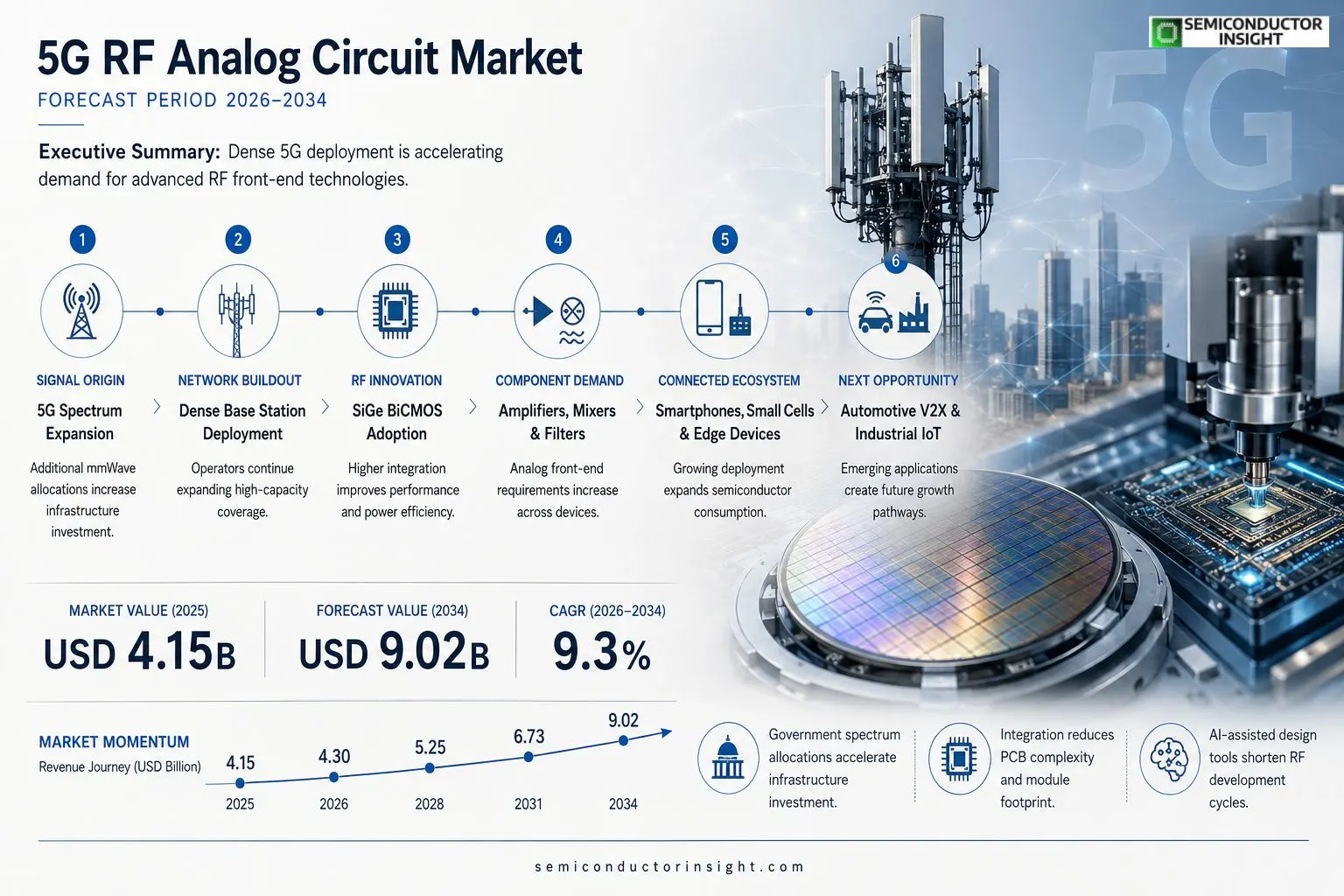
5G RF Analog Circuit market size was valued at USD 4.15 billion in 2025.The market is projected to grow from USD 4.30 billion in 2026 to USD 9.02 billion by 2034, exhibiting a CAGR of 9.3% during the forecast period.
RF analog circuits encompass low‑noise amplifiers, power amplifiers, mixers, filters and phase‑shifters designed for millimeter‑wave frequencies used in base stations, small cells and user equipment.
These components enable signal conditioning, frequency conversion and impedance matching essential for reliable high‑speed data transmission in the emerging 5G ecosystem.The market is accelerating because telecom operators are expanding dense network deployments and device manufacturers demand higher integration.Furthermore, government spectrum allocations worldwide are driving volume growth.
Key players such as Qorvo Inc., Skyworks Solutions Inc., NXP Semiconductors N.V., Analog Devices Inc., and Texas Instruments Inc.,are investing heavily in advanced SiGe BiCMOS technologies and portfolio diversification to meet stringent performance targets.
MARKET DRIVERS
Growing Demand for High‑Performance 5G Infrastructure
5G RF Analog Circuit Market is being propelled by telecom operators’ aggressive rollout of mid‑band and mmWave networks. Network densification requires analog front‑end modules that deliver low noise, high linearity, and superior power efficiency, driving manufacturers to invest in advanced silicon‑based solutions.
Rise of Integrated Photonic and Silicon‑Based Technologies
Integration of photonic components with silicon RF circuits reduces form factor and cost, making them attractive for massive MIMO and beamforming applications. This technological convergence shortens time‑to‑market for new base‑station equipment, further accelerating market growth.
➤ Analysts forecast a compound annual growth rate of roughly 12% for the sector through 2032, reflecting strong momentum from carrier capital expenditure.
Regulatory support for spectrum allocation in the 24 GHz to 40 GHz bands also creates a favorable environment, encouraging R&D spending and boosting the overall value chain of 5G RF Analog Circuit Market.
MARKET CHALLENGES
Stringent Performance Requirements and Validation Costs
Designing analog circuits that meet the stringent linearity and power‑handling specifications of 5G renders testing and validation expensive. Small‑to‑medium vendors often face capital constraints, limiting their ability to compete with larger players.
Other Challenges
Supply‑Chain Vulnerabilities
Component shortages, especially for high‑purity silicon wafers and specialty passives, can delay production schedules and increase BOM costs, posing a risk to timely network deployments.
MARKET RESTRAINTS
High Capital Expenditure for Advanced Fabrication
State‑of‑the‑art analog RF processes demand multi‑billion‑dollar fabs, creating a barrier to entry for new entrants and limiting the pool of capable suppliers.
Thermal Management Constraints
Increasing power density in compact modules raises thermal dissipation challenges, requiring sophisticated cooling solutions that add to overall system cost.
MARKET OPPORTUNITIES
Expansion into Automotive and Industrial IoT Segments
Beyond telecom, 5G RF Analog Circuit Market can capitalize on emerging automotive V2X and industrial IoT applications, where robust analog front‑ends are essential for reliable connectivity.
Adoption of AI‑Assisted Design Tools
AI‑driven simulation and layout optimization reduce design cycles, enabling faster time‑to‑market and lowering development costs, thereby opening new revenue streams for circuit designers.
5G RF Analog Circuit Market Trends
Network Deployment Density Fuels Component Demand
The rapid rollout of dense 5G base stations and small‑cell sites is reshaping the supply dynamics for low‑noise amplifiers, power amplifiers, mixers, and filters. Telecom operators are prioritizing millimeter‑wave spectrum to meet high‑throughput requirements, which directly elevates the need for precision analog front‑end blocks. As these deployments expand into urban and suburban corridors, 5G RF Analog Circuit Market experiences a steady uptick in volume, driven by the necessity for reliable signal conditioning and impedance matching across a broader range of carrier frequencies. The trend reflects an industry‑wide shift toward higher integration levels to reduce footprint and power consumption while preserving performance at elevated frequencies.
Other Trends
Integration and SiGe BiCMOS Innovation
Key manufacturers such as Qorvo, Skyworks, NXP, Analog Devices, and Texas Instruments are accelerating the adoption of silicon‑germanium (SiGe) BiCMOS processes. This technology enables the consolidation of multiple analog functions,amplification, mixing, and phase‑shifting,into single chips, shortening bill‑of‑materials and simplifying PCB layouts. The move toward integrated solutions aligns with device makers’ demand for smaller, more power‑efficient modules in user equipment and edge‑computing platforms. By leveraging advanced SiGe nodes, suppliers can achieve lower noise figures and higher linearity, which are critical for maintaining link reliability in dense 5G deployments.
Regulatory Spectrum Allocation and Supply Chain Coordination
Government allocations of additional millimeter‑wave bands worldwide have created a predictable demand pipeline for analog front‑end components. Regulators are establishing clear timelines for spectrum releases, allowing component manufacturers to synchronize production planning with network roll‑out schedules. This regulatory clarity, combined with coordinated supply‑chain initiatives, mitigates the risk of component shortages that could otherwise impede network expansion. As a result, 5G RF Analog Circuit Market benefits from a more stable procurement environment, encouraging long‑term investment in research and development across the ecosystem.
COMPETITIVE LANDSCAPEKey Industry Players
5G RF Analog Circuit Market – Competitive Dynamics
5G RF Analog Circuit Market is dominated by a handful of silicon and RF‑specialist firms that have leveraged SiGe BiCMOS and advanced CMOS processes to deliver low‑noise amplifiers, power amplifiers, mixers and phase‑shifters for millimeter‑wave base stations and user equipment. Qorvo Inc., Skyworks Solutions Inc., and NXP Semiconductors N.V. collectively command a sizable share of the high‑performance segment, benefitting from multi‑year product roadmaps and strategic investments aligned with telecom operators’ dense‑network roll‑outs. Analog Devices Inc. and Texas Instruments Inc. complement this tier with broad portfolio breadth and strong design‑win capabilities, positioning them as primary suppliers for both carrier‑grade infrastructure and emerging small‑cell deployments. Their scale, combined with a CAGR of roughly 9 % projected through 2034, underpins a market that is expanding from an estimated USD 4.30 billion in 2026 to over USD 9 billion by 2034.Beyond the core tier, a diverse set of niche players contributes critical innovations and regional strengths. Murata Manufacturing Co., STMicroelectronics, and Infineon Technologies focus on compact filter and mixer solutions for edge devices, while MACOM Technology Solutions and Broadcom Inc. deliver high‑power amplifier modules for carrier‑grade equipment. Qualcomm Incorporated and Nexperia enhance the ecosystem with integrated RF front‑end modules that streamline system‑in‑package designs. Additional contributors such as Renesas Electronics, AMS AG, and Maxim Integrated (now part of Analog Devices) provide specialized low‑noise amplifiers and phase‑shifter ASICs that serve bespoke 5G use‑cases in automotive and industrial IoT sectors.
List of Key 5G RF Analog Circuit Companies Profiled
- Qorvo Inc.
- Skyworks Solutions Inc.
- NXP Semiconductors N.V.
- Analog Devices Inc.
- Texas Instruments Inc.
- Murata Manufacturing Co., Ltd.
- STMicroelectronics
- Infineon Technologies AG
- MACOM Technology Solutions
- Broadcom Inc.
- Qualcomm Incorporated
- Nexperia
- Renesas Electronics Corporation
- AMS AG
- Maxim Integrated (Analog Devices)
Segment Analysis:
| Segment Category | Sub-Segments | Key Insights |
| By Type |
|
Low‑Noise Amplifiers
|
| By Application |
|
Base Stations
|
| By End User |
|
Telecom Operators
|
| By Technology |
|
SiGe BiCMOS
|
| By Integration Level |
|
Highly Integrated Modules
|
Regional Analysis: North America
North America
Significant investments in upgrading and expanding 5G infrastructure are the primary drivers of demand for RF analog circuits in North America. This includes the deployment of millimeter-wave (mmWave) 5G networks, which require advanced components for high-frequency signal processing and transmission.
The integration of 5G connectivity into vehicles is creating new opportunities for RF analog circuits. This includes applications such as autonomous driving, connected car services, and advanced driver-assistance systems (ADAS), all of which rely on high-performance RF components.
The growth of the Industrial Internet of Things (IIoT) is driving demand for 5G-enabled industrial applications. These applications, which include remote monitoring, predictive maintenance, and automation, leverage RF analog circuits for reliable and high-bandwidth communication.
5G is enabling new functionalities in consumer electronics, such as enhanced mobile gaming, augmented reality (AR), and virtual reality (VR). These advanced features require sophisticated RF analog circuits for seamless and reliable connectivity.
Europe
Europe is experiencing a steady expansion in 5G RF Analog Circuit Market, driven by government initiatives and increasing consumer demand. The region’s focus on sustainable technologies and digital transformation is fostering innovation in 5G infrastructure and applications. While adoption rates may lag slightly behind North America in some sectors, Europe presents a significant long-term growth opportunity. Key areas of focus include the development of 5G networks for smart cities, industrial automation, and connected vehicles. European manufacturers are increasingly investing in research and development to create energy-efficient and environmentally friendly RF analog circuits. The regulatory landscape in Europe is supportive of 5G deployment, but variations across different countries present some challenges for market players. The demand for components supporting advanced modulation techniques and higher frequencies is expected to increase substantially.
Asia-Pacific
Asia-Pacific represents the largest and fastest-growing market for 5G RF Analog Circuits globally. Driven by massive investments in 5G infrastructure in China, India, and other countries in the region, this market is poised for exponential expansion. The proliferation of 5G-enabled smartphones and the increasing adoption of 5G in industrial applications are key factors fueling this growth. China, in particular, is leading the way in 5G deployment and is a major consumer of RF analog circuits. The region’s manufacturing prowess also makes it a significant supplier of these components. However, the market is highly competitive, with several domestic and international players vying for market share. The demand for low-cost, high-volume RF analog circuits is particularly strong in the Asia-Pacific region.
South America
5G RF Analog Circuit Market in South America is in its early stages of development but is expected to experience significant growth in the coming years. Increasing investments in telecommunications infrastructure and the growing adoption of 5G technologies in urban areas are driving demand for these components. Brazil and Argentina are leading the way in 5G deployment in the region. However, challenges such as infrastructure limitations and economic uncertainties may slow down the pace of growth. The demand for RF analog circuits in South America is projected to increase steadily as 5G networks expand and 5G-enabled applications become more prevalent.
Middle East & Africa
The Middle East and Africa represent a promising market for 5G RF Analog Circuits, driven by increasing investments in telecommunications infrastructure and the growing demand for high-speed data connectivity. Governments across the region are actively promoting the deployment of 5G networks to support economic growth and digital transformation. The tourism sector, oil and gas industry, and government services are key drivers of demand for 5G-enabled applications. While the market is relatively small compared to other regions, it offers significant growth potential. The demand for robust and reliable RF analog circuits capable of withstanding harsh environmental conditions is particularly important in this region.
Report Scope
This market research report provides a comprehensive analysis of the 5G RF Analog Circuit Market , covering the forecast period 2026–2034. It offers detailed insights into market dynamics, technological advancements, competitive landscape, and key trends shaping the industry.
Key focus areas of the report include:
- Market Overview: The report begins with an overview outlining its current market scenario, key growth indicators, and industry transformation drivers. It discusses macroeconomic factors, demand–supply balance, regulatory landscape, and the strategic role of semiconductors in powering advancements across industries such as automotive, telecommunications, consumer electronics, and industrial automation.
- Market Size & Forecast: Historical data and future projections for revenue, unit shipments, and market value across major regions and segments.
- Segmentation Analysis: Detailed breakdown by product type, technology, application, and end-user industry to identify high-growth segments and investment opportunities.
- Regional Insights: Insights into market performance across North America, Europe, Asia-Pacific, Latin America, and the Middle East & Africa, including country-level analysis where relevant.
- Competitive Landscape: Profiles of leading market participants, including their product offerings, R&D focus, manufacturing capacity, pricing strategies, and recent developments such as mergers, acquisitions, and partnerships.
- Technology Trends & Innovation: Assessment of emerging technologies, integration of AI/IoT, semiconductor design trends, fabrication techniques, and evolving industry standards.
- Market Drivers & Restraints: Evaluation of factors driving market growth along with challenges, supply chain constraints, regulatory issues, and market-entry barriers.
- Stakeholder Insights: Insights for component suppliers, OEMs, system integrators, investors, and policymakers regarding the evolving ecosystem and strategic opportunities.
Primary and secondary research methods are employed, including interviews with industry experts, data from verified sources, and real-time market intelligence to ensure the accuracy and reliability of the insights presented.
FREQUENTLY ASKED QUESTIONS:
What is the current market size of 5G RF Analog Circuit Market?
-> 5G RF Analog Circuit Market was valued at USD 4.15 billion in 2025 and is expected to reach USD 9.02 billion by 2034.
Which key companies operate in 5G RF Analog Circuit Market?
-> Key players include Qorvo Inc., Skyworks Solutions Inc., NXP Semiconductors N.V., Analog Devices Inc., Texas Instruments Inc..
What are the key growth drivers?
-> Key growth drivers include expansion of dense network deployments, higher integration demand from device manufacturers, and worldwide government spectrum allocations.
Which region dominates the market?
-> The provided reference does not specify a single dominant region.
What are the emerging trends?
-> Emerging trends include advancements in SiGe BiCMOS technology, portfolio diversification by leading vendors, and increased focus on high‑performance millimeter‑wave components.

Get Sample Report PDF for Exclusive Insights
Report Sample Includes
- Table of Contents
- List of Tables & Figures
- Charts, Research Methodology, and more...
 Download Sample Report PDF