Market Insights
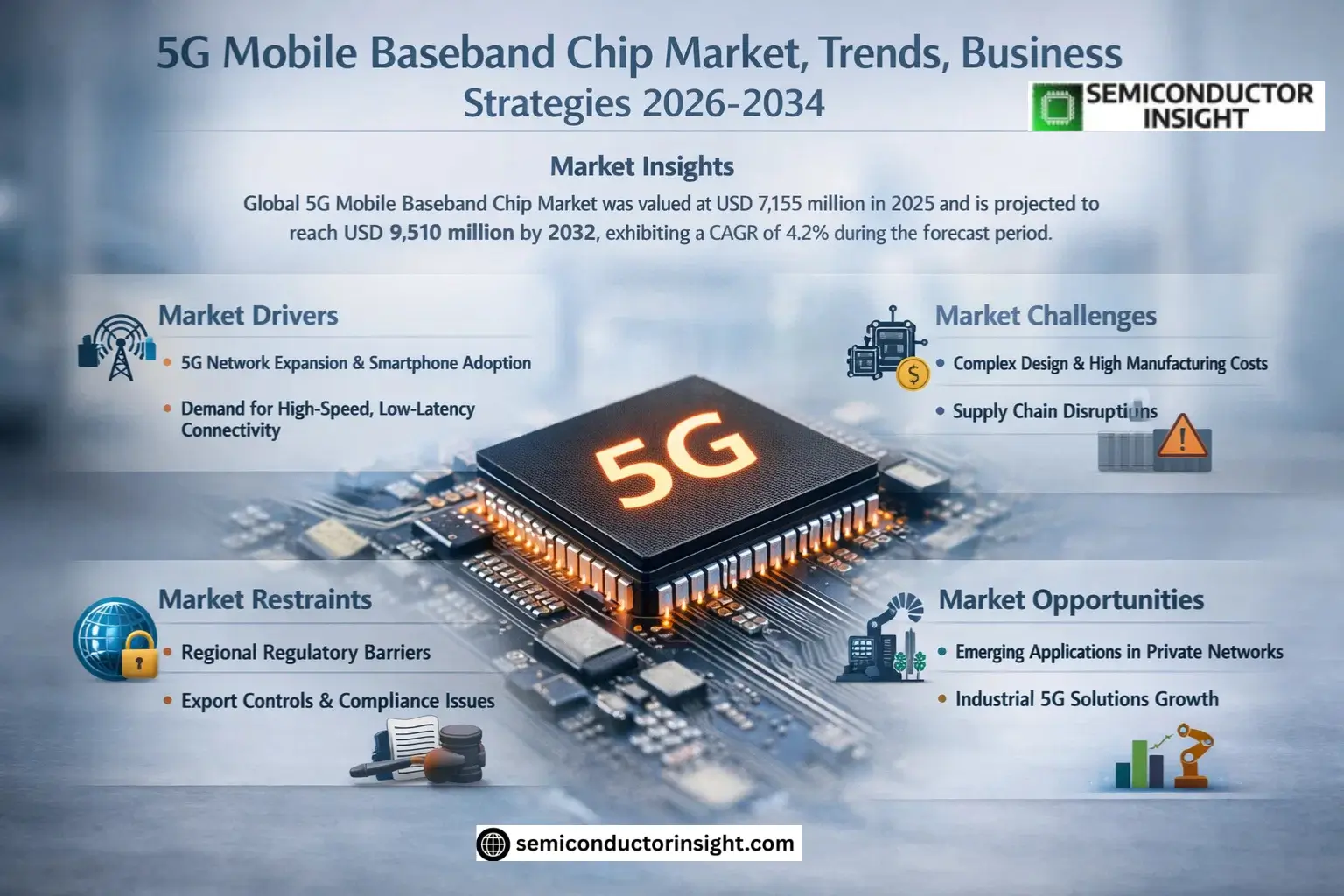
Global 5G Mobile Baseband Chip Market was valued at USD 7,155 million in 2025 and is projected to reach USD 9,510 million by 2032, exhibiting a CAGR of 4.2% during the forecast period.
5G Mobile Baseband Chip Market is the core semiconductor component in smartphones that enables high-speed cellular communication. It integrates digital signal processing for the 5G New Radio (NR) air interface, protocol stack management, and RF transceiver coordination to ensure stable connectivity across diverse network conditions. These chips support critical functions such as network access, authentication, and data transmission while optimizing performance in challenging environments like weak signal areas or high mobility scenarios.
The market growth is driven by accelerating global 5G network deployments and rising demand for enhanced mobile broadband experiences. However, design complexities and supply chain constraints pose challenges. Key players like Qualcomm, MediaTek, and Samsung dominate the sector with advanced solutions such as integrated system-on-chip (SoC) designs that combine baseband modems with application processors for improved efficiency.
MARKET DRIVERS
5G Network Expansion and Smartphone Adoption
The rapid global rollout of 5G infrastructure is accelerating demand for 5G mobile baseband chips. Over 70% of new smartphones shipped in 2023 supported 5G connectivity, creating sustained market growth. Telecom operators are investing heavily in network upgrades, with 5G coverage expected to reach 60% of the global population by 2025.
Demand for High-Speed, Low-Latency Connectivity
Applications like augmented reality (AR), autonomous vehicles, and industrial IoT require the ultra-low latency provided by 5G mobile baseband chips. The market is witnessing increased adoption in industries beyond consumer electronics, including healthcare and manufacturing. Semiconductor companies are reporting 35% year-over-year revenue growth in 5G-related components.
Continuous innovation in chip architecture is enabling higher energy efficiency and better performance, further fueling adoption across price segments.
MARKET CHALLENGES
Complex Design and High Manufacturing Costs
Developing 5G mobile baseband chips requires advanced fabrication processes, with leading manufacturers utilizing 5nm and below process nodes. The R&D investment for next-generation chips exceeds USD 500 million per design, creating high barriers to entry.
Other Challenges
Supply Chain Disruptions
The semiconductor shortage has impacted 5G mobile baseband chip production, delaying device launches. Geopolitical tensions have further complicated the sourcing of rare earth materials essential for chip manufacturing.
MARKET RESTRAINTS
Regional Regulatory Barriers
Stringent export controls on advanced semiconductor technology are limiting 5G mobile baseband chip availability in certain markets. Countries implementing local content requirements are creating fragmented supply chains and increasing compliance costs for manufacturers.
MARKET OPPORTUNITIES
Emerging Applications in Private Networks
Enterprise demand for private 5G networks is creating new revenue streams for 5G mobile baseband chip manufacturers. Industrial sectors are deploying customized solutions that require specialized chipsets, with the market expected to grow 42% annually until 2026.
5G Mobile Baseband Chip Market Trends
Accelerated Integration and System Optimization
5G Mobile Baseband Chip Market is witnessing rapid architectural shifts toward deeper system integration. Leading vendors are optimizing SoC designs to combine baseband processing with application processors, reducing power consumption by 15-20% while improving thermal performance. This trend particularly benefits mainstream smartphones where cost and battery life are critical. However, premium devices continue leveraging discrete modems for faster generational updates and specialized radio configurations.
Other Trends
AI-Driven Connectivity Enhancement
Modern 5G baseband chips increasingly incorporate machine learning algorithms for real-time radio link management. These intelligent systems dynamically adjust parameters like carrier aggregation configurations and MIMO layers based on network conditions, improving average throughput by 25-30% in congested urban environments while reducing dropped connections during handovers.
Regional Spectrum Diversification Challenges
The fragmentation of 5G spectrum allocations across global markets has necessitated more flexible baseband architectures. Chipset vendors now support over 30 NR frequency bands alongside legacy mode fallbacks, increasing design complexity. This trend drives demand for unified test platforms that can validate performance across multiple operator profiles while meeting strict regional certification requirements.
Uplink Performance Prioritization
With live streaming and cloud synchronization driving user expectations, 5G baseband designs now emphasize uplink capabilities through techniques like dual-connectivity and uplink carrier aggregation. Recent chipsets demonstrate 40% improvement in sustained uplink speeds compared to early 5G implementations, enabling higher-quality real-time applications.
Supply Chain Localization Pressures
Geopolitical factors are prompting OEMs to diversify their 5G baseband chip sourcing strategies. While Qualcomm and MediaTek dominate the merchant market, smartphone brands are investing in alternative suppliers and in-house solutions. This trend could reshape competitive dynamics as new entrants leverage open RAN architectures and regional manufacturing partnerships.
COMPETITIVE LANDSCAPE
Key Industry Players
5G Baseband Chip Market Dominated by Technology and Integration Leaders
5G Mobile Baseband Chip Market is highly concentrated, with Qualcomm and MediaTek leading as the dominant players. These companies control over 70% of the global market share through their advanced SoC-integrated solutions, extensive IP portfolios, and strategic partnerships with major smartphone OEMs. Qualcomm maintains its premium position with the Snapdragon X-series modems, while MediaTek has gained significant traction with its Dimensity platforms in the mid-range segment. Samsung and Huawei HiSilicon follow as strong regional competitors with vertically integrated solutions for their respective device ecosystems.
Specialized players like UNISOC are gaining ground in entry-level 5G devices, while Apple’s in-house modem development signals increasing vertical integration among OEMs. Emerging Chinese suppliers are challenging the status quo with cost-competitive offerings, though they face barriers in carrier certification and advanced technology nodes. The competitive landscape is further shaped by ongoing R&D in mmWave support, AI-assisted connectivity, and energy-efficient architectures, driving continuous innovation cycles among market leaders.
List of Key 5G Mobile Baseband Chip Companies Profiled
- Qualcomm
- MediaTek
- Samsung
- Huawei HiSilicon
- Apple
- UNISOC
- Intel
- Spreadtrum Communications
- Xperi
- Marvell Technology
- Skyworks Solutions
- Qorvo
- Broadcom
- NXP Semiconductors
- Texas Instruments
Segment Analysis:
| Segment Category | Sub-Segments | Key Insights |
| By Type |
|
5G NR Sub-6 Modem dominates due to its wider compatibility with global network infrastructures.
|
| By Application |
|
Android Mobile Phone represents the largest addressable market for 5G baseband chips.
|
| By End User |
|
Consumer Electronics remains the primary growth driver for 5G baseband chips.
|
| By Modem Architecture |
|
SoC-Integrated Modem leads through system-level optimization benefits.
|
| By Performance Tier |
|
Mainstream segment captures the largest volume demand.
|
Regional Analysis: 5G Mobile Baseband Chip Market
China’s national semiconductor policy drives substantial R&D investments in 5G baseband chips, seeking to reduce dependence on foreign technology. Domestic firms like Huawei’s HiSilicon and Unisoc are making progress in developing competitive alternatives to Qualcomm chips, though they face technological hurdles in advanced nodes.
South Korea’s established semiconductor industry, led by Samsung, provides vertically integrated advantages for 5G baseband development. The country’s early 5G deployment creates real-world testing grounds for optimizing chip performance across diverse network conditions and user scenarios.
Japanese companies emphasize industrial and enterprise 5G applications, developing specialized baseband chips for factory automation and IoT. This niche focus complements broader consumer-focused offerings from other regional players, creating a diversified ecosystem.
The Asia-Pacific region’s dominant position in smartphone manufacturing creates natural synergies for 5G baseband chip integration. This proximity allows for tighter chipset-device optimization and faster time-to-market for new 5G handsets using locally developed chips.
North America
North America remains a key innovation hub for 5G mobile baseband technology, driven by Qualcomm’s market leadership and strong R&D capabilities. The region focuses on mmWave implementations requiring advanced chip designs. US carriers’ spectrum strategies influence chip development priorities, creating specialized requirements that only established players can meet. However, the market faces challenges from geopolitical restrictions on technology transfers and intense competition from Asian chipmakers gaining capability in mainstream 5G solutions.
Europe
European 5G baseband chip development emphasizes industrial and automotive applications, with specialized requirements for low-latency and reliability. The region benefits from strong academic research in wireless technologies but lacks major commercial chip players. Collaboration between equipment vendors, operators and research institutions drives innovation, though dependence on non-European chip suppliers remains a strategic concern that policymakers seek to address through various semiconductor initiatives.
Middle East & Africa
The Middle East leads in 5G adoption within the region, particularly in Gulf countries investing heavily in digital infrastructure. This drives demand for baseband chips compatible with high-capacity networks. Africa’s market remains nascent but shows potential as affordable 5G solutions emerge. Both sub-regions depend entirely on imported chips, creating opportunities for suppliers offering cost-optimized solutions for developing markets.
South America
South America’s 5G rollout has been slower than other regions, delaying baseband chip demand. The market shows potential as major economies begin spectrum auctions, but remains constrained by economic volatility and infrastructure challenges. Chip suppliers must adapt solutions for cost-sensitive operators and hybrid 4G/5G network environments that dominate initial deployments in the region.
Report Scope
This market research report provides a comprehensive analysis of the 5G Mobile Baseband Chip Market, covering the forecast period 2025–2032. It offers detailed insights into market dynamics, technological advancements, competitive landscape, and key trends shaping the industry.
Key focus areas of the report include:
- Market Overview: The report begins with an overview outlining its current market scenario, key growth indicators, and industry transformation drivers. It discusses macroeconomic factors, demand–supply balance, regulatory landscape, and the strategic role of semiconductors in powering advancements across industries such as automotive, telecommunications, consumer electronics, and industrial automation.
- Market Size & Forecast: Historical data and future projections for revenue, unit shipments, and market value across major regions and segments.
- Segmentation Analysis: Detailed breakdown by product type, technology, application, and end-user industry to identify high-growth segments and investment opportunities.
- Regional Insights: Insights into market performance across North America, Europe, Asia-Pacific, Latin America, and the Middle East & Africa, including country-level analysis where relevant.
- Competitive Landscape: Profiles of leading market participants, including their product offerings, R&D focus, manufacturing capacity, pricing strategies, and recent developments such as mergers, acquisitions, and partnerships.
- Technology Trends & Innovation: Assessment of emerging technologies, integration of AI/IoT, semiconductor design trends, fabrication techniques, and evolving industry standards.
- Market Drivers & Restraints: Evaluation of factors driving market growth along with challenges, supply chain constraints, regulatory issues, and market-entry barriers.
- Stakeholder Insights: Insights for component suppliers, OEMs, system integrators, investors, and policymakers regarding the evolving ecosystem and strategic opportunities.
Primary and secondary research methods are employed, including interviews with industry experts, data from verified sources, and real-time market intelligence to ensure the accuracy and reliability of the insights presented.
FREQUENTLY ASKED QUESTIONS:
What is the current market size of 5G Mobile Baseband Chip Market?
-> 5G Mobile Baseband Chip Market was valued at USD 7,155 million in 2025 and is projected to reach USD 9,510 million by 2032, exhibiting a CAGR of 4.2% during the forecast period.
Which key companies operate in 5G Mobile Baseband Chip Market?
-> Key players include Qualcomm, MediaTek, Samsung, Huawei HiSilicon, Apple, and UNISOC.
What are the key growth drivers?
-> Key growth drivers include rising demand for high-speed connectivity, increasing 5G smartphone adoption, and advancements in carrier aggregation and massive MIMO technologies.
Which region dominates the market?
-> Asia is the dominant market, with China accounting for a significant share of global 5G baseband chip production and consumption.
What are the emerging trends?
-> Emerging trends include integration of AI/ML for link management, tighter system coordination with RF components, and development of hybrid modem architectures.
Get Sample Report PDF for Exclusive Insights
Report Sample Includes
- Table of Contents
- List of Tables & Figures
- Charts, Research Methodology, and more...
 Download Sample Report PDF