3D TSV interposer MIM capacitor for in-package decoupling Market Insights
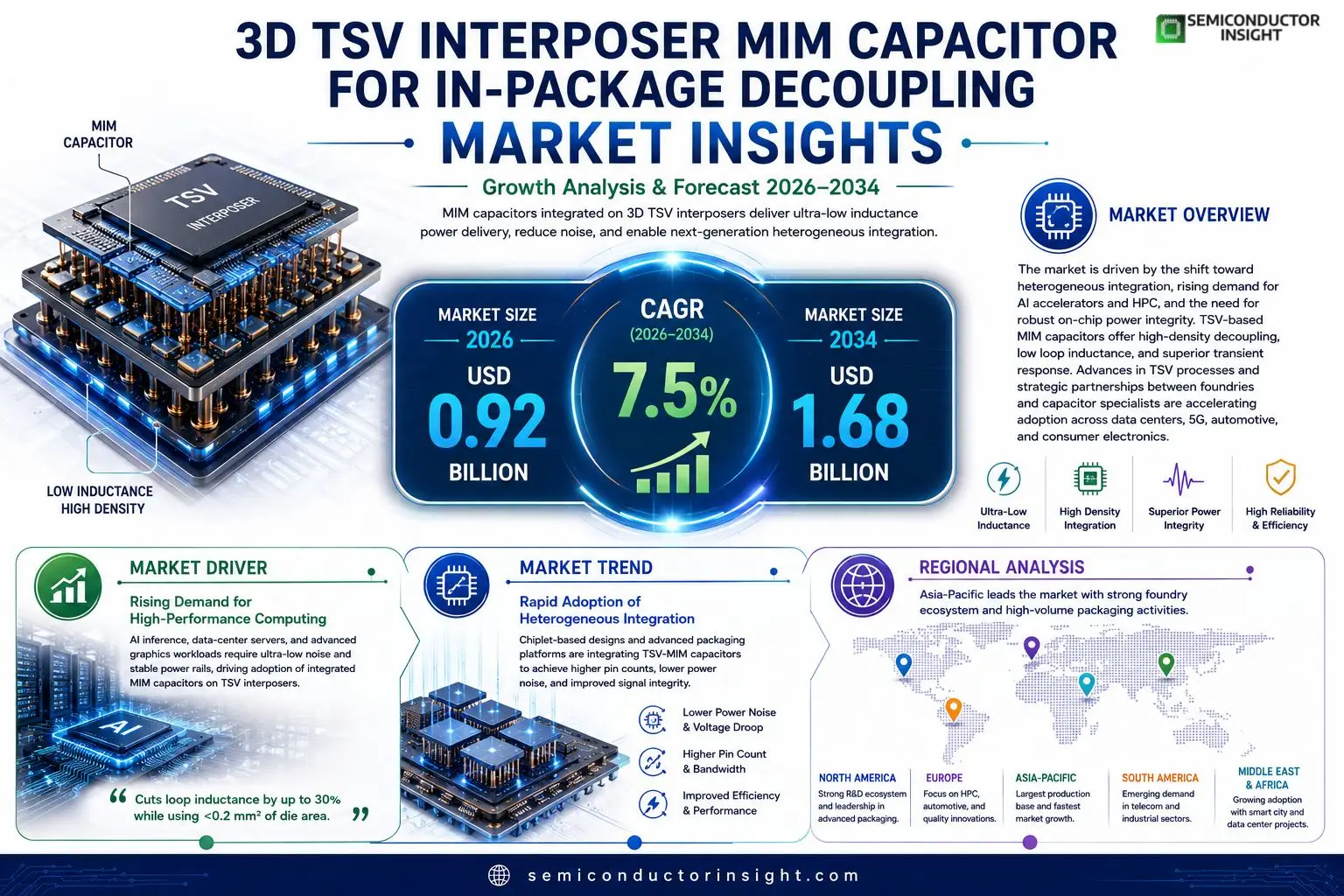
3D TSV interposer MIM capacitor for in‑package decoupling market size was valued at USD 0.85 billion in 2025. The market is projected to grow from USD 0.92 billion in 2026 to USD 1.68 billion by 2034, exhibiting a CAGR of 7.5% during the forecast period.
A MIM (Metal‑Insulator‑Metal) capacitor integrated on a three‑dimensional through‑silicon‑via (TSV) interposer provides high‑density decoupling directly within the package stack‑up. This architecture enables low‑inductance power delivery, reduces signal noise, and supports the increasing pin counts of advanced heterogeneous integration platforms such as AI accelerators and high‑performance computing modules.The market is accelerating because semiconductor manufacturers are shifting toward heterogeneous integration to meet demand for higher bandwidth and lower power consumption. Furthermore, the rise of chiplet‑based designs and the need for robust on‑chip power integrity are driving adoption of TSV‑based MIM capacitors. Leading foundries and packaging specialists are expanding their portfoliosrecently, a major foundry announced a partnership with a capacitor supplier to qualify a new TSV‑MIM solution for next‑generation compute chipsfurther fueling growth.
MARKET DRIVERS
Rising Demand for High‑Performance Computing
3D TSV interposer MIM capacitor for in-package decoupling Market is being propelled by an accelerating need for compute‑intensive workloads such as AI inference, data‑center servers, and advanced graphics. System‑level designers are seeking solutions that minimize power‑rail noise while preserving signal integrity, which directly drives adoption of integrated MIM capacitors on TSV interposers.
Advancements in Miniaturization and Power Integrity
Recent process refinements in silicon‑through‑via (TSV) fabrication enable tighter pitch and thinner dielectric layers, allowing MIM capacitors to be placed closer to active devices. This reduces loop inductance and improves transient response, making the technology attractive for next‑generation smartphones and wearables where space is at a premium.
➤ Integrating MIM capacitors on TSV interposers can cut loop inductance by up to 30 % while occupying less than 0.2 mm² of die area.
Overall, the convergence of performance‑driven applications and manufacturing breakthroughs creates a robust growth trajectory for the market, with industry analysts forecasting a compound annual growth rate that outpaces traditional passive‑component segments.
MARKET CHALLENGES
Manufacturing Yield and Process Complexity
Embedding MIM capacitors within 3D TSV interposers adds an extra lithography step and requires precise planarization. Small deviations can lead to dielectric breakdown or capacitance variance, which directly impacts yield. Companies must invest in advanced metrology to maintain consistency, raising the barrier to entry for smaller players.
Other Challenges
Cost Sensitivity
The added process steps increase per‑unit cost, and end‑users are often constrained by tight bill‑of‑materials targets, especially in consumer electronics where price elasticity is high.
MARKET RESTRAINTS
Material Compatibility Constraints
The dielectric materials used for MIM capacitors must be compatible with copper‑filled TSVs to avoid delamination during thermal cycling. Limited availability of high‑k dielectrics that meet reliability standards can constrain design flexibility.Furthermore, the thermal expansion mismatch between silicon and certain ceramic dielectrics can introduce stress, potentially leading to premature failure under high‑frequency operation.
MARKET OPPORTUNITIES
Emerging Applications in AI Accelerators
AI‑focused processors require ultra‑low‑noise power delivery networks to sustain high‑speed tensor operations. 3D TSV interposer MIM capacitor for in-package decoupling Market is uniquely positioned to meet these requirements, offering localized energy storage that reduces voltage droop during bursty workloads. Early collaborations between semiconductor fabs and AI chip designers indicate a growing pipeline of products that will rely on this technology.Additionally, the push toward heterogeneous integrationcombining logic, memory, and RF modules on a single interposercreates new design windows where embedded MIM capacitors can replace discrete decoupling components, further expanding market potential.
3D TSV interposer MIM capacitor for in-package decoupling Market Trends
Rapid Adoption of Heterogeneous Integration
3D TSV interposer MIM capacitor for in-package decoupling Market is being propelled by the shift toward heterogeneous integration across advanced compute platforms. By embedding MIM capacitors directly on TSV interposers, designers achieve markedly lower inductance and superior power‑delivery performance, which is essential for AI accelerators and high‑performance computing modules. This architecture also supports higher pin counts and tighter form factors, enabling chiplet‑based designs to meet stringent bandwidth and power‑efficiency targets without sacrificing signal integrity.
Other Trends
Strategic Partnerships and Supply Chain Expansion
Leading foundries and packaging specialists are forming strategic alliances with capacitor manufacturers to qualify next‑generation TSV‑MIM solutions. These collaborations accelerate technology transfer, streamline qualification cycles, and ensure that the supply chain can meet the escalating demand for on‑chip power‑integrity components. Concurrently, investment in advanced silicon‑through processes is expanding capacity, reducing lead times, and fostering a robust ecosystem that supports rapid scaling of heterogeneous designs across multiple semiconductor segments.
Emerging Applications in Edge and Automotive Domains
Beyond data‑center compute, 3D TSV interposer MIM capacitor for in-package decoupling Market is gaining traction in edge‑computing and automotive electronic systems. The need for compact, high‑density power‑decoupling solutions aligns with the growing integration of sensor arrays, radar modules, and autonomous‑driving processors, where reliable power delivery under harsh environmental conditions is critical. As these sectors prioritize miniaturization and stringent reliability standards, the adoption of TSV‑based MIM capacitors is expected to reinforce their roadmap toward higher functionality within constrained footprints.
COMPETITIVE LANDSCAPE
Key Industry Players
Competitive Outlook for 3D TSV Interposer MIM Capacitor Market
3D TSV interposer MIM capacitor market, valued at approximately USD 0.85 billion in 2025, is dominated by leading foundries that integrate high‑density decoupling into advanced package stacks. TSMC, Samsung Electronics, and Intel command the majority of qualified volume production, leveraging extensive TSV expertise and in‑house capacitor design to deliver low‑inductance power‑delivery solutions for AI accelerators and HPC modules. These incumbents benefit from deep R&D investments, strategic partnerships with capacitor specialists, and economies of scale that shape a consolidated market structure projected to reach USD 1.68 billion by 2034 with a 7.5% CAGR.Beyond the tier‑one tier, a cohort of niche players enriches the ecosystem with differentiated technologies and packaging services. ASE Group and Amkor Technology provide advanced flip‑chip and interposer assembly capabilities that enable rapid qualification of TSV‑MIM designs. STMicroelectronics, Infineon Technologies, and NXP Semiconductors contribute proprietary dielectric materials and thin‑film processes, while capacitor manufacturers such as KEMET, Murata and Vishay Supply offer customized MIM structures optimized for high‑frequency decoupling. This diversified landscape supports a vibrant supply chain that accelerates adoption across chiplet‑based platforms and heterogeneous integration strategies.
List of Key 3D TSV Interposer MIM Capacitor Companies Profiled
- TSMC
- Samsung Electronics
- Intel Corporation
- Foundries
- ASE Group
- Amkor Technology
- STMicroelectronics
- Infineon Technologies
- NXP Semiconductors
- KEMET Corporation
- Murata Manufacturing
- Vishay Intertechnology
- Broadcom Inc.
- Qualcomm Incorporated
- Advanced Micro Devices (AMD)
Segment Analysis:
| Segment Category | Sub-Segments | Key Insights |
| By Type |
|
Silicon Interposer TSV‑MIM – Preferred for its superior thermal conductivity and mechanical robustness, enabling dense stacking of high‑performance compute modules. – Supports the aggressive scaling of pin counts while maintaining low inductance paths for power delivery. – Aligns closely with leading foundry roadmaps that emphasize heterogeneous integration and chiplet ecosystems. |
| By Application |
|
AI Accelerators – Demand ultra‑low‑noise power rails to sustain peak AI inference workloads, making TSV‑MIM decoupling essential for stable voltage domains. – The dense vertical integration permits tighter floorplans, reducing signal latency across compute clusters. – Enables rapid iteration of chiplet‑based AI architectures where power integrity is a primary design constraint. |
| By End User |
|
Foundries – View TSV‑MIM capacitors as a strategic enabler for next‑generation heterogeneous platforms, integrating them into standard process design kits. – Leverage partnerships with capacitor specialists to co‑qualify solutions, accelerating time‑to‑market for advanced compute chips. – Emphasize design‑for‑power‑integrity to differentiate their offering in a competitive packaging landscape. |
| By Technology |
|
Thin‑Film MIM – Offers exceptional capacitance density within a minimal footprint, crucial for space‑constrained package stacks. – Provides consistent dielectric reliability across thermal cycles, aligning with high‑reliability compute modules. – Facilitates seamless integration with TSV structures, reducing process complexity for foundries. |
| By Integration Approach |
|
Chiplet‑Based Integration – Leverages TSV‑MIM capacitors to provide localized decoupling for each functional chiplet, enhancing overall system stability. – Enables modular redesign of compute blocks without redesigning the entire power delivery network. – Aligns with industry movement toward flexible, mix‑and‑match chiplet ecosystems that demand robust on‑chip power solutions. |
Regional Analysis: 3D TSV interposer MIM capacitor for in-package decoupling Market
North America
Companies leverage mature CMOS fabs alongside specialized TSV bonding lines, enabling seamless insertion of MIM capacitors within high‑density interposers. This integration reduces signal loss and enhances thermal performance across complex packages.
A resilient supplier network for high‑purity dielectric films and electro‑plating services ensures consistent material quality, mitigating lead‑time risks for large‑scale production runs.
Heavy funding directed toward low‑k dielectric research and TSV‑aligned capacitor architectures sustains a pipeline of next‑generation decoupling solutions tailored for AI accelerators.
Streamlined compliance processes for advanced packaging promote faster market entry, while environmental guidelines drive adoption of lead‑free, low‑impact manufacturing methods.
Europe
Europe’s strong emphasis on high‑performance computing and automotive safety standards fuels steady interest in the 3D TSV interposer MIM capacitor for in‑package decoupling Market. Collaborative research programs across Germany, France, and the Netherlands focus on reducing interconnect parasitics, while niche players specialize in low‑loss dielectric materials. Although supply chain complexity can be higher than in North America, stringent quality certifications enhance customer confidence. The region’s regulatory framework encourages eco‑friendly processes, prompting manufacturers to adopt lead‑free MIM capacitor formulations. As a result, Europe maintains a solid foothold, particularly in precision‑engineered modules for autonomous vehicles and edge‑AI devices.
Asia‑Pacific
Asia‑Pacific exhibits rapid growth driven by massive production capacities in China, Taiwan, and South Korea. The region’s cost‑effective fabs enable large‑volume fabrication of TSV‑enabled interposers, supporting the expanding demand for consumer electronics and data‑center processors. Local incumbents are increasingly investing in advanced dielectric stacks to improve capacitance density, thereby narrowing the performance gap with Western rivals. Trade policies and strategic subsidies further accelerate adoption, while emerging talent pools enhance design expertise. Nonetheless, challenges such as IP protection and environmental regulatory alignment remain focal points for sustained market maturation.
South America
South America remains an emerging market for the 3D TSV interposer MIM capacitor for in‑package decoupling sector. Brazil’s semiconductor initiatives and Brazil‑Chile collaborations aim to establish localized design houses capable of integrating advanced interposer technologies. Although current manufacturing infrastructure is limited, growing demand for telecommunications infrastructure and renewable‑energy converters creates a pipeline for future adoption. Stakeholders emphasize capacity‑building and technology transfer to bridge the expertise gap, positioning the region for gradual expansion over the forecast horizon.
Middle East & Africa
The Middle East & Africa region shows nascent interest, primarily driven by smart‑city projects and increasing data‑center deployments in the Gulf states. Initiatives to develop local semiconductor design capabilities, combined with strategic partnerships with fab operators, are laying the groundwork for future integration of 3D TSV interposer MIM capacitors. While the ecosystem is still developing, government incentives for high‑tech manufacturing and a focus on sustainable energy solutions could catalyze market entry in the coming decade.
Report Scope
This market research report provides a comprehensive analysis of the 3D TSV interposer MIM capacitor for in-package decoupling Market , covering the forecast period 2026–2034. It offers detailed insights into market dynamics, technological advancements, competitive landscape, and key trends shaping the industry.
Key focus areas of the report include:
- Market Overview: The report begins with an overview outlining its current market scenario, key growth indicators, and industry transformation drivers. It discusses macroeconomic factors, demand–supply balance, regulatory landscape, and the strategic role of semiconductors in powering advancements across industries such as automotive, telecommunications, consumer electronics, and industrial automation.
- Market Size & Forecast: Historical data and future projections for revenue, unit shipments, and market value across major regions and segments.
- Segmentation Analysis: Detailed breakdown by product type, technology, application, and end-user industry to identify high-growth segments and investment opportunities.
- Regional Insights: Insights into market performance across North America, Europe, Asia-Pacific, Latin America, and the Middle East & Africa, including country-level analysis where relevant.
- Competitive Landscape: Profiles of leading market participants, including their product offerings, R&D focus, manufacturing capacity, pricing strategies, and recent developments such as mergers, acquisitions, and partnerships.
- Technology Trends & Innovation: Assessment of emerging technologies, integration of AI/IoT, semiconductor design trends, fabrication techniques, and evolving industry standards.
- Market Drivers & Restraints: Evaluation of factors driving market growth along with challenges, supply chain constraints, regulatory issues, and market-entry barriers.
- Stakeholder Insights: Insights for component suppliers, OEMs, system integrators, investors, and policymakers regarding the evolving ecosystem and strategic opportunities.
Primary and secondary research methods are employed, including interviews with industry experts, data from verified sources, and real-time market intelligence to ensure the accuracy and reliability of the insights presented.
FREQUENTLY ASKED QUESTIONS:
What is the current market size of 3D TSV interposer MIM capacitor for in-package decoupling Market?
-> 3D TSV interposer MIM capacitor for in-package decoupling Market was valued at USD 0.85 billion in 2025 and is expected to reach USD 1.68 billion by 2034, reflecting a CAGR of 7.5% over the forecast period.
Which key companies operate in 3D TSV interposer MIM capacitor for in-package decoupling Market?
-> Key players include major semiconductor foundries and advanced packaging specialists such as TSMC, Intel, Samsung, ASE Group and Amkor Technology, among others.
What are the key growth drivers?
-> Key growth drivers include the shift toward heterogeneous integration, increasing adoption of chiplet‑based designs, and the need for robust on‑chip power integrity to support AI accelerators and high‑performance computing modules.
Which region dominates the market?
-> Asia‑Pacific leads the market due to the concentration of leading foundries and high‑volume packaging activities, while North America remains a significant contributor.
What are the emerging trends?
-> Emerging trends include integration of TSV‑based MIM capacitors in chiplet ecosystems, advanced materials for higher capacitance density, and co‑design of power‑delivery networks with AI‑enabled design automation.
Get Sample Report PDF for Exclusive Insights
Report Sample Includes
- Table of Contents
- List of Tables & Figures
- Charts, Research Methodology, and more...