3D Narrow Band Filters Market Insights
3D Narrow Band Filters market size was valued at USD 285 million in 2025. The market is projected to grow from USD 285 million in 2025 to USD 406 million by 2034, exhibiting a CAGR of 5.3% during the forecast period.
3D narrow band filters play a key role in 3D imaging and can be manufactured through all-dielectric hard-coating technology. These filters are characterized by high light transmission efficiency, high cut-off rate, small optical signal attenuation rate, and wider bandwidth , collectively contributing to improved imaging clarity and accuracy across a range of optical and sensing applications.
The market is witnessing steady growth driven by rising adoption of 3D sensing technologies across consumer electronics, automotive LiDAR systems, and industrial machine vision. Furthermore, the proliferation of facial recognition systems and augmented reality platforms has significantly amplified the demand for precision optical components. Key players operating in 3D Narrow Band Filters market include Viavi Solutions Inc., Alluxa, Edmund Optics, Iridian Spectral Technologies, and Semrock (IDEX Health & Science), each offering diversified product portfolios catering to high-performance optical filtering requirements.
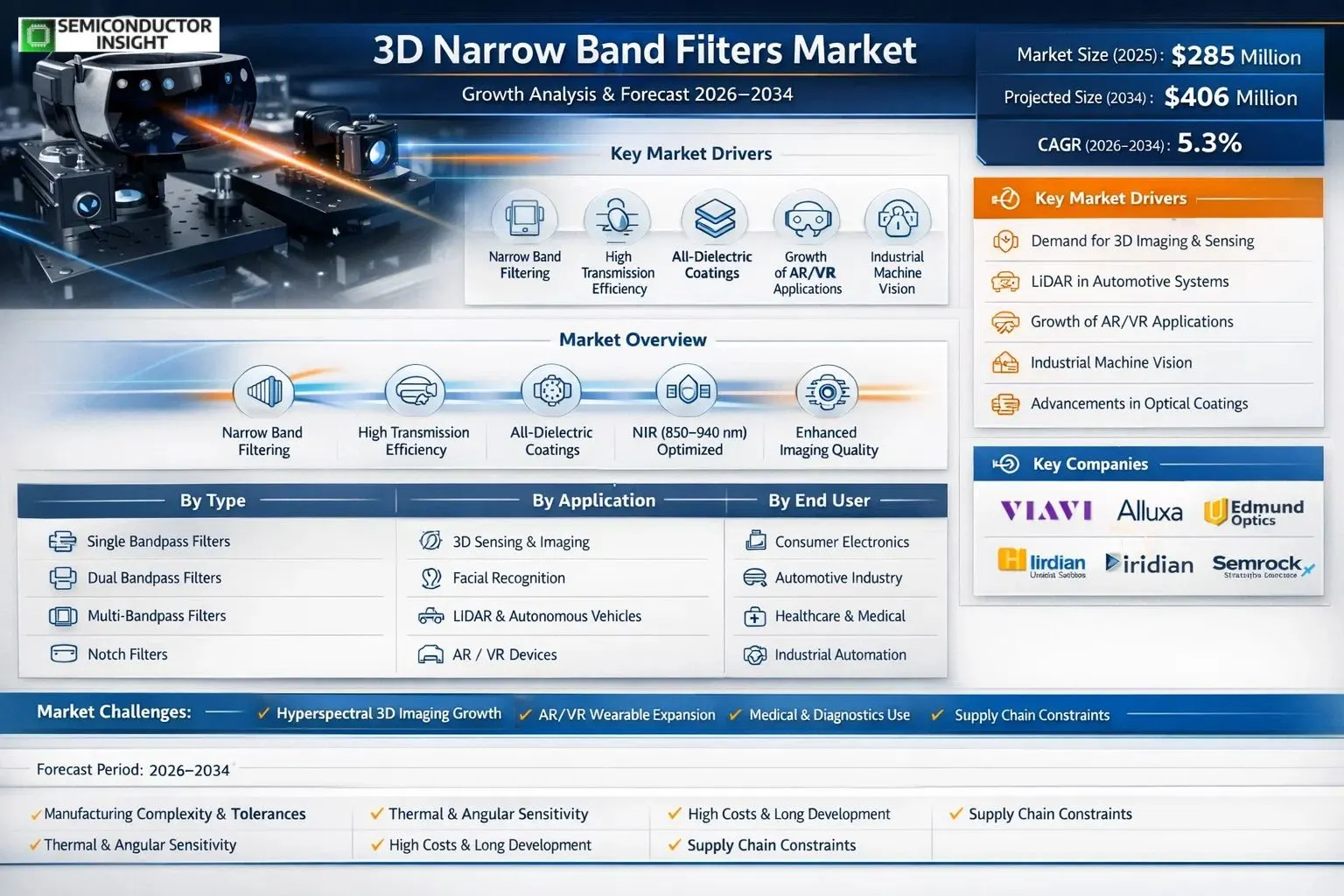
MARKET DRIVERS
Rising Demand for Advanced Optical Imaging Systems in Scientific and Industrial Applications
The 3D Narrow Band Filters Market is experiencing significant momentum driven by the accelerating adoption of advanced optical imaging technologies across scientific research, semiconductor inspection, and industrial machine vision sectors. Narrow band filters, which transmit only a specific, tightly controlled range of wavelengths, are increasingly critical in 3D imaging systems that require high spectral precision to distinguish depth, surface texture, and material composition. As industries push toward greater automation and quality control, the requirement for filters capable of operating within 3D structured light and time-of-flight (ToF) systems has expanded considerably, creating a sustained upward trajectory in market demand.
Expansion of LiDAR and 3D Sensing Technologies in Automotive and Consumer Electronics
One of the most consequential drivers propelling the 3D Narrow Band Filters Market forward is the rapid integration of LiDAR and 3D depth-sensing modules in automotive advanced driver-assistance systems (ADAS) and consumer electronics. Narrow band optical filters are essential components in these systems, enabling precise isolation of specific laser wavelengths , typically in the 850 nm to 940 nm near-infrared range , while suppressing ambient light interference. The global push toward autonomous vehicle development and the proliferation of facial recognition and augmented reality features in smartphones have created a robust demand environment for high-performance narrow band filters optimized for 3D sensing applications.
➤ The integration of 3D narrow band filters in next-generation LiDAR modules is anticipated to redefine optical precision standards in autonomous systems, with filter transmission efficiencies increasingly exceeding 90% at target wavelengths while maintaining out-of-band blocking of optical density 4 or higher.
Furthermore, the growing deployment of structured light 3D scanning systems in medical imaging, dental diagnostics, and dermatology has opened new application corridors for the 3D Narrow Band Filters Market. Medical-grade 3D imaging platforms demand filters with exceptional uniformity across large apertures and superior thermal stability to ensure diagnostic accuracy. This convergence of healthcare digitization and optical technology innovation continues to reinforce demand across both developed and emerging markets, underlining the multi-sector nature of the key growth drivers shaping this market landscape.
MARKET CHALLENGES
High Manufacturing Complexity and Stringent Tolerances Constraining Scalable Production
Despite strong demand signals, the 3D Narrow Band Filters Market faces notable challenges rooted in the inherent complexity of producing filters with the spectral precision required for 3D imaging applications. Manufacturing narrow band optical filters involves sophisticated thin-film deposition techniques such as ion beam sputtering (IBS) and plasma-assisted chemical vapor deposition (PECVD), processes that demand highly controlled environments and precise layer thickness management at the nanometer scale. Any deviation in coating uniformity can result in spectral shift or passband inconsistency, leading to elevated rejection rates and increased production costs. These technical barriers limit the number of qualified suppliers capable of consistently delivering high-performance 3D narrow band filters at scale, creating supply concentration risks across the value chain.
Other Challenges
Thermal and Angular Sensitivity Issues
A significant technical challenge in the 3D Narrow Band Filters Market involves the sensitivity of narrow band filters to temperature fluctuations and angle of incidence variations. As the angle of incoming light deviates from the filter’s design specification, the central wavelength of the passband shifts toward shorter wavelengths, a phenomenon known as blue-shift. In dynamic 3D sensing environments , such as automotive LiDAR operating under extreme thermal conditions or mobile AR devices subject to varying usage angles , maintaining consistent spectral performance poses a persistent engineering challenge that requires either advanced filter design compensations or additional system-level calibration mechanisms.
Intense Price Competition from Low-Cost Regional Manufacturers
The market also contends with growing pricing pressure as manufacturers based in cost-competitive regions introduce narrow band filter products at substantially lower price points. While these offerings may serve less demanding applications, they create margin compression challenges for established precision filter manufacturers and can distort purchasing decisions in price-sensitive industrial segments. Maintaining differentiation based on performance, reliability, and application-specific customization remains a central commercial challenge for leading players in the 3D Narrow Band Filters Market.
MARKET RESTRAINTS
Elevated Capital Requirements and Long Development Cycles Limiting New Market Entrants
A primary restraint impacting the growth trajectory of the 3D Narrow Band Filters Market is the substantial capital investment required to establish competitive thin-film optical coating capabilities. High-precision deposition equipment, cleanroom infrastructure, and metrology systems necessary for quality validation represent significant upfront expenditures that create formidable barriers to entry for new participants. Additionally, the development of application-specific 3D narrow band filter solutions involves extended iterative design and validation cycles, particularly in regulated sectors such as medical devices and aerospace, where optical component qualification processes are governed by rigorous international standards. These dynamics slow overall market capacity expansion and constrain competitive diversification.
Supply Chain Vulnerabilities in Specialty Optical Materials and Substrates
The 3D Narrow Band Filters Market is further restrained by vulnerabilities in the supply chains for specialty optical substrates and coating materials, including high-purity fused silica, borosilicate glass, and rare-earth oxide coating compounds. Geopolitical disruptions, export controls on critical materials, and the limited number of qualified specialty glass and coating material suppliers introduce procurement risks that can delay production schedules and inflate input costs. These supply chain constraints are particularly acute for manufacturers producing filters for defense, aerospace, and semiconductor inspection applications, where material traceability and certification requirements add additional layers of procurement complexity to an already specialized sourcing environment within the broader narrow band optical filters industry.
MARKET OPPORTUNITIES
Emerging Applications in Hyperspectral 3D Imaging for Precision Agriculture and Environmental Monitoring
The convergence of hyperspectral imaging and 3D spatial mapping technologies presents a compelling growth opportunity for the 3D Narrow Band Filters Market. In precision agriculture, drone-mounted hyperspectral 3D imaging systems equipped with multiple narrow band filters are being deployed to assess crop health, detect soil moisture gradients, and identify pest infestations with spatial accuracy previously unattainable. Similarly, environmental monitoring platforms leveraging 3D spectral imaging for atmospheric composition analysis and land surface mapping are generating new procurement cycles for high-performance narrow band optical filters. As these applications transition from research deployments to commercial-scale operations, they are expected to represent a meaningful incremental demand segment for filter manufacturers with demonstrated capability in multi-wavelength 3D optical systems.
Accelerating Adoption of Augmented Reality Headsets and Wearable 3D Sensing Platforms
The commercialization of augmented reality (AR) headsets and wearable spatial computing devices represents one of the most strategically significant long-term opportunities in the 3D Narrow Band Filters Market. These devices rely on compact, precisely engineered narrow band filters to enable accurate eye-tracking, hand gesture recognition, and environmental depth mapping in varied ambient lighting conditions. As leading technology developers advance toward mass-market AR hardware platforms, demand for miniaturized, substrate-thin 3D narrow band filters compatible with wafer-level optics manufacturing processes is expected to scale substantially. Filter manufacturers investing in wafer-level coating technologies and collaborative optical design partnerships with AR hardware developers are well-positioned to capture disproportionate value from this structural market opportunity over the coming years.
MAIN TITLE HERE () Trends
Rising Adoption of 3D Imaging Technology Driving Demand in the 3D Narrow Band Filters Market
The 3D Narrow Band Filters Market is experiencing steady growth as demand for precision optical components intensifies across medical imaging, machine vision, and consumer electronics sectors. These filters, manufactured using advanced all-dielectric hard-coating technology, are engineered to deliver high light transmission efficiency, elevated cut-off rates, and minimal optical signal attenuation , characteristics that are becoming increasingly critical in high-performance 3D imaging systems. As industries prioritize imaging clarity and depth accuracy, narrow band filters have emerged as essential components in structured light and time-of-flight (ToF) sensing applications.
Other Trends
Expansion in Medical and Industrial Imaging Applications
One of the most prominent trends shaping the 3D Narrow Band Filters Market is the growing integration of 3D imaging solutions in medical diagnostics and industrial inspection systems. In medical imaging, narrow band filters enhance the accuracy of fluorescence imaging and endoscopic procedures by isolating specific wavelengths while eliminating background noise. In industrial environments, machine vision systems leveraging these filters enable precise defect detection and dimensional measurement, driving consistent adoption across automotive manufacturing and semiconductor inspection sectors.
Advancements in Hard-Coating and Filter Manufacturing Processes
Technological progress in all-dielectric hard-coating methods continues to redefine performance benchmarks within the 3D Narrow Band Filters Market. Manufacturers are achieving tighter bandwidth tolerances and improved environmental durability, allowing filters to perform reliably under varying temperature and humidity conditions. These advancements are enabling filter designers to address increasingly specialized optical requirements across scientific instrumentation, LiDAR systems, and augmented reality (AR) devices.
Growing Role in Consumer Electronics and AR/VR Devices
The rapid proliferation of AR and VR headsets, along with facial recognition modules in smartphones, is generating sustained demand for compact, high-performance narrow band optical filters. As consumer electronics manufacturers integrate more sophisticated 3D sensing capabilities into handheld and wearable devices, the 3D Narrow Band Filters Market is benefiting from increased volume requirements and a push toward miniaturized filter form factors without compromising optical precision.
Asia-Pacific Emerging as a Key Manufacturing and Consumption Hub
Asia-Pacific is increasingly asserting its influence in the 3D Narrow Band Filters Market, driven by a robust electronics manufacturing base in China, Japan, South Korea, and Taiwan. The region’s concentration of optical component manufacturers, combined with rising investments in semiconductor and consumer electronics production, positions it as both a major supplier and consumer of narrow band filter technologies. This regional momentum, paired with growing research activity in photonics and optical engineering, is expected to sustain the market’s upward trajectory through the coming years.
COMPETITIVE LANDSCAPE
Key Industry Players
Global 3D Narrow Band Filters Market: Competitive Dynamics, Leading Manufacturers, and Strategic Positioning
3D Narrow Band Filters market, valued at approximately USD 285 million in 2025 and projected to reach USD 406 million by 2034 at a CAGR of 5.3%, is characterized by a moderately consolidated competitive landscape. Viavi Solutions Inc. stands out as one of the dominant forces in this space, leveraging its advanced optical coating expertise and extensive manufacturing capabilities to serve key end-use sectors including consumer electronics, automotive LiDAR systems, and industrial 3D sensing applications. Other major incumbents such as Alluxa, Iridian Spectral Technologies, and Semrock (a part of IDEX Health & Science) maintain strong footholds by offering high-performance all-dielectric hard-coating technologies that deliver superior light transmission efficiency, high cut-off rates, and minimal optical signal attenuation , attributes increasingly demanded in precision 3D imaging environments. The competitive intensity is further shaped by ongoing R&D investments directed at expanding bandwidth capabilities and improving filter durability across a range of operating temperatures and environmental conditions.
Beyond the dominant players, the 3D Narrow Band Filters market also features a number of strategically significant niche manufacturers and regional specialists. Companies such as Edmund Optics, Omega Optical, Photon Dynamics, Materion Precision Optics, Sydor Optics, Spectrogon, Andover Corporation, and Koshin Kogaku Co., Ltd. contribute meaningfully to the competitive ecosystem by addressing specialized application requirements in scientific imaging, medical diagnostics, machine vision, and augmented reality (AR) systems. These players differentiate through custom filter design, rapid prototyping services, and application-specific coating expertise. The entry of Asian manufacturers, particularly from China and Japan, is gradually intensifying price competition, prompting established Western players to pivot toward value-added services and premium optical performance as key differentiators in sustaining their market positions.
List of Key 3D Narrow Band Filters Companies Profiled
- Viavi Solutions Inc.
- Alluxa
- Iridian Spectral Technologies
- Semrock (IDEX Health & Science)
- Edmund Optics
- Omega Optical
- Materion Precision Optics
- Sydor Optics
- Spectrogon AB
- Andover Corporation
- Koshin Kogaku Co., Ltd.
- Chroma Technology Corporation
- Photon Dynamics
- Optolong Optics Co., Ltd.
- Daheng New Epoch Technology, Inc.
Segment Analysis:
| Segment Category | Sub-Segments | Key Insights |
| By Type |
|
Single Bandpass Narrow Band Filters represent the leading segment within the By Type category, owing to their widespread adoption across standard 3D imaging systems and structured light applications.
|
| By Application |
|
3D Sensing & Depth Imaging stands as the dominant application segment, driven by the proliferation of advanced imaging systems across multiple high-growth industries.
|
| By End User |
|
Consumer Electronics Manufacturers emerge as the leading end-user segment, fueled by the rapid incorporation of 3D sensing modules into smartphones, tablets, wearables, and smart home devices.
|
| By Coating Technology |
|
All-Dielectric Hard Coating is the dominant technology segment, widely recognized as the industry benchmark for manufacturing high-performance 3D narrow band filters.
|
| By Wavelength Range |
|
Near-Infrared (NIR) Range filters represent the leading wavelength segment, underpinned by their extensive use in structured light and ToF-based 3D sensing systems across consumer, automotive, and industrial applications.
|
Regional Analysis: 3D Narrow Band Filters Market
North America
North America’s 3D narrow band filters market benefits from a deeply embedded culture of optical and photonic research. Universities, national laboratories, and private R&D centers collaborate to push the boundaries of filter precision, spectral performance, and miniaturization. This innovation ecosystem positions the region ahead of global peers in developing next-generation filter solutions for emerging applications.
The defense and aerospace sectors remain among the most significant end-users of 3D narrow band filters in North America. Military-grade optical systems, target recognition platforms, and satellite imaging instruments rely heavily on high-performance narrow band filters. Sustained government procurement programs and modernization initiatives ensure consistent and growing demand from these strategically important sectors.
The rapid expansion of autonomous vehicle programs and augmented reality platforms across North America is creating substantial new demand for precision optical components. 3D narrow band filters play a critical role in LiDAR sensor systems and mixed-reality headsets, where accurate spectral isolation is essential for reliable performance. This emerging application base is becoming a key growth driver in the regional market.
North America benefits from well-established domestic supply chains and supportive regulatory policies that prioritize local manufacturing of sensitive optical technologies. These factors reduce dependency on foreign sourcing and provide market stability. Government incentives aimed at bolstering domestic photonics production are expected to further consolidate the region’s leadership position in the 3D narrow band filters market through the forecast period.
Europe
Europe represents a mature and technologically sophisticated segment of 3D Narrow Band Filters market. The region’s strength lies in its precision engineering heritage, particularly in countries such as Germany, France, and the Netherlands, which are home to world-renowned optics and photonics manufacturers. European demand is substantially shaped by the region’s thriving medical imaging, industrial machine vision, and scientific instrumentation sectors, all of which require highly accurate spectral filtering solutions. The European Union’s strategic commitment to advancing its photonics industry through coordinated research programs and funding mechanisms provides additional momentum. Growing adoption of 3D sensing technologies in automotive safety systems, particularly in Germany’s dominant automotive manufacturing sector, is creating meaningful new application pathways for narrow band filter producers. Stringent quality and environmental standards in Europe also encourage innovation in filter durability and performance efficiency, raising the overall quality benchmark for the regional market.
Asia-Pacific
The Asia-Pacific region is emerging as the fastest-growing market for 3D narrow band filters, underpinned by rapid industrialization, expanding electronics manufacturing ecosystems, and significant government-led investments in technology development. China stands at the forefront of this growth, leveraging its massive consumer electronics production base and strategic national initiatives in semiconductor and photonics self-sufficiency. Japan and South Korea contribute advanced manufacturing capabilities and a strong tradition of optical component innovation, supporting both domestic demand and global export markets. India is progressively strengthening its position through expanding defense modernization programs and a growing medical technology sector. The proliferation of smartphones equipped with sophisticated 3D sensing cameras, combined with increasing deployment of LiDAR in smart city and infrastructure applications across the region, is generating robust and sustained demand for narrow band filter technologies throughout Asia-Pacific.
South America
South America presents a developing yet gradually maturing landscape for the 3D narrow band filters market. Brazil leads regional activity, supported by a diversifying industrial base and increasing investments in scientific research infrastructure. Demand within South America is primarily concentrated in academic and research institutions, select medical imaging applications, and emerging industrial automation sectors. While the region currently lacks the large-scale domestic manufacturing capacity seen in North America or Asia-Pacific, growing partnerships with international technology suppliers are helping to bridge this gap. Economic stabilization efforts and targeted government support for technology-intensive industries are creating conditions for longer-term market development. As regional awareness of advanced optical technologies grows and industrial modernization accelerates, South America is expected to offer incremental but consistent growth opportunities for participants in the 3D narrow band filters market over the forecast period.
Middle East & Africa
The Middle East and Africa region occupies a nascent but strategically noteworthy position in 3D Narrow Band Filters market. Demand is primarily driven by defense and security applications, particularly in Gulf Cooperation Council countries where significant investments in military modernization and border surveillance infrastructure are ongoing. The United Arab Emirates and Saudi Arabia are the most active markets, supported by ambitious national technology diversification programs that encourage adoption of advanced optical and sensing technologies. In Africa, market development remains at an early stage, with demand concentrated in specialized scientific and research applications. Long-term growth prospects for the region are tied to broader infrastructure development, increasing technology transfer initiatives, and the gradual expansion of industrial and healthcare sectors that rely on precision optical components. Strategic international partnerships are expected to play a key role in shaping market evolution across the Middle East and Africa.
Report Scope
This market research report provides a comprehensive analysis of the 3D Narrow Band Filters Market , covering the forecast period 2026–2034. It offers detailed insights into market dynamics, technological advancements, competitive landscape, and key trends shaping the industry.
Key focus areas of the report include:
- Market Overview: The report begins with an overview outlining its current market scenario, key growth indicators, and industry transformation drivers. It discusses macroeconomic factors, demand–supply balance, regulatory landscape, and the strategic role of semiconductors in powering advancements across industries such as automotive, telecommunications, consumer electronics, and industrial automation.
- Market Size & Forecast: Historical data and future projections for revenue, unit shipments, and market value across major regions and segments.
- Segmentation Analysis: Detailed breakdown by product type, technology, application, and end-user industry to identify high-growth segments and investment opportunities.
- Regional Insights: Insights into market performance across North America, Europe, Asia-Pacific, Latin America, and the Middle East & Africa, including country-level analysis where relevant.
- Competitive Landscape: Profiles of leading market participants, including their product offerings, R&D focus, manufacturing capacity, pricing strategies, and recent developments such as mergers, acquisitions, and partnerships.
- Technology Trends & Innovation: Assessment of emerging technologies, integration of AI/IoT, semiconductor design trends, fabrication techniques, and evolving industry standards.
- Market Drivers & Restraints: Evaluation of factors driving market growth along with challenges, supply chain constraints, regulatory issues, and market-entry barriers.
- Stakeholder Insights: Insights for component suppliers, OEMs, system integrators, investors, and policymakers regarding the evolving ecosystem and strategic opportunities.
Primary and secondary research methods are employed, including interviews with industry experts, data from verified sources, and real-time market intelligence to ensure the accuracy and reliability of the insights presented.
FREQUENTLY ASKED QUESTIONS:
What is the current market size of 3D Narrow Band Filters Market?
-> Global 3D Narrow Band Filters Market was valued at USD 285 million in 2025 and is expected to reach USD 406 million by 2034, growing at a CAGR of 5.3% during the forecast period.
Which key companies operate in 3D Narrow Band Filters Market?
-> Key players in the 3D Narrow Band Filters Market include leading manufacturers specializing in optical filter technologies, all-dielectric hard-coating solutions, and 3D imaging components, among others.
What are the key growth drivers?
-> Key growth drivers include rising demand for 3D imaging technologies, advancements in all-dielectric hard-coating manufacturing, and increasing need for high light transmission efficiency and improved imaging clarity and accuracy across various end-use industries.
Which region dominates the market?
-> Asia-Pacific is the fastest-growing region driven by expanding electronics and optical manufacturing sectors, while North America remains a dominant market due to strong adoption of advanced 3D imaging technologies.
What are the emerging trends?
-> Emerging trends include all-dielectric hard-coating technology advancements, high cut-off rate filter development, miniaturization of optical components, and integration of narrow band filters in next-generation 3D sensing and imaging applications with wider bandwidth and reduced optical signal attenuation.

Get Sample Report PDF for Exclusive Insights
Report Sample Includes
- Table of Contents
- List of Tables & Figures
- Charts, Research Methodology, and more...
 Download Sample Report PDF