
Key Statistics
Key Takeaways
- Market size: The market is valued at USD 170.45 billion in 2025 and is projected to reach USD 378.76 billion by 2034, representing a 9.3% CAGR during 2026–2034.
- 3D/4D Output Devices is a leading segment, reflecting broad use across the largest volume applications.
- North America leads the market, while Asia Pacific provides the strongest growth profile.
- Entertainment is a major application, supported by rising performance and reliability requirements.
- industrial digital twins, additive manufacturing and immersive visualization is becoming a central competitive differentiator as customers seek higher performance and lower system-level cost.
3D & 4D Technology Market Overview
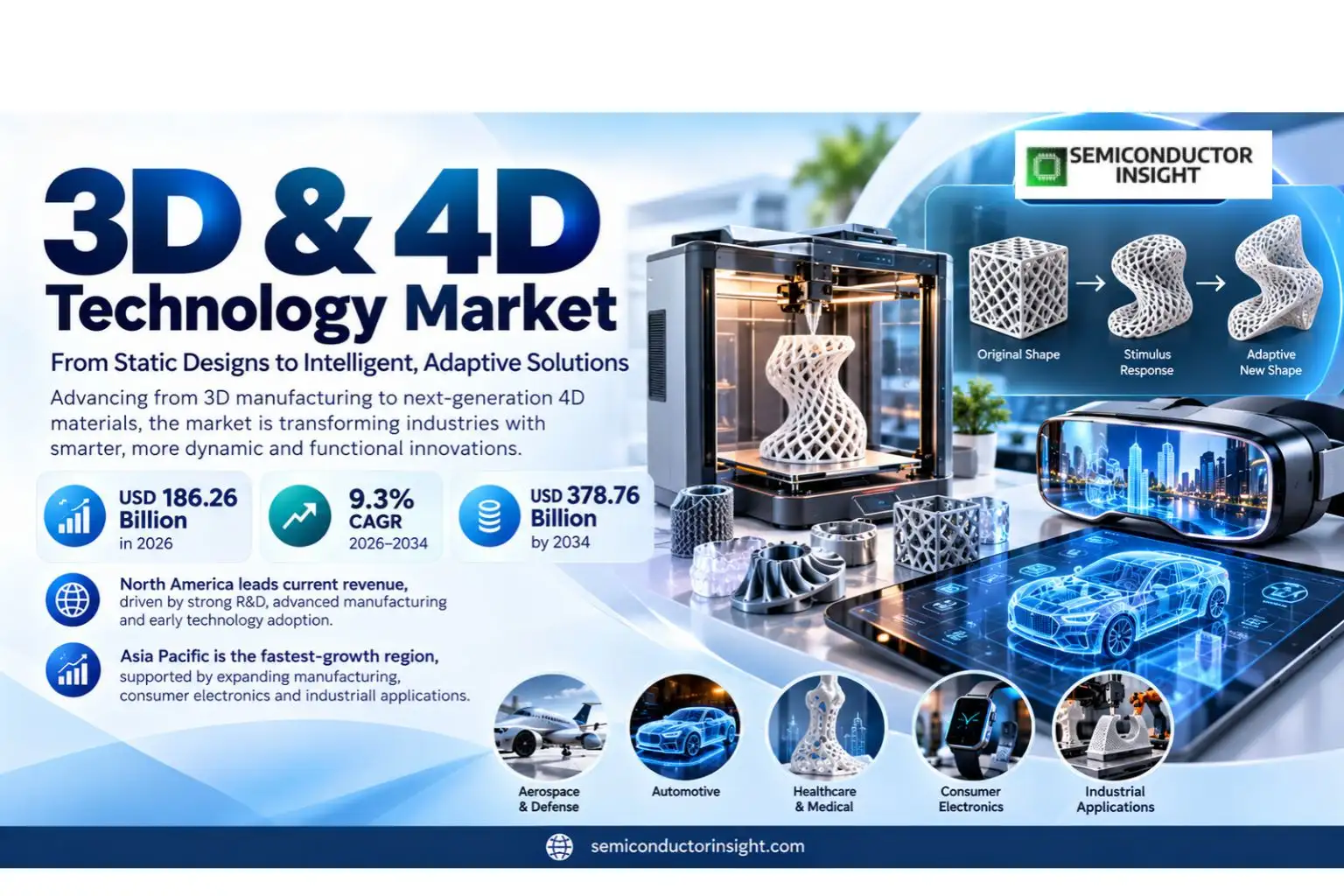
3D and 4D technology market is valued at USD 170.45 billion in 2025 and is projected to reach USD 378.76 billion by 2034, expanding at a 9.3% CAGR during 2026–2034. The 2026 market level is USD 186.26 billion. North America leads current revenue, while Asia Pacific is the fastest-growth region through manufacturing, consumer electronics and industrial adoption. The market spans both mature 3D technologies and emerging 4D adaptive systems.
3D & 4D Technology products provide a critical functional layer inside modern electronic and industrial systems. Their commercial value depends on performance, reliability, manufacturability, qualification and compatibility with the broader hardware architecture. Customers increasingly assess total system impact rather than component price alone, which favors suppliers that combine proven technology with consistent global support.
Technology development is focused on industrial digital twins, additive manufacturing and immersive visualization, tighter integration and more automated manufacturing. These trends raise the value of precision process control and application engineering because smaller geometries, higher data rates or greater power density leave less margin for variation. Qualification therefore becomes a major barrier to entry in premium applications.
Commercial competition combines scale with specialization. Large suppliers benefit from purchasing power, engineering resources and global manufacturing, while specialist vendors can win through process expertise or application-specific performance. Design wins are often durable because changing suppliers can require requalification of electrical, thermal, mechanical or reliability performance. Commercial decisions in the 3D & 4D Technology market also depend on qualification history, integration effort, operating reliability, lifecycle support and measurable system-level value.
Segment Analysis: By Type
By type, the market is segmented into 3D/4D Output Devices, 3D Imaging Solutions, 3D Input Devices, 3D/4D Applications. Product selection depends on performance, cost, manufacturing complexity and the target system architecture. Higher-value variants generally offer tighter tolerances, greater integration or improved reliability, while mainstream categories retain volume leadership because of lower cost and broad compatibility.
| Type | Commercial role |
|---|---|
| 3D/4D Output Devices | 3D/4D Output Devices serves a distinct portion of the 3D & 4D Technology market based on performance, cost and integration requirements. |
| 3D Imaging Solutions | 3D Imaging Solutions serves a distinct portion of the 3D & 4D Technology market based on performance, cost and integration requirements. |
| 3D Input Devices | 3D Input Devices serves a distinct portion of the 3D & 4D Technology market based on performance, cost and integration requirements. |
| 3D/4D Applications | 3D/4D Applications serves a distinct portion of the 3D & 4D Technology market based on performance, cost and integration requirements. |
Additional Segmentation: By Technology Platform
Technology Platform segmentation highlights important technical or commercial differences inside the 3D & 4D Technology market. These categories affect pricing, qualification, process requirements and customer fit, making them useful for evaluating where value growth differs from simple unit growth. Commercial decisions in the 3D & 4D Technology market also depend on qualification history, integration effort, operating reliability, lifecycle support and measurable system-level value.
| Technology Platform | Demand characteristics |
|---|---|
| 3D Printing | Additive manufacturing for prototypes, tooling and production parts. |
| 3D Imaging & Scanning | Capture, visualization, metrology and digital-twin applications. |
| Volumetric / Holographic Display | Immersive display and visualization technologies. |
| 4D Adaptive Systems | Time-responsive materials, monitoring and smart-structure applications. |
Segment Analysis: By Application
By application, the market covers Entertainment, Consumer Electronics, Automotive, Construction, Industrial Manufacturing, Healthcare, Military & Defense, Others. Demand varies by reliability, performance and product lifecycle. Premium applications usually require stricter qualification and long-term supply support, while higher-volume applications place more emphasis on cost, manufacturing scale and rapid technology migration. Commercial decisions in the 3D & 4D Technology market also depend on qualification history, integration effort, operating reliability, lifecycle support and measurable system-level value.
| Application | Demand characteristics |
|---|---|
| Entertainment | Entertainment is a material demand segment where reliability, cost and system performance influence purchasing decisions. |
| Consumer Electronics | Consumer Electronics is a material demand segment where reliability, cost and system performance influence purchasing decisions. |
| Automotive | Automotive is a material demand segment where reliability, cost and system performance influence purchasing decisions. |
| Construction | Construction is a material demand segment where reliability, cost and system performance influence purchasing decisions. |
| Industrial Manufacturing | Industrial Manufacturing is a material demand segment where reliability, cost and system performance influence purchasing decisions. |
| Healthcare | Healthcare is a material demand segment where reliability, cost and system performance influence purchasing decisions. |
| Military & Defense | Military & Defense is a material demand segment where reliability, cost and system performance influence purchasing decisions. |
| Others | Others is a material demand segment where reliability, cost and system performance influence purchasing decisions. |
Additional Segmentation: By End User
End User provides a second analytical view of the 3D & 4D Technology market. It captures how product architecture and end-use requirements change supplier economics, qualification effort and technology roadmaps across the forecast period. Commercial decisions in the 3D & 4D Technology market also depend on qualification history, integration effort, operating reliability, lifecycle support and measurable system-level value.
| End User | Commercial relevance |
|---|---|
| Consumer | Entertainment, gaming and personal electronics. |
| Enterprise | Manufacturing, construction, design and engineering. |
| Healthcare | Imaging, surgical planning and personalized devices. |
| Government & Defense | Simulation, mapping, training and mission systems. |
Regional Analysis
North America is the largest regional market, while Asia Pacific is the fastest-growth region. Regional positioning reflects manufacturing concentration, downstream electronics demand, capital investment and the availability of qualified suppliers. Commercial decisions in the 3D & 4D Technology market also depend on qualification history, integration effort, operating reliability, lifecycle support and measurable system-level value.
Why does regional demand differ across the 3D & 4D Technology market?
Regional demand varies with electronics manufacturing, technology adoption and local investment. North America leads high-value software, entertainment and healthcare adoption, while Asia Pacific benefits from manufacturing scale and fast industrial digitization. Commercial decisions in the 3D & 4D Technology market also depend on qualification history, integration effort, operating reliability, lifecycle support and measurable system-level value.
| Region | Position | Demand profile | Supplier-selection factor |
|---|---|---|---|
| Asia Pacific | Fastest growth | Technology and end-market demand | Qualification, cost and local support |
| North America | Largest / strategic | Technology and end-market demand | Qualification, cost and local support |
| Europe | Strategic | Technology and end-market demand | Qualification, cost and local support |
| South America | Strategic | Technology and end-market demand | Qualification, cost and local support |
| Middle East & Africa | Strategic | Technology and end-market demand | Qualification, cost and local support |
Competitive Landscape
Samsung Electronics, Sony, Dassault Systèmes, Google, Hexagon, Autodesk, Stratasys, 3D Systems, FARO Technologies, Barco, Cognex and Dolby Laboratories form the core competitive landscape. Suppliers differentiate through process capability, product breadth, qualification history, manufacturing scale and technical support. Commercial decisions in the 3D & 4D Technology market also depend on qualification history, integration effort, operating reliability, lifecycle support and measurable system-level value.
The competitive frontier is shifting toward industrial digital twins, additive manufacturing and immersive visualization, which raises the value of engineering integration and reduces the importance of price alone in premium segments. Commercial decisions in the 3D & 4D Technology market also depend on qualification history, integration effort, operating reliability, lifecycle support and measurable system-level value.
Customer relationships are durable because qualified products become embedded inside longer-lived systems. This creates switching costs but also requires suppliers to maintain lifecycle support and predictable quality. Commercial decisions in the 3D & 4D Technology market also depend on qualification history, integration effort, operating reliability, lifecycle support and measurable system-level value.
| Competitive tier | Representative companies | Primary differentiation |
|---|---|---|
| Global leaders | Samsung Electronics, Sony, Dassault Systèmes, Google, Hexagon, Autodesk, Stratasys, 3D Systems, FARO Technologies, Barco, Cognex and Dolby Laboratories | Scale, technology and customer qualification. |
| Specialists | Regional and application-focused vendors | Process expertise and niche performance. |
| Emerging suppliers | New regional entrants | Cost, local capacity and diversification. |
Key companies profiled
Samsung Electronics, Sony, Dassault Systèmes, Google, Hexagon, Autodesk, Stratasys, 3D Systems, FARO Technologies, Barco, Cognex and Dolby Laboratories are included in the competitive scope. Their positions differ by product mix, technology capability, geographic manufacturing footprint and customer qualification. Commercial decisions in the 3D & 4D Technology market also depend on qualification history, integration effort, operating reliability, lifecycle support and measurable system-level value.
Production Capacity Analysis
Capacity depends on specialized materials, precision manufacturing, automated inspection and qualified final test. Effective output is determined by saleable yield and customer-approved capacity rather than nominal equipment throughput alone. Commercial decisions in the 3D & 4D Technology market also depend on qualification history, integration effort, operating reliability, lifecycle support and measurable system-level value.
Supply expansion increasingly requires duplicated qualification across several factories. This is strategically important because customers want resilience without sacrificing consistency, particularly in automotive, data-center, industrial and high-reliability applications. Commercial decisions in the 3D & 4D Technology market also depend on qualification history, integration effort, operating reliability, lifecycle support and measurable system-level value.
Market Dynamics
The market is driven by electronics content growth, system performance requirements and supply-chain modernization. Growth is restrained by capital intensity, qualification cycles and pricing pressure. industrial digital twins, additive manufacturing and immersive visualization creates the strongest opportunity for premium value growth. Commercial decisions in the 3D & 4D Technology market also depend on qualification history, integration effort, operating reliability, lifecycle support and measurable system-level value.
Market Drivers
| Driver | Impact | Commercial mechanism |
|---|---|---|
| Technology migration | High | industrial digital twins, additive manufacturing and immersive visualization increases product value and complexity. |
| Electronics demand | High | More electronic content increases component consumption. |
| Supply diversification | Medium-High | Customers want qualified capacity across several regions. |
| Automation | Medium | Higher automation improves yield and throughput. |
Technology migration
Customers are adopting more advanced architectures to improve performance, density or efficiency. This raises qualification and process-control requirements and supports premium pricing for technically differentiated suppliers. Commercial decisions in the 3D & 4D Technology market also depend on qualification history, integration effort, operating reliability, lifecycle support and measurable system-level value. Buyers therefore evaluate technical performance together with manufacturability, supply continuity and the cost of maintaining the solution across its intended service life.
Electronics demand
Growth in automotive, data centers, industrial automation and connected devices expands the installed base requiring 3D & 4D Technology products. Commercial decisions in the 3D & 4D Technology market also depend on qualification history, integration effort, operating reliability, lifecycle support and measurable system-level value. Buyers therefore evaluate technical performance together with manufacturability, supply continuity and the cost of maintaining the solution across its intended service life.
Supply diversification
Geopolitical and logistics risk encourage multi-site sourcing, creating opportunities for suppliers that can replicate quality across factories. Commercial decisions in the 3D & 4D Technology market also depend on qualification history, integration effort, operating reliability, lifecycle support and measurable system-level value. Buyers therefore evaluate technical performance together with manufacturability, supply continuity and the cost of maintaining the solution across its intended service life.
Automation
Automated process control, inspection and material handling can reduce variation and support larger production volumes. Commercial decisions in the 3D & 4D Technology market also depend on qualification history, integration effort, operating reliability, lifecycle support and measurable system-level value. Buyers therefore evaluate technical performance together with manufacturability, supply continuity and the cost of maintaining the solution across its intended service life.
Market Restraints
| Restraint | Impact | Commercial consequence |
|---|---|---|
| Capital intensity | High | Advanced manufacturing requires specialized equipment. |
| Qualification cycles | Medium-High | Customer approval can take many months. |
| Price pressure | Medium | High-volume segments face continuing cost reduction. |
| Supply-chain risk | Medium | Specialized materials or equipment can be concentrated. |
Capital intensity
New 3D & 4D Technology capacity can require significant equipment and qualification investment before revenue scales. Commercial decisions in the 3D & 4D Technology market also depend on qualification history, integration effort, operating reliability, lifecycle support and measurable system-level value. Buyers therefore evaluate technical performance together with manufacturability, supply continuity and the cost of maintaining the solution across its intended service life.
Qualification cycles
Reliability validation and system integration slow supplier switching and delay new-factory ramps. Commercial decisions in the 3D & 4D Technology market also depend on qualification history, integration effort, operating reliability, lifecycle support and measurable system-level value. Buyers therefore evaluate technical performance together with manufacturability, supply continuity and the cost of maintaining the solution across its intended service life.
Price pressure
Suppliers must offset lower average selling prices with yield, automation and differentiated technology. Commercial decisions in the 3D & 4D Technology market also depend on qualification history, integration effort, operating reliability, lifecycle support and measurable system-level value. Buyers therefore evaluate technical performance together with manufacturability, supply continuity and the cost of maintaining the solution across its intended service life.
Supply-chain risk
Dependence on limited upstream suppliers can affect lead times and create the need for strategic inventory or second sourcing. Commercial decisions in the 3D & 4D Technology market also depend on qualification history, integration effort, operating reliability, lifecycle support and measurable system-level value. Buyers therefore evaluate technical performance together with manufacturability, supply continuity and the cost of maintaining the solution across its intended service life.
Market Opportunities
industrial digital twins, additive manufacturing and immersive visualization
industrial digital twins, additive manufacturing and immersive visualization can expand value per unit and improve system performance. Commercial decisions in the 3D & 4D Technology market also depend on qualification history, integration effort, operating reliability, lifecycle support and measurable system-level value. Buyers therefore evaluate technical performance together with manufacturability, supply continuity and the cost of maintaining the solution across its intended service life.
Regional manufacturing
New qualified capacity can support customers seeking geographic diversification. Commercial decisions in the 3D & 4D Technology market also depend on qualification history, integration effort, operating reliability, lifecycle support and measurable system-level value. Buyers therefore evaluate technical performance together with manufacturability, supply continuity and the cost of maintaining the solution across its intended service life.
Automation and inspection
Better process control can raise yield and reduce lifecycle cost. Commercial decisions in the 3D & 4D Technology market also depend on qualification history, integration effort, operating reliability, lifecycle support and measurable system-level value. Buyers therefore evaluate technical performance together with manufacturability, supply continuity and the cost of maintaining the solution across its intended service life.
Application-specific products
Tailored designs can capture premium niches with stronger qualification barriers. Commercial decisions in the 3D & 4D Technology market also depend on qualification history, integration effort, operating reliability, lifecycle support and measurable system-level value. Buyers therefore evaluate technical performance together with manufacturability, supply continuity and the cost of maintaining the solution across its intended service life.
Supply Chain Analysis
Upstream. Specialized materials, wafers, laminates, metals or process equipment provide the technical foundation. Quality at this stage influences downstream yield and reliability. Commercial decisions in the 3D & 4D Technology market also depend on qualification history, integration effort, operating reliability, lifecycle support and measurable system-level value. Buyers therefore evaluate technical performance together with manufacturability, supply continuity and the cost of maintaining the solution across its intended service life.
Manufacturing. Suppliers use precision process control and automated inspection to produce 3D & 4D Technology products within tight tolerances. Yield improvement is a major economic lever. Commercial decisions in the 3D & 4D Technology market also depend on qualification history, integration effort, operating reliability, lifecycle support and measurable system-level value. Buyers therefore evaluate technical performance together with manufacturability, supply continuity and the cost of maintaining the solution across its intended service life.
Integration. Products are qualified inside customer systems where electrical, thermal or mechanical behavior is validated. Design changes can trigger additional testing. Commercial decisions in the 3D & 4D Technology market also depend on qualification history, integration effort, operating reliability, lifecycle support and measurable system-level value. Buyers therefore evaluate technical performance together with manufacturability, supply continuity and the cost of maintaining the solution across its intended service life.
Deployment. Finished products enter electronics, industrial, automotive, data-center or aerospace systems. Lifecycle support and supply continuity determine long-term customer value. Commercial decisions in the 3D & 4D Technology market also depend on qualification history, integration effort, operating reliability, lifecycle support and measurable system-level value. Buyers therefore evaluate technical performance together with manufacturability, supply continuity and the cost of maintaining the solution across its intended service life.
Recent Developments in the 3D & 4D Technology Market
Developments tracked through September 2026 and limited to events that materially affect technology, capacity, adoption or competition.
- 2026 Industrial 3D Portfolio
Stratasys continues expanding industrial additive manufacturing platforms for production, tooling and high-performance polymer applications. Source - 2026 Digital Twin & 3D Design
Dassault Systèmes continues integrating 3D design, simulation and virtual-twin environments across manufacturing, healthcare and infrastructure workflows. Source - 2026 Metrology & Reality Capture
Hexagon continues expanding 3D scanning, metrology and digital-reality platforms used across manufacturing, construction and industrial inspection. Source
Report Scope & Segmentation
| Attribute | Scope |
|---|---|
| Base year | 2025 |
| Estimated year | 2026 |
| Forecast period | 2026–2034 |
| 2025 market size | USD 170.45 billion |
| 2026 estimated size | USD 186.26 billion |
| 2034 projected size | USD 378.76 billion |
| CAGR (2026–2034) | 9.3% |
| Largest market in 2025 | North America |
| By Type | 3D/4D Output Devices; 3D Imaging Solutions; 3D Input Devices; 3D/4D Applications |
| By Application | Entertainment; Consumer Electronics; Automotive; Construction; Industrial Manufacturing; Healthcare; Military & Defense; Others |
| By Technology Platform | 3D Printing; 3D Imaging & Scanning; Volumetric / Holographic Display; 4D Adaptive Systems |
| By End User | Consumer; Enterprise; Healthcare; Government & Defense |
| Companies profiled | Samsung Electronics, Sony, Dassault Systèmes, Google, Hexagon, Autodesk, Stratasys, 3D Systems, FARO Technologies, Barco, Cognex and Dolby Laboratories |
Frequently Asked Questions
What is the 3D & 4D Technology market size in 2025?
The global market is valued at USD 170.45 billion in 2025.
What is the market forecast for 2034?
The market is projected to reach USD 378.76 billion by 2034, representing a 9.3% CAGR during 2026–2034. The 2026 market level is USD 186.26 billion.
Which region leads the market?
North America is the largest market, while Asia Pacific has the strongest growth profile.
Which type is most important?
3D/4D Output Devices is a leading category within the current market structure.
Which applications matter most?
Entertainment and other listed applications are the principal demand segments.
What technology trend matters most?
industrial digital twins, additive manufacturing and immersive visualization is a major technology and competitive trend.
Who are the major suppliers?
Major participants include Samsung Electronics, Sony, Dassault Systèmes, Google, Hexagon, Autodesk, Stratasys, 3D Systems, FARO Technologies, Barco, Cognex and Dolby Laboratories.
What drives market growth?
Electronics content, technology upgrades, automation and supply-chain modernization are the main growth drivers.
What limits growth?
Capital intensity, qualification cycles, price pressure and supply-chain concentration are the main restraints.
What will shape the market through 2034?
industrial digital twins, additive manufacturing and immersive visualization, regional manufacturing diversification and more automated production will shape the market through 2034.
Research Sources & Evidence Base
View research sources used in this market overview
- Dassault Systèmes — 3DEXPERIENCE Platform. Current 3D design, simulation and virtual-twin platform evidence.
- Stratasys — Industrial 3D Printing. Current additive-manufacturing platform evidence.
- Hexagon — Digital Reality Solutions. Current 3D scanning, metrology and digital-twin context.

Get Sample Report PDF for Exclusive Insights
Report Sample Includes
- Table of Contents
- List of Tables & Figures
- Charts, Research Methodology, and more...
 Download Sample Report PDF




