Key Statistics
Key Takeaways
- Market size: the 10G-PON Chips market was valued at USD 1.17 billion in 2025 and is projected to reach USD 2.08 billion by 2034, representing a 6.6% CAGR over 2026–2034.
- 10G-GPON holds the strongest position within the type segmentation because it aligns with the broadest installed application base and current purchasing requirements.
- FTTx is the most commercially important application, with demand shaped by measurable performance, reliability and integration needs rather than feature novelty alone.
- Asia Pacific is the largest market in 2025, while growth opportunities vary by region according to installed infrastructure, manufacturing concentration, regulation and customer investment cycles.
- Competitive differentiation is shifting toward integration, software, service quality and lifecycle support as buyers seek lower deployment risk and stronger total-cost-of-ownership outcomes.
10G-PON Chips Market Overview
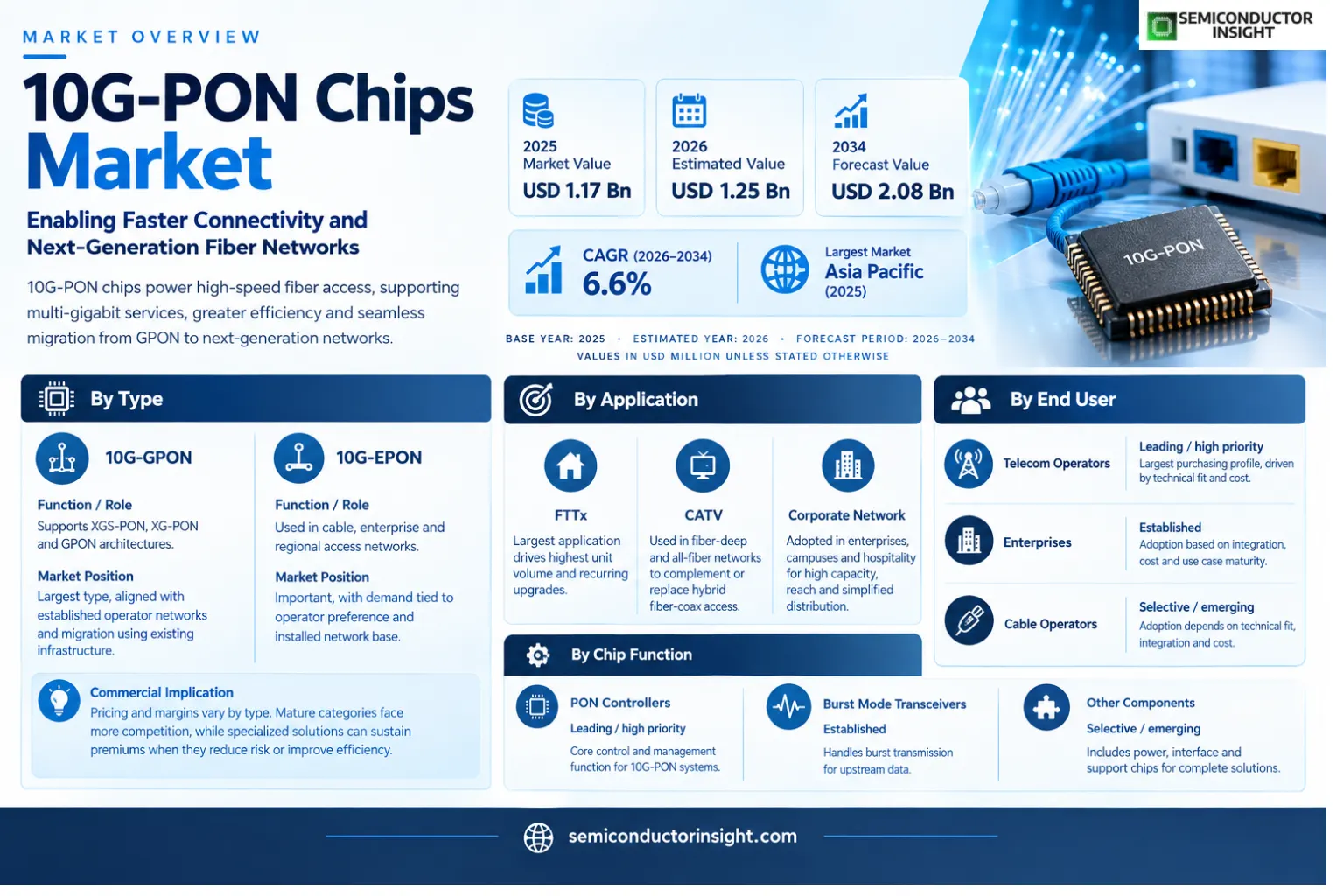
10G-PON Chips market was valued at USD 1.17 billion in 2025 and is estimated at USD 1.25 billion in 2026. It is projected to reach USD 2.08 billion by 2034, registering a 6.6% CAGR over 2026–2034. Asia Pacific held the largest market position in 2025.
10G-PON chips provide the control, burst-mode transmission, processing and interface functions required in 10-gigabit passive optical network equipment. They are deployed in optical line terminals and customer-premises ONU/ONT devices supporting XGS-PON, XG-PON and 10G-EPON architectures. Market growth follows fiber-access upgrades as operators move from gigabit-class GPON toward multi-gigabit services while seeking backward compatibility with existing optical distribution networks and lower power consumption per delivered bit.
The commercial boundary of this market includes the hardware, software-enabled functionality and specialist services directly associated with 10g-pon chips deployments. Demand is ultimately created by customer investment in the downstream systems that use these products or services. Procurement decisions therefore depend on performance, reliability, qualification effort, interoperability and supplier support as much as on headline unit price. The market is becoming more technically segmented as customers optimize architectures for specific workloads, regulatory regimes and operating environments.
The 2026–2034 outlook is shaped by a combination of replacement demand and new capacity. Existing users are upgrading platforms to gain better efficiency, automation and analytics, while new deployments expand the installed base. Suppliers with defensible intellectual property, strong application engineering and established customer qualification records can capture a disproportionate share of incremental value because switching costs rise once a solution is embedded in a production or clinical workflow.
Segment Analysis: By Type
By type, the market is segmented into 10G-GPON, 10G-EPON. 10G-GPON currently has the strongest market position, while growth within the remaining categories depends on application-specific performance requirements, lifecycle economics and the pace at which customers migrate from installed legacy platforms.
| Type | Function / role | Market position |
|---|---|---|
| 10G-GPON | 10G-GPON addresses a distinct technical or service requirement within the 10g-pon chips ecosystem. | Largest type because the wider ITU-T 10-gigabit PON family, including XGS-PON, aligns with established GPON operator networks and supports migration using existing fiber distribution infrastructure. |
| 10G-EPON | 10G-EPON addresses a distinct technical or service requirement within the 10g-pon chips ecosystem. | Important in cable, enterprise and regional access networks that evolved from Ethernet PON architectures. Demand depends on operator standard preference and installed network base. |
Commercial implications by type
Pricing and margin structures differ materially by type because customer value is tied to performance, qualification effort and integration depth. Mature high-volume categories face more price competition, while specialized solutions can sustain premiums when they reduce failure risk, simplify integration or improve operating efficiency. Suppliers increasingly use platform architectures to reuse core technology across several variants, lowering development cost while allowing customers to select the configuration suited to a specific application.
Segment Analysis: By Application
By application, the market is segmented into FTTx, CATV, Corporate Network. FTTx represents the largest or most strategically important application because it combines a substantial installed base with clear performance requirements and recurring upgrade cycles.
| Application | Demand characteristics |
|---|---|
| FTTx | Largest application because residential and business fiber access drives the highest unit volume of OLT and ONU/ONT silicon. Multi-gigabit broadband tiers and symmetric services support upgrades from GPON. |
| CATV | Cable operators use 10G PON in fiber-deep and all-fiber architectures where PON can complement or replace portions of hybrid fiber-coax access networks. |
| Corporate Network | Enterprises, campuses and hospitality networks adopt passive optical LAN and dedicated fiber access where high capacity, reach and simplified distribution are valued. |
By End User
| End User | Market role | Commercial relevance |
|---|---|---|
| Telecom Operators | Leading / high priority | Telecom Operators represents a distinct purchasing profile within the 10g-pon chips value chain, with adoption influenced by technical fit, integration requirements, cost and the maturity of the downstream use case. |
| Enterprises | Established | Enterprises represents a distinct purchasing profile within the 10g-pon chips value chain, with adoption influenced by technical fit, integration requirements, cost and the maturity of the downstream use case. |
| Cable Operators | Selective / emerging | Cable Operators represents a distinct purchasing profile within the 10g-pon chips value chain, with adoption influenced by technical fit, integration requirements, cost and the maturity of the downstream use case. |
By Chip Function
| Chip Function | Market role | Commercial relevance |
|---|---|---|
| PON Controllers | Leading / high priority | PON Controllers represents a distinct purchasing profile within the 10g-pon chips value chain, with adoption influenced by technical fit, integration requirements, cost and the maturity of the downstream use case. |
| Burst Mode Transceivers | Established | Burst Mode Transceivers represents a distinct purchasing profile within the 10g-pon chips value chain, with adoption influenced by technical fit, integration requirements, cost and the maturity of the downstream use case. |
| Other Components | Selective / emerging | Other Components represents a distinct purchasing profile within the 10g-pon chips value chain, with adoption influenced by technical fit, integration requirements, cost and the maturity of the downstream use case. |
Regional Analysis
Asia Pacific leads the 10G-PON Chips market in 2025. Regional demand differs according to manufacturing or deployment concentration, customer investment cycles, regulation, infrastructure maturity and local supplier ecosystems. These structural differences influence both market size and the route to market.
How does regional demand differ across the 10G-PON Chips market?
Regional demand cannot be explained by a single growth factor. Mature regions buy more replacement, premium and compliance-intensive solutions, while faster-growing regions often add new capacity or infrastructure. The most attractive supplier strategy therefore varies by geography: direct technical selling is important for complex accounts, distributor and partner coverage matters in fragmented markets, and local service capability becomes a deciding factor where downtime, qualification or regulatory requirements are costly.
| Region | Position | Growth outlook | Demand profile | What decides supplier selection |
|---|---|---|---|---|
| Asia Pacific | Largest and fastest-growing | High | Fiber rollout and equipment manufacturing led | Technical fit, local support, qualification and total cost |
| North America | Large | High | Operator upgrade and broadband funding led | Technical fit, local support, qualification and total cost |
| Europe | Established | Moderate | Competition and wholesale fiber led | Technical fit, local support, qualification and total cost |
| South America | Developing | Moderate | FTTH expansion led | Technical fit, local support, qualification and total cost |
| Middle East & Africa | Emerging | Moderate | Greenfield fiber led | Technical fit, local support, qualification and total cost |
Competitive Landscape
Competition in the 10G-PON Chips market is shaped by technology depth, application expertise, customer qualification and the ability to support deployments over a long lifecycle. Leading suppliers combine differentiated core technology with software, services or ecosystem partnerships that make replacement less attractive once customers have standardized on a platform.
Large vendors benefit from broader R&D budgets, global sales coverage and established account relationships. They can spread development costs across multiple products and regions while supporting demanding qualification programs. Smaller specialists can still win where they solve a narrow technical problem, respond faster to customization requests or offer a cost structure suited to regional and mid-tier customers.
Competitive intensity is highest where core specifications have become standardized. In those segments, vendors increasingly differentiate through reliability, analytics, integration tools, reference designs, customer support and supply assurance. In high-complexity applications, qualification cycles and workflow integration protect incumbent positions because customers are reluctant to introduce new technical risk without a measurable performance or cost advantage.
| Competitive tier | Representative participants | Strategic position |
|---|---|---|
| Global / platform leaders | Broadcom, Cortina Access (Realtek), Microchip, Sanechips, Airoha Technology (MTK) | Broad portfolios, major R&D investment, global account access and deep integration with customer workflows. |
| Established specialists | Fisilink (Fiberhome), Semtech, MaxLinear, Hisense Broadband, MACOM Technology Solutions | Application-focused portfolios, regional strengths and targeted technical differentiation. |
| Emerging / niche participants | Centron Technology, Marvell Semiconductor, Shanghai Belling | Compete through specialization, cost, new architectures or local customer access. |
Companies Profiled
- Broadcom
- Cortina Access (Realtek)
- Microchip
- Sanechips
- Airoha Technology (MTK)
- Fisilink (Fiberhome)
- Semtech
- MaxLinear
- Hisense Broadband
- MACOM Technology Solutions
- Centron Technology
- Marvell Semiconductor
- Shanghai Belling
Production Capacity Analysis
Capacity in the 10G-PON Chips market is best understood as the combination of physical production capability, engineering throughput, software capacity and qualified supplier availability required to serve customer demand. Capacity does not expand instantly because new lines, design teams, tooling or regulated workflows require investment and qualification. The most important bottleneck varies by market segment, but specialized talent, high-performance components, process know-how and customer acceptance commonly limit how quickly suppliers can convert capital expenditure into revenue.
Regional concentration also creates supply risk. When production, engineering expertise or critical upstream inputs are clustered in a small number of countries or suppliers, disruptions can lengthen lead times and increase customer inventory requirements. Vendors are responding through dual sourcing, modular platform design, regional service teams and selective localization. Buyers increasingly evaluate continuity plans during qualification, especially when the component or service sits on a critical path for manufacturing, clinical operation or network availability.
Market Dynamics
The 10G-PON Chips market is expanding because downstream systems require greater performance, automation and intelligence, but adoption remains constrained by qualification cost, technical integration and the need for reliable lifecycle support. Growth is therefore strongest where the new solution produces a measurable operational or economic benefit rather than simply adding specifications.
Demand is moving from isolated product purchases toward platform decisions. Customers increasingly assess compatibility with software, infrastructure, standards and service ecosystems before committing to a vendor. This raises switching costs for incumbents but also creates entry points for challengers that can solve integration pain points or reduce total ownership cost. The balance between innovation and risk management is especially important in semiconductor, healthcare and communications markets where a failed deployment can interrupt production or essential services.
Market Drivers
Drivers Impact Analysis
| Driver | Impact | Time horizon |
|---|---|---|
| Multi-gigabit broadband demand | High | 2026–2034 |
| Reuse of optical distribution networks | High | 2026–2034 |
| Public broadband investment | Medium-High | 2026–2034 |
| Chip integration and power efficiency | Medium-High | 2026–2034 |
Multi-gigabit broadband demand
Streaming, cloud applications, remote work and household device density push operators toward access networks that can offer higher downstream and upstream speeds.
Reuse of optical distribution networks
10G PON standards are designed for fiber access environments where operators can often reuse passive splitters and installed fiber, improving upgrade economics compared with rebuilding the entire access network.
Public broadband investment
Government-backed broadband programs expand fiber coverage and accelerate operator procurement of OLT, ONT and access silicon in underserved areas.
Chip integration and power efficiency
More integrated PON SoCs combine controllers, processors, SerDes and security functions, reducing board complexity and power per subscriber while lowering equipment cost.
Market Restraints
Restraints Impact Analysis
| Restraint | Impact | Commercial effect |
|---|---|---|
| Operator capex and upgrade timing | Medium-High | Can delay adoption, increase qualification cost or compress supplier margins. |
| Interoperability complexity | Medium-High | Can delay adoption, increase qualification cost or compress supplier margins. |
| Power and thermal limits | Medium | Can delay adoption, increase qualification cost or compress supplier margins. |
| Competition from alternative access technologies | Medium | Can delay adoption, increase qualification cost or compress supplier margins. |
Operator capex and upgrade timing
10G PON economics depend on subscriber demand, competitive pressure and the remaining life of existing GPON equipment. Operators may defer upgrades where gigabit service remains sufficient.
Interoperability complexity
Multi-vendor OLT, ONU and optical module environments require standards compliance and extensive testing. Software behavior and management features can still create integration work even when physical-layer standards align.
Power and thermal limits
Higher line rates increase processing and optical power requirements, especially in dense OLT systems and fanless customer devices.
Competition from alternative access technologies
DOCSIS, point-to-point Ethernet, fixed wireless and future 25G/50G PON options can redirect investment depending on operator network strategy.
Market Opportunities
XGS-PON OLT consolidation
Universal PON MACs and multi-mode SoCs allow equipment makers to support multiple generations on common platforms, reducing SKU count and accelerating upgrades.
Enterprise and passive optical LAN
10G PON chipsets can expand beyond residential broadband into campus, hospitality and enterprise access networks.
Rural fiber programs
Public funding and greenfield builds create opportunities for cost-optimized ONT silicon and integrated optical access platforms.
Migration toward 25G and 50G PON
Vendors with scalable architectures can use 10G design wins as a platform for higher-speed generations, protecting customer relationships as access speeds rise.
Supply Chain Analysis
1. Upstream inputs
2. Component / platform creation
3. OEM / integrator channel
4. End-use deployment
Upstream value is concentrated in differentiated technology and scarce technical inputs, while downstream value is captured through integration, qualification and customer support. For the 10G-PON Chips market, suppliers that own key IP or process know-how have greater pricing power than commodity component providers. At the same time, system integrators and service partners can capture meaningful value by reducing deployment risk and providing a single accountable interface to the customer.
The principal bottleneck is not always raw material availability. In many cases, engineering validation, software compatibility, qualified manufacturing capacity or customer acceptance limits shipment growth. This makes supply-chain resilience a combination of sourcing strategy and technical execution. Multi-sourcing is useful only when alternate suppliers can meet the same performance and qualification requirements without forcing customers to repeat lengthy validation programs.
Recent Developments
Report Scope & Segmentation
| Attribute | Coverage |
|---|---|
| Market | 10G-PON Chips |
| Base Year | 2025 |
| Estimated Year | 2026 |
| Forecast Period | 2026–2034 |
| 2025 Market Size | USD 1.17 billion |
| 2034 Projected Market Size | USD 2.08 billion |
| CAGR (2026–2034) | 6.6% |
| Largest Market in 2025 | Asia Pacific |
| By Type | 10G-GPON, 10G-EPON |
| By Application | FTTx, CATV, Corporate Network |
| By End User | Telecom Operators, Enterprises, Cable Operators |
| By Chip Function | PON Controllers, Burst Mode Transceivers, Other Components |
| By Deployment | OLT Chips, ONU/ONT Chips, Other |
| Regions | North America, Europe, Asia Pacific, South America, Middle East & Africa |
| Companies Profiled | Broadcom, Cortina Access (Realtek), Microchip, Sanechips, Airoha Technology (MTK), Fisilink (Fiberhome), Semtech, MaxLinear, Hisense Broadband, MACOM Technology Solutions, Centron Technology, Marvell Semiconductor, Shanghai Belling |
Frequently Asked Questions
What is the 10G-PON Chips market size in 2025?
What is the projected 10G-PON Chips market size by 2034?
What is the CAGR of the 10G-PON Chips market from 2026 to 2034?
Which region leads the 10G-PON Chips market?
What are the main product or service types?
What are the key applications?
What is a major growth driver?
What is a major restraint?
Where are the strongest opportunities?
Which companies are active in the market?
Research Sources & Evidence Base
View primary and official evidence sources

Get Sample Report PDF for Exclusive Insights
Report Sample Includes
- Table of Contents
- List of Tables & Figures
- Charts, Research Methodology, and more...
 Download Sample Report PDF