Wafer Grinding Wheels Market Insights
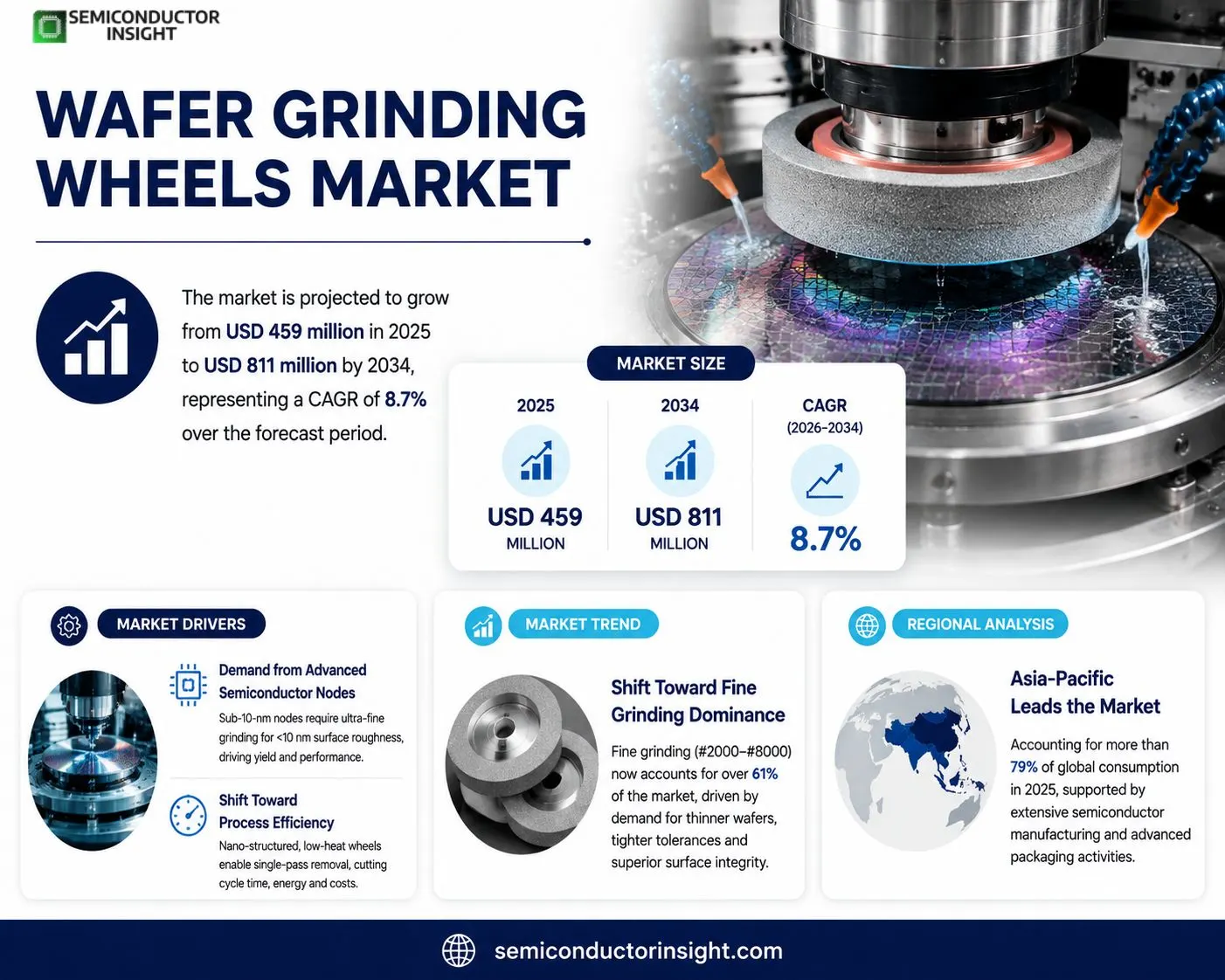
Wafer Grinding Wheels market size was valued at USD 459 million in 2025. The market will reach USD 811 million by 2034, representing a CAGR of 8.7% over the forecast period.
Wafer Grinding Wheels are precision grinding consumables employed in the in‑feed grinding of semiconductor wafers such as TSV package wafers (Cu/compound), SiC wafers, sapphire wafers, silicon wafers and reclaimed wafers. Rough grinding typically uses grit sizes #325‑#1000, while fine grinding relies on #2000‑#8000. These wheels combine diamond abrasives with customized vitrified bond materials that feature a porous microstructure, delivering stable high removal rates, long service life and low grinding resistance.The market expands because semiconductor fab capacity continues to rise and advanced packaging technologies demand tighter thickness control and superior surface integrity. Growth is further supported by the increasing adoption of compound‑semiconductor materials which require reliable thinning solutions. At the same time, demand fluctuations tied to fab utilization cycles and stringent qualification procedures create headwinds for suppliers.
MARKET DRIVERS
Demand from Advanced Semiconductor Nodes
The push for sub‑10‑nm feature sizes compels wafer manufacturers to adopt ultra‑fine grinding wheels that can achieve surface roughness below 10 nm. Higher precision translates directly into yield improvements for photolithography, making the selection of the right grinding wheel a competitive differentiator.
Shift Toward Process Efficiency
Plant managers are increasingly measuring success by cycle‑time reduction. Modern ceramic‑bonded wheels equipped with nano‑structured abrasives allow a single pass to remove the same material volume that previously required two passes, cutting down energy consumption and labor costs.
➤ Companies that integrate low‑heat‑generation wheel formulations can lower wafer breakage rates by up to 12 %.
These efficiency gains are amplified in high‑volume fabs, where even a marginal drop in defect density yields measurable profit margins. Consequently, Wafer Grinding Wheels Market experiences sustained interest from equipment OEMs seeking to align with the latest node requirements.
MARKET CHALLENGES
Material Consistency Issues
Achieving uniform abrasive distribution across large‑diameter wheels remains difficult, especially when scaling from prototype to production runs. Variability can cause uneven wear patterns, leading to localized hot spots that jeopardize wafer integrity.
Other Challenges
Cost of High‑Purity Abrasives
The price premium for specialty alumina and diamond grades has risen as mining sources tighten, pressuring fabs to balance performance with budget constraints.
MARKET RESTRAINTS
Supply Chain Volatility
Global logistics disruptions, combined with limited upstream raw‑material capacity, introduce lead‑time uncertainties that can stall wheel procurement cycles. Manufacturers often maintain higher safety stocks, inflating working capital.Regulatory scrutiny over particulate emissions during grinding adds another layer of compliance cost, particularly in regions with strict environmental standards.Finally, the capital intensity required to retrofit existing grinding lines with advanced wheel handling systems deters smaller fabs from adopting the latest technologies.
MARKET OPPORTUNITIES
Emerging Applications in Power Electronics
Wide‑bandgap semiconductors such as SiC and GaN demand wafer thicknesses below 150 µm, a regime where conventional grinding tools struggle. Tailored grinding wheels featuring ultra‑hard silicon carbide abrasives can meet these tolerances, opening a niche but rapidly expanding revenue stream.Simultaneously, the rise of 3‑D integration technologies mandates frequent re‑grinding of stacked wafers. Wheels engineered for minimal chipping enable higher stacking yields, making Wafer Grinding Wheels Market suppliers attractive partners for next‑generation packaging firms.Strategic alliances between wheel manufacturers and equipment integrators accelerate time‑to‑market for customized solutions, positioning early adopters to capture market share as demand for specialized grinding intensifies.
Wafer Grinding Wheels Market Trends
Shift Toward Fine Grinding Dominance
The fine‑grinding segment (grit #2000‑#8000) now accounts for more than 61% of Wafer Grinding Wheels Market, reflecting manufacturers’ push for tighter thickness control and surface integrity on advanced wafers. As 12‑inch silicon and compound‑semiconductor wafers become the baseline for high‑volume production, the tolerance envelope tightens, making high‑precision finishing essential. Operators favor fine wheels because they deliver stable removal rates while limiting subsurface damage, a prerequisite for subsequent lithography steps. The rise of 3‑D integration and heterogeneous integration further amplifies the need for ultra‑thin, defect‑free wafers, positioning fine grinding as the logical progression from rapid material removal to the final polishing stage.
Other Trends
Regional Concentration in Asia‑Pacific
Asia‑Pacific absorbs roughly 79% of global consumption, underscoring its role as the manufacturing hub for semiconductor fabs. The region’s extensive wafer‑fab capacity, combined with aggressive cost‑optimization initiatives, drives demand for grinding consumables that can sustain high throughput without sacrificing yield. Local players such as Wolfspeed and SMIC favor vendors that can provide long‑life wheels at predictable price points, especially given the average unit price of about US$ 2,002. Moreover, the concentration of advanced packaging facilities intensifies the requirement for reliable back‑grinding solutions across 8‑inch and 12‑inch platforms, reinforcing the regional market’s resilience even when capital‑spending cycles fluctuate.
Supply‑Chain Pressures and Margin Management
Upstream, the market depends on a narrow set of abrasive (e.g., Element Six, Hyperion) and bond suppliers (e.g., Sumitomo Bakelite, Hexion). Any disruption in these inputs reverberates through pricing and delivery schedules, compressing the gross‑margin envelope that typically ranges from 35% to 65% based on grit specification and customization level. Qualification cycles with end‑users add another layer of cost, as new formulations must clear stringent reliability tests before adoption. Consequently, manufacturers balance R&D investment against margin preservation, seeking micro‑structural innovations that extend wheel life while keeping the per‑unit cost in line with the prevailing $2,000 benchmark. This dynamic shapes competitive strategies and influences pricing negotiations across Wafer Grinding Wheels Market.
COMPETITIVE LANDSCAPEKey Industry Players
Wafer Grinding Wheels Market – Competitive Overview
DISCO (Japan) dominates the high‑precision segment, leveraging its heritage in semiconductor equipment to supply fine‑grinding wheels that meet the strict qualification regimes of 12‑inch fabs. Its portfolio spans customized vitrified bonds and ultra‑fine diamond grades, enabling wafer thinning rates that align with the industry’s push for sub‑10‑µm thicknesses. By coupling in‑house R&D with a global service network, DISCO captures a disproportionate share of premium contracts, translating into gross margins that comfortably sit above the sector average. The company’s ability to co‑develop proprietary formulations with key customers such as SMIC and Wolfspeed reinforces its position as a preferred supplier in both established and emerging fab sites.Beyond the market leader, a constellation of specialized firms intensifies competition. Saint‑Gobain (France) and TOKYO SEIMITSU (Japan) focus on coarse‑grinding products for initial back‑grinding stages, exploiting their strong bond‑material expertise. EHWA DIAMOND (South Korea) and Asahi Diamond Industrial (Japan) are noted for aggressive pricing in the fine‑grinding niche, supported by vertically integrated abrasive sourcing from Element Six. SAESOL (South Korea) and Noritake (Japan) differentiate through proprietary micro‑porous structures that extend wheel life. European entrant Meister Abrasives (Switzerland) and Taiwan‑based KINIK COMPANY concentrate on niche applications such as SiC and sapphire wafers, where material hardness demands tailored grit sizes. Chinese manufacturers Sinomach‑pi, Sail Science & Technology, Tokyo Diamond Tools, Nanjing Sanchao and UKAM (USA) benefit from proximity to the Asia‑Pacific production base, offering cost‑effective options that satisfy local qualification cycles. Collectively, these players create a fragmented yet highly technical landscape where product customization, supply‑chain reliability and after‑sales support dictate market share.
List of Key Wafer Grinding Wheels Companies Profiled
- DISCO
- Saint‑Gobain
- TOKYO SEIMITSU
- EHWA DIAMOND
- Asahi Diamond Industrial Co.,Ltd.
- SAESOL
- Noritake
- Meister Abrasives
- KINIK COMPANY
- A.L.M.T. Corp.
- Sinomach‑pi
- Sail Science & Technology
- Tokyo Diamond Tools
- Nanjing Sanchao
- UKAM
Segment Analysis:
| Segment Category | Sub-Segments | Key Insights |
| By Type |
|
Fine Grinding is favored for its superior surface finish and thickness uniformity. • Enables high‑precision final thinning required by advanced semiconductor nodes. • Offers stable removal rates while minimizing subsurface damage. • Aligns with the industry shift toward thinner, higher‑performance wafers. |
| By Application |
|
12‑Inch Wafer dominates because it supports high‑volume production and cost‑effective scaling. • Provides a larger surface area that improves throughput per cycle. • Meets the demand of leading‑edge fabs that prioritize density and yield. • Drives continuous refinement of grinding wheel designs to sustain low defect rates. |
| By End User |
|
Semiconductor fabs drive the core demand due to their need for consistent wafer thinning and surface integrity. • Require wheels that deliver low grinding resistance to maintain cycle efficiency. • Expect long service life to reduce consumable turnover. • Prioritize qualification pathways that align with stringent fab standards. |
| By Process Stage |
|
Fine Grinding Stage is critical for achieving the dimensional precision demanded by next‑generation devices. • Emphasizes micro‑roughness control to support downstream lithography. • Leverages proprietary vitrified bond formulations for enhanced stability. • Aligns with the trend toward ultra‑thin wafers where material removal must be meticulously managed. |
| By Material Compatibility |
|
Silicon wafers remain the primary focus because they constitute the bulk of mainstream semiconductor production. • Grinding wheels are tuned to balance removal efficiency with minimal defect generation on silicon substrates. • Continuous innovation in diamond grit and bond chemistry is driven by silicon’s thermal and mechanical characteristics. • Supports the broader ecosystem of silicon‑based chips, ensuring sustained relevance of the grinding consumables. |
Regional Analysis: Wafer Grinding Wheels Market
Asia-Pacific
Capacity expansions are linked to the rollout of EUV‑compatible processes, prompting wheel makers to experiment with nano‑structured abrasives. The push for higher throughput has resulted in patents focused on heat‑dissipating bond systems that maintain grit integrity during prolonged cycles.
A handful of large fabs dominate the order book, encouraging wheel suppliers to establish long‑term service agreements. These ties often include joint development programs where feedback loops accelerate product refinements specific to 3‑nm and 2‑nm line‑ups.
Proximity to raw‑material exporters in China reduces lead times for ceramic binders and specialty alumina. Integrated logistics hubs near major ports enable just‑in‑time deliveries, mitigating inventory risks that could otherwise stall fab schedules.
Stricter emissions standards in Japan and South Korea push vendors toward low‑dust slurry formulations. Compliance initiatives have spurred the adoption of closed‑loop grinding cells that capture particulates while preserving wheel performance.
North America
The United States maintains a robust ecosystem of equipment integrators and specialty tool makers. While domestic fab capacity lags behind Asia, the region’s emphasis on high‑value, low‑volume production—particularly for defense and automotive silicon—creates a niche demand for wafer grinding wheels that excel in reliability and repeatability. Partnerships between wheel suppliers and R&D divisions at leading universities foster incremental advances in bond chemistry, ensuring that American offerings stay aligned with the strategic priorities of local chip manufacturers.
Europe
European semiconductor activity clusters around Germany, the Netherlands, and Ireland, where precision engineering traditions intersect with emerging quantum‑computing initiatives. Customers prioritize wheel solutions that can tolerate stringent cleanliness standards required for advanced photolithography. Consequently, vendors focusing on ultra‑low‑particle‑emission designs find receptive markets, especially as EU funding programs earmark resources for next‑generation wafer processing equipment.
South America
Growth in South America remains modest, anchored mainly by Brazil’s electronics assembly sector. The region’s Wafer Grinding Wheels Market presence is characterized by import reliance, yet localized assembly workshops are beginning to experiment with cost‑effective wheel variants for lower‑tier node production. Market participants who can balance price sensitivity with acceptable performance thresholds are positioned to capture early adopters as domestic semiconductor initiatives gain modest momentum.
Middle East & Africa
Investment in semiconductor fabs across the United Arab Emirates and select African technology parks is in its infancy. The prevailing strategy involves establishing pilot lines that require versatile grinding wheels capable of handling diverse wafer sizes. Suppliers that can provide flexible tooling kits and offer technical support for skill‑building programs are likely to secure footholds as regional governments pursue diversification away from traditional oil‑based economies.
Report Scope
This market research report provides a comprehensive analysis of the Wafer Grinding Wheels Market , covering the forecast period 2026–2034. It offers detailed insights into market dynamics, technological advancements, competitive landscape, and key trends shaping the industry.
Key focus areas of the report include:
- Market Overview: The report begins with an overview outlining its current market scenario, key growth indicators, and industry transformation drivers. It discusses macroeconomic factors, demand–supply balance, regulatory landscape, and the strategic role of semiconductors in powering advancements across industries such as automotive, telecommunications, consumer electronics, and industrial automation.
- Market Size & Forecast: Historical data and future projections for revenue, unit shipments, and market value across major regions and segments.
- Segmentation Analysis: Detailed breakdown by product type, technology, application, and end-user industry to identify high-growth segments and investment opportunities.
- Regional Insights: Insights into market performance across North America, Europe, Asia-Pacific, Latin America, and the Middle East & Africa, including country-level analysis where relevant.
- Competitive Landscape: Profiles of leading market participants, including their product offerings, R&D focus, manufacturing capacity, pricing strategies, and recent developments such as mergers, acquisitions, and partnerships.
- Technology Trends & Innovation: Assessment of emerging technologies, integration of AI/IoT, semiconductor design trends, fabrication techniques, and evolving industry standards.
- Market Drivers & Restraints: Evaluation of factors driving market growth along with challenges, supply chain constraints, regulatory issues, and market-entry barriers.
- Stakeholder Insights: Insights for component suppliers, OEMs, system integrators, investors, and policymakers regarding the evolving ecosystem and strategic opportunities.
Primary and secondary research methods are employed, including interviews with industry experts, data from verified sources, and real-time market intelligence to ensure the accuracy and reliability of the insights presented.
FREQUENTLY ASKED QUESTIONS:
What is the current market size of Wafer Grinding Wheels Market?
-> Wafer Grinding Wheels Market was valued at USD 459 million in 2025 and is expected to reach USD 811 million by 2034, growing at a CAGR of 8.7% during the forecast period.
Which key companies operate in Wafer Grinding Wheels Market?
-> Key players include DISCO (JP), Saint-Gobain (FR), TOKYO SEIMITSU (JP), EHWA DIAMOND (KR), Asahi Diamond Industrial Co.,Ltd. (JP), SAESOL (KR), Noritake (JP), Meister Abrasives (CH), KINIK COMPANY (TW), A.L.M.T. Corp. (JP), Sinomach-pi (CN), Sail Science & Technology (CN), Tokyo Diamond Tools (JP), Nanjing Sanchao (CN), UKAM (US).
What are the key growth drivers?
-> Key growth drivers include continuous expansion of the semiconductor industry, increasing adoption of advanced packaging technologies, and rapid growth of compound semiconductor and specialty wafer markets, all of which raise demand for high‑performance wafer grinding consumables.
Which region dominates the market?
-> Asia-Pacific dominates Wafer Grinding Wheels Market, accounting for more than 79% of global consumption in 2025, driven by its extensive semiconductor manufacturing base and advanced packaging activities.
What are the emerging trends?
-> Emerging trends include the shift toward fine‑grinding (#2000‑#8000) which now represents over 61% of the market, the push for thinner wafers with tighter thickness tolerances, and increasing emphasis on high‑precision surface preparation for advanced semiconductor applications.
Get Sample Report PDF for Exclusive Insights
Report Sample Includes
- Table of Contents
- List of Tables & Figures
- Charts, Research Methodology, and more...
 Download Sample Report PDF