Standard Digital Isolator Market Insights
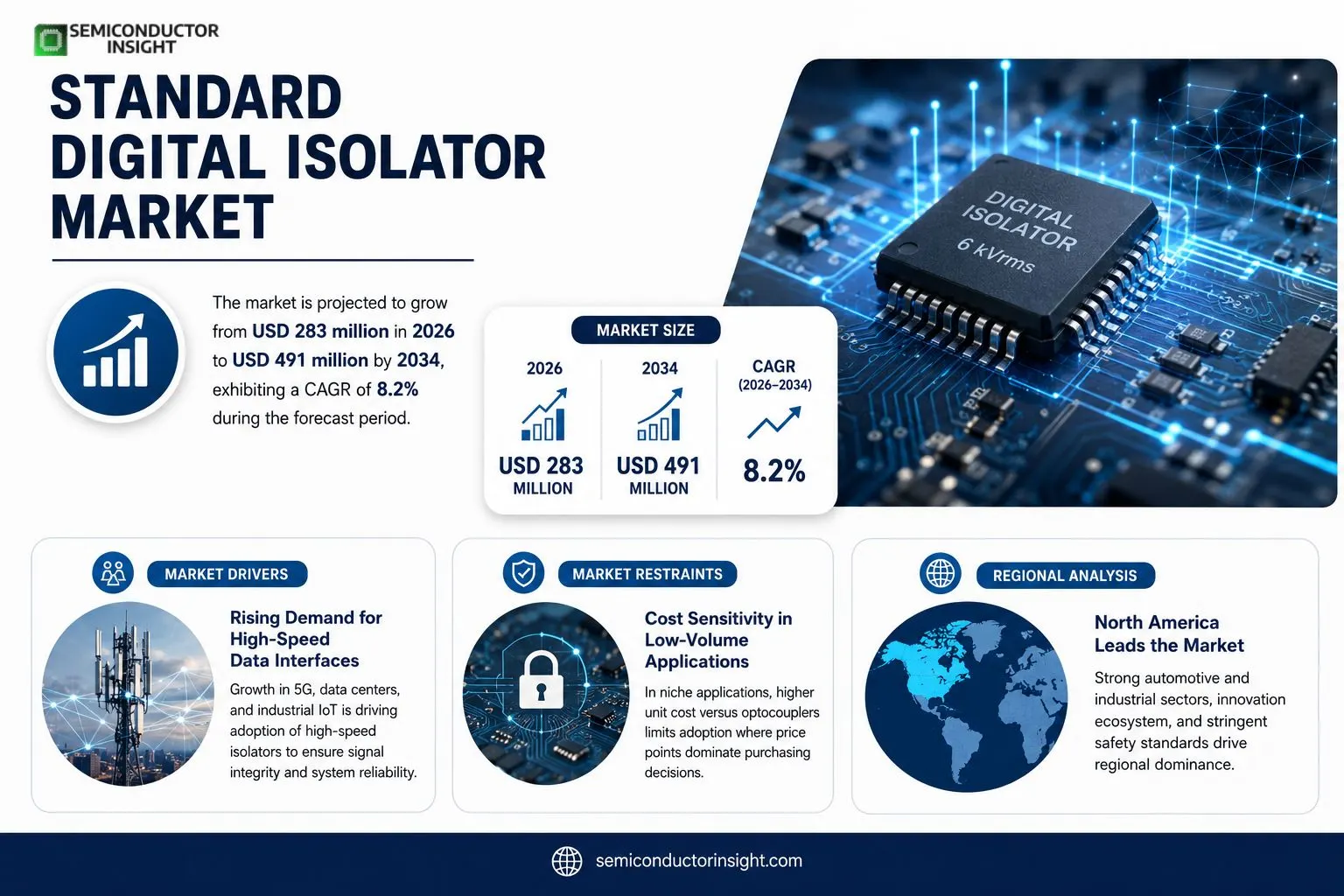
Standard Digital Isolator market size was valued at USD 283 million in 2025 and will reach USD 491 million by 2034, reflecting a CAGR of 8.2% over the forecast horizon. In the same year, worldwide production totaled roughly 269.2 million units with an average selling price of about USD 1.15 per unit, while manufacturing capacity stood near 280 million units.
A Standard Digital Isolator is an electronic isolation component that conveys digital signalssuch as SPI, I²C, UART or GPIObetween separate circuits while maintaining galvanic separation to block high‑voltage transients, noise or ground loops. The device typically employs capacitive, magnetic or optical coupling techniques and finds extensive use in industrial automation, power electronics, data‑acquisition systems and communication interfaces where enhanced safety, signal integrity and reliability are paramount.
MARKET DRIVERS
Rising Demand for High‑Speed Data Interfaces
The proliferation of 5G base stations, data‑center interconnects, and industrial IoT gateways calls for signal integrity at frequencies exceeding 1 GHz. Standard Digital Isolator Market participants are benefiting from OEMs that prioritize low‑latency, galvanic isolation to protect critical transceivers without sacrificing bandwidth. This shift reflects a broader move away from traditional transformer‑based solutions toward semiconductor‑centric architectures.
Stringent EMC Regulations Across Geographic Zones
Regulators in North America, Europe, and Asia‑Pacific have tightened limits on electromagnetic emissions for equipment operating in crowded spectra. Manufacturers therefore embed digital isolators to meet compliance thresholds while maintaining compact PCB footprints. The added ability to isolate control loops without introducing magnetic components simplifies certification pathways, making compliance a compelling value proposition.
➤ Designers now view isolation as a performance lever rather than a safety add‑on, reshaping component selection criteria.
Collectively, these forces accelerate product cycles that embed isolation early in the schematic, prompting a measurable uptick in bill‑of‑materials allocation for digital isolator chips.
MARKET CHALLENGES
Integration Complexity in Multi‑Domain Systems
Contemporary platforms combine power, signal, and communication domains on a single board. Achieving timing closure while preserving isolation margins often forces engineers to trade off between latency and design simplicity. The lack of standardized design kits for mixed‑signal environments can elongate development timelines, especially for smaller suppliers with limited R&D bandwidth.
Other Challenges
Supply‑Chain Vulnerabilities
semiconductor shortages have exposed the fragility of sourcing high‑purity silicon substrates used in digital isolators. While demand remains robust, lead‑times for critical wafers fluctuate, compelling OEMs to maintain safety stocks that erode cash flow and compress profit margins.
MARKET RESTRAINTS
Cost Sensitivity in Low‑Volume Applications
In niche markets such as medical wearables or bespoke industrial controllers, unit volumes rarely exceed a few thousand pieces per year. The per‑unit cost of a digital isolator, which includes packaging and testing overhead, can surpass that of a conventional optocoupler, discouraging adoption where price points dominate purchasing decisions.
MARKET OPPORTUNITIES
Emerging Automotive Electrification
Electric vehicle architectures now feature high‑voltage battery management systems, fast‑charging interfaces, and advanced driver‑assistance modules. Each of these subsystems requires isolation that can operate reliably across wide temperature ranges while supporting automotive‑grade data rates. Companies that tailor digital isolator families to meet AEC‑Q100 standards stand to capture a growing slice of the automotive electronics spend.
Standard Digital Isolator Market Trends
Escalating Demand for High‑Performance Isolation in Power‑Intensive Applications
Industrial automation, electric‑vehicle powertrains, and renewable‑energy converters increasingly rely on digital signals that cross voltage barriers. Customers now require isolation solutions that sustain multi‑megabit‑per‑second data rates while consuming less than a milliwatt of power. The shift originates from tighter system‑level energy budgets and the need to preserve signal fidelity in noisy environments. As a result, design teams are prioritising isolators that combine elevated isolation voltage (up to 6 kVrms) with compact footprints, allowing manufacturers to pack more functionality into smaller enclosures. This trend forces suppliers to accelerate development cycles, invest in advanced coupling mechanisms, and differentiate on parameters such as propagation delay and power‑on reset performance.
Other Trends
Technology Mix and Product‑Type Dynamics
The market’s technology portfolio is anchored by capacitive, magnetic, and giant‑magnetoresistive (GMR) couplings. Capacitive devices dominate the volume segment because of their cost efficiency and ease of integration into dense printed‑circuit‑board layouts. Magnetic isolators retain a niche in applications demanding superior immunity to external magnetic fields, while GMR units are gaining attention for ultra‑high‑speed data paths exceeding 150 Mbps. Manufacturers are realigning production lines to boost capacitive output, as evidenced by the 269 million units produced in 2025, which approached the 280 million‑unit capacity ceiling. This rebalancing creates entry points for firms that can offer hybrid platforms marrying the low‑power profile of capacitive solutions with the robustness of magnetic designs.
Profitability Pressures and Supply‑Chain Considerations
Average selling prices hover around US$1.15 per unit, translating into gross margins that fluctuate between 20 % and 40 % depending on product complexity and volume commitments. The narrow price band intensifies competition, prompting vendors to seek margin uplift through value‑added services such as custom‑data‑rate configurations and integrated diagnostics. Simultaneously, the proximity of production capacity to actual output limits excess inventory, reinforcing a “just‑in‑time” procurement mindset among OEMs. Firms that can optimise wafer utilisation and shorten time‑to‑market are better positioned to convert unit‑volume advantage into sustainable profitability within Standard Digital Isolator Market.
COMPETITIVE LANDSCAPE
Key Industry Players
Standard Digital Isolator Market: Competitive Overview 2025‑2034
The sector continues to be dominated by a handful of multinational semiconductor firms that command the bulk of revenue and steer pricing strategies. Texas Instruments leverages its expansive analog portfolio and deep relationships with OEMs in automotive and industrial automation, enabling it to secure premium pricing while preserving margins above 30 %. Analog Devices, bolstered by the integration of Maxim Integrated’s isolator line, captures a sizeable share of high‑speed, magnetoresistive products and often differentiates through aggressive R&D spending that sustains a pipeline of sub‑nanowatt devices. NXP’s focus on automotive safety standards gives it a defensible niche in the EV power‑train market, where its isolation solutions are bundled with broader microcontroller offerings, creating cross‑selling opportunities that reinforce its market position. Across these leaders, the typical gross profit margin of 20‑40 % reflects a balance between cost‑controlled silicon processes and value‑added design services.Beyond the tier‑one giants, a diverse set of specialists deepens competitive pressure through application‑specific innovations. Infineon’s magnetic‑coupling modules, for instance, target renewable‑energy converters where high voltage isolation is critical, while STMicroelectronics emphasizes capacitive‑coupling devices optimized for low‑power IoT gateways. ON Semiconductor and Microchip maintain a strong foothold in legacy industrial equipment, offering cost‑effective parts that appeal to volume manufacturers. Smaller entrants such as Silan, Taiyo Yuden, and Rohm Semiconductor differentiate by pursuing ultra‑compact form factors and aggressive data‑rate improvements, forcing larger players to accelerate their own miniaturization roadmaps. The cumulative effect is a market where niche expertise can translate into meaningful share gains, especially as end‑users demand higher data rates and tighter power envelopes.
List of Key Standard Digital Isolator Companies Profiled
- Texas Instruments
- Analog Devices (including Maxim Integrated)
- NXP Semiconductors
- Infineon Technologies
- STMicroelectronics
- ON Semiconductor
- Microchip Technology
- Silan Microelectronics
- Taiyo Yuden
- Rohm Semiconductor
- Broadcom Inc.
- Cypress Semiconductor (now part of Infineon)
- Renesas Electronics
- Lattice Semiconductor
- Marvell Technology Group
Segment Analysis:
| Segment Category | Sub-Segments | Key Insights |
| By Type |
|
Capacitive Coupling dominates due to its ease of integration, low power consumption and broad compatibility across industrial and automotive platforms. • Provides reliable isolation for moderate voltage levels while maintaining signal fidelity. • Favoured by designers seeking straightforward PCB implementation and cost‑effective solutions. • Enables rapid adoption in legacy and emerging high‑speed communication interfaces. |
| By Application |
|
Industrial Automation is the leading application segment as manufacturers pursue robust isolation to safeguard control loops from high‑voltage transients. • Enhances system safety in programmable logic controllers and motor drives. • Supports seamless integration with sensor networks and field‑bus architectures. • Drives continuous innovation toward higher data‑rate capabilities while preserving low latency. |
| By End User |
|
OEM Manufacturers lead the end‑user landscape because they embed isolators directly into chassis‑level designs, demanding compact footprints and reliable performance. • Prioritize devices that combine high isolation voltage with minimal power draw. • Seek solutions that align with stringent automotive and safety standards. • Influence supplier roadmaps through early‑stage specification engagement. |
| By Technology |
|
High Data‑Rate Solutions emerge as the foremost technology trend, responding to the demand for faster communication across isolation barriers. • Enable seamless integration with modern SPI, I²C and UART protocols at elevated speeds. • Support emerging requirements in electric‑vehicle powertrain control and renewable‑energy converters. • Encourage co‑development of driver ICs and firmware to optimise signal integrity. |
| By Design Focus |
|
Miniaturization drives the current design philosophy as product developers aim for ever smaller form factors without compromising isolation performance. • Encourages the adoption of System‑in‑Package (SiP) approaches that combine isolator and driver functions. • Reduces board real‑estate pressure, facilitating tighter integration in compact automotive modules. • Aligns with industry moves toward modular, scalable architectures for both industrial and consumer electronics. |
Regional Analysis: Standard Digital Isolator Market
North America
Automotive electrification programs demand isolation solutions that can operate across wide voltage ranges while preserving signal fidelity, prompting designers to favor digital isolators for power‑train control and high‑speed communication networks.
A handful of legacy semiconductor firms dominate, yet emerging players are differentiating through ultra‑low power consumption and integration of built‑in diagnostics, reshaping the competitive hierarchy.
The migration toward mixed‑signal ASICs that embed digital isolators directly on die is reducing bill‑of‑materials and enabling more compact system architectures across multiple industries.
End‑users are increasingly requiring real‑time monitoring of isolation health, driving vendors to embed self‑test capabilities that provide continuous assurance without external instrumentation.
Europe
European manufacturers are responding to stringent electromagnetic compatibility directives by embedding digital isolators into safety‑critical applications such as railway signalling and renewable‑energy converters. The region’s emphasis on sustainability has spurred integration of isolation components in offshore wind turbine converters, where reliability under harsh marine conditions is paramount. Collaborative research programmes funded by the EU encourage cross‑border innovation, linking semiconductor specialists with automotive and industrial partners to co‑create application‑specific isolation solutions that meet both performance and regulatory expectations.
Asia-Pacific
In the Asia‑Pacific corridor, rapid growth of electric‑vehicle production facilities is heightening demand for compact, high‑efficiency isolation technologies. Local chip manufacturers are leveraging cost‑effective process nodes to produce digital isolators that cater to mass‑market vehicle platforms, while also supporting burgeoning smart‑factory initiatives. The convergence of mobile communications upgrades and industrial IoT deployments is prompting customers to seek isolation devices that can operate reliably across diverse temperature and humidity profiles common in the region’s varied climates.
South America
South American markets are witnessing a gradual shift from legacy analog isolation to digital alternatives as manufacturers modernize legacy equipment in mining, oil‑and‑gas, and emerging electric‑bus fleets. Investment in regional testing facilities is enhancing confidence in the robustness of new digital solutions, encouraging adoption in environments where downtime carries significant economic penalties. Local policy incentives aimed at reducing emissions are also prompting infrastructure upgrades that incorporate digital isolators into power‑conversion equipment.
Middle East & Africa
The Middle East & Africa region is leveraging digital isolation to improve reliability in high‑temperature power‑distribution networks that support large‑scale desalination plants and renewable‑energy projects. Adoption is further driven by telecom operators expanding 5G roll‑outs, which require isolation components capable of handling high‑frequency data streams without degradation. In Africa, pilot programs focused on micro‑grid electrification are experimenting with digital isolators to enhance system resilience, positioning the technology as a cornerstone for future grid modernization efforts.
Report Scope
This market research report provides a comprehensive analysis of the Standard Digital Isolator Market , covering the forecast period 2026–2034. It offers detailed insights into market dynamics, technological advancements, competitive landscape, and key trends shaping the industry.
Key focus areas of the report include:
- Market Overview: The report begins with an overview outlining its current market scenario, key growth indicators, and industry transformation drivers. It discusses macroeconomic factors, demand–supply balance, regulatory landscape, and the strategic role of semiconductors in powering advancements across industries such as automotive, telecommunications, consumer electronics, and industrial automation.
- Market Size & Forecast: Historical data and future projections for revenue, unit shipments, and market value across major regions and segments.
- Segmentation Analysis: Detailed breakdown by product type, technology, application, and end-user industry to identify high-growth segments and investment opportunities.
- Regional Insights: Insights into market performance across North America, Europe, Asia-Pacific, Latin America, and the Middle East & Africa, including country-level analysis where relevant.
- Competitive Landscape: Profiles of leading market participants, including their product offerings, R&D focus, manufacturing capacity, pricing strategies, and recent developments such as mergers, acquisitions, and partnerships.
- Technology Trends & Innovation: Assessment of emerging technologies, integration of AI/IoT, semiconductor design trends, fabrication techniques, and evolving industry standards.
- Market Drivers & Restraints: Evaluation of factors driving market growth along with challenges, supply chain constraints, regulatory issues, and market-entry barriers.
- Stakeholder Insights: Insights for component suppliers, OEMs, system integrators, investors, and policymakers regarding the evolving ecosystem and strategic opportunities.
Primary and secondary research methods are employed, including interviews with industry experts, data from verified sources, and real-time market intelligence to ensure the accuracy and reliability of the insights presented.
FREQUENTLY ASKED QUESTIONS:
What is the current market size of Standard Digital Isolator Market?
-> Standard Digital Isolator Market was valued at USD 283 million in 2025 and is expected to reach USD 491 million by 2034.
Which key companies operate in Standard Digital Isolator Market?
-> Key players include Axalta Coating Systems, AkzoNobel, BASF SE, PPG, Sherwin-Williams, and 3M, among others.
What are the key growth drivers?
-> Key growth drivers include railway infrastructure investments, urbanization, and demand for durable coatings.
Which region dominates the market?
-> Asia-Pacific is the fastest-growing region, while Europe remains a dominant market.
What are the emerging trends?
-> Emerging trends include bio-based coatings, smart coatings, and sustainable rail solutions.
Get Sample Report PDF for Exclusive Insights
Report Sample Includes
- Table of Contents
- List of Tables & Figures
- Charts, Research Methodology, and more...